Scheduling Controversy
November 14, 2017
A dozen years ago, I asked our counterpart organizations in other states if they scheduled their schools’ regular-season varsity football games. Very few did so.
More recently, I’ve realized that I didn’t ask enough questions. It turns out that few statewide high school associations tell schools who they play each week of the regular season. However, many more give schools the group of opponents they may schedule. They place schools in leagues and/or districts and/or regions and instruct schools to schedule from among those schools only or predominantly.
I have been waiting for the tipping point where a sufficient number of high schools in Michigan are sufficiently stressed over scheduling football games that they would turn to the MHSAA to solve the problem.
I’m anticipating this might occur first among schools playing 8-player football, and that success there will lead to our assistance for 11-player schools.
One approach – the simpler solution – would work like this:
-
All 8-player schools within the enrollment limit for the 8-player tournament would be placed in two divisions on the basis of enrollment in early March. About 32 schools in each, based on current participation.
-
At the same time, each division would be divided into four regions of about eight schools.
-
In April, the schools of each region would convene to schedule seven regular season games for each school.
-
Based on current numbers, schools would still have two open weeks to fill, if they wish, for games with schools in other regions or of the other division or in neighboring states.
A second option – the date-specific solution – would provide every school its weekly schedule for all nine dates, or weeks 1 through 8, or weeks 2 through 8, depending on local preferences. This would not be difficult in concept once there is agreement on what criteria would be used and what value each criterion would have.
For example, one important criterion would be similarity of enrollment; another of great value would be proximity. Perhaps league affiliation would be a factor with some value. Perhaps historic rivalries would be another factor with a value. Then the computer spits out schedules for each school for every week for two years, home and away.
I don’t campaign for this task because, frankly, it will produce complaints and controversy. But if this organization exists to serve, then this is a service that today’s chronic complaints tell us we should begin to provide soon.
I suggest we do this for 8-player football for the 2019 and 2020 seasons (with a paper trial run for 2018). If it proves successful, we could expand the service to 11-player schools as soon after as they are satisfied with our efforts for 8-player schools.
Officials Sharpen Skills at MHSAA Clinic
June 28, 2012
By Geoff Kimmerly
Second Half Editor
ALMA --Frequently in pairs, they lined up beside linebackers, ran the sidelines and monitored the goallines earlier this week, next to many of Michigan's best recently-graduated high school football players.
The athletes were practicing for Saturday's Michigan High School Football Coaches Association All-Star Game at Alma College. But beside and all around them, officials also worked to hone their skills with the upcoming season only two months away.
A group of 34 attended the MHSAA's summer clinic Monday and Tuesday, run in coordination with the all-star game for the second year. Some were veterans brushing up on new rules, while others -- like Flushing's Tim Collick -- were newer officials hoping to pick up some knowledge from 12 clinicians providing instruction and feedback.
"The biggest thing is just the different tips from experienced guys you don't find in the books," said Collick, 32, who was one of 14 chosen from clinic participants to officiate Saturday's game. "Different, helpful clues like keys that made them successful, made things easier for them."
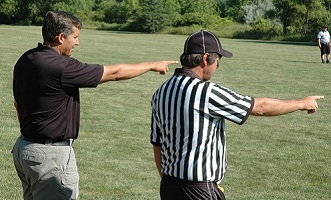 Instructors shadowed Collick and other participants during two practices and a Monday night scrimmage, providing guidance and feedback along the way.
Those practice sessions are combined with classroom instruction, similar to what the MHSAA has conducted during previous summers with basketball officials at Michigan State University camps.
Every participant this week came from the Lower Peninsula, but as far north as just below Mackinac Bridge, east from Detroit and west from the Grand Rapids area.
Two crews of seven officials were chosen from the camp participants to work Saturday’s game. The crews will alternate quarters, with five instructors also on hand to provide feedback.
The MHSFCA has been putting on the All-Star Game for 32 years, and has been a fantastic partner in providing an opportunity football officials don't often receive during the offseason, MHSAA assistant director Mark Uyl said.
"Football is unique in that there isn't a way to get live reps, while basketball, baseball and softball have summer team camps," Uyl said. "This is an opportunity for football officials to get training in the real thing."
Collick, a Flint Hamady grad who has been mentored by longtime Flint-area official Tom Rau, is heading into his third season of football as a back judge with a crew from the Genesee County Coaches and Officials Association. Although he'd heard a few of the speakers at the clinic before, he didn't know any of the officials before Monday. But he was sure to soak up as much as possible, with an eye on officiating for years to come and eventually, perhaps, at the college level as well.
"For me, one of the biggest things (at the clinic) is getting to make contacts with much more veteran officials. I'm learning from those guys," Collick said. "The instructors have worked at high levels as college officials, as high school officials for many years. It's nice to pick their brains."
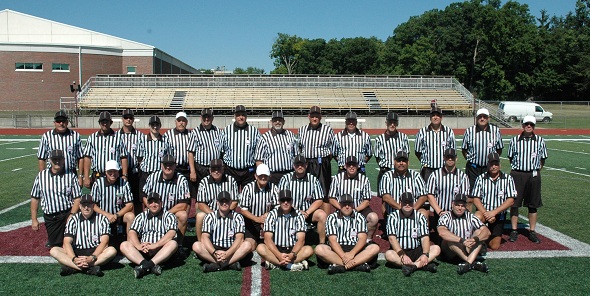
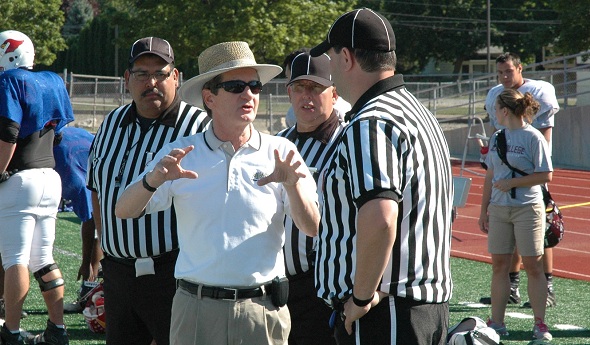
PHOTOS: (Top) Longtime official and recently-retired MHSAA assistant director Tom Minter (center) works with an official during Tuesday morning's East practice at Alma College. (Middle) MHSAA assistant director Mark Uyl (left) points something out to an official during the West practice. (Bottom) Officals at this year's clinic came from all parts of the Lower Peninsula, including the Detroit, Grand Rapids and Mackinaw areas.