

Scoring Record Falls, North Central Soars
January 16, 2021
By Tim Robinson
Special for Second Half
BRIGHTON – It's not often when a pair of defensive plays are key in a 70-48 decision.
But that's the way it went for Powers North Central, which beat Portland St. Patrick by that score in the 8-Player Division 2 championship game at the Legacy Center.
The North Central Jets (11-0), who won their third MHSAA Finals championship, sacked St. Patrick quarterback Connor Cross seven times. But he completed 25 of 38 passes for 374 yards and six touchdowns.
"My hat's off to Portland St. Patrick," North Central coach Leo Gorzinski said. "They tested our kids like no one has this season."
The Jets were led by Luke Gorzinski, who rushed for 299 yards and four touchdowns and threw for 156 yards and three more scores.
"I was on the team last year, when we lost in the Final," he said. "It was a heartbreaking loss, but this is the top of the world."
Wyatt Raab rushed for a pair of touchdowns and caught two passes for scores. He also sacked Cross in the end zone for a safety that gave the Jets a 10-0 lead after the first quarter.
But the Shamrocks (10-1) then got going, scoring 22 points in the second quarter, only to see the Jets add 24 to take a 34-22 halftime lead.
While the game would go on to set multiple 8-Player Finals scoring records, including for most points scored by both teams combined, the aforementioned pair of defensive plays helped North Central pull away during the third quarter.
 The Jets thwarted the Shamrocks on the first drive of the second half, when Luke Klieman intercepted a pass at the Jets’ 40. After the teams exchanged touchdowns, North Central forced St. Patrick to turn the ball over on downs. Raab then scored two plays later from 28 yards out to effectively put the game out of reach.
The Jets’ defense, which allowed St. Patrick 404 yards in total offense, allowed only 31 on the ground, most of them after the game was out of reach, and stopped the Shamrocks on four attempted two-point conversions.
Both teams were without starters due to the coronavirus or contact tracing.
"We were missing some key players," Luke Gorzinski said. "But their replacements stepped up. We had freshmen and sophomores out there, and they were awesome."
North Central racked up 579 yards in scoring 70 or more points for the fifth time this season.
The Shamrocks, to their credit, kept after the Jets to the end.
"That's the way we've played all year, through the shutdown and everything" St. Patrick coach Patrick Russman said. "They want to play and have fun, and that's what they wanted people to see. That's their character."
Shane Cook had 13 catches for 179 yards and three touchdowns for the Shamrocks.
But a North Central team that had several starters and their defensive coordinator at home had enough to take the championship trophy home to the Upper Peninsula, thrilling the 100 or so fans who made the long drive.
"It was fun to play in the (Superior) Dome last week," Raab said, referring to the Jets' Semifinal win over Cedarville, "but it felt weird with no fans. To have our families here to watch meant a lot."
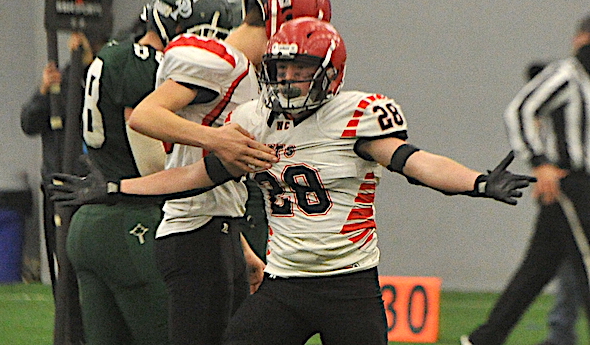
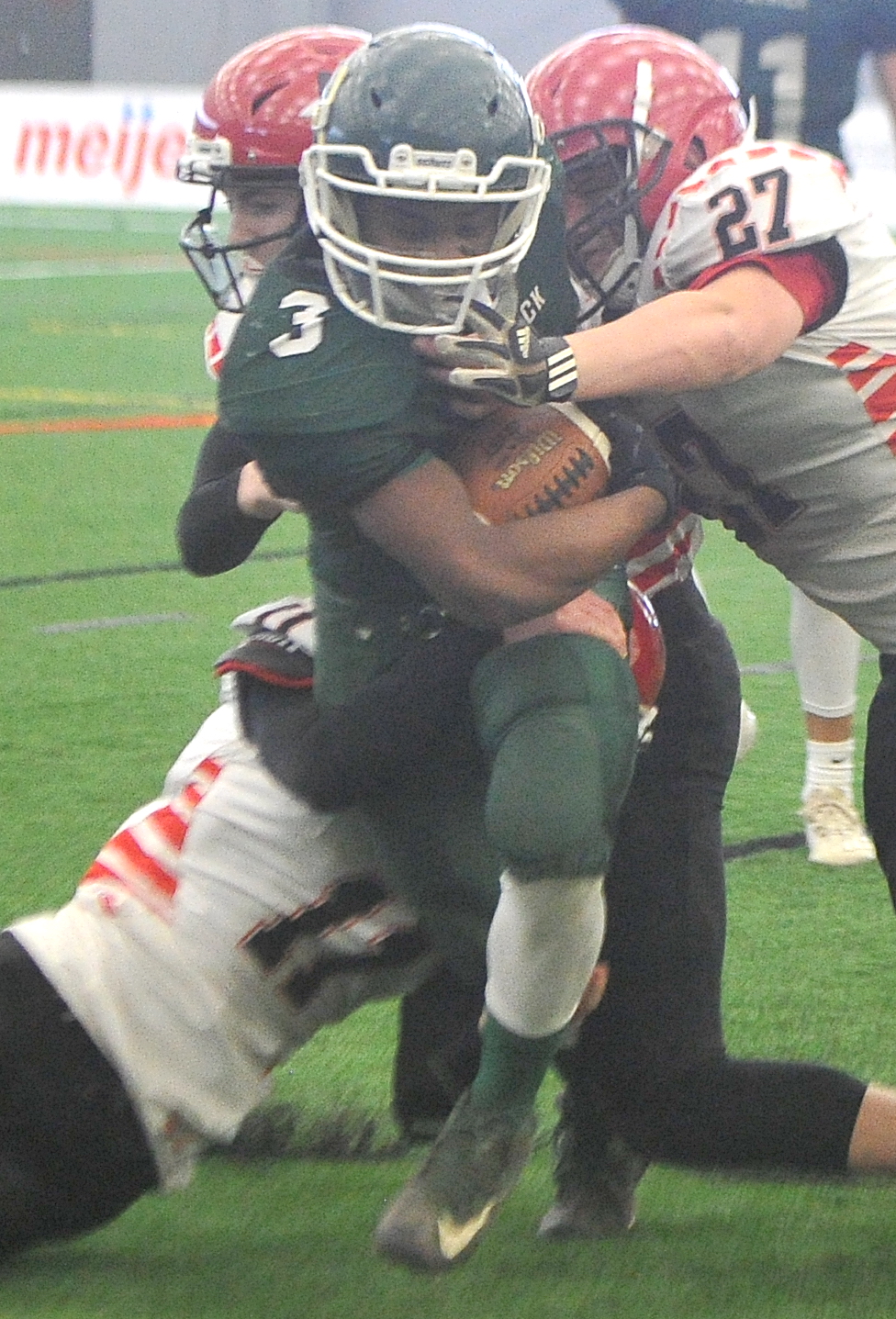
PHOTOS: (Top) North Central’s Wyatt Raab celebrates a defensive stop during Saturday’s Division 2 Final. (Middle) Portland St. Patrick’s Jacobe Hayes-Dunning works to get out of the grasp of a pair of Jets defenders. (Click for more from Hockey Weekly Action Photos.

Heads and Heat
August 16, 2012
We are engaged in very serious discussions. They’re not only complicated, with unintended negative consequences possible from what are thought to be positive actions; they’re also a matter of life and death.
The topic is football – the high school sport under most scrutiny today and suffering from the most criticism it’s seen since the 1970s when catastrophic neck injuries spiked, liability awards soared, many insurers balked, and most helmet manufacturers abandoned the business altogether.
During recent years we have learned about the devastating long-term effects of repeated blows to the head; and we’re trying to reduce such hits. We’ve learned that 70 percent of concussions in football result from helmet-to-helmet contact, and we’re trying to have coaches teach blocking and tackling differently and have officials penalize “high hits” consistently and rigorously.
During the past several years we’ve learned that serious heat illness and heat-related deaths are 100 percent preventable, yet nationwide there were 35 heat-related deaths in high school football alone from 1995 to 2010; and we’re promoting practices that acclimatize athletes more gradually than “old school” traditionalists might advocate.
As we simultaneously address issues of heads and heat in football, some coaches may think we’re being overbearing, while many in medical fields say we’re out of date, citing higher standards of the American Academy of Pediatrics, National Athletic Trainers Association and National Federation of State High School Associations, as well as many of our counterpart organizations across the country.
As we consider in-season changes to improve athlete acclimatization and reduce blows to the head, we should be open to making out-of-season changes that work toward rather than in opposition to those objectives. There can be no sacred cows. The topic is too serious.
Ultimately, if we err in the outcome of this year’s discussions about heads and heat in football, it must be on the side of safety, on minimizing risks for student participants. They deserve it and, once again, the sport of football needs it.