

Search for Longest FG Starts in '50s
October 30, 2020
By Ron Pesch
Special for Second Half
Rob LaMielle’s first attempted field goal was a memorable one, and frankly, a bit amazing.
For starters, his track record on extra points, at least to that point in the season, was less than stellar. Flint Holy Redeemer entered their third game of the 1963 slate with a 1-1 record. The Flyers were defeated by Bad Axe in Week 1, then trounced Imlay City the next week. The senior had been successful on only 3 of 9 extra-point placements on the year.
“You had to bring that up,” said LaMielle over 55 years later, laughing at the statistic. “That’s probably so. Bad Axe was rated No. 1 in the state in Class ‘B.’ We were a ‘C’ school. They beat us 13-12 that night, because I missed two extra points. They scored in the very last couple minutes.”
The fact that his field goal was on the mark is all the more impressive considering it traveled 50 yards, clearing the crossbar by three feet, according to observers. Even more remarkable, it was a mere three yards shy of Lou ‘The Toe’ Groza’s best effort for the National Football League’s Cleveland Browns, and just six yards short of the NFL record, set by Bert Rechichar of the Baltimore Colts in 1953. Rechichar held the mark until it was famously topped by New Orleans Saints kicker Tom Dempsey in 1970 against the Detroit Lions.
“We practiced behind our football field,” said LaMielle, recalling how he got the job. “Behind our football field was two baseball fields with a backstop at each end. Well the coach lined everybody up on second base and said, ‘OK, we’re going to find out who can kick a field goal.’ So we started kicking the ball over the backstop. One of the times I kicked it, and it went a long ways.”
St. Redeemer’s coach Dick Clark stopped the drill and named LaMielle the team’s kicker.
“Before my senior year, I’d never kicked off, never attempted an extra point.”
At the time, the 220-pound LaMielle, who, like Groza, played tackle, was asked if he was surprised by the success of his kick.
“I was more surprised Coach Clark asked me to try it,” he said.
The field goal helped Flint Holy Redeemer top Bay City St. James, 29-6.
It also prompted another question from sports reporters. Was LaMielle’s kick a Michigan high school record?
The Search
The publicity surrounding the kick sent sportswriters around the state scurrying for the archives.
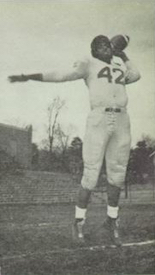 Initial inquiries indicated that Jim Yore of Battle Creek Central held the state mark, with a 56-yard field goal about 10 years prior, but a recheck of records by Dick Kishpaugh, “sports publicity director at Kalamazoo College and a close observer of Michigan prep football records,” indicated that Yore’s longest had been a 38-yard field goal, kicked on the last play of the game to beat Ypsilanti 3-0 on Oct. 3, 1952. It was thought to be the longest in state history.
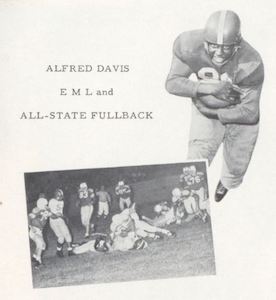
Additional digging found that Port Huron High School’s Alfred Davis, a 212-pound fullback, had drilled a flawless 46-yard field goal in a 19-14 win over Hazel Park in 1953.
“The word ‘tremendous’ is probably one of the most overused words in sports lexicon,” wrote Port Huron Times reporter Fred J. Vincent, “but it should be used in describing this kick.”
Vincent called it “perfect, splitting the uprights and clearing the bar by about six feet.”
Impressively, Davis also had kicked a 36-yarder earlier in the contest. “Bob Boyd held on both kicks,” added the sportswriter. “Not since Oct. 8, 1930 had a Big Red player kicked a three pointer. Hank Ceasor did it then to best Ferndale, 3-0.”
Word came that Cheboygan Catholic’s Joe Poirier had kicked one “reported to have traveled at least 53 yards from the point of the kick to the goal posts” in a 10-0 victory over Alcona in 1957. Since the MHSAA didn’t keep records at the time, Kishpaugh added it to his listing of unofficial state records.
The Ironwood Daily Globe unearthed a nugget. While it wasn’t considered by Kishpaugh for his record book, it did bring back memories of changes seen in the game.
Ironwood’s John ‘Cutz’ Cavosie made a “tremendous boot on Oct. 10, 1925 in the final seconds of a game at Oliver Field here in which Ironwood swamped Menominee 41-0. Cavosie apparently was back to punt, but instead he dropkicked the ball squarely through the goal posts 55 yards away. He was in his senior year that fall and was captain of the team. He played a big role in the rout on Menominee by scoring on runs of 42, 51 and 67 yards.”
Record Toppled
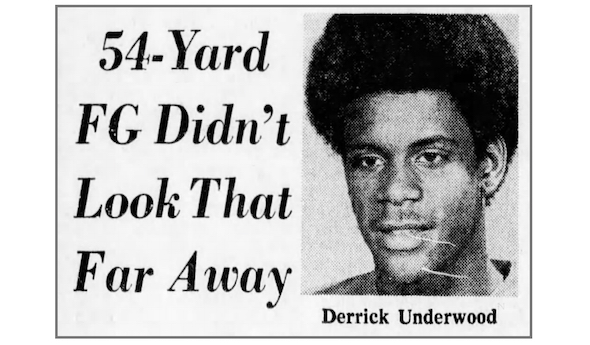
So it was quite the event when, nearly 19 years later, junior Derrick Underwood broke Poirier’s mark on a cold October Friday at Inkster.
A week earlier, Underwood had made his first field goal of the season, a 23-yard boot in overtime to give Ecorse its first victory of the year in five starts, 9-6, over River Rouge. This time, his kick gave Ecorse a 3-0 victory over the Vikings, although in decidedly less dramatic fashion as the kick came in the second quarter.
 “The strange thing is I didn’t even know that I was kicking it from the 44-yard line. To be honest, I wasn’t paying that much attention and it didn’t look that long,” Underwood told the Detroit Free Press in 1976. “But I got a real good snap on it and an excellent hold.
Red Raiders coach Patrick Kearney believed the kick would have been good from another five or 10 yards out.
“It felt good when I hit it,” added Underwood, “but because I was in front of the goal posts, I couldn’t tell whether it went over or under the crossbar. But I saw my teammates jumping up and down on the sidelines and I knew it made it.
“I was pretty loose because I figured that if I missed, we still had another half to come back and win it.”
Underwood’s accomplishment garnered national attention in the June/July ’77 issue of Joe Namath’s National Prep Sports magazine. At the time, Jerry Spicer of Hobart (Ind.) High School held the national record with a kick of 61 yards in 1975.
Exasperation to Jubilation
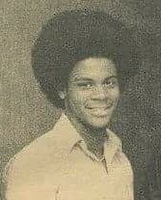
Underwood, who also served as the Red Raiders’ quarterback and defensive end, guided the team to Inkster’s one-foot line in that same game as the clock wound down. But with the lead, instead of pushing for the end zone, they let time expire.
A year earlier, in 1975, the Ecorse players watched their season disappear after a single game.
“The school millage was defeated just prior to the start of that season,” said Underwood, recalling his high school days some 45 years later. “I was the starting QB for the Red Raiders through my senior year ('78). We were heartbroken that our season was over after the first game against Muskegon Heights. No energy for that game.
“We were foaming at the mouth to be playing organized football. Some of us played flag football to stay active.”
“I was just practicing holding for a teammate,” Underwood had told the Free Press back in October 1976. “Eventually I thought I’d try and I got to be pretty good at it.”
“I didn’t take kicking seriously at all,” he states now. “I wasn’t a dedicated kicker. My stars were aligned in my head as being the next Thomas Lott.”
 Lott, a Parade All-American out of San Antonio, Texas, played quarterback at Oklahoma, where his coach, the legendary Barry Switzer, once called him the greatest wishbone quarterback in Oklahoma history.
“Went down to Tennessee State University and found out how much football I didn’t know,” Underwood said.
Reminiscing he added, “Looking back, wouldn’t change a thing growing up in Ecorse.”
Equaled, then Topped – in the Same Game
Underwood’s mark would hold in Michigan until 1979, when junior Harold Moore of Dearborn equaled, then topped the mark in a season-ending game against Plymouth Canton.
Moore, a left-footed, straight-on kicking specialist, matched Underwood’s record with a 54-yard boot in the game’s first half, and then topped the record with a 55-yard field goal during the second half.
“I’ve never seen anyone with the leg power he has,” said his coach, Dick Ryan. “His 55-yard field goal cleared the bar with 20 feet to spare.”
Over the next two seasons, three players – Mike Prindle of Grand Rapids Union (1980), Bob Hirschman from Sterling Heights Ford (1980), and Dave Blackmer of Farmington Hills Harrison (1981) – would match Moore’s longest kick.
Since then, only five players have matched or exceeded 55 yards. John Langeloh of Utica shattered the mark in 1985 with a 58 yarder. Doug Kochanski of Warren Woods-Tower is the state’s current record holder, with a kick in 1994 that traveled 59 yards before splitting the uprights. The successful kick came in his final high school contest.
In these days of more and more specialization, one wonders, will Michigan ever see one of 60 yards or more?
 Ron Pesch has taken an active role in researching the history of MHSAA events since 1985 and began writing for MHSAA Finals programs in 1986, adding additional features and "flashbacks" in 1992. He inherited the title of MHSAA historian from the late Dick Kishpaugh following the 1993-94 school year, and resides in Muskegon. Contact him at [email protected] with ideas for historical articles.
PHOTOS: (Top) The Detroit Free Press told the story behind Derrick Underwood’s record field goal for Ecorse in its Oct. 30, 1976 edition. (2) Battle Creek Central’s Jim Yore was one of the earliest record holders for longest field goal in Michigan high school history. (3) Alfred Davis also was a standout fullback for Port Huron. (4) Underwood also played quarterback and defensive end for the Red Raiders. (Photos gathered by Ron Pesch.)
Moore Finishes Legendary King Career by Leading Crusaders to D3 Repeat
By
Scott DeCamp
Special for MHSAA.com
November 27, 2022
DETROIT – Dante Moore had no tears left to cry Saturday night, even happy tears, after he played his final high school football game for Detroit Martin Luther King at Ford Field.
“Everybody sees I’m not crying – I really cried before I got here to the game. Before I walked to the gate, I was crying and I cried last night,” Moore said.
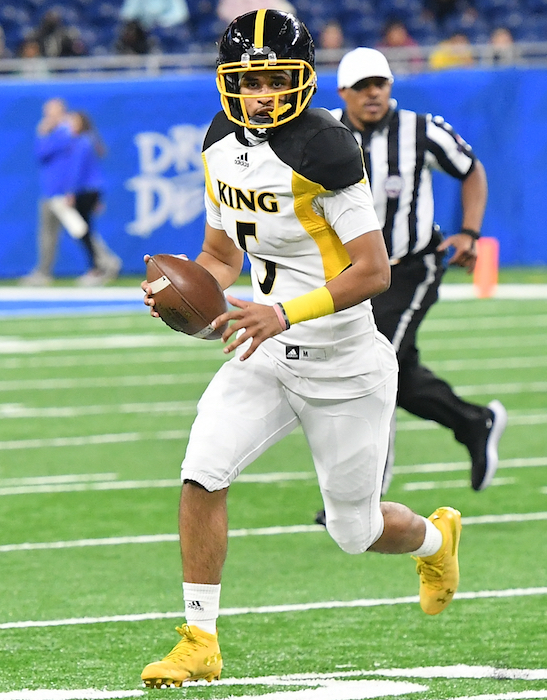
King’s four-year starting quarterback cemented his legacy, leading the Crusaders to their second-straight MHSAA Division 3 championship with a 56-27 victory over Muskegon.
The Oregon commit finished 21-of-26 passing for 275 yards with four touchdowns and no interceptions to power King (10-3) to its sixth Finals title overall and fifth in eight years.
Before Moore even took the field for his first offensive series against Muskegon (11-3), junior Jameel Croft Jr. staked King to an immediate lead with an electrifying 96-yard return of the game’s opening kickoff.
The Crusaders never looked back.
“I wasn’t expecting that. I just followed my blocks. Guys were blocking for me and the coaches set it up perfectly for me, for real,” Croft said. “It gave us a lot of momentum in the beginning of the game. It helped us out a lot.”
 Muskegon pulled within 14-7 midway through the first quarter and 21-14 three minutes into the second, but Moore & Co. always seemed to have an answer.
Croft scored the game’s first two TDs, as he added a 13-yard scoring catch from Moore to make it 14-0 with 6:28 left in the first quarter.
“We started out chasing. We gave up that opening kickoff for a touchdown and we just got ourselves chasing and kind of things went from there,” said Muskegon coach Shane Fairfield, whose team trailed 35-14 at halftime and pulled within 14 with five minutes left in the third but got no closer.
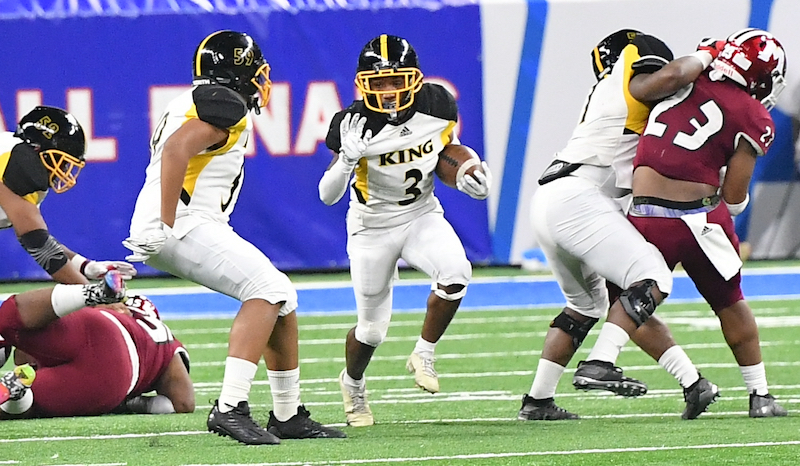
Croft was Moore’s top pass-catcher, finishing with six receptions for 64 yards and two TDs. Senior Sterling Anderson Jr. was a blur as King’s top rusher, totaling 207 yards on only 13 carries, highlighted by his 80-yard scoring sprint that gave the Crusaders a 49-27 lead with 10:55 remaining.
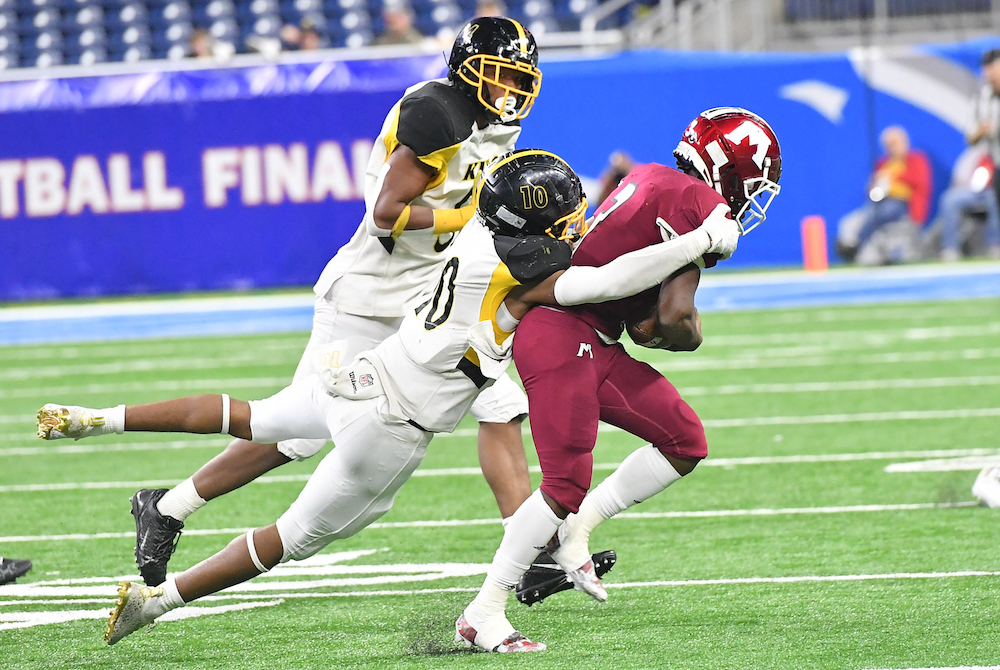
Seniors Samuel Washington and Tim Ruffin paced King defensively with nine and eight tackles, respectively. For Muskegon, senior Julian Neely registered a team-high seven stops, while junior Stanley Cunningham recorded two sacks among his six tackles.
Muskegon junior quarterback M’Khi Guy ran 20 times for 135 yards with two TDs, including a 60-yard breakaway to pull the Big Reds within 14-7 midway through the first quarter. He also completed 2-of-4 passes for 97 yards, including a 71-yard scoring strike to junior Destin Piggee.
Muskegon junior Jakob Price added 93 rushing yards and a TD on 17 carries, but the night belonged to King and Moore.
“There’s no excuse: That kid is amazing. He threw balls that we haven’t seen probably in my career,” said Fairfield, whose program was seeking its first Finals title since 2017. His Big Reds teams have been to the Finals to finish eight of his 13 seasons at the helm.
“Only one other guy threw touchdown passes like (Moore) and passes and balls like that in my career here, and that was (Bloomfield Hills Brother Rice’s) Alex Malzone – went to Michigan. Seems like we always see the (Dequan) Finns and the Dantes and Malzones and stuff when we get here, but you know, we’re here,” added Fairfield, whose 2018 squad lost to Finn and King, 41-25, in the Division 3 championship game.
King coach Tyrone Spencer said that his team overcame a lot of adversity this season. The Crusaders could not practice on their field because it’s undergoing a makeover, so they bussed to practice. They lost their season opener to Warren Central (Ind.), 44-26, and dropped the final two games of the regular season to Detroit Cass Tech (28-14) and Cincinnati Moeller (30-14).
 The Crusaders got it going in the playoffs, however. They threatened the Finals record for points by one team, established Friday night by Grand Rapids West Catholic with 59.
“(The season) was up and down, but the kids, I mean, they trust us and we got it back going,” Spencer said. “They’re a resilient group of kids. It speaks to their character.”
Moore mentioned the “championship culture” at King, how one expects to be a champion once he puts on that jersey.
It’s also about giving back and respecting the game, too, which has been a custom of Moore’s since his freshman year when King lost to Muskegon Mona Shores in the Division 2 Final, 35-26.
“My freshman year, me playing against Brady Rose and Muskegon Mona Shores, I remember Brady Rose pulled me to the side and that’s where I really got it from – him taking me to the side, telling me things I can work on, and me congratulating him for what he’s done and being one of the best players to come through Michigan to be honest and leading his team on his back,” Moore recalled.
“I just knew that I had to carry that on through this past year and really pull the (opposing) quarterbacks to the side, especially (those) younger than me. Me being a senior, I’ve been through a lot. I just want to give them the keys and terms to help them be the best they can be in high school.”
Croft called the 6-foot-2, 210-pound Moore a “great leader,” who is “so poised” and one who will leave “a great legacy right here for sure.”
“Special, man,” is how Spencer reflected on Moore’s four-year run.
“You know, he’ll be the one that they’ll talk about maybe the greatest we’ve ever had here,” Spencer said. “Just really proud of him and the person that he is. He deserves it. He works hard for it, and I just couldn’t be more pleased. It couldn’t happen to a better person.”
Meanwhile, Muskegon got off to a bit of a slow start this season by Big Reds standards. They lost two of their first five games, including a 49-16 road defeat to eventual Division 2 champion Warren De La Salle Collegiate, but got healthy and played their best football at the right time leading up to Saturday night.
Fairfield said the Big Reds battled and left it all on the field.
“They played 14 and when you play 14 games, of course this is going to hurt more because it’s the very last one and now you’ve got 364 days to get back,” he said.
PHOTOS (Top) Detroit King’s Samuel Washington (10) wraps up Muskegon’s M’Khi Guy during Saturday’s night’s Division 3 Final. (Middle) Crusaders quarterback Dante Moore rolls out looking for a receiver. (Below) King’s Sterling Anderson Jr. (3) follows his blockers through a sizable opening. (Click for more from Hockey Weekly Action Photos.)