

Search for Longest FG Starts in '50s
October 30, 2020
By Ron Pesch
Special for Second Half
Rob LaMielle’s first attempted field goal was a memorable one, and frankly, a bit amazing.
For starters, his track record on extra points, at least to that point in the season, was less than stellar. Flint Holy Redeemer entered their third game of the 1963 slate with a 1-1 record. The Flyers were defeated by Bad Axe in Week 1, then trounced Imlay City the next week. The senior had been successful on only 3 of 9 extra-point placements on the year.
“You had to bring that up,” said LaMielle over 55 years later, laughing at the statistic. “That’s probably so. Bad Axe was rated No. 1 in the state in Class ‘B.’ We were a ‘C’ school. They beat us 13-12 that night, because I missed two extra points. They scored in the very last couple minutes.”
The fact that his field goal was on the mark is all the more impressive considering it traveled 50 yards, clearing the crossbar by three feet, according to observers. Even more remarkable, it was a mere three yards shy of Lou ‘The Toe’ Groza’s best effort for the National Football League’s Cleveland Browns, and just six yards short of the NFL record, set by Bert Rechichar of the Baltimore Colts in 1953. Rechichar held the mark until it was famously topped by New Orleans Saints kicker Tom Dempsey in 1970 against the Detroit Lions.
“We practiced behind our football field,” said LaMielle, recalling how he got the job. “Behind our football field was two baseball fields with a backstop at each end. Well the coach lined everybody up on second base and said, ‘OK, we’re going to find out who can kick a field goal.’ So we started kicking the ball over the backstop. One of the times I kicked it, and it went a long ways.”
St. Redeemer’s coach Dick Clark stopped the drill and named LaMielle the team’s kicker.
“Before my senior year, I’d never kicked off, never attempted an extra point.”
At the time, the 220-pound LaMielle, who, like Groza, played tackle, was asked if he was surprised by the success of his kick.
“I was more surprised Coach Clark asked me to try it,” he said.
The field goal helped Flint Holy Redeemer top Bay City St. James, 29-6.
It also prompted another question from sports reporters. Was LaMielle’s kick a Michigan high school record?
The Search
The publicity surrounding the kick sent sportswriters around the state scurrying for the archives.
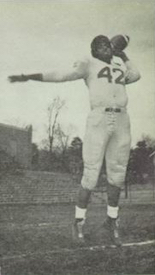 Initial inquiries indicated that Jim Yore of Battle Creek Central held the state mark, with a 56-yard field goal about 10 years prior, but a recheck of records by Dick Kishpaugh, “sports publicity director at Kalamazoo College and a close observer of Michigan prep football records,” indicated that Yore’s longest had been a 38-yard field goal, kicked on the last play of the game to beat Ypsilanti 3-0 on Oct. 3, 1952. It was thought to be the longest in state history.
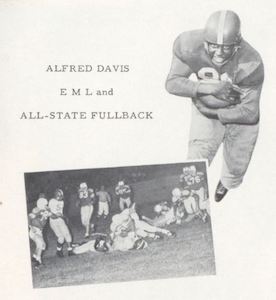
Additional digging found that Port Huron High School’s Alfred Davis, a 212-pound fullback, had drilled a flawless 46-yard field goal in a 19-14 win over Hazel Park in 1953.
“The word ‘tremendous’ is probably one of the most overused words in sports lexicon,” wrote Port Huron Times reporter Fred J. Vincent, “but it should be used in describing this kick.”
Vincent called it “perfect, splitting the uprights and clearing the bar by about six feet.”
Impressively, Davis also had kicked a 36-yarder earlier in the contest. “Bob Boyd held on both kicks,” added the sportswriter. “Not since Oct. 8, 1930 had a Big Red player kicked a three pointer. Hank Ceasor did it then to best Ferndale, 3-0.”
Word came that Cheboygan Catholic’s Joe Poirier had kicked one “reported to have traveled at least 53 yards from the point of the kick to the goal posts” in a 10-0 victory over Alcona in 1957. Since the MHSAA didn’t keep records at the time, Kishpaugh added it to his listing of unofficial state records.
The Ironwood Daily Globe unearthed a nugget. While it wasn’t considered by Kishpaugh for his record book, it did bring back memories of changes seen in the game.
Ironwood’s John ‘Cutz’ Cavosie made a “tremendous boot on Oct. 10, 1925 in the final seconds of a game at Oliver Field here in which Ironwood swamped Menominee 41-0. Cavosie apparently was back to punt, but instead he dropkicked the ball squarely through the goal posts 55 yards away. He was in his senior year that fall and was captain of the team. He played a big role in the rout on Menominee by scoring on runs of 42, 51 and 67 yards.”
Record Toppled
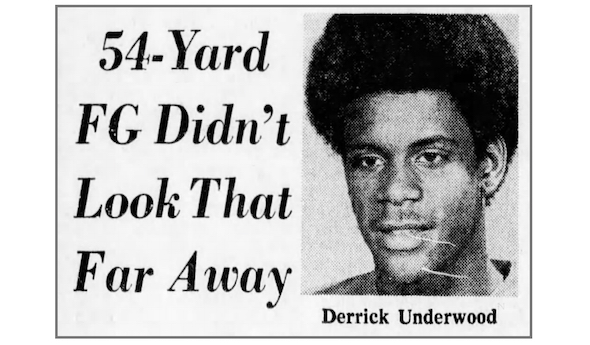
So it was quite the event when, nearly 19 years later, junior Derrick Underwood broke Poirier’s mark on a cold October Friday at Inkster.
A week earlier, Underwood had made his first field goal of the season, a 23-yard boot in overtime to give Ecorse its first victory of the year in five starts, 9-6, over River Rouge. This time, his kick gave Ecorse a 3-0 victory over the Vikings, although in decidedly less dramatic fashion as the kick came in the second quarter.
 “The strange thing is I didn’t even know that I was kicking it from the 44-yard line. To be honest, I wasn’t paying that much attention and it didn’t look that long,” Underwood told the Detroit Free Press in 1976. “But I got a real good snap on it and an excellent hold.
Red Raiders coach Patrick Kearney believed the kick would have been good from another five or 10 yards out.
“It felt good when I hit it,” added Underwood, “but because I was in front of the goal posts, I couldn’t tell whether it went over or under the crossbar. But I saw my teammates jumping up and down on the sidelines and I knew it made it.
“I was pretty loose because I figured that if I missed, we still had another half to come back and win it.”
Underwood’s accomplishment garnered national attention in the June/July ’77 issue of Joe Namath’s National Prep Sports magazine. At the time, Jerry Spicer of Hobart (Ind.) High School held the national record with a kick of 61 yards in 1975.
Exasperation to Jubilation
Underwood, who also served as the Red Raiders’ quarterback and defensive end, guided the team to Inkster’s one-foot line in that same game as the clock wound down. But with the lead, instead of pushing for the end zone, they let time expire.
A year earlier, in 1975, the Ecorse players watched their season disappear after a single game.
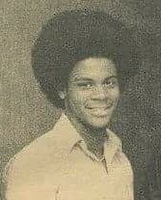
“The school millage was defeated just prior to the start of that season,” said Underwood, recalling his high school days some 45 years later. “I was the starting QB for the Red Raiders through my senior year ('78). We were heartbroken that our season was over after the first game against Muskegon Heights. No energy for that game.
“We were foaming at the mouth to be playing organized football. Some of us played flag football to stay active.”
“I was just practicing holding for a teammate,” Underwood had told the Free Press back in October 1976. “Eventually I thought I’d try and I got to be pretty good at it.”
“I didn’t take kicking seriously at all,” he states now. “I wasn’t a dedicated kicker. My stars were aligned in my head as being the next Thomas Lott.”
 Lott, a Parade All-American out of San Antonio, Texas, played quarterback at Oklahoma, where his coach, the legendary Barry Switzer, once called him the greatest wishbone quarterback in Oklahoma history.
“Went down to Tennessee State University and found out how much football I didn’t know,” Underwood said.
Reminiscing he added, “Looking back, wouldn’t change a thing growing up in Ecorse.”
Equaled, then Topped – in the Same Game
Underwood’s mark would hold in Michigan until 1979, when junior Harold Moore of Dearborn equaled, then topped the mark in a season-ending game against Plymouth Canton.
Moore, a left-footed, straight-on kicking specialist, matched Underwood’s record with a 54-yard boot in the game’s first half, and then topped the record with a 55-yard field goal during the second half.
“I’ve never seen anyone with the leg power he has,” said his coach, Dick Ryan. “His 55-yard field goal cleared the bar with 20 feet to spare.”
Over the next two seasons, three players – Mike Prindle of Grand Rapids Union (1980), Bob Hirschman from Sterling Heights Ford (1980), and Dave Blackmer of Farmington Hills Harrison (1981) – would match Moore’s longest kick.
Since then, only five players have matched or exceeded 55 yards. John Langeloh of Utica shattered the mark in 1985 with a 58 yarder. Doug Kochanski of Warren Woods-Tower is the state’s current record holder, with a kick in 1994 that traveled 59 yards before splitting the uprights. The successful kick came in his final high school contest.
In these days of more and more specialization, one wonders, will Michigan ever see one of 60 yards or more?
 Ron Pesch has taken an active role in researching the history of MHSAA events since 1985 and began writing for MHSAA Finals programs in 1986, adding additional features and "flashbacks" in 1992. He inherited the title of MHSAA historian from the late Dick Kishpaugh following the 1993-94 school year, and resides in Muskegon. Contact him at [email protected] with ideas for historical articles.
PHOTOS: (Top) The Detroit Free Press told the story behind Derrick Underwood’s record field goal for Ecorse in its Oct. 30, 1976 edition. (2) Battle Creek Central’s Jim Yore was one of the earliest record holders for longest field goal in Michigan high school history. (3) Alfred Davis also was a standout fullback for Port Huron. (4) Underwood also played quarterback and defensive end for the Red Raiders. (Photos gathered by Ron Pesch.)
1st & Goal: 2021 Week 1 Preview
By
Geoff Kimmerly
MHSAA.com senior editor
August 26, 2021
Welcome to what might be the most anticipated opening weekend in Michigan high school football history.
No one is saying life is back to pre-pandemic normal, of course. But after last football season saw multiple delays, an abbreviated regular season and altered playoff format, it’s hard not to be excited about most things beginning “as they always have” this weekend across our state.
And there are plenty of opportunities to dig in and enjoy.
Check out your local game, or one of those highlighted below – including a number of games from three showcase events, the Battle at the Big House at University of Michigan, the Xenith Prep Kick Off Classic at Wayne State and the Vehicle City Gridiron Classic at Kettering’s Atwood Stadium. There are also plenty of opportunities to tune in from home – more than 150 games will be streamed live on the NFHS Network or by partner Bally Sports Detroit, including two televised live on BSD’s primary cable channel. (Click for details.)
As in seasons past, our weekly football previews will point out intriguing games from every region of the state – opportunities to see a great story unfold no matter where fans live or are visiting that weekend. Records below are from the 2020 season. (Games from the aforementioned showcases are listed in the region of one of the competitors.)
Bay & Thumb
Davison (10-1) vs. Clarkston (7-1), Friday at U-M
A number of teams from the I-75 corridor and particularly the Flint suburbs will be playing showcase games this weekend, and this might be the biggest as well as a preview of a more significant rematch to come. Clarkston’s lone loss last season came by seven to Grand Blanc in a District Semifinal – a week before the Wolves would have faced Davison, which suffered its only defeat at Ford Field against West Bloomfield in the Division 1 championship game. The Cardinals also were Division 1 champs in 2019, with Clarkston most recently making the Finals as Division 1 runner-up in 2018.
Keep an eye on these THURSDAY Lapeer (3-4) vs. Grand Rapids Catholic Central (10-0) at U-M, Frankenmuth (11-1) vs. Goodrich (6-2) at Atwood Stadium. FRIDAY East Lansing (8-1) vs. Grand Blanc (7-2) at Atwood Stadium, Midland Dow (5-3) vs. Fenton (7-1) at U-M.
Greater Detroit
Detroit Catholic Central (9-1) vs. Clinton Township Chippewa Valley (3-4), Thursday at WSU
This might be the premier matchup of the Wayne State games, and also one where a 2020 record should be ignored when making that argument. Chippewa Valley may have lost four games last season, but those defeats came by a combined 21 points and none by more than nine. DCC, meanwhile, suffered its only loss to Davison, in a Division 1 Regional Final. The Shamrocks were especially tough defensively last fall, giving up 10 points per game, while winning a Detroit Catholic League Central that sent Warren De La Salle Collegiate to the Division 2 championship game.
Keep an eye on these THURSDAY Canton (8-1) vs. Dearborn Fordson (5-3) at Wayne State, Bloomfield Hills Brother Rice (7-2) at Macomb Dakota (6-2). FRIDAY Oak Park (5-6) at Orchard Lake St. Mary's (2-4). SATURDAY Southfield Arts & Technology (3-4) vs. Detroit Cass Tech (8-1) at Wayne State.
Mid-Michigan
DeWitt (12-0) vs. Traverse City Central (9-2), Thursday at U-M
The Panthers are coming off their first Finals championship, claiming the Division 3 title last season, and might be even better on offense this fall with multiple playmakers returning after the team scored at least 37 points in all but one game. Central missed making Ford Field by one win, falling to eventual champion Muskegon Mona Shores in a Division 2 Semifinal. The Trojans scored at least 30 points in all but one game last season and should be a handful in an intriguing Michigan Stadium clash.
Keep an eye on these THURSDAY Olivet (7-2) at Charlotte (2-5). FRIDAY Freeland (8-2) at Clare (7-1), Fowler (6-3) at Carson City-Crystal (6-2), Lansing Everett (did not play) at Lansing Sexton (did not play).
Northern Lower Peninsula
Reed City (8-0) at Cadillac (7-3), Thursday
Rewind again to when the MHSAA football season concluded at Ford Field, and Cadillac was one of the surprises of championship weekend. The Vikings reached the Finals for the first time, and while being held scoreless by Detroit Country Day in the Division 4 championship game they also put up one of their most impressive defensive performances holding the Yellowjackets to 13 points. Reed City’s story, though, had to feel a little unfinished – after starting out with eight straight wins, the Coyotes’ last playoff game before the COVID-related break in November was canceled, as was their Regional Final when play resumed in January.
Keep an eye on these THURSDAY Traverse City West (6-2) vs. Midland (8-1) at U-M, Beaverton (6-2) at Lake City (2-4), Houghton Lake (4-3) at Maple City Glen Lake (5-3), Kingsley (8-0) at McBain (6-1).
Southeast & Border
New Lothrop (11-0) at Jackson Lumen Christi (5-5), Thursday
These two have made a combined six trips to Ford Field with five championships over the last five seasons. New Lothrop is coming off its second Division 7 title in three seasons in January, while Lumen Christi was stopped short in the Regional Finals – a week before it would have met New Lothrop with a Finals bid on the line. This is also an intriguing matchup between the state’s longest-serving and third-winningest football coach, Lumen’s Herb Brogan (373-89 over 42 seasons), against a younger leader on the path to join the all-time greats in Clint Galvas (129-15 over 13).
Keep an eye on these THURSDAY Ithaca (8-1) at Hudson (4-4). FRIDAY Ottawa Lake Whiteford (6-3) at Blissfield (8-1), Michigan Center (6-2) at Homer (5-3), Saline (8-2) vs. Hudsonville (5-3) at U-M.
Southwest Corridor
Portage Central (3-5) at Stevensville Lakeshore (6-3) , Thursday
After not awarding a league champion last season because of the abbreviated regular-season schedule, the Southwestern Michigan Athletic Conference gets rolling immediately with two frequent contenders facing off. Central and Lakeshore didn’t play last season, but Central has won two straight in the otherwise-annual series.
Keep an eye on these THURSDAY Lake Odessa Lakewood (3-4) at Battle Creek Pennfield (5-4), Grand Ledge (5-3) at Coldwater (5-2), Cassopolis (2-5) at Schoolcraft (9-2). FRIDAY Battle Creek Lakeview (5-3) vs. Battle Creek Harper Creek (5-3).
Upper Peninsula
Negaunee (6-4) at Iron Mountain (7-2), Thursday
Once the regular season finally got started last fall, the Upper Peninsula proved quickly captivating as the status of best team north of Mackinac Bridge seemed to change hands weekly. Iron Mountain was the last remaining in the playoffs, reaching the Division 8 Regional Finals and missing the Semifinals with a one-point defeat. Both of these teams stand to be in the conversation again not only across the peninsula and statewide but more locally as the Western Peninsula Athletic Conference Copper (and Silver) reinstates league play after also not awarding a 2020 champ.
Keep an eye on these FRIDAY Gladstone (2-4) at Calumet (4-4), Bark River-Harris (5-3) at Gwinn (4-4), Houghton (2-3) at Ishpeming Westwood (5-2), Sault Ste. Marie (6-3) at St. Ignace (1-6).
West Michigan
Edwardsburg (9-1) at Montague (12-0), Thursday
The anticipation for this matchup should rival any this weekend including for the games being played at the three opening showcases. Montague put together one of the most impressive 2020 runs in any division on the way to claiming the Division 6 title but enters this fall with a new coach and quarterback. Edwardsburg missed returning to Ford Field with a two-point loss to Cadillac in a Division 4 Semifinal and likely would have reached double-digit wins for a sixth-straight season if not for the abbreviated schedule.
Keep an eye on these THURSDAY Zeeland West (5-1) at East Grand Rapids (6-4), Muskegon Mona Shores (12-0) at Lowell (4-4). FRIDAY Grand Rapids South Christian (8-2) at Grand Rapids Christian (4-4), Hudsonville Unity Christian (7-0) at Hopkins (5-2).
8-Player
Gaylord St. Mary (7-2) at Pickford (7-2), Friday
These two won’t see each other again when the playoffs roll around – Pickford is in Division 1 this season and St. Mary in Division 2. But if recent history serves, this opener could be a primer for the kind of matchup both could earn a few months from now. Pickford made the Regional Finals last season and has pushed at least that far into the playoffs the last five seasons. Gaylord St. Mary is coming off two straight Regional Finals trips, both in Division 1 as well before moving into Division 2 for this fall.
Keep an eye on these THURSDAY Mendon (6-2 in 11-player) at Vandercook Lake (4-2). FRIDAY Merrill (6-2) at Marion (8-2), Wyoming Tri-unity Christian (3-5) at Martin (8-2), Onaway (6-1) at Indian River Inland Lakes (8-2).
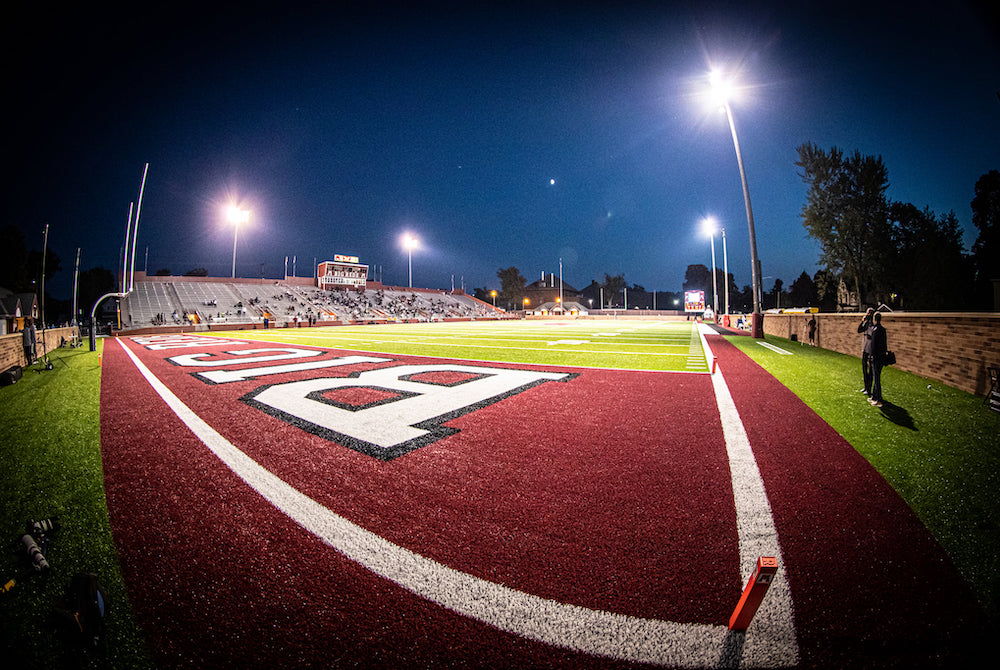
PHOTO: Football stadium lights, like these last season at Muskegon High School, will brighten the sky again for the 2021 season beginning this weekend. (Photo by Tim Reilly.)