

Snowbirds Soar Again As 8-Player Power
October 4, 2019
By Chris Dobrowolski
Special for Second Half
GAYLORD — After the first three weeks of the football season, it didn’t look like anyone was going to be able to stop Gaylord St. Mary.
 The Snowbirds, after all, had scored 215 points over three convincing victories during their first season since making the move to compete as an 8-player team.
But that high-powered, explosive offense was ground to a halt over the last two weeks. It wasn’t because of a sudden lack of execution by St. Mary. Nor was it due to a stout defense rising to the occasion. Rather, it was back-to-back forfeits by opponents who weren’t able to field teams that sidelined the Snowbirds’ dynamic attack with an unwanted midseason break.
“Our kids want to play, but unfortunately it is what it is,” said Gaylord St. Mary head coach Kevin O’Connell. “It stunk for the kids because I know they really wanted to look forward to Friday nights, especially homecoming.”
St. Mary tried to turn the two-week pause into a positive. They hit the reset button and went back to focusing on fundamentals, with short periods of live contact during quick, but effective practices.
“Our practices have been nothing short of awesome,” said O’Connell.
St. Mary will find out this week against Suttons Bay if the time off disrupted its offensive flow. But the players are confident the break was not a hinderance.
“I don’t think it broke our rhythm. I think it brought us closer together,” said quarterback Brady Hunter. “We were able to bang heads with each other, get some frustration out.”
Hunter is one of a multitude of weapons the Snowbirds have in their veer option attack. The senior quarterback is joined by a stable of talented running backs in seniors Steven Koscielniak and Logan Murrell, and juniors Christopher Koscielniak and Dominic Keister. Senior center Rory Curran anchors the offensive line.
“I like this offense,” said Steven Koscielniak. “This is what our team is about, quick and fast.”
While the Snowbirds’ scoreboard numbers are eye-popping, the team’s individual stats are more modest – partly because those main threats didn’t play in second halves of two games St. Mary was thoroughly dominating. Also, there is enough talent on board to share the wealth and not miss a beat.
“It’s everybody. There’s not just one player who runs it. It’s the whole team,” said Steven Koscielniak.
 As the quarterback, however, Hunter is thrust into the important role of leading the group, a task he does well. The three-sport standout, who also excels at basketball and baseball, fittingly, has his pilot’s license.
“He’s one of the best leaders,” Steven Koscielniak said. “No doubt about it. He pushes us to the next level. He pushes us in practice, when we’re lifting.”
“He conducts himself the right way in everything,” O’Connell said of his signal caller. “He conducts practices. He speaks respectfully. He’s a great leader.”
Each of St. Mary’s skill players are returning starters, but it’s been a completely different experience this season for the Snowbirds, who were depleted by injuries and suffered through a 2-7 grind a season ago.
“We took our lumps,” said O’Connell, in his seventh year in charge of the Snowbirds. “A lot of that had to do with we were senior-laden the year prior and then a lot of the seniors last year didn’t get quality reps the year prior. High school football is extremely cyclical.”
Still, St. Mary had a good outlook for 2019. It had speed, athleticism, leadership and experience all on its side, plus a better fit as an 8-player team for a school its size.
“We definitely saw it coming,” said Hunter. “Last year we had a little bit of a rough season. Coming into 8-man we had all of our skill players returning. We knew this offensive power was here.”
The offense has been so impressive that it overshadows what the defense can do, but St. Mary is tough on that side of the ball as well. The Snowbirds’ depth allows them to have only a few players who play on both sides of the ball. Kyle Murphy and Chris Grody are disruptive on the defensive line, while Murrell leads the defensive backfield and Christopher Koscielniak – who his coach lauds for his toughness – is an all-state caliber linebacker.
“He’s not physically imposing, but he is so tough,” said O’Connell. “He’s disciplined. He’s good.
“We’re not big in stature. We just have a lot of tough kids.”
The astonishing thing is the Snowbirds have only started to tap their potential on offense. The team hasn’t even utilized some of its capabilities yet.
“We like to spread ourselves so we’re very diverse. If a team comes and stops our run, we’ve got a great spread offense, a great wing set and a lot of stuff we can throw at them,” said Hunter.
The time to introduce some of that could be coming as the schedule ramps up considerably when St. Mary finally steps back onto the field. The matchup at Suttons Bay is a showdown between unbeaten teams and is followed by contests against a pair of current 4-1 teams in Vestaburg and Mio — the latter a rematch from a 48-32 Week 2 game — and 3-2 Brethren.
“It’s definitely going to be fun,” said Hunter. “Those blowout games aren’t really fun for anyone. Suttons Bay’s a great team. Mio, (Vestaburg and Brethren) — they’re all great teams. It’s going to be a good battle towards the end of the season, and it’s really going to prepare us for playoffs.”
 Chris Dobrowolski has covered northern Lower Peninsula sports since 1999 at the Ogemaw County Herald, Alpena News, Traverse City Record-Eagle and currently as sports editor at the Antrim Kalkaska Review since 2016. He can be reached at [email protected] with story ideas for Manistee, Wexford, Missaukee, Roscommon, Ogemaw, Iosco, Alcona, Oscoda, Crawford, Kalkaska, Grand Traverse, Benzie, Leelanau, Antrim, Otsego, Montmorency, Alpena, Presque Isle, Cheboygan, Charlevoix and Emmet counties.
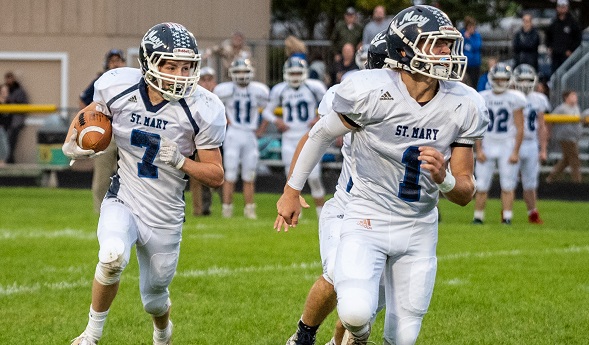
PHOTOS: (Top) Gaylord St. Mary’s Logan Murrell (7) follows Steven Koscielniak (1) and another blocker around the edge during a Week 3 win over Central Lake. (Middle) The Snowbirds bring down the Trojans' T.J. Schultz. (Photos by Sports in Motion.)
Portland Makes Right Moves for March
November 29, 2012
By Geoff Kimmerly
Second Half editor
Dylan Carroll and Adam Goodman knew the request was coming long before coach John Novara asked them to make a big change for their senior seasons on the Portland football team.
The writing was on the scale, so to say. At 6-foot-5 and 230 pounds, Carroll was among the three most sizable players on the Raiders’ roster this fall. And Goodman, at a solid 6-0, 200, wasn't far behind.
Still, it’s fair to assume not a lot of players want to trade in the opportunity to carry the ball for a jersey in the 50s. But Novara had no choice but to ask; he needed two new guards, and the best fits were tight end Carroll and the fullback, Goodman.
“At first, it was block, block, block. But after that, you get to pancake guys when you pull. Especially in this offense, guard is one of the best positions that we run,” Goodman said. “At first, it wasn't so exciting. But after that, it’s the best position. I would've played it all four years if I’d had the chance.”
Their one season on the line helped the Raiders produce unprecedented results.
Portland gets a Second Half High 5 this week after finishing a 13-1 season with its first trip to the MHSAA Finals – and first championship, thanks to a 12-9 win over Grand Rapids West Catholic.
The Raiders won in the same way they've made the playoffs every season over the last decade – with a mix of physical play up front, tough running and stout defense. That style often has been made possible by big bodies up front – a standout or two like alum and recently-graduated Eastern Michigan University 300-pounder Bridger Buche have been more the usual than occasional for Portland of late.
Not this season. For the Raiders to win again like they always have, it took the sacrifices of a couple smaller but just as tough seniors to be the catalysts.
“I think that was one of the keys to our success, offensively,” Novara said. “They graciously moved there. Without them moving to guards, I don’t know that we could've done this.”
Portland scored 500 points this season, likely its most ever (Michigan-football.com records date back to 1950). No other Raiders team had scored even 400.
Carroll and Goodman also were two of only three Portland players who pulled double duty, with Carroll also a starting defensive end and Goodman a starting linebacker. They helped key a defense that gave up just 13 points per game.
That defense gave up more than 14 points only once during the regular season – in a 41-32 loss to 2011 Division 5 runner-up Lansing Catholic. It gave up more than 20 twice in the playoffs, but hung on when it counted in a 45-28 win over reigning champion Flint Powers Catholic in the Regional Final and then the next week in a 28-23 nail-biter against Ann Arbor Gabriel Richard.
Portland scored all of its points of the MHSAA Final during the game's first 15 minutes. But the defense came up with three interceptions and two turnovers on downs, plus blocked a field goal attempt. The Raiders ended West Catholic’s final drive with a fourth-down stop on their 12-yard-line.
“The defense had been there all season, and we were just happy to make that one last play to win a state championship,” Goodman said.
And if he and Carroll’s moves to the offensive line hadn't been worth it completely before, they certainly became so that afternoon. As Carroll said after, he and most of his teammates are three-sport athletes who grew up together in their small town midway between Lansing and Grand Rapids. A position change hardly qualified as a sacrifice for an opportunity like this.
“I wasn't going to go out without a state championship this year. Our seniors deserved it,” Carroll said.
“We kept our mouths shut. We did whatever was best for the team, and we still worked as hard as we could this summer. It was well worth it.”
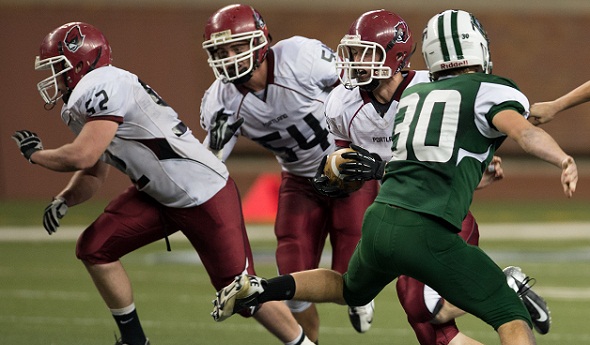
PHOTO: Portland linemen Adam Goodman (52) and Dylan Carroll (54) lead the way for teammate Auston Brandt during Saturday's Division 5 Final at Ford Field. (Click for more from Terry McNamara Photography.)