

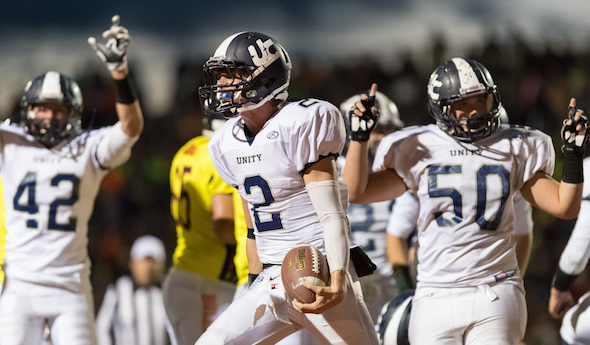
'Soccer School' Cheers Best Football Run
November 16, 2016
By Dean Holzwath
Special for Second Half
HUDSONVILLE – When people mention Hudsonville Unity Christian, the first thing most think about is the unparalleled success the school has experienced in boys and girls soccer.
 The two programs have combined to win 14 MHSAA Finals with the girls capturing a remarkable 10 from 2005-2016.
However, another sport at the Ottawa County school is beginning to make a name for itself and gain attention.
The football team collected its first Division 4 Regional title last Friday with a 36-16 victory over Lake Odessa Lakewood.
The Crusaders (10-2) will appear in their first MHSAA Semifinal on Saturday against Grand Rapids Catholic Central (11-1).
This is their Unity Christian’s eighth appearance in the postseason, and their 10 wins thus far is a school record.
“Football is getting more of a notice now,” Unity senior quarterback Mitch Dykstra said. “Soccer has always been good at Unity and always will be, but football is becoming more prominent. It’s good to see.”
Unity’s deepest run in the MHSAA tournament wasn’t necessarily expected, especially after the team dropped two of its last three games to end the regular season.
The Crusaders won a school-record six straight games to open the season, but lost to Zeeland East (12-7) in Week 7 and Ottawa-Kent Conference Green champion Byron Center (40-19) in the regular-season finale.
Unity tied for second in the conference standings.
“We played hard, and in both games we battled,” said the Crusaders’ Craig Tibbe, the only head coach the program has had since its inception in 2003.
“We did some OK things, and took a few positives from that. We played one of the better teams (Byron Center) in the area that last week, but we gave good effort and moved the ball.”
The postseason started with a 24-6 victory over Three Rivers and a trip to the District Finals, but that’s where most prognosticators thought Unity’s season would end.
The Crusaders clashed with unbeaten Benton Harbor, a team loaded with size, speed and athleticism – and a mismatch in most people’s eyes.
“We were a little nervous about the unknown,” Tibbe said. “How good are they?”
Unity pulled off perhaps one its biggest wins in school history, a 35-34 overtime thriller. The Crusaders were moving on.
“It was a great game, and they were tired when we got home, but what a fun night,” Tibbe said. “They had a lot of skilled athletes, but we hung on and walked out of there with the W. Going forward, that definitely showed them that we could play with these guys. Even though we didn’t have the speed and size, we could go in there and battle.”
 Last season, Unity possessed one of its better teams. It advanced to the Regional Finals for the first time before succumbing to eventual Division 4 champion Zeeland West.
The Crusaders lost several key starters from that squad, but found capable replacements. Still, Tibbe was unsure how this season would unfold.
“This season has been very special and a lot of fun,” he said. “You just never know from year to year how it’s going to go and these kids have surprised us, but what’s not surprising is how hard they’ve played week in and week out to survive.
“We look at it as why is it this way this year and not other years? We felt like we had a couple teams in the past that were pretty solid, but we ran into eventual state champs early.”
What hasn’t been mentioned is the Crusaders’ lack of numbers and depth. Throughout the season, they’ve dressed only 22 or 23 on the varsity.
Six starters and eight in all, including Dykstra and running backs Parker Scholten, Alec Headley, Austin Shaban and Luke DeGroot, play both offense and defense.
“They’ve been thrown into the fire and forced to do that when they start in our program,” Tibbe said. “It carries over, and they learn to take a little pride in the fact that this is what we do and we try to do the best we can with it.”
Unity senior tight end/linebacker Cole DeVries said there were doubts as to whether this team could surpass last year’s win total.
“We lost our whole lines, and not a lot of people believed that we could go as far as last year,” he said. “It’s been a journey, but definitely my favorite year. It’s the farthest we’ve ever been at Unity, and we’re making history. We’re doing a lot of things that Unity hasn’t done, and it’s been a blast for me.”
Added Dykstra: “I can’t describe how amazing this season is. No one believed in us, and it has pushed us to strive for greatness and that’s what we’ve done. We’re always undersized, and other teams have more players and athletes, but we work well together and we want to work hard for each other.”
 Dean Holzwarth covered primarily high school sports for the Grand Rapids Press and MLive for 16 years and more recently served as sports editor of the Ionia Sentinel and as a sports photojournalist for WZZM. Contact him at[email protected] with story ideas for Allegan, Kent and Ottawa counties.
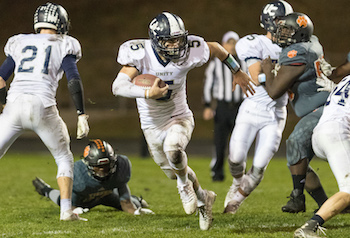
PHOTOS: (Top) Hudsonville Unity Christian players celebrate during a game this season. (Middle) The Crusaders' Alec Headley (5) finds an opening during the playoff win over Benton Harbor. (Photos by Larry Treece Jr./LTpics.com.)
Drive for Detroit: Playoff Week 3 Preview
November 14, 2019
By Geoff Kimmerly
Second Half editor
Detroit is only two wins away for Michigan’s remaining 11-player teams.
 But 8-player semifinalists need just one more win to complete a “March to Marquette” – and we’re flipping our usual format by leading off this week’s preview with a look at those four games.
All matchups below are Friday or Saturday, as noted. The 8-player winners will move on to Nov. 23 championship games at The Superior Dome at Northern Michigan University. The 11-player Regional champs this week will play next in neutral-site Semifinals, with those locations and times announced by Sunday morning.
A total of 15 games will be streamed either by Fox Sports Detroit's Prep Zone or MHSAA.tv this weekend; click for links and listings.
"Drive for Detroit" is sponsored by MI Student Aid.
8-Player
Division 1
Kingston (9-2) at Suttons Bay (11-0), Saturday
Only four years ago, when current seniors were freshman, Suttons Bay had to cancel its final seven games for lack of healthy players. The Norsemen have made quite a return along with the move to 8-player, going from seven to nine to 11 wins over the last three seasons, respectively. Luke Mikesell keys a balanced attack with 1,231 yards and 20 touchdowns rushing and eight more scores receiving. Kingston also is celebrating a historic run, making the Semifinals for the first time since 1996. A dominating run game deserves much of the credit, with Caleb Goss (1,470 yards/15 TDs) and Jake DeLong (1,304/20) leading the way and quarterback Aaron Koehler running for 10 touchdowns and throwing for 15 more scores.
Morrice (10-1) at Colon (11-0), Saturday
The reigning Division 1 champion Orioles might be facing their strongest opponent of the last two seasons – including a year ago when it defeated the Magi 40-8 in a Semifinal. Colon is outscoring opponents 53-5 on average, led by dual threat quarterback Phillip Alva (792 yards/16 TDs rushing, 876 yards/17 TDs passing) and top rusher Brandon Crawford (1,404 yards/22 TDs rushing, 11.4 yds./carry). Morrice graduated some significant standouts from last season, but quarterback Jonathan Carpenter has picked things up quickly as the new starter at his spot with 1,413 yards and 21 touchdowns rushing and eight touchdown passes. Morrice’s only loss of the last two years was in Week 8 to Crystal Falls Forest Park, and it handed Deckerville its only loss this season last week.
Division 2
Hillman (10-1) at Pickford (10-1), Friday
Pickford was last season’s Division 1 runner-up with a junior-filled lineup, and that group has the team on the verge of returning to the Superior Dome. Jimmy Storey was the Associated Press’ 8-player Player of the Year in 2018 and is leading the return charge that last week included avenging the team’s lone loss, to Powers North Central. Hillman is in the midst of its 14th straight playoff trip, with only the last two in 8-player, and playing in its first Semifinal in either format. Lead rusher Gunner Mellingen (949 yards/16 TDs) has taken over even more during the playoffs, last week running for nearly 300 yards and five touchdowns in a 48-44 win over Cedarville.
Climax-Scotts (9-2) at Portland St. Patrick (11-0), Saturday
Portland St. Patrick was among early movers to 8-player and will play in its third-straight Semifinal and fourth since making the format switch in 2012. Somewhat quietly, the Shamrocks rarely have been challenged this fall – their closest win was 42-24 in Week 7 over 2018 Division 2 runner-up Onekama. Climax-Scotts is enjoying a 17th-consecutive playoff run, but this one in 8-player for the first time. The Panthers will enter their first Semifinal since 2007 after defeating Onekama last week and with the experience of rumbling through a tough southwestern region, with its losses to undefeated Division 1 semifinalist Colon and Martin, which suffered its lone loss last week to the Magi in a Regional Final. Conner Gibson (1,342 yards/16 TDs rushing) leads an offense that has run for more than 3,000 yards.
11-Player
Division 1
West Bloomfield (10-1) at Belleville (11-0), Saturday
West Bloomfield has given Belleville one of its few close games during a two-year 23-1 run, coming within 13-10 of the Tigers in last year’s Regional Final. Another defensive showdown might be to the Lakers’ favor, as the difference this time likely will come when Belleville has the ball. The Tigers have broken 500 points and average 46 per game, while West Bloomfield is giving up only 11 and has surrendered a combined 28 points over its last six games.
Other Regional Finals FRIDAY Hudsonville (8-3) at Brighton (9-2), Utica Eisenhower (9-2) at Davison (9-2), Detroit Cass Tech (7-4) at Sterling Heights Stevenson (7-4).
Division 2
Port Huron (8-3) at Birmingham Seaholm (8-3), Friday
Seaholm is looking to add its first Regional title since 1997 to its first District title since 2001 won last week, while Port Huron’s last District title was a little more recent (2011) but the farthest the Big Reds have advanced. Port Huron avenged regular-season losses the last two weeks to Port Huron Northern and St. Clair Shores Lakeview, and Seaholm did the same last week in its rematch with Birmingham Groves. The Maples are enjoying their most potent offense arguably ever (36 ppg) and could set the pace, although the Big Reds have shown they’re capable of keeping up.
Other Regional Finals FRIDAY Muskegon Mona Shores (9-2) at Portage Northern (10-1), Livonia Churchill (7-4) at Walled Lake Western (10-1), Detroit U-D Jesuit (8-3) at Detroit Martin Luther King (9-2).
Division 3
River Rouge (10-1) at Orchard Lake St. Mary’s (10-1), Saturday
After two straight seasons of sub-.500 football, the host Eaglets have rounded back into the form that carried them to seven MHSAA Finals trips in eight seasons from 2009-16. Their only loss was Week 7 to Detroit Catholic Central, and they avenged it two weeks later and have gone on to break 50 points in both playoff wins so far. But River Rouge won’t be fazed as it’s also beaten DCC this fall and is a three-point Week 1 loss to Division 4 contender Grand Rapids Catholic Central from undefeated. The Panthers’ defense has been particularly impressive; after finishing last season with a 7-6 first-round playoff loss to eventual Division 3 champion King, Rouge this fall is giving up only 7.8 points per game.
Other Regional Finals FRIDAY Allen Park (9-2) at Chelsea (11-0). SATURDAY East Grand Rapids (8-3) at Muskegon (11-0), DeWitt (9-2) at Edwardsburg (11-0).
Division 4
Milan (11-0) at Detroit Country Day (11-0), Saturday
Speaking of shutdown defenses, Country Day is giving up 5.5 points per game while facing a schedule that so far has included seven playoff teams as the Yellowjackets have made their longest run since finishing Division 4 runner-up in 2016. Milan is pretty strong on that side of the ball as well, giving up just under 16 ppg as it seeks to reach the Semifinals for the first time. Both also have had to win close this fall – Country Day got past Harper Woods by five last week, and Milan has two one-point victories – and it will be interesting to see if that experience comes into play as these two play one of two games between undefeated teams this week.
Other Regional Finals FRIDAY Hudsonville Unity Christian (8-3) at Paw Paw (10-1), Flint Powers Catholic (9-2) at Pontiac Notre Dame Prep (10-1). SATURDAY Cadillac (7-4) at Grand Rapids Catholic Central (10-1).
Division 5
Kalamazoo United (7-4) at Lansing Catholic (10-1), Friday
Neither of these teams was given enough credit earlier this season as opponents appeared to be standing in their way. But Lansing Catholic finally got past nemesis Portland last week for the first time since 2015, and the Cougars have a defense (giving up 13 ppg) to match their always high-octane scoring attack (41 ppg). United with a new coach and mostly new offensive stars opened this season 0-3 but have won seven of eight since including three straight over league champions. The Titans may not be scoring at last year’s program-record pace, but have given up only 14 points per game during the 7-1 run.
Other Regional Finals FRIDAY Dearborn Heights Robichaud (9-2) at Detroit Denby (9-2). SATURDAY Freeland (9-2) at Kingsley (11-0), Saginaw Swan Valley (8-3) at Almont (11-0).
Division 6
Maple City Glen Lake (10-1) at Calumet (10-1), Saturday
A familiar opponent stands in the way of Calumet potentially reaching the Semifinals for the first time. Just as they did in 2016, the Copper Kings will be hosting Maple City Glen Lake in a Regional Final – and last time, Glen Lake won 14-0 and ended up reaching Ford Field and finishing Division 6 runner-up. The Copper Kings are giving up just a few more points three years later, but scoring a lot more and at the same pace as the Lakers, who have broken 30 points eight of the last nine weeks.
Other Regional Finals FRIDAY Onsted (9-2) at Hillsdale (11-0). SATURDAY Sanford Meridian (8-3) at Montague (9-2), Montrose (10-1) at Monroe St. Mary Catholic Central (9-1).
Division 7
Pewamo-Westphalia (11-0) at New Lothrop (11-0), Friday
With the last three Division 7 championships between these contenders, and both undefeated and barely scored upon this season, this small-school game will be getting some big attention. New Lothrop defeated the Pirates 26-14 in last year’s Regional title game on the way to winning its first Finals championship since 2006. The Hornets have outscored their opponents on average 46-7 against a schedule that included previously-unbeaten Beaverton last week, Division 6 still-contending Montrose in league play and recently-eliminated Division 5 Frankenmuth. P-W has given up 21 points this season, and none over the last three weeks. The Pirates made a statement early with a Week 1 shutout over Division 8 reigning champion Reading and haven’t been challenged since, with a 41-7 win over another Division 8 contender Fowler among highlights. The Pirates score in bunches too, averaging nearly 43 ppg.
Other Regional Finals: FRIDAY Schoolcraft (10-1) at Jackson Lumen Christi (10-0). SATURDAY Traverse City St. Francis (8-3) at Iron Mountain (11-0), Detroit Loyola (6-4) at Cass City (10-1).
Division 8
Ishpeming (9-2) at Beal City (10-1), Saturday
The Aggies’ struggles of the last two seasons should be pushed farther into distant memory as they’ve come all the way back to the verge of what would be a first Semifinal since 2014. A Week 8 loss to McBain aside, Beal City has followed a defense giving up just 11 points per game as it’s rebounded from a combined 6-12 record over the last two years and defeated previously-unbeaten Johannesburg-Lewiston last week for a District title. Ishpeming is playing for its first Semifinal berth since 2015 after narrowly missing in a close Regional loss last year to Breckenridge. The Hematites have won six straight since dropping two in a row against playoff teams Westwood and Negaunee in Weeks 4 and 5, respectively.
Other Regional Finals FRIDAY Adrian Lenawee Christian (10-1) at Reading (10-1). SATURDAY Saginaw Nouvel (7-4) at Ubly (9-2), Fowler (10-1) at Royal Oak Shrine (9-2).
Second Half’s weekly “Drive for Detroit” previews are powered by MI Student Aid, a part of the Office of Postsecondary Financial Planning located within the Michigan Department of Treasury. MI Student Aid encourages students to pursue postsecondary education by providing access to student financial resources and information. MI Student Aid administers the state’s 529 college savings programs (MET/MESP), as well as scholarship and grant programs that help make college Accessible, Affordable and Attainable for you. Connect with MI Student Aid at www.michigan.gov/mistudentaid and find more information on Facebook and Twitter @mistudentaid.
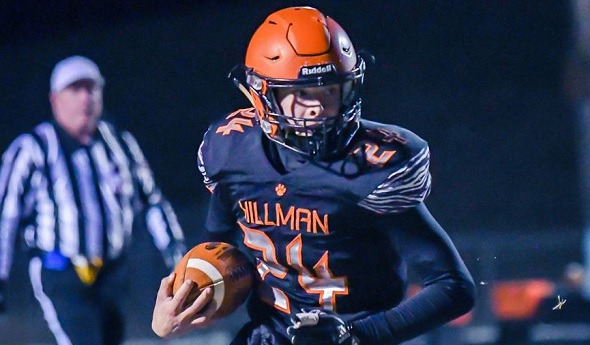
PHOTO: Hillman quarterback Nash Steinke turns upfield during last week's Regional Final win over Cedarville. (Photo by Sports in Motion.)