


Sold Out
December 13, 2016
We are sometimes criticized for limiting the scope of school sports – for restricting long-distance travel and prohibiting national tournaments; but there is no question that we are doing the correct thing by protecting school sports from the excesses and abuses that characterize major college sports.
Across the spectrum of intercollegiate athletics, but especially in Division I football and basketball, there exists an insatiable “keep-up-with-the-Joneses” appetite.
Universities are building increasingly extravagant facilities. They are sending their “students” into increasingly expansive scheduling. But it’s never enough.
There is always another university somewhere building a bigger stadium, a fancier press box or more palatial dressing rooms, practice facilities and coaches quarters.
So-called “students” are sent across the US and beyond to play on any day at any time in order to generate revenue to keep feeding the beast.
The Big Ten knows it’s wrong, admits it, but schedules football games on Friday nights to attract larger rights fees from television.
Feeling used or abused, some of the athletes of Northwestern and then at the University of Wisconsin, talk of creating a union to protect themselves from the obvious, rampant exploitation.
And then occasionally, some college coaches dare to suggest that high schools are wrong to have regulations that reject the road that colleges have traveled, a road that has distanced athletics very far from academics in intercollegiate sports.
The intercollegiate model is not and must not be the interscholastic model. We who are sold out for educational athletics have nothing good to learn from those who have sold out for broadcast revenue.
Hanover-Horton Off to Record-Setting Start, with More Program 1sts Possible
By
Doug Donnelly
Special for MHSAA.com
October 15, 2024
Hanover-Horton’s football team is in uncharted territory.
 The Comets had never won a playoff game, never won an overall Cascades Conference championship and never started the season with seven straight victories before this fall.
One of those milestones was reached Friday when Hanover-Horton shut out Addison 42-0 for its seventh consecutive victory. The other two are still possible.
“There are a lot of firsts for everybody here,” third-year Comets head coach David Messer said. “Our plan is to just keep it one play at a time.”
Hanover-Horton’s best previous start to a season was 4-0.
“When we got to 5-0, the kids celebrated that,” Messer said. “We talked about getting to 5-0. But I told them we are only going to celebrate over the weekend because Monday we had to get back to work.”
Hanover-Horton went 2-7 last season and 3-6 the year before. The last time the school won seven games in a season was 2014 when they went 8-2, setting a school record for victories that the Comets can equal against Brooklyn Columbia Central on Senior Night this Friday.
“We aren’t looking past that game,” Messer said.
The Addison win also clinched a share of the league's West division title, which the Comets can claim outright Friday. The West and East divisions winners will play for the overall Cascades Conference championship in Week 9.
The Hanover-Horton seniors are on cloud nine about this football season, guaranteed to be the first winning one for the Comets since that 2014 campaign.
“They are on top of the world, but they are not strutting down the hallways or anything,” Messer said. “They are keeping everything in perspective.”
Hanover-Horton has eight seniors. Luke Soper is the quarterback and a two-way starter. Gavin Berkeypile is a physical player who has a nose for the ball. Center Bryant Hamisfar is a captain and makes the calls for the offensive line. Jackson Johnson and Jack Wooster are split ends on offense who have turned into excellent blockers, and Wyatt Ashworth has developed into a solid two-way starter.
The Comets defense is led by junior Adam Ley, a third-year starter despite being only a junior.
“We brought him up as a freshman out of necessity,” Messer said. “He’s really become a great football player. The play of our defensive front has been so strong, it has helped Adam be able to make a lot of tackles from his linebacker spot. Last year he had offensive linemen in his face every play. This year, he’s able to fill the gaps and make plays.”
Ley made 19 tackles last week against Addison during Hanover-Horton’s third consecutive shutout and fourth of the season, also a school record.
On offense, the Comets already have set the single-season school scoring record. Soper directs an offense that has been heavy on the run through the first seven games with multiple backs, including freshman Austyn Hocter.
 “We are still finding our way on offense,” Messer said. “We try to be a little more balanced. Luke is a heck of a quarterback who has a really good arm. We want to find ways to be more balanced.”
The offense is averaging 43 points a game, while the defense is allowing just 8.4.
“I don’t really look at how many points we score or give up,” Messer said. “I will look at those kinds of things after the season when we have a chance to sit down and assess how things went. We are really focused on the next play, next play.”
Messer comes from a football background rooted in success.
“I’m a Hudson guy through and through,” Messer said. “I was born in Hudson, played football at Hudson and coached for 15 years at Hudson.”
He coached for several years under Hall of Fame coach Chris Luma, and coached defense with current Hudson head coach Dan Rogers.
“Every step of the way, I’ve had some great coaches to help me,” Messer said. “Chris was a tremendous mentor. I know I can still pick up the phone at any time and give him a call.”
One of the first things Messer did at Hanover-Horton was work on the physical strength of the team.
“When I first got here, it was obvious to me that we weren’t a very physical football team,” he said. “The weight room part of it did not come quickly. I’ve had old-timers here tell me they’ve never had so many kids in the weight room. That was one of the things we needed to turn around.”
There already have been several big wins this season for the Comets, but close ones over Michigan Center (21-20) and Jonesville (21-18) made Messer particularly proud.
“We’ve had some moments this year where we reverted to the Hanover-Horton of old, but I’m so proud of the guys to overcome that and stay focused,” Messer said. “That third quarter against Jonesville things weren’t going our way, but we held on. Our goal is to just keep it one play, one drive at a time and make this a historic season.”
 Doug Donnelly has served as a sports and news reporter and city editor over 25 years, writing for the Daily Chief-Union in Upper Sandusky, Ohio from 1992-1995, the Monroe Evening News from 1995-2012 and the Adrian Daily Telegram since 2013. He's also written a book on high school basketball in Monroe County and compiles record books for various schools in southeast Michigan. E-mail him at [email protected] with story ideas for Jackson, Washtenaw, Hillsdale, Lenawee and Monroe counties.
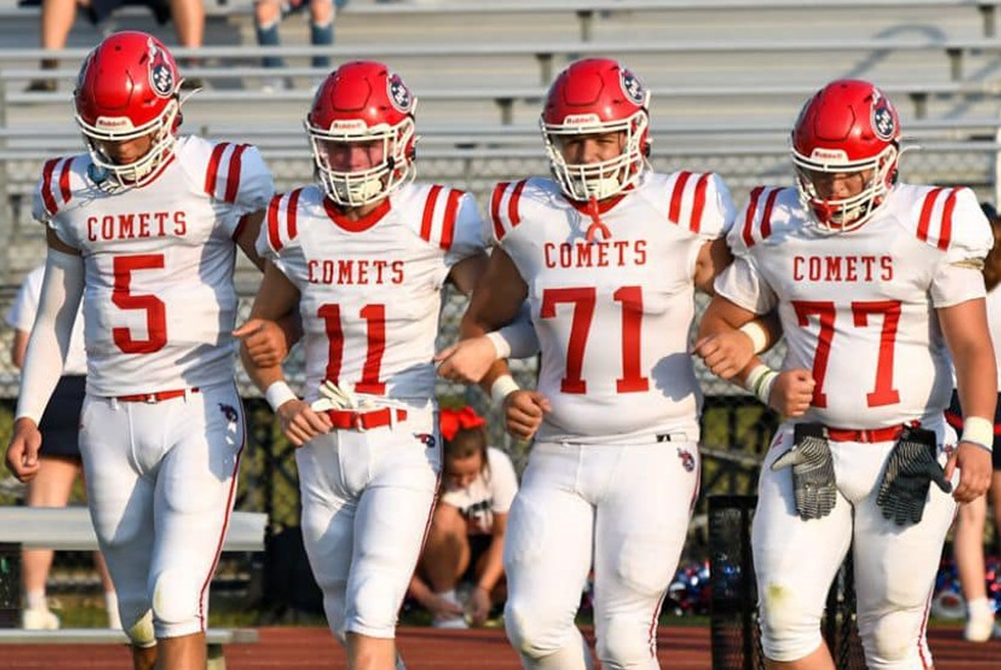
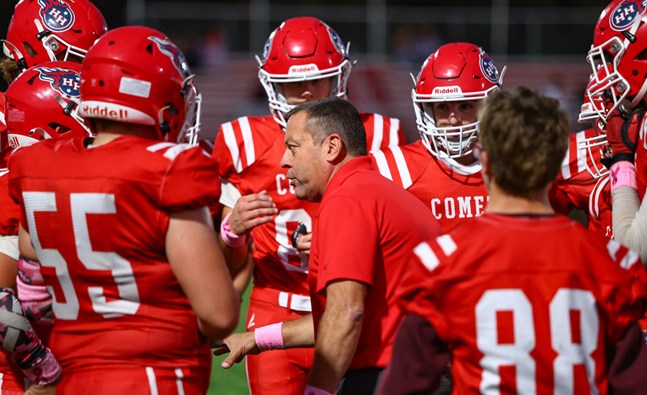
PHOTOS (Top) From left, Hanover-Horton’s Luke Soper (5), Jack Wooster (11), Braden Cogan (71) and Bryan Hamisfar (77) take the field together arm-in-arm. (Middle) Comets coach David Messer talks things over with his players. (Top photo courtesy of the Hanover-Horton athletic department; middle photo courtesy of Karson Durocher/JTV.)