

St. Mary's Builds Early Lead, Holds Off Mona Shores in Clash of Unstoppable Offenses
By
Paul Costanzo
Special for MHSAA.com
November 27, 2026
DETROIT – Jabin Gonzales will not get much sympathy for the dilemma he faced in Friday night’s Division 2 Football Final at Ford Field.
The Orchard Lake St. Mary’s senior quarterback simply had too many offensive weapons around him in his team’s 48-34 victory against Muskegon Mona Shores.
“I would say it’s a blessing and a curse at the same time to have all these weapons around you,” Gonzales said after throwing for 192 yards and two touchdowns, spreading his 14 completions to five receivers. “Everybody’s going to want the ball, everybody’s open. Everybody might actually be open, because they’re all dogs. So, it’s a blessing and a curse.”
Gonzales and the Eaglets offense exploded for 502 total yards to claim their third straight Finals title. It was the 11th all-time for the program, which also won three in a row in 2014, 2015 and 2016 and joined Jackson Lumen Christi as the only schools to have two separate three-peats during the playoff era.
“It means a lot to be able to set a standard that we did, that my dad (St. Mary’s coach Jermaine Gonzales) instilled in us,” Jabin Gonzales said. “To be able to set a standard like that for St. Mary’s to continue to live up to and to grow, and hopefully push that standard.”
Friday night’s win was the second this season for St. Mary’s against Mona Shores, as the two met in Week 1, with the Eaglets coming out on top then 35-27.
That game served as a springboard for Mona Shores to get back to Ford Field for the first time since 2020, as it won 12 straight games to get a second shot at the Eaglets.
“I’m super proud of what our team was able to do,” Mona Shores coach Matt Koziak said. “Our two losses were to the state champions, which is pretty remarkable. Mona Shores, we haven’t won a District championship since 2020. Last year, we were 5-5 which was kind of unchartered waters for us. What a credit to Team 64 for the offseason and putting in work. Orchard Lake had an opening (Week 1) and we had an opening, so why not test yourself with the back-to-back state champs. We went in there and played them tough, a couple breaks and maybe we win the game, but we don’t. But what this team does is we win 12 games in a row after that.”
The teams combined for 972 yards of total offense, the fourth-most in Finals history. Mona Shores put up its own massive numbers on offense, with 470 yards, including 355 on the ground. It averaged 8.9 yards per play in a loss.
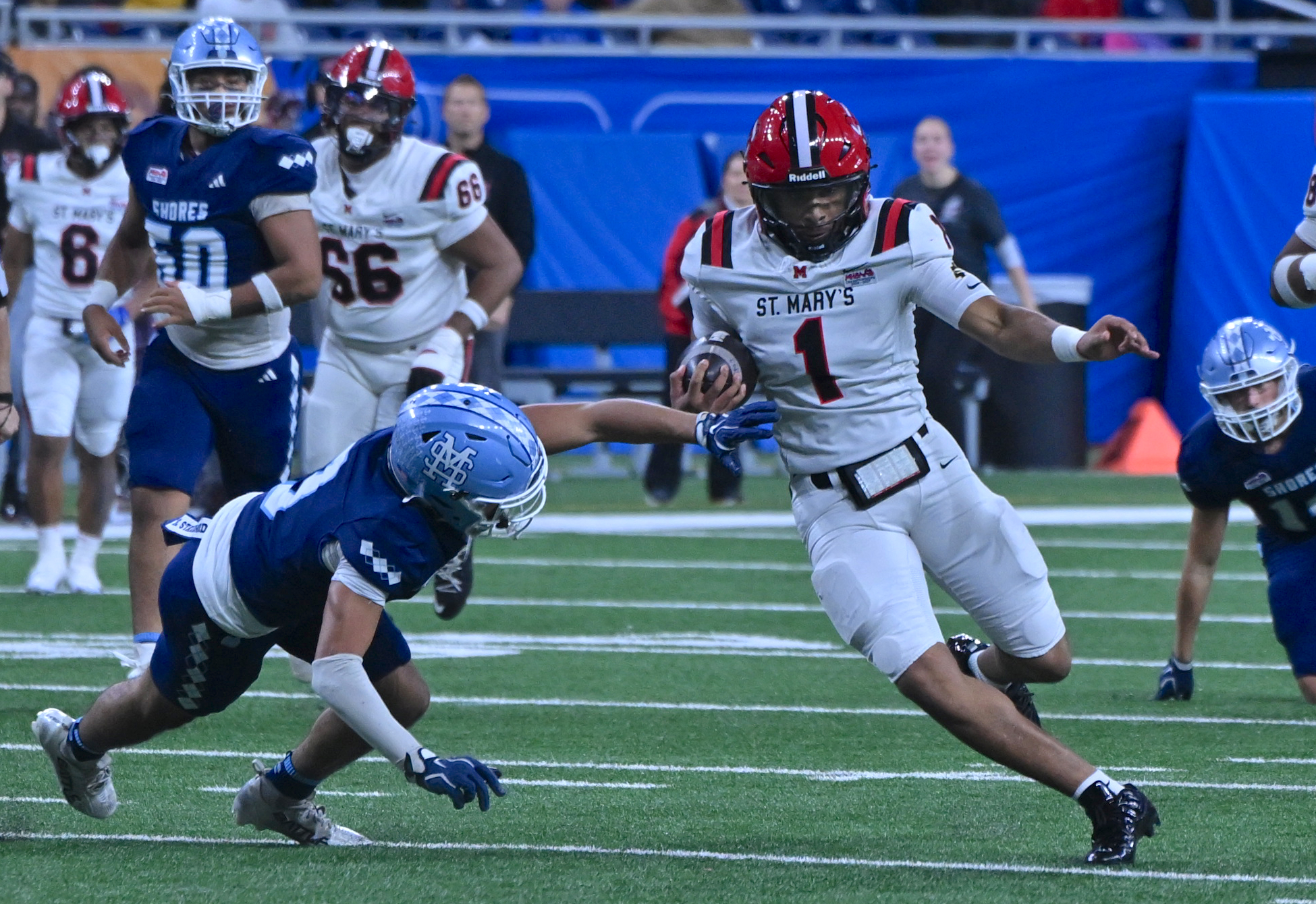
That was counteracted by the weapons on St. Mary’s (11-3), which scored on each of its first seven possessions. Jamari Givhan had 121 yards and two touchdowns (29 and two yards) on 14 carries to lead the St. Mary’s ground game, while Gonzales added 72 rushing yards.
Lorenzo Barber led the receivers with 118 yards and a touchdown on seven catches.
That, of course, was all made possible by an offensive line that allowed just two negative plays.
“I do want to give a big hats off to Michael King, Brian Matthews and our whole O-line,” Jermaine Gonzales said. “The things you see (the skill players) do in space and in the air, these boys literally work their butts off every day in practice. Best O-line in the state.”
In a game where offenses traded big plays and touchdowns, it was stops on the first two drives of the game that gave the Eaglets a cushion and control throughout.
They forced a three-and-out on Mona Shores’ first possession, and followed that up with the game’s first score, a one-yard TD run by Gonzales.
Mona Shores found its groove and went 81 yards and took nearly eight minutes off the clock on its next drive, but was stuffed at the 1-yard line, turning the ball over on downs early in the second quarter.
The Eaglets then went 99 yards on 15 plays to stretch their lead to 13-0 with a four-yard TD run by Daniel Taylor Jr.
While Mona Shores was able to bounce back and go right back down the field, getting a seven-yard touchdown run from Owen Terpstra to pull within one score, St. Mary’s immediately responded again.
This time, it went 87 yards on 15 plays, getting deep into Mona Shores territory thanks to a 60-yard catch-and-run by Barber. He would close the drive out with a five-yard reception from Gonzales on 4th-and-goal, putting the Eaglets up 21-7 going into the half.
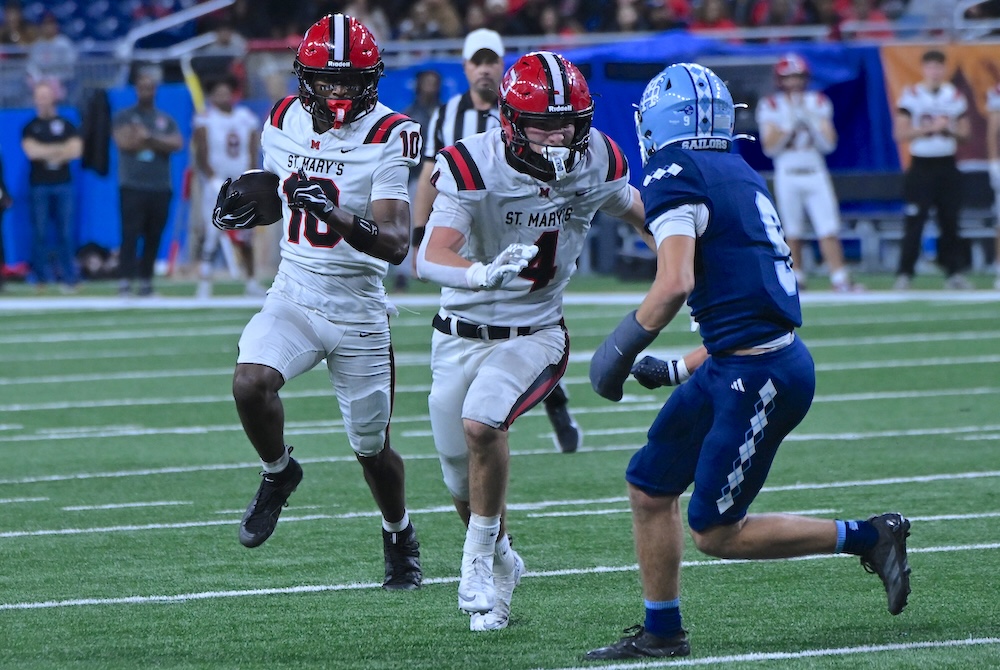
When it appeared Mona Shores was going to get the stop it needed to get back into the game, the Eaglets came up with yet another massive play. St. Mary’s was forced into a 4th-and-18 on its first possession of the third quarter, but Gonzales stepped up away from pressure and found Brannon Hardy in the back of the end zone for a 33-yard touchdown.
With that swing, Mona Shores found itself trailing 28-7.
“Fourth and long, time to make a play,” Jabin Gonzales said. “I’ve got plenty of guys that can go up and get the ball. I saw Brannon in the back of the end zone, so I gave him a shot and he made the play.”
Mona Shores would get second-half touchdown runs from Michael Himes (49 and nine yards), Kevin White (71 yards) and Terpstra (three yards).
White led all rushers in the game with 178 yards on 14 carries, while Himes added 98 yards rushing and 51 receiving and Terpstra had 73 on the ground. Terpstra also added 115 through the air, with Kyle Himes hauling in passes for 64 of those yards.
“I feel like that was something that I call Sailor blood, Sailor grit,” White said. “The game’s not over until it hits triple zeroes on the clock. We kept that in our mind. If they scored a touchdown, ‘Opportunity, let’s go. We’ve got another chance …’ We did that, we fought for as long as we could until the clock hit zeroes.”
Chad Willis added a one-yard TD run late for St. Mary’s.
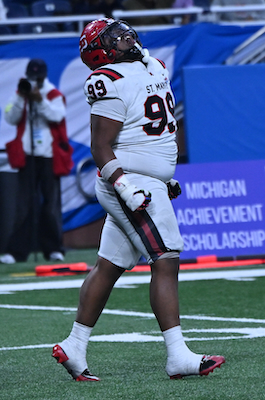
PHOTOS (Top) Orchard Lake St. Mary’s Brannon Hardy (10) follows a block by teammate Daniel Taylor Jr. (4) during Friday’s Division 3 Final. (Middle) The Eaglets’ Jabin Gonzales (1) breaks through an opening. (Below) OLSM’s Ian Black (99) lets out a celebratory yell.
Undefeated Contenders Make Claims as 1925 High School Football Champion
By
Ron Pesch
MHSAA historian
November 14, 2025
It was another football season without an official postseason, just as they all were prior to 1975 in Michigan.
Well – that’s not exactly true – but we will detail that story on another day.
In the Great Lakes State, the 1925 prep season – now 100 years ago - provides a beautiful illustration of the fun, fascination, and frustration in proclaiming gridiron championships in Michigan before the arrival of the MHSAA playoffs.
“The Roaring Twenties” – built in the age of prosperity that followed the end of World War I – were an age of excess, an era of more, and a time where anything seemed possible.
The Twenties are also known as the Golden Age of College Football, and excitement for the sport certainly trickled down to the high school level. The need or desire to open or break ground on impressively bigger and better stadiums hit schools around the nation. The 1925 season marked the opening of the University of Pittsburgh’s Pitt Stadium, with potential seating for 70,000. In Michigan, just upriver on Saginaw Bay in Bay City, the town’s Central High School unveiled a facility with a capacity of 7,100. That season marked the end of college careers for University of Illinois’ legend Harold “Red” Grange, Dartmouth’s Andy Oberlander, and Stanford’s Ernie Nevers. It was also the first varsity season at University of Michigan for Muskegon High School’s Bennie Oosterbaan, who became the school’s first three-time football All-American.
With a lack of lighted fields in Michigan, prep contests were mostly played on Saturdays, and the kickoff to seasons began around mid-September. Scheduled games generally ended in late November, with a few schools around the state closing their slate with a traditional Thanksgiving Day game.
Call it what you will – bragging rights, statewide acclaim, untethered validation, or an unsatisfied heart – but the regular season did not end the fascination and desire to name a state champion. While the state’s governing body did not sponsor championships, that did not stop cities, schools, the media, and the fan base from attempts to assign bragging rights to teams with unbeaten records. That was pretty much the case since the start of the prep game, dating back to 1888.
The era was often filled with “post season” challenges for games between teams to crystalize a claim on a championship. In general, they seldom came to fruition.
The MHSAA
The recently-created Michigan High School Athletic Association established three classes based on hard student enrollment numbers, with Class A – comprised of the state’s largest schools, each with a minimum of 500 students – Class B with between 175 and 499 enrolled, and Class C for schools with fewer than 175 pupils. Back then, the classifications were not segmented with an equal number of schools in each Class, as they are in today’s Division format. Rather, there were many more schools that fell into Class B and Class C than Class A. (Additional subdividing, adding Class D, and Class E, would come later).
Spurred on by fans and sportswriters, schools who wanted a share of the spotlight saw those classifications conveniently offering a means to segment claims on a state title. Acknowledging that they could seldom compete successfully against the larger schools in football, there was nothing to stop unbeaten teams from declaring themselves Class B or Class C gridiron champions.
The Fall of '25
Following the results of mid-November games across the state, just two prep teams in Michigan’s emerged as possible claimants to the title in Class A. Both Flint Central and Grand Rapids Union were unbeaten and untied. Flint would play Bay City Central at home on Saturday, Nov. 21, then square off for a Thanksgiving game with Ann Arbor in the university city.
Union would complete its regular season in a showdown with crosstown rival Grand Rapids South on Nov. 21. Unbeaten in 1924, South had shared that season’s mythical state title with Flint Central.
Just days before kickoff however, a third school emerged, making lots of noise.
 Port Huron Times-Herald reporter Ray Bouslog penned an article that appeared in the Tuesday, Nov. 17 edition.
“Comparing Port Huron with the other two undefeated teams, the locals appear to have just as good a record as their rivals,” he noted. Comparing scores of games among the three schools against common opponents, and opponent’s common opponents – a common practice among fans and sportswriters then and now – he felt the local school was among the state’s best regardless of class.
Two days later, in the same paper, Port Huron’s athletic director and head coach Melvin J. Myers, acknowledging they had two more games on their schedule, was quoted by Bouslog:
“Having gone through the schedule unbeaten, untied, and unscored on, we consider that we have as much a claim (on the state title) as either Grand Rapids Union or Flint Central. But unlike the situation in former years, when the teams were unable to agree on terms of the post season battle, we are willing to play either of these schools at home or away.”
It was a bold statement. Port Huron was classified as a Class B school by the MHSAA. Five of its eight wins had come against Class B or Class C competition. While its goal line had not been crossed, Port Huron had scored 151 points – an average of just under 19 per contest.
Port Huron also had scheduled a Turkey Day game with Richmond, a Class C opponent. Myers considered the contest “only a workout for the team,” with victory by a large margin expected. But Saturday’s contest was on the road against a University of Detroit High School squad – no pushover. Port Huron, of course, would fall out of the race with a defeat in either contest.
On Friday, the Flint Daily Journal, in an Extra edition, acknowledged the Myers’ challenge: “(T)he recognized leader in Class B having no blemish on her record ... Port Huron is willing to step out of her class (and) has hurled challenges at both Flint and Union, provided they are untied and unbeaten.”
Since Union did not have a scheduled Thanksgiving Day contest, Myers stated he was willing to reschedule the Richmond game and meet Union, in Grand Rapids, on the holiday. The move would set up a “playoff” for an undisputed championship.
Union coach John Truesdale responded in the Grand Rapids Press, stating “This is no time to talk such stuff. The proper time for serious entertainment of such ideas is after the South game is played. If we win Saturday we talk. If we lose, and that is not impossible, then we will be in a position to consider such things.”
 Union brushed off Coach Myers’ desire for a game on Thanksgiving. Truesdale indicated he was willing to listen to proposals from either Flint or Port Huron – not Thanksgiving Day – but on Saturday, Nov. 28, and no later.
Flint coach Charles Bassett was blunt with his response to the talk: “It is absolutely out of the question for Flint to even think of playing Union or any other team on Nov 28. We have a regularly scheduled game with Ann Arbor only two days before that time. It would be physically impossible for the boys to play two games in three days.”
Emphasizing that his two remaining games had been scheduled over a year ago, he stated, “Union knows our schedule and so does every other school in Michigan. I have no intention whatever of trying to change it. … If Union or Port Huron desire to play at some later date, after my boys have had a suitable rest, I shall be glad to listen to their proposals.”
Stage is Nearly Set
All three schools won their game on Saturday, Nov. 21. Rocky Parsaca nailed three out of four drop-kicks as Union topped South, 9-0, while Port Huron slipped past U of D High, 6-0, on a fourth-quarter TD by senior fullback Cecil Turner. Flint crushed Bay City Central, 32-0, to set the stage.
With that win, on the Wednesday before Thanksgiving, Bassett told the Journal, “If Central is successful against Ann Arbor tomorrow, we stand ready and willing to play either Port Huron or Grand Rapids Union for the undisputed state championship. This should settle all doubts as to our sincerity in believing we have the best team in the state. We are willing to test it on any neutral field.”
By then, however, negotiations for a three-way series involving Union had broken down and the news had reached the paper. In the same edition, it was noted that Union had packed up for the fall. Without a game on Thanksgiving or the Saturday following, Truesdale stated Union could not carry its squad for two full weeks without a game. On Monday, Nov. 24, the Press had announced that Union had closed out its football season and was now focused on basketball.
With that bit of news, the Flint paper stated, “It is probable that Flint and Port Huron will arrange a game for Saturday, Dec 5.”
Thanksgiving
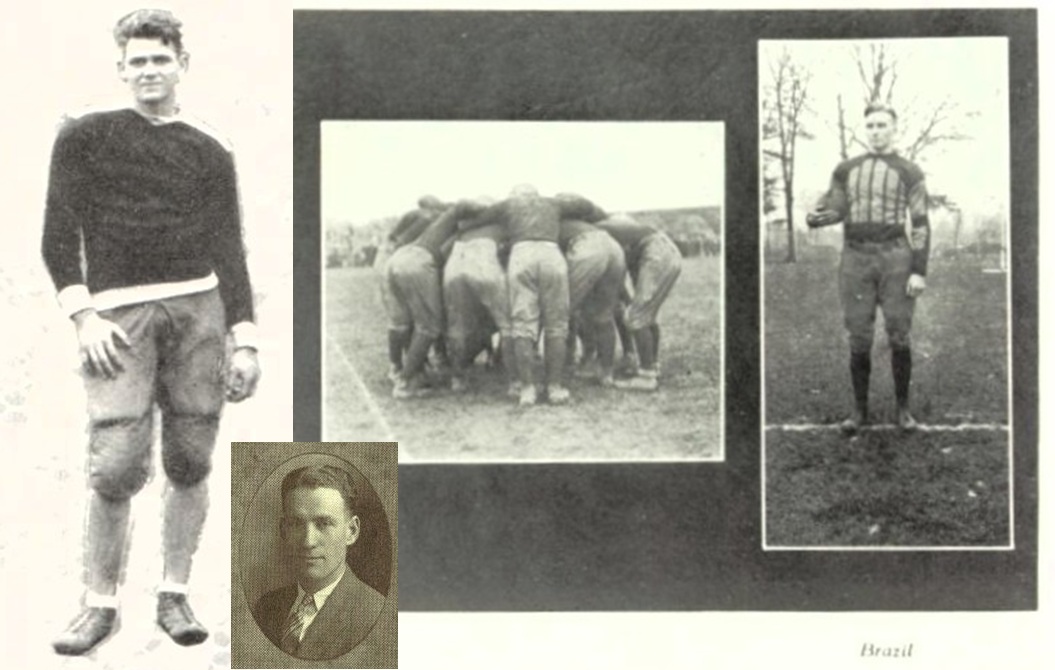
Played on Ann Arbor’s high school field, located just three blocks from University of Michigan’s Ferry Field, Flint had its hands full, downing the hosts, 6-3, on a second-quarter touchdown by senior captain Lloyd Brazil, before 5,000 fans. A future star, and later head coach at the University of Detroit, Brazil intercepted an Ann Arbor pass during the closing minutes, capping a scoreless second half and sealing the win.
As expected, Port Huron trounced Richmond, 55-0.
Talk about a game with Flint to be played at Michigan State College at the new State stadium hit the papers. But discussions failed, and by the weekend, Port Huron and Flint Central also closed out their seasons.
With that, multiple schools laid claim to the crown proving, once again, football championships from the era are valid, but “mythical.”
Check back next week for a second installment on the 1925 football “championship” race.
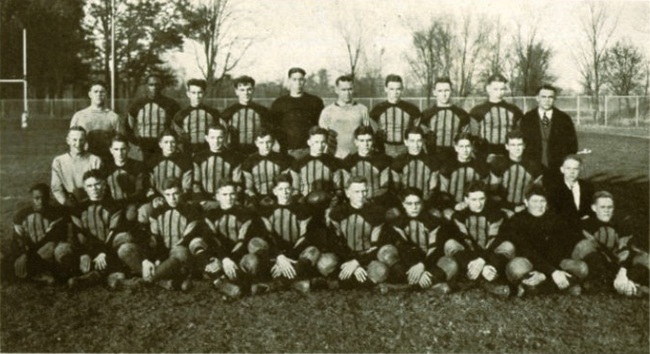
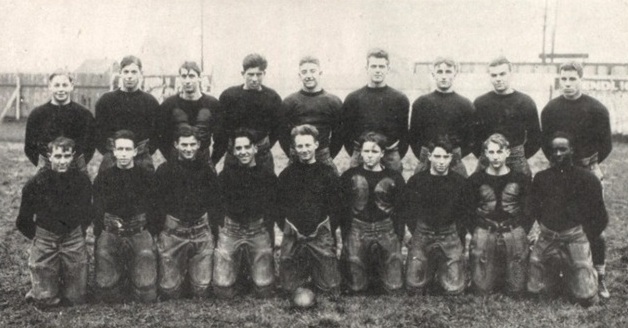
PHOTOS (Top) From left, Port Huron standout Cecil Turner, Grand Rapids Union football coach John Truesdale, Flint Central players huddling and Central’s Lloyd Brazil. (Middle) The 1925 Flint Central team. (Below) The 1925 Port Huron team. (Photos gathered by Ron Pesch.)