

St. Mary's Repeats in St. Mary's Fashion
November 28, 2015
By Bill Khan
Special for Second Half
DETROIT — Glamorous moments come rarely for wide receivers in Orchard Lake St. Mary's offense.
 To play receiver for the Eaglets requires patience, a selfless attitude and a player who doesn't mind doing the little things that only get noticed within the inner circle of the team.
Junior K.J. Hamler would be the primary weapon in many offenses, but he knows his role with St. Mary’s — make the blocks that keep the chains moving for a pound-and-ground attack.
When his number is called, he needs to make the most of it — and he usually does.
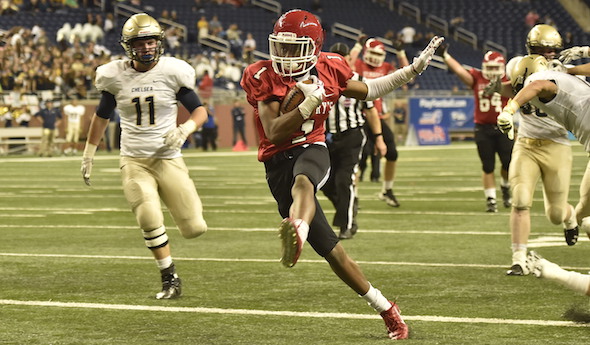
Hamler caught four passes for 63 yards and two touchdowns, as the Eaglets repeated as MHSAA Division 3 champions with a 29-12 victory over Chelsea on Saturday at Ford Field.
He hauled in a 34-yard pass from Brendan Tabone on a go route to give St. Mary's a 15-0 lead with 4:09 left in the first quarter. Hamler’s 16-yard catch-and-run of a screen pass from Tabone made it a 22-6 game with 7:31 to go in the third quarter.
"I'm always prepared for anything," Hamler said. "I know we're a running powerhouse team. I've just got to prepare to block better. As soon as coach (George) Porritt gives our team a chance to pass the ball, I try my best."
A year ago, Hamler didn't have a catch in the championship game. Tabone had a minimal role as a passer, going 3 for 11 for 31 yards in a 7-0 victory over Muskegon.
St. Mary's ran the ball on its first 15 plays of this game before Tabone got the green light to go deep to Hamler. The Eaglets ran eight more plays before the next pass was called. They finished with 293 rushing yards on 56 carries, while Tabone went 5 for 9 passing for 79 yards, two touchdowns and an interception.
"I look forward to every pass play, because we don't throw a ton," Tabone said. "We have such great backs. It was really special to be able to have an impact on the game; I'll remember it forever."
Tabone said Hamler has the right mental framework to play wide receiver in St. Mary's offense.
"K.J.'s such a great guy," he said. "He's selfless. Whenever his number gets called, our eyes light up and we do our best to make a big play when we can."
The flashes of brilliance in the passing game added to a championship performance that was typical for St. Mary's — grind down the opponent with the running game and stifle it with defense.
Justin Myrick had 108 yards and two touchdowns on 20 carries, Troy Marks had 105 yards on 17 carries, Rashawn Allen had 55 yards on 13 carries, and Ryan Johnson had 22 yards on three carries to lead the balanced ground game.
"We have depth in our running backs, so if somebody gets hurt we can put in somebody else," said Myrick, who missed the Semifinal victory over East Grand Rapids with an injured hamstring.
Brandon Adams, who ran for the only touchdown in last year's championship victory, missed the game because of an injury sustained on his only carry in the Semifinal.
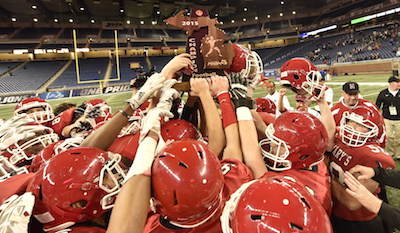 The Eaglets repeated as MHSAA champions for only the second time in 13 Finals appearances. They won back-to-back titles in 1999 and 2000, missing out on their three-peat bid in a 14-7 loss to Chesaning in 2001.
"At the beginning of the season, we were ranked No. 1 and all that good stuff," said junior linebacker Josh Ross, who had six tackles and an interception. "It was a lot of pressure. We had to come through it. We suffered a bad loss (31-8 to Warren DeLaSalle), which made us bond together as brothers. We came through all that adversity and won the state championship. I couldn't be prouder of our team."
It looked like St. Mary's might run away with it early. The Eaglets were leading 15-0 when they elected to go for a 33-yard field goal on fourth-and-inches from Chelsea's 17-yard line on their third possession. John Kwiecinski missed for only the second time in 10 field goal tries this season, opening the door for the Bulldogs (12-2) to get back in the game.
It took them only four plays to get into the end zone, as Graham Kuras took a reverse and heaved a 47-yard touchdown pass to Noah vanReesema with 8:22 left in the second quarter. Ralph Holley blocked the extra point, leaving the score at 15-6.
"That's our go-to trick play," Kuras said. "I was looking over for Noah. Usually, he's halfway across the field. This time, he wasn't. I was kind of lost on the play. I saw the safety get drawn up, so I knew he'd be open. I stepped up and threw it. I thought I overthrew it. I saw him step into second gear. That was probably one of the biggest plays in the game. Getting down 15-0 right away, we were kind of low on ourselves. Getting a score like that with the crowd behind us and boosting everyone's confidence was key to this game. Without that, it could've been much worse."
St. Mary's took that 15-6 lead into halftime, then expanded it to 22-6 on the 16-yard pass to Hamler following a shanked 11-yard punt.
Chelsea was held to only 13 yards rushing on 22 carries, but was able to do some damage through the air. A 14-yard touchdown pass from Jack Bush to Cameron Cooper with 5:07 left in the third quarter got the Bulldogs within 22-12. A 2-point pass that would've made it a one-possession margin was incomplete.
The response was a vintage St. Mary's drive, a 13-play, 80-yard march made up entirely of running plays. The Eaglets took 6:13 off the clock before Myrick scored on a 3-yard run to make it 29-12 with 8:44 left in the game.
The championship was within St. Mary's grasp once the defense came up with a big goal line stand on the following Chelsea drive. The Bulldogs had first-and-goal at the 3 but ended up with a turnover on downs with 5:39 left.
Chelsea would never touch the ball again, as St. Mary's ran out the final 5:39 with a 10-play, 48-yard drive.
"That's our football," Porritt said. "That last drive was big-time for us. The last drive and the defensive stop were our M.O. for the year. The defense has come up big in some goal line situations. Our offense running clock and having long sustained drives has been our football strategy all year."
Bush was 13 for 21 for 145 yards, one touchdown and one interception. He was sacked four times.
While St. Mary's is a regular visitor to the championship game, it was the first time Chelsea made it this far.
"As sad as it is to be over, I wouldn't want to end it anywhere else with any other guys or any other team," Kuras said. "It was the experience of a lifetime."
The MHSAA Football Finals are sponsored by the Michigan National Guard.
PHOTOS: (Top) K.J. Hamler beats the Chelsea defense for one of his two touchdowns Saturday. (Middle) The Eaglets celebrate their second straight Division 3 championship.
Drive for Detroit: Playoff Week 1 Preview
October 26, 2017
By Geoff Kimmerly
Second Half editor
Michigan’s high school football championship quest is set to begin this weekend in historic fashion, with a record 288 teams taking part in this 43rd MHSAA Playoffs.
 So let’s get right to it. Our “Drive for Detroit” previews powered by MI Student Aid will follow a similar format as during the regular season, except that instead of organizing the must-watch games by region we’ll pick out some of the most intriguing from every division – including the two 8-player divisions in something of a “March to Marquette.”
There are a variety of options to watch 13 playoff games live tonight – click Prep Zone for four free broadcasts from FOX Sports Detroit and check out the MHSAA.tv schedule – and be sure to keep up with all of the scores and new pairings as they’re created on the MHSAA playoff scoreboard page. The MHSAA Playoffs are sponsored by the Michigan Army National Guard.
11-Player Division 1
Saline (7-1) at Canton (8-1), Friday
This is a rematch of last season’s District Final, a 37-31 Saline win. The Hornets are coming back from a week off after winning the Southeastern Conference Red. They’ve won seven straight since falling to Rockford on opening night, and few teams have had as much playoff success of late – Saline has played in three straight Regional Finals and four over the last five seasons. Like Saline, Canton also fell on opening night – to Muskegon Mona Shores – but has won eight straight on the way to the overall Kensington Lakes Activities Association title. The Chiefs also are quietly are as familiar with the playoffs as any program; Canton will be making its 16th appearance in 17 seasons.
Others that caught my eye: FRIDAY Grandville (6-3) at Holland West Ottawa (8-1), Bloomfield Hills (6-3) at West Bloomfield (7-2), Romeo (7-2) at Rochester Adams (8-1), Rockford (6-3) at Grand Ledge (8-1).
11-Player Division 2
Birmingham Brother Rice (6-3) at Birmingham Groves (7-2), Friday
These two have met in District games in 2016, 2014 and 2013, with Groves winning last season’s 24-0 to claim a District Final after falling badly in their first two recent meetings. The Falcons are Oakland Activities Association White co-champions but coming off a 49-26 loss to OAA Red co-champ West Bloomfield. Brother Rice has rattled off four straight wins including two over playoff teams and could be hitting stride offensively. The Warriors’ combined 97 points over the last two weeks were 43 percent of their total this season.
Others that caught my eye: FRIDAY Portage Central (7-2) at Muskegon Mona Shores (8-1), Lowell (6-3) at Flushing (7-2), Livonia Churchill (7-2) at Pinckney (8-1), Warren DeLaSalle (7-2) at Ferndale (8-1).
11-Player Division 3
Grand Rapids Christian (7-2) at DeWitt (8-1), Friday
This is a rematch from opening night, when Grand Rapids Christian got up big and held off DeWitt’s fourth-quarter comeback attempt to win 38-30. The Panthers rebounded immediately to defeat Grand Ledge the next week for the unofficial title of Greater Lansing’s best team, and they haven’t given up more than 14 points in a game since falling to the Eagles. Christian mostly navigated the competitive Ottawa-Kent Conference Gold schedule, falling only to East Grand Rapids until last week’s unexpected 24-20 loss to two-win Middleville Thornapple Kellogg. Many eyes will be watching to see if the Eagles bounce back this time as the winner has the possibility of seeing EGR in the District Final.
Others that caught my eye: FRIDAY Zeeland West (6-3) at Zeeland East (9-0), Coldwater (6-3) at Battle Creek Harper Creek (9-0), St. Joseph (7-2) at Stevensville Lakeshore (8-1), Redford Thurston (6-3) at Romulus (6-3).
11-Player Division 4
Wyoming Godwin Heights (7-2) at Wyoming Kelloggsville (9-0), Friday
Few rivalries have enjoyed the level of back-and-forth this one has rolled out over the last four seasons, and this will be the first playoff rematch. Kelloggsville won this season’s first meeting in Week 6 by a point, last season’s by two points and the 2014 game by four. In the middle, Godwin Heights claimed a two-point win in 2015. In part because of that 21-20 victory four weeks ago, Kelloggsville went on to finish as champ of an O-K Silver that sent four teams to the playoffs.
Others that caught my eye: FRIDAY Williamston (5-4) at Lake Fenton (8-1), Coopersville (6-3) at Comstock Park (6-3), Benton Harbor (5-4) at Edwardsburg (8-1), Vicksburg (7-2) at Three Rivers (7-2).
11-Player Division 5
Gladstone (7-2) at Kingsford (7-1), Friday
Gladstone has enjoyed its best season since 2008, winning the Mid-Peninsula Conference after moving into that league this season from the Great Northern Conference. Despite taking its two losses over the last three weeks, the Braves tuned up for the offseason against former GNC foe Escanaba and Calumet, two more of the best in the Upper Peninsula. They’ll hope that extra prep work pays off against arguably the number one team north of Mackinac Bridge, GNC champion Kingsford, which has beaten Gladstone in 18 straight.
Others that caught my eye: FRIDAY Grant (6-3) at Newaygo (7-2), Carrollton (6-3) at Freeland (6-3), Lansing Catholic (7-2) at Olivet (8-1), Richmond (7-2) at Marine City (7-2).
11-Player Division 6
Detroit Henry Ford (6-3) at Warren Michigan Collegiate (9-0), Friday
This District provides an interesting gauge for a pair of Detroit leagues that don’t frequently cross paths. Henry Ford and Central in the other Pre-District opener are from the Detroit Public School League – Ford finished fourth in the Green behind Division 1 Cass Tech, Division 3 Cody and Division 4 Mumford. Michigan Collegiate, from the Charter School Conference, built the highest playoff point average in Division 6 by winning that league ahead of Division 4 Harper Woods Chandler Park while also earning significant nonleague wins over Division 4 Pontiac Notre Dame Prep and Division 1 Walled Lake Central.
Others that caught my eye: FRIDAY Maple City Glen Lake (6-2) at Boyne City (9-0), Morley Stanwood (7-2) at Kent City (9-0), Schoolcraft (5-4) at Watervliet (9-0), Detroit Central (7-2) at Clinton Township Clintondale (7-2).
11-Player Division 7
Riverview Gabriel Richard (8-1) at Rochester Hills Lutheran Northwest (9-0), Friday
This is another opportunity for two programs already enjoying historic success this fall. Gabriel Richard is 8-1 for the first time since 1980 after finishing second in the Detroit Catholic League Intersectional I and has won a playoff game only once before – two seasons ago. Lutheran Northwest won the Michigan Independent Athletic Conference title with its second 9-0 season since starting the program in 1987 – and a win tonight also would be its second playoff win ever, adding to the first that came after starting 10-0 in 2008.
Others that caught my eye: FRIDAY Grand Rapids NorthPointe Christian (6-3) at Pewamo-Westphalia (8-1), Flint Hamady (7-2) at Elkton-Pigeon-Bay Port Laker (8-1), Clinton (6-3) at Hudson (8-1). SATURDAY Ishpeming Westwood (8-1) at Elk Rapids (7-2).
11-Player Division 8
Ubly (7-2) at Harbor Beach (8-1), Friday
Only two weeks ago, Harbor Beach downed Ubly 26-14 to win the outright Greater Thumb Conference East championship. How much has changed in 14 days? Perhaps not much, but the rematch could be even closer especially considering Ubly won the previous two meetings before falling Oct. 13. The rivals are plenty familiar with each other, but Ubly more so with the playoffs – the Bearcats made the Semifinals a year ago, while Harbor Beach’s last playoff berth turned into the Semifinal run of 2014.
Others that caught my eye: FRIDAY Newberry (6-2) at Frankfort (6-2), Johannesburg-Lewiston (6-3) at Lincoln Alcona (7-2), Petersburg-Summerfield (6-3) at Morenci (6-3), Waterford Our Lady (6-2) at Clarkston Everest Collegiate (7-2).
8-Player Division 1
Rudyard (7-2) at Cedarville (7-2), Friday
These two tied for second place (with Engadine) in the Bridge Alliance and also had the same playoff point average; Cedarville broke the tie to host this Pre-Regional with its 46-28 opening night win over the Bulldogs. A year ago, the Trojans lost their last three regular-season games and were out of the playoffs the first week; this season they lost two straight in Weeks 7 and 8 but rebounded last week to beat a Brimley team by 50 that may have made the playoffs with a win. Rudyard, on the other hand, fell to league champion Pickford 53-14 last week and has to bounce back quickly to continue its best season since 2011 in 11-player.
Others that caught my eye: FRIDAY Mayville (5-4) at Deckerville (8-1), Kingston (7-2) at Morrice (8-1), Lawrence (4-5) at Camden-Frontier (9-0), SATURDAY Wyoming Tri-unity Christian (6-3) at Suttons Bay (6-3).
8-Player Division 2
Powers North Central (6-2) at Crystal Falls Forest Park (6-2), Friday
These two (with Stephenson) also tied for second place in their league, the Western Eight Conference, behind Rapid River. North Central, the reigning 8-player champion, handed the Rockets a first of two straight losses two weeks ago – and the winner of this game could face Rapid River again in the Regional Final. Forest Park won the first meeting with North Central, 66-58 in Week 2, as both were breaking in new playmakers who now have plenty of experience and lots of opportunity in a division that appears wide open.
Others that caught my eye: FRIDAY Engadine (7-2) at Rapid River (7-2), Bay City All Saints (6-3) at Marion (7-2), Bellaire (5-4) at Onekama (8-1), SATURDAY Battle Creek St. Philip at Flint International Academy (7-2).
Second Half’s weekly “Drive for Detroit” previews and reviews are powered by MI Student Aid, a part of the Student Financial Services Bureau located within the Michigan Department of Treasury. MI Student Aid encourages students to pursue postsecondary education by providing access to student financial resources and information, including various student financial assistance programs to help make college more affordable for Michigan students. MI Student Aid administers the state’s 529 savings programs (MET/MESP) and eight additional aid programs within its Student Scholarships and Grants division. Click for more information and connect with MI Student Aid on Facebook and Twitter @mistudentaid.
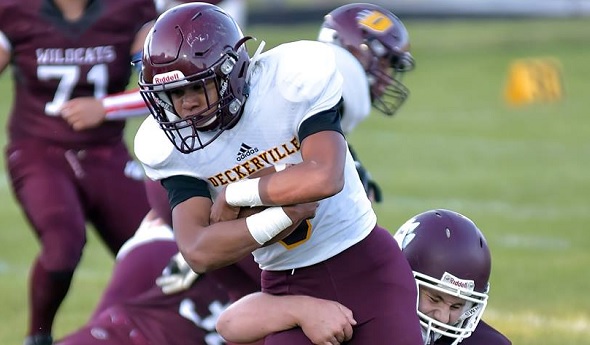
PHOTO: Deckerville downed league rival Mayville 42-8 on Sept. 8; they will meet again this weekend in an 8-player Division 2 opener. (Click for more from Varsity Monthly.)