

St Mary's Scores 3-Peat on Late TD
By
Tom Markowski
Special for Second Half
November 26, 2016
DETROIT – Orchard Lake St. Mary’s has been bitten before by teams that made last-second winning plays.
This time St. Mary’s bit back.
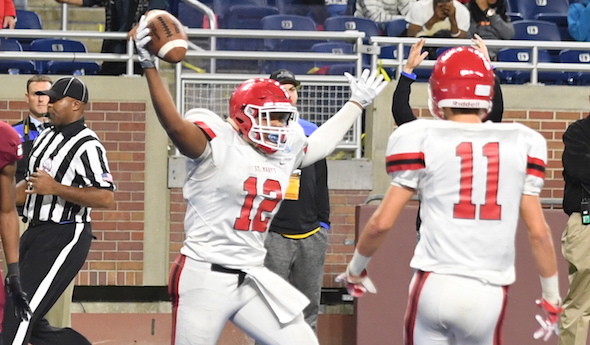
Ky’ren Cunningham’s 18-yard touchdown reception with four seconds left gave the Eaglets a thrilling 29-28 victory over Muskegon in the Division 3 Final on Saturday at Ford Field.
St. Mary’s (10-4) began its last drive on its 20-yard line with 1:55 left. A pass interference penalty by Muskegon and Rashawn Allen’s 22-yard run placed the Eaglets in a good position to go for the winning score.
On 3rd-and-3 from the 22, quarterback Caden Prieskorn scrambled for four yards and a first down. An incomplete pass preceded the winning score.
“It was a pistol right,” Prieskorn said. “All we knew was we were going to have man-on-man coverage.”
Make no mistake. This was desperation, and it was a makeshift play. Cunningham is a starting running back. The last time he lined up as a receiver was in the first game this season against Macomb Dakota. Coach George Porritt ditched that plan afterward. Cunningham would stay in the backfield.
But not this time. St. Mary’s had five wideouts and to confuse matters more, Cunningham went to the slot, then switched spots with Clay Antishin, with Antishin moving inside.
“I play running back,” said Cunningham, a junior. “It was one-on-one and the safety didn’t come over the top. Caden just threw it. He just made the read.
“My body felt so weak (when I caught it). I don’t remember much.”
If Cunningham was stunned, Muskegon was more so.
The only loss the Big Reds (12-2) had this season was to a team from Illinois (Lincolnshire Stevenson). They rolled through the playoffs with their Semifinal game against Edwardsburg (19-8) the only close one.
“I just didn’t do a good enough job of teaching coverage,” Muskegon coach Shane Fairfield said.
“People say we can’t win the big one," he added. "We won a lot of big games to get here. The football game doesn’t define you. It’s what you do and the way you act afterwards that defines you.”
It was Muskegon’s fourth loss in a Final since winning its last title in 2008. Meanwhile, the championship was St. Mary’s third straight and eighth overall.
 Muskegon took a 21-20 lead on its second possession of the second half. It took the Big Reds 1:48 to go 50 yards with senior quarterback/running back Kalil Pimpleton going the final 18 to give Muskegon the lead with 11:21 remaining.
St. Mary’s then went on one of its patented long, time-consuming drives to retake the lead. The Eaglets took 12 plays to go 47 yards, and Ben Fee set an MHSAA Finals record with a 49-yard field goal to give his team a short-lived 23-21 lead with 4:47 left.
Clinton Jefferson, Jr., returned the ensuing kickoff 49 yards to midfield to give the Big Reds great field position, and they made it count. Jefferson carried five times on the drive for 32 yards, including the last three for a touchdown with 1:55 left.
As it turned out, that was too much time to leave for St. Mary’s.
“Cade made some big throws against DeWitt (in a Regional Final),” St. Mary’s coach George Porritt said. “What amazes me is we were 5-4 at one point, and we battled back.”
St. Mary’s is the fifth team to win an MHSAA football title having lost four games.
Muskegon led 14-13 at the end of an entertaining first half.
The Big Reds went 70 yards during the opening drive and took a 7-0 lead on Pimpleton’s 18-yard touchdown run. Pimpleton’s 27-yard pass to Jefferson helped set up the score.
St. Mary’s then went 69 yards, but its drive stalled and Fee kicked a 32-yard field goal.
La’darius Jefferson took over at quarterback for Pimpleton in the second quarter, and Muskegon increased its lead to 14-3 as Jefferson completed an 80-yard drive with a 2-yard touchdown run. He carried five times on the drive for 25 yards. His 54-yard pass to Pimpleton was the key play.
After another Fee field goal, Muskegon had possession late in the half. But on 3rd-and-9 Jefferson handed off to Pimpleton, who threw a halfback pass that was intercepted by Shermond Dabney, who returned it 30 yards to the Muskegon 30. On St. Mary’s 3rd-and-9, Prieskorn threw a 29-yard touchdown pass to Antishin, who made a diving catch in the end zone with 35 seconds left before the break.
Allen was a workhorse in the backfield, and ran with determination. A junior, he rushed for 136 yards on 25 carries, and Cunningham had 15 carries for 46 yards. Prieskorn was 13 of 21 passing for 200 yards and two touchdowns.
For Muskegon, Pimpleton had three receptions for 88 yards, was 3 of 4 passing for 58 and rushed nine times for 56 yards and two touchdowns.
The MHSAA Football Finals are sponsored by the Michigan National Guard.
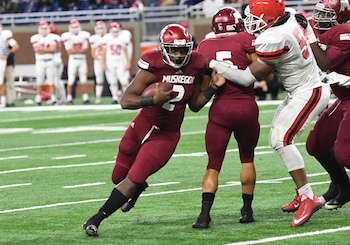
PHOTOS: (Top) St. Mary’s Ky’ren Cunningham (12) celebrates his game-winning touchdown. (Middle) Muskegon’s La’darius Jefferson breaks around his blocker Saturday.
Drive for Detroit: Week 4 in Review
September 21, 2015
By Geoff Kimmerly
Second Half editor
If Week 4 was an indication, there will be a few new leaders of their packs by the end of this football regular season.
This weekend's highlights included the end of one of the most impressive league winning streaks in the state, a few more headlining upsets and the emergence of a handful of other teams that haven't made the "Drive" in a few seasons.
Bay & Thumb
Midland 21, Mount Pleasant 14
Five of the last six meetings between these Saginaw Valley League Red rivals have been decided by eight points or fewer, with Midland running its streak to three straight over the Oilers. Both are considered playoff contenders this fall, lining up potentially in Division 2 – and if that happens, it’s a strong possibility they could meet again. The Chemics (4-0) also equaled last season’s win total, while Mount Pleasant fell to 3-1. Click for more from the Midland Daily News.
Also noted:
Sanford Meridian 32, Clare 10 – After falling to Clare (1-3) by only two points a year ago, Meridian (4-0) this time ended the Pioneers’ 33-game Jack Pine Conference winning streak that went back to 2010.
Flint Beecher 26, Goodrich 9 – The reigning champion Bucs (4-0) are in the Genesee Area Conference Red driver’s seat again after downing last season’s league runner-up, Goodrich (2-2).
Flint Powers Catholic 10, Davison 0 – After falling to Flushing on opening night, the Chargers (3-1) have given up seven points total in three games, with Davison (2-2) the second to be held scoreless.
Ubly 36, Marlette 12 – The Bearcats equaled their win totals of each of the last two seasons in moving to 3-1 for the first time since 2011, while beating Marlette (3-1) for the first time since 2012.
Greater Detroit
Warren DeLaSalle 30, Birmingham Brother Rice 6
Reigning Division 2 champion DeLaSalle (3-1) had fallen to Brother Rice by seven points or fewer both of the last two seasons, but got past the Warriors for the first time since 2011 to start the Detroit Catholic League schedule off with a key victory. The Warriors (1-3) had three losses combined from 2012-14, but also opened this fall with three tough out-of-state opponents. Click for more from MLive-Detroit.
Also noted:
Lincoln Park 18, Wyandotte Roosevelt 15 – The Railsplitters (3-1) are for real, this week equaling last season’s win total to tie for their best finish already since 2005, while downing annual Downriver League contender Roosevelt (3-1).
St. Clair Shores South Lake 34, Clinton Township Clintondale 8 – The Cavaliers (4-0) continued their nice comeback from 2-7 a year ago and can now circle Oct. 16 against Madison Heights Madison as the possible decider in the Macomb Area Conference Silver, although Clintondale (3-1) remains in the chase facing Madison the week before.
Dearborn Heights Robichaud 49, Redford Thurston 21 – Playoff regular Thurston (2-2) presented a new league challenge to Robichaud (4-0), but not enough as the Bulldogs moved to 2-0 in the Western Wayne Athletic Conference Blue.
Plymouth 24, Livonia Churchill 16 – The Wildcats (3-1) owed this rival some big payback after last season’s 42-0 loss to the Chargers (2-2) that broke a string of three straight games between the two decided by a touchdown or less.
Mid-Michigan
Portland 28, Lansing Catholic 6
Consider Portland’s comeback complete. Not only the Raiders beat their third 2014 playoff team already this fall, and not only did they equal last season’s win total after just four games. But Portland (4-0) also took a major step ahead in the Capital Area Activities Conference White, downing the reigning Division 5 runner-up and holding the usually high-powered Cougars (3-1) to their fewest points since 2009. Click for more from the Lansing State Journal.
Also noted:
Brighton 35, Grand Blanc 12 – The Bulldogs (4-0) also equaled their win total from last season, beating Grand Blanc (3-1) during the regular season for the first time in their seven recent meetings as part of the Kensington Lakes Activities Association.
St. Johns 34, Haslett 32 – The Redwings (3-1) just keep looking more impressive and held off a late charge by Haslett (3-1) to become DeWitt’s biggest obstacle in the CAAC Red.
Lake Odessa Lakewood 61, Stockbridge 42 – There were few defensive stops as Lakewood (4-0) not only equaled its 2014 win total but pulled into lead position ahead of the Panthers (3-1) in the Greater Lansing Activities Conference.
Jackson 35, Lansing Sexton 34 – The Vikings (3-1) bounced back from last week’s seven-point loss by beating Sexton (0-4) for the first time since 2006; the Big Reds’ defeats this season are by a combined 24 points.
Northern Lower Peninsula
Alpena 21, Cadillac 18
Alpena (2-2) has had its share of football struggles over the last decade, but is showing signs of a team on the rise – including this first win over Cadillac since 2007. The Wildcats opened with two losses by 14 and then nine points, respectively, but are 2-0 in the Big North Conference for the first time since their last playoff season of 2004. Cadillac (0-4) owns two three-point losses this season, contributing to its toughest start since 2003 – but could make a run to the finish and hope to reach the postseason at 5-4. Click for more from the Alpena News.
Also noted:
Boyne City 55, Kingsley 28 – The Ramblers (4-0) gave up their most points this season but also scored their most since Week 9 of 2014 against a Kingsley team (2-2) that hadn’t given up more than 14.
Grayling 48, Charlevoix 36 – The Vikings (3-1) pulled within a win of matching last season’s success by extending their streak over the Red Rayders (2-2) to seven straight.
Hillman 22, Rogers City 6 – While never in the same division of the North Star League, this two have played each other for 12 consecutive years; the Tigers (3-1) made it five in a row over Rogers City (2-2), which opened the series with seven straight wins.
Traverse City Central 28, Whitehall 21 – The Trojans (4-0) continued their surge, following up a close win over rival West last week with an impressive victory over previously-undefeated Whitehall (3-1).
Southeast & Border
Brooklyn Columbia Central 21, Hudson 0
The Golden Eagles (4-0) have made a 180-degree turn from last season’s 0-6 start, which included a 43-7 loss to Hudson. Columbia Central won a combined seven games over the last three seasons but looks like the favorite in the Lenawee County Athletic Association after downing the reigning champion Tigers (2-2) and also 2014 runner-up Hillsdale in Week 3. Click for more from the Brooklyn Exponent.
Also noted:
Manchester 23, Grass Lake 13 – The Dutchmen (3-1) have taken control of this Cascades Conference rivalry with three straight wins over the Warriors (2-2).
Petersburg-Summerfield 38, Ottawa Lake-Whiteford 18 – The Bulldogs (3-1) succeeded in bouncing back quickly after losing last week to Morenci, and now will root for Whiteford (3-1) to beat Morenci in Week 7.
Monroe 41, Ann Arbor Skyline 6 – The Southeastern Conference Red is loaded this fall, making this a key win for the Trojans (3-1) over improved Skyline (2-2).
Monroe St. Mary Catholic Central 27, New Boston Huron 7 – The Falcons (4-0) could be headed for a second straight Huron League title after beating New Boston Huron (2-2), last season’s runner-up.
Southwest Corridor
Berrien Springs 7, Cassopolis 0
This matchup of former Lakeland Conference rivals might turn out to be a meeting between eventual Berrien-Cass-St. Joseph Conference champions. Berrien Springs scored near the end of the first quarter, and hung on through a weather delay to hand Cassopolis (3-1) its first loss. The Shamrocks (4-0) are one of four teams in the BCS White, while the Rangers are one of four in the BCS Red and frontrunners in that league thanks to a Week 2 win over Mendon. Click for more from the St. Joseph Herald-Palladium.
Also noted:
Stevensville Lakeshore 28, St. Joseph 14 – Lakeshore (3-1) remains in the Southwest Michigan Athletic Conference West race thanks to this win, necessary after a one-point loss to Portage Central in Week 3; St. Joseph (3-1) gets Portage Central in Week 9.
Hartford 32, Gobles 29 – The Indians (1-3) struggled at the start this season, but handed Gobles (3-1) its first loss of the fall.
Edwardsburg 26, Paw Paw 6 – The new-look Wolverine B Conference is filled with contenders, but Edwardsburg (4-0) remains at the top after downing playoff regular Paw Paw (2-2).
Battle Creek Lakeview 48, Mattawan 14 – After two straight losses and with two tough league crossovers ahead, the Spartans (2-2) needed a stand against a Mattawan team (2-2) in a similar spot.
Upper Peninsula
Newberry 31, Munising 14
It's early, of course. But at 3-1 and with a win over Munising, Newberry could be setting up for its best season in more than a decade. The Indians will have a tough time winning the Mid-Eastern Conference after losing to Bark River-Harris in Week 3, but are two wins off last season’s total and haven’t won six games since 2005. The Mustangs (3-1), last season’s Division 8 runners-up, had won 17 straight regular-season games and can create an interesting scenario at the top of the league standings when they face Bark River-Harris in Week 7.
Also noted:
Marquette 28, Escanaba 21 – The Redmen (1-3) loaded their nonleague slate and got off to a tough start, but are in first in the Great Northern Upper Peninsula Conference with Escanaba (2-2) dropping its second straight.
Crystal Falls Forest Park 28, Felch North Dickinson 20 – The Trojans (2-2) have had three games decided by eight points or fewer, and this was the first in their favor; it also dropped the Nordics to 1-3.
Negaunee 28, Iron Mountain 14 – Negaunee (4-0) avenged a three-point loss to the Mountaineers (2-2) from last season to move to 2-0 in the Mid-Peninsula Conference.
Ishpeming 46, Ishpeming Westwood 6 – The Hematites (4-0) continue to own this rivalry with 20 straight wins over the Patriots (2-2).
West Michigan
Zeeland West 38, Comstock Park 28
This was one of the most challenging wins of the Dux’ 20-game regular-season winning streak, and certainly a different story than last season’s 57-7 win over Comstock Park. The Panthers (3-1) jumped out to a two-touchdown lead before the punishing running game and defense caught stride for West (4-0). Both are favorites in their divisions of the Ottawa-Kent Conference, with play beginning this week. Click for more from the Grand Rapids Press.
Also noted:
Muskegon Mona Shores 30, Caledonia 7 – The offense gets the praise, but the defense definitely was most impressive in this one for the Sailors (4-0), who have given up only 31 points this season; Caledonia (2-2) hadn’t scored in single digits since its last meeting with Mona Shores a year ago.
Muskegon 56, East Grand Rapids 28 – The Big Reds (3-1) got four touchdowns from quarterback Kalil Pimpleton after the teams were tied 21-21, and the Pioneers (3-1) were unable to keep pace.
Grand Rapids Christian 24, Zeeland East 20 – While nonleague, this was key for the Eagles (3-1) with the Chix (3-1) one of a number of tough teams dotting the final two thirds of the schedule.
Grand Rapids West Catholic 45, Hudsonville Unity Christian 28 – Handing the Crusaders (3-1) their first loss should provide a nice confidence boost for a West Catholic team (2-2) that had won 23 straight games before dropping two of three to start this fall.
8-Player
Cedarville 18, Onaway 12
Few have given Cedarville (3-1) a regular-season challenge during the 8-player era, but Onaway (2-2) didn’t make the move to 8-player until this season – and was a solid 4-5 a year ago playing 11-player in the Ski Valley Conference. Onaway’s other loss this season was to Rapid River – which gave Cedarville its only defeat.
Also noted:
Posen 42, Bellaire 6 – The Vikings (4-0) are looking like contenders in Bridge Alliance Conference after arguably their most impressive win since also beating Bellaire (2-2) in 2013.
Burton Madison 38, Akron-Fairgrove 16 – Madison (2-1), in only its eighth game every of 8-player, handed a first loss this season to the much more experienced Vikings (3-1).
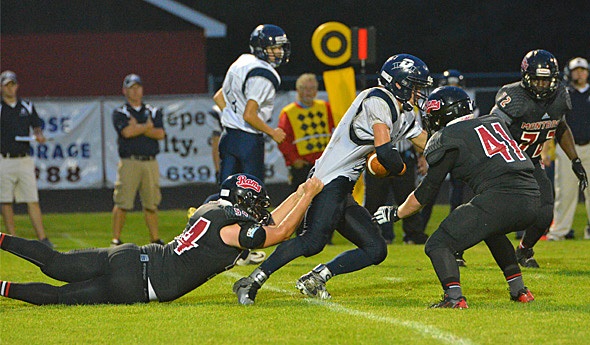
PHOTO: Montrose, on defense, stopped Durand 69-0 on Friday to bounce back from two straight losses and improve to 2-2.