

Students Make Championship Calls
By
John Johnson
MHSAA Communications Director emeritus
December 16, 2013
It’s a great thrill each Thanksgiving weekend for those schools that make the trip to the Finals of the MHSAA Football Playoffs at Ford Field.
For the players, they get to occupy the same space as some of their professional favorites did just hours earlier… names like Calvin Johnson and Matthew Stafford … Joe Buck, Troy Aikman and Pam Oliver.
Buck, Aikman and Oliver?!!?!?
Joining the 16 schools playing the games this year were about 70 students from five other schools getting the experience of a lifetime on their own Ford Field trip as they got insights into the world of professional sports broadcasting.
The newly-founded Student Broadcast Foundation and the MHSAA partnered to provide the same kind of access the media covering the Finals get – and then some. Students visited various parts of Ford Field, including touring the Game Creek Video FX remote television facilities – the same production unit used for the Detroit Lions-Green Bay Packers contest on Thanksgiving Day, which will also originate FOX Sports’ Super Bowl XLVIII coverage at MetLife Stadium in East Rutherford, N.J., in February.
Some of the students were able to meet with media in attendance at the Finals to have their pictures taken and ask questions about careers in sports broadcasting and journalism.
Students, faculty advisors and parent-chaperones from the following schools took part in the experience: Cedar Springs, Davison, Detroit U- D Jesuit, Hillman, Warren DeLaSalle, Birmingham Brother Rice, Montrose and Detroit Catholic Central. Cedar Springs had the largest contingent with 28 students, with a parent covering the travel expenses for the group. Its experience is recapped in this embedded video.
"The whole experience at Ford Field was tremendous for our CSTV students,” said Justin Harnden, a teacher from Cedar Springs. “They were welcomed by the Student Broadcast Foundation, MHSAA, and Ford Field with open arms. Every student that attended had nothing but great things to say about everything. Seeing first-hand what it takes to put on such a big event will truly be beneficial to us as we all go forward in making our program better.”
Hillman had the second largest group with 17 students out of a student body of 151 from this school in Montmorency County, about 35 miles west of Alpena. “Absolutely outstanding job by your kids. You all made the best of your opportunity. Way to go! Your program just woke up a lot of people,” Hillman school board president Brad McLaren said in a text after the event to instructor Erin Brege.
Other videos were produced by students from Davison, Hillman and Montrose, and links to their productions are shown below. You can check out photos from the activities by visiting the Student Broadcasting Foundation’s Facebook page. Also, click to see videos shot by Davison and Montrose that now appear at MHSAA.TV.
“In the many years that Tom Skinner, Ken Kolb and I have been involved with broadcasting high school sports on radio and cable TV, this year’s Football Finals weekend was the most inspiring, satisfying, fun weekend working with these talented students and their dedicated instructors,” said Thom Lengyel, one of the founders of the Student Broadcast Foundation, a private non-profit organization.
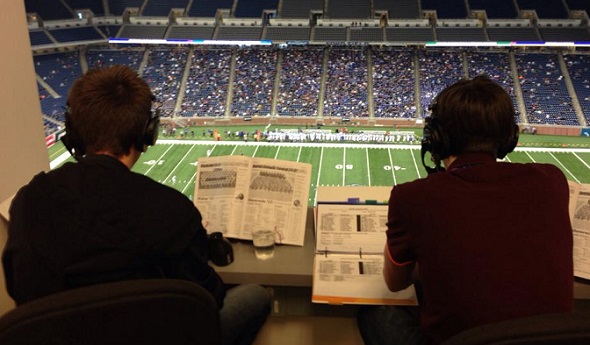
Students from the participating schools also took part in calling the action of the eight championship games on the MHSAANetwork.com website, where an average of 250 people clicked in per contest. Calling the games were:
- Cedar Springs - Kyle Maka, Kody Hall, Alex Hughes (Division 1)
- Davison - Shawn Bednard, Chris Jared, Brandon Snyder (Division 7)
- Detroit U-D Jesuit - Jack Sznewjas, Chris Houle (Division 8)
- Hillman – Mike Klein, Kyle McLaren, Noah Allen, Bubba Banks (Division 4)
- Warren DeLaSalle - Brendan Johnson, Jake O'Donnell (Division 2)
- Birmingham Brother Rice – Miles Hampton, Jeremy Otto - Mentor (Division 6)
- Detroit Catholic Central – Joesph Trojniak, Adam Abraham - Mentor (Division 5)
Several of the schools involved also are part of the MHSAA’s Student Broadcast Program, which produced nearly 1,000 events during the fall sports season for the MHSAA.TV Website.
Read more about Hillman's experience here in reports from the Alpena News and WBKB-TV. And read on for a report on Cedar Springs' experience by student reporter Kendra Coons.
C.S.T.V. Production Program “Hits it out of the park” at Ford Field
Change.
It’s a word that many people don’t deal with well. In this case, it was for the better at Cedar Springs High School.
In 2012, drama teacher, Justin Harnden took over the television program at CSHS. The second he took it over many changes were made to the C.S.T.V. program. The program bought brand new cameras, computers, TVs, and much more. He started working on getting his students to film sporting events, work on Public Service Announcements, capture the latest news in the school; and for the biggest change, start announcing play-by-play.
“We are here to put out more than just news for our school and community. We are doing sports, award shows, graduation, Red Flannel things, and much more. We are destined for great things,” expressed Harnden.
With one year under his belt, Harnden started to submit C.S.T.V.’s work to the MHSAA. After the fall season of 2013, Thom Lengyel and Ken Kolb, who are a part of the Student Broadcast Foundation, heard C.S.T.V. production students Kyle Maka and Kody Hall perform play-by-play for one of Cedar Springs’ football games. After listening to the both of them, Lengyel contacted Harnden and offered for Maka, Hall, and the rest of the class to come down to Ford Field. Lengyel explained to Harnden that the trip to Ford Field would give the class a chance to receive a behind-the-scenes look at what goes on during a broadcast and give Maka and Hall a chance to call the Division 1 championship high school football game.
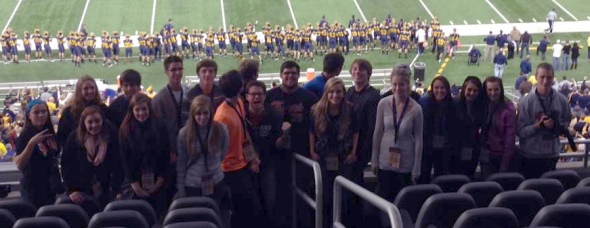
On Saturday, Nov. 30 the C.S.T.V. Production program traveled out of their little town of Cedar Springs, Michigan, to face the big town of Detroit, Michigan. The day started out with the students boarding the bus at 8:15 am for a three-hour drive to the east side of the state. Once the students stepped off the bus they received their press passes. This gave them full access to walk out onto the field and sit in press row. Once the class arrived at Ford Field, they traveled up to the seventh floor to meet Lengyel. Lengyel then introduced the class to Kolb, showed them where Fox Sports does all of their announcing, and showed them where press row was located. After all of that was done, it was time for Maka and Hall to announce play-by-play for the Division 1 championship. Another member of C.S.T.V. also received a chance to announce play-by-play for the game, Alex Hughes.
Coming from a town with an estimated 3,500 people, the three boys were not used to a big stage. A lot of the community would annually attend our high school football games, but nothing to the caliber of what the three boys were about to announce.
“Doing the play-by-play was just amazing. I felt on top of the world. It was the best experience of my life,” commented Maka.
“It was honestly a feeling that I've never felt before ... It almost didn't seem real at first, but once I opened up (to) the environment I had an amazing time,” stated Hughes.
While the three boys were announcing play-by-play, the rest of the class received the opportunity to walk onto the field and sit in press row. After the game the students received the chance to walk through the Fox Sports trailers. These trailers are where all of the action happens. Being able to walk through these trailers was a once-in-a-lifetime experience for the C.S.T.V program.
“I thought looking around the Fox Sports Detroit mobile studio was eye opening. Seeing two of the three trucks that will handle all the production aspects of the Super Bowl was really great. We were able to see all that goes on in that setting, and we were amazed by it,” explains Harnden.
“Getting to tour Fox Sports was crazy because normally the behind the scenes work isn't seen at all, so that opportunity was perfect for the class,” said Hall.
After the students toured the buses, they all headed back up to the seventh floor to grab their things, say their goodbyes, and thank Lengyel and Kolb for the opportunity. Right before the class got ready to leave Lengyel had a few words to say to the class. He told the class how well they were behaved and how well the three boys did at calling the game.
“Getting those compliments from someone who has been in the business for so long was quite overwhelming, especially for myself not knowing much about football and (it) being the first time doing commentary,” said Hughes.
“(I had) a sense of joy and pride. I was so glad that somebody of his job caliber enjoyed how we did,” added Hall.
“When Thom gave us those compliments, I just could not stop smiling. When Thom said that we were just as good on our fourth game as those who have been calling games for four years, (it) just made me believe that this is something I can really do for the rest of my life. I hope that dream comes true,” commented Maka.
Not only did Lengyel and the rest of the class believe they did a great job, Maka, Hughes, and Hall’s teacher also believed they did exceptionally.
“I thought Kyle, Kody, and Alex did a great job. This was only the fourth game that they have called and they went above and beyond our expectations. Everyone involved with the production was impressed with what they did,” stated Harnden.
The students were able to take away many things from traveling to Ford Field. Going behind the scenes of Fox Sports is something not many people get a chance to say that they did. The class and Harden believe it was very beneficial to be able to participate in an experience like this.
“The students were exposed to a lot of aspects within media production. From press row, to the Fox Sports Detroit mobile studio, calling the game on the radio, and being allowed to see every aspect of a big stadium production really was eye opening,” explained Harnden.
The experience of traveling to Ford Field was definitely an experience that none of the class members will ever forget. Not only did they have a blast, but they learned a ton too.
“I definitely think that the trip benefited the class because we (were all able) to see things about professional broadcasting that most people can't. (Also) we (were able) to learn what it takes to make a professional broadcast,” says Maka.
The day after the program traveled to Ford Field, Lengyel emailed Harnden about C.S.T.V. Production and his view on their performance.
“... During the broadcast I knew that they were doing a good job,” expressed Thom. “So I wanted to listen to their broadcast when I got home. I could not put the mp3 player down. I did not pause it until halftime. For their fifth broadcast, listening to their preparation come out in the broadcast, changed my opinion to: THEY HIT IT OUT OF THE PARK.”
Lengyel has been in the business for many years. Having a compliment like that from a man with so much experience really hit home for the C.S.T.V. Production program.
If you would like to see what C.S.T.V. is all about, like us on Facebook, “CSTV”, follow us on Twitter “@CedarSpringsTV”, visit our website, “www.cedarspringstv.com” and make sure to watch our newscasts and listen for our play-by-play on MHSAA.TV.
C.S.T.V. Production truly wants to thank the Student Broadcast Foundation for the opportunity it was given. And a special thanks to Lengyel and Kolb for selecting C.S.T.V. and helping with advancing the program to the next level.
Hughes stated, “I can't thank the Student Broadcast Foundation and the MHSAA enough for letting our class have the opportunity to go to Ford Field and experience everything that we did. I would also like to thank our teacher Justin Harnden for turning around our TV Pro program. … Lastly, I would like to thank our class for always being there for one another and making this year memorable.”
PHOTOS: (Top) Two students call a game during the MHSAA Football Finals. (Below) Some of the students who visited Ford Field pose during a championship game. (Photos courtesy of the School Broadcast Foundation.)
New Field Next Step in Glen Lake Surge
August 31, 2017
By Dennis Chase
Special for Second Half
MAPLE CITY – With school about to begin, Glen Lake will be hosting perhaps its biggest event of the school year tonight.
 Perennial power Traverse City St. Francis heads up to Leelanau County to take on the Lakers in a Week 2 football showdown.
Glen Lake, a 42-20 winner over Kingsley in last week’s season opener, is coming off an 11-3 campaign that ended in the MHSAA Division 6 Final at Ford Field. The Lakers lost the title game to Jackson Lumen Christi 26-14.
St. Francis, a 21-7 victor over Marquette last weekend, finished 11-1 a year ago, losing to eventual Division 7 champion Pewamo-Westphalia 17-14 in the Regional Finals.
“Anytime you play St. Francis – it doesn’t matter if you play them on the beach – it’s a big game,” Lakers coach Jerry Angers said.
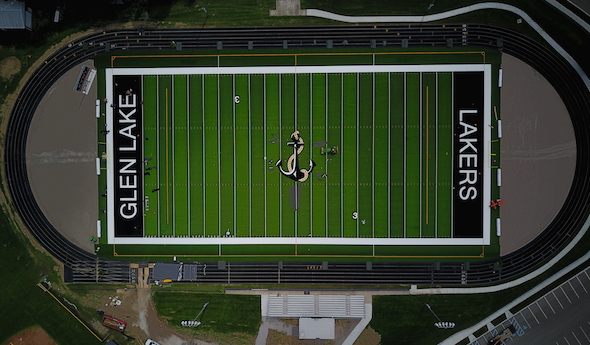
The two teams will not be playing in the sand tonight. They’ll be playing on Glen Lake’s new synthetic field, which workers put the finishing touches on to meet a down-to-the-wire deadline this week.
The field is the latest positive for the Glen Lake program.
The school board considered installing a new natural grass field, but opted for the artificial turf because of its “usability.”
“Once you accept the premise that the football field needed to be replaced, it wasn’t that much of a leap to go to artificial turf (over natural grass) given how much more we can use it,” superintendent Sander Scott said. “Usability – that was the determining factor.”
The field will be used by other sports teams as well as physical education classes.
“That’s the beauty of it,” athletic director Jennifer Johnston added. “Our entire student body and community can reap the benefits of having a field like that.”
 The school board approved spending nearly $850,000 on the surface, but Scott said “it’s looking like it’s going to come in well below that.”
Scott said officials put added emphasis on drainage, an issue that’s plagued Traverse City’s Thirlby Field.
“We’re aware of the challenges Thirlby Field has had (with its synthetic surface), so we really made sure we did not duplicate whatever mistake that was done there,” he said. “We probably overbuilt for drainage.”
The field is not the only new enhancement fans will notice tonight. Officials “beefed up” the wireless network at the field and brought back the berms on the home side for those who prefer lawn seating to bleachers.
The upgrades add to the momentum that’s building in the athletic program. Glen Lake was named the Traverse City Record-Eagle’s School of Year in 2016-17 after the football team reached the MHSAA Finals and the girls basketball team the Semifinals. In addition, Nichole Cox won a third consecutive individual MHSAA Finals golf championship.
“We’re on an upswing,” Angers said. “Everybody is upbeat.
“I know we savored it (last year’s football tournament run). Hopefully, it will fuel us this year – and in years to come.”
Johnston said her message to fall coaches was “keep doing what you’re doing because it’s working.”
“We have a vision and that’s to work hard to improve every day with pride, class and integrity,” she added.
It’s that motto that the school emphasized in ads that ran in the Record-Eagle fall sports tab and in the Leelanau Enterprise.
“We wanted to promote and brand our athletic department,” Johnston said.
Still, Johnston noted, the school has goals other than winning for its student athletes.
“We want to prepare our students to be successful in the real world and contribute to society in a positive way,” she said. “We have high expectations on the playing field, but it starts in the classroom.”
 Speaking of the classroom, Glen Lake is on a roll there, too. The school conducted a search this summer for two secondary math teachers with proven records of increasing student achievement. The school even offered a signing bonus. Forty-six teachers applied, compared to 14 for a similar position at another local high school.
Glen Lake ended up hiring two teachers with more than 20 years of experience.
“The one thing we do that distinguishes us from other schools,” Scott said, “is that we will give teachers credit for all their years. When I was part of other districts, the highest they typically go is six years. If you’re a teacher with 20-plus years, you’re not going to take a huge pay cut to move. We wanted to eliminate that (obstacle). We just posted an elementary opening and had 153 applicants.”
For Johnston, she had another reason to celebrate the 2016-17 sports season. Her father, Roy, who coaches basketball at Beaverton, became the state’s all-time winningest coach in that sport last winter.
“I was really excited for him,” she said. “He’s definitely stood the test of time. He’ll be the first to tell you that you’re not put in that position, to reach a milestone like that, without a lot of good players and without the support of a great community and school. To me, the entire Beaverton community earned that accolade.”
When Glen Lake was making its run to Ford Field last fall, Johnston was quick to mention to Angers that he should enjoy every minute of it.
“I said, ‘Jerry, you have to realize my dad’s been coaching 46 years and the furthest he’s made it is to the Semifinals,” she said. “You never know. (The Finals are) quite an accomplishment. Enjoy it to the fullest.”
One game into the new season, Angers already is raving about the support his team is receiving from the student body and community.
“The crowd we had at Kingsley was unbelievable,” he said. “And I expect it will continue to grow.”
Especially with St. Francis coming to town tonight.
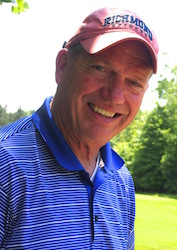 But for all the good cheer, Glen Lake is also without a familiar face this season. Paul Christiansen stepped down as girls golf coach after last season, ending a coaching career that started at the school in 1973.
“I texted him after our coaches meeting in August,” Johnston said. “I said, ‘It was sure weird not having you at that coaches meeting.’ He texted me back and said, ‘Trust me, it was sure weird not being there.’”
When Christiansen started in the fall of 1973, he was an assistant varsity football coach and boys JV basketball coach. By the next year, he had become the head football and boys varsity track coach, in addition to coaching JV basketball for his close friend Don Miller.
“After the second year, our superintendent said three (coaching jobs) is too many, especially with two as a head coach at the varsity level,” Christiansen recalled. “He said, ‘I don’t care which ones you do, but pick two. I think you’ll be better off.’”
Christiansen gave up football. But he later picked up a third sport again when he coached girls middle school basketball. He would end up coaching boys JV basketball for 25 years and boys and girls varsity track 20 years apiece. In all, he coached 92 sports seasons at Glen Lake.
“It’s an odd feeling after 44 years,” Christiansen said. “It’s like, ‘Whoa!’ But it was time to move on.”
Christiansen went out on a high note after Cox became just the third girl in MHSAA history to win three consecutive individual golf titles. She’s now at Bowling Green University.
“I didn’t script it that way, but if you were to script it, going out with an individual or team championship would be the way,” he said.
Glen Lake had just three golfers last season, not enough to compete as a team. The school dropped the sport this season.
“For Glen Lake to allow us to keep competing (last season), even though we didn’t have a full complement of players to count as a team score, I was really thankful for that,” Christiansen said. “And Nichole was especially thankful.”
Cox’s title was part of a “wave of success” that highlighted the last school year.
But this is a new year. New teams. New challenges.
Angers, for one, is hoping to keep that momentum rolling, although he lost some talented players to graduation, including eight defensive starters.
“The key is you want to retool (not rebuild) every year and I think that’s where we are right now with the program,” he said.
St. Francis will be a good test.
 Dennis Chase worked 32 years as a sportswriter at the Traverse City Record-Eagle, including as sports editor from 2000-14. He can be reached at [email protected] with story ideas for Manistee, Wexford, Missaukee, Roscommon, Ogemaw, Iosco, Alcona, Oscoda, Crawford, Kalkaska, Grand Traverse, Benzie, Leelanau, Antrim, Otsego, Montmorency, Alpena, Presque Isle, Cheboygan, Charlevoix and Emmet counties.
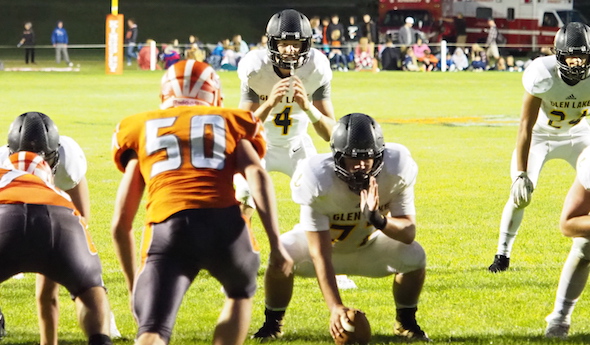
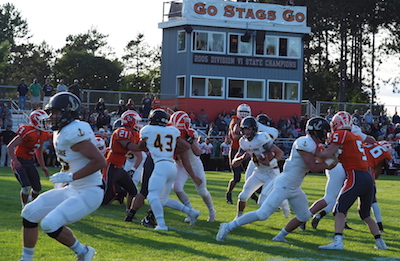
PHOTOS: (Top) Maple City Glen Lake quarterback Cade Peterson prepares to take a snap last season. (Middle top) A drone's view of the new artificial turf field at Glen Lake, set to debut Friday. (Middle below) Peterson breaks through a hole following a block by teammate Max Guilbeau (43). (Below) Recently retired coach Paul Christiansen. (Photos courtesy of Greg Guilbeau [action] Scott Jozwiak [drone] and Don Miller [Christiansen].)