

Students Make Championship Calls
By
John Johnson
MHSAA Communications Director emeritus
December 16, 2013
It’s a great thrill each Thanksgiving weekend for those schools that make the trip to the Finals of the MHSAA Football Playoffs at Ford Field.
For the players, they get to occupy the same space as some of their professional favorites did just hours earlier… names like Calvin Johnson and Matthew Stafford … Joe Buck, Troy Aikman and Pam Oliver.
Buck, Aikman and Oliver?!!?!?
Joining the 16 schools playing the games this year were about 70 students from five other schools getting the experience of a lifetime on their own Ford Field trip as they got insights into the world of professional sports broadcasting.
The newly-founded Student Broadcast Foundation and the MHSAA partnered to provide the same kind of access the media covering the Finals get – and then some. Students visited various parts of Ford Field, including touring the Game Creek Video FX remote television facilities – the same production unit used for the Detroit Lions-Green Bay Packers contest on Thanksgiving Day, which will also originate FOX Sports’ Super Bowl XLVIII coverage at MetLife Stadium in East Rutherford, N.J., in February.
Some of the students were able to meet with media in attendance at the Finals to have their pictures taken and ask questions about careers in sports broadcasting and journalism.
Students, faculty advisors and parent-chaperones from the following schools took part in the experience: Cedar Springs, Davison, Detroit U- D Jesuit, Hillman, Warren DeLaSalle, Birmingham Brother Rice, Montrose and Detroit Catholic Central. Cedar Springs had the largest contingent with 28 students, with a parent covering the travel expenses for the group. Its experience is recapped in this embedded video.
"The whole experience at Ford Field was tremendous for our CSTV students,” said Justin Harnden, a teacher from Cedar Springs. “They were welcomed by the Student Broadcast Foundation, MHSAA, and Ford Field with open arms. Every student that attended had nothing but great things to say about everything. Seeing first-hand what it takes to put on such a big event will truly be beneficial to us as we all go forward in making our program better.”
Hillman had the second largest group with 17 students out of a student body of 151 from this school in Montmorency County, about 35 miles west of Alpena. “Absolutely outstanding job by your kids. You all made the best of your opportunity. Way to go! Your program just woke up a lot of people,” Hillman school board president Brad McLaren said in a text after the event to instructor Erin Brege.
Other videos were produced by students from Davison, Hillman and Montrose, and links to their productions are shown below. You can check out photos from the activities by visiting the Student Broadcasting Foundation’s Facebook page. Also, click to see videos shot by Davison and Montrose that now appear at MHSAA.TV.
“In the many years that Tom Skinner, Ken Kolb and I have been involved with broadcasting high school sports on radio and cable TV, this year’s Football Finals weekend was the most inspiring, satisfying, fun weekend working with these talented students and their dedicated instructors,” said Thom Lengyel, one of the founders of the Student Broadcast Foundation, a private non-profit organization.
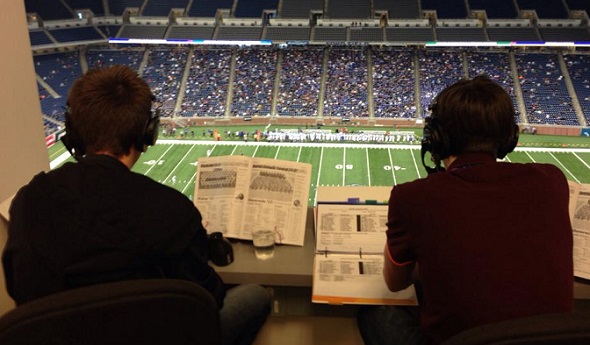
Students from the participating schools also took part in calling the action of the eight championship games on the MHSAANetwork.com website, where an average of 250 people clicked in per contest. Calling the games were:
- Cedar Springs - Kyle Maka, Kody Hall, Alex Hughes (Division 1)
- Davison - Shawn Bednard, Chris Jared, Brandon Snyder (Division 7)
- Detroit U-D Jesuit - Jack Sznewjas, Chris Houle (Division 8)
- Hillman – Mike Klein, Kyle McLaren, Noah Allen, Bubba Banks (Division 4)
- Warren DeLaSalle - Brendan Johnson, Jake O'Donnell (Division 2)
- Birmingham Brother Rice – Miles Hampton, Jeremy Otto - Mentor (Division 6)
- Detroit Catholic Central – Joesph Trojniak, Adam Abraham - Mentor (Division 5)
Several of the schools involved also are part of the MHSAA’s Student Broadcast Program, which produced nearly 1,000 events during the fall sports season for the MHSAA.TV Website.
Read more about Hillman's experience here in reports from the Alpena News and WBKB-TV. And read on for a report on Cedar Springs' experience by student reporter Kendra Coons.
C.S.T.V. Production Program “Hits it out of the park” at Ford Field
Change.
It’s a word that many people don’t deal with well. In this case, it was for the better at Cedar Springs High School.
In 2012, drama teacher, Justin Harnden took over the television program at CSHS. The second he took it over many changes were made to the C.S.T.V. program. The program bought brand new cameras, computers, TVs, and much more. He started working on getting his students to film sporting events, work on Public Service Announcements, capture the latest news in the school; and for the biggest change, start announcing play-by-play.
“We are here to put out more than just news for our school and community. We are doing sports, award shows, graduation, Red Flannel things, and much more. We are destined for great things,” expressed Harnden.
With one year under his belt, Harnden started to submit C.S.T.V.’s work to the MHSAA. After the fall season of 2013, Thom Lengyel and Ken Kolb, who are a part of the Student Broadcast Foundation, heard C.S.T.V. production students Kyle Maka and Kody Hall perform play-by-play for one of Cedar Springs’ football games. After listening to the both of them, Lengyel contacted Harnden and offered for Maka, Hall, and the rest of the class to come down to Ford Field. Lengyel explained to Harnden that the trip to Ford Field would give the class a chance to receive a behind-the-scenes look at what goes on during a broadcast and give Maka and Hall a chance to call the Division 1 championship high school football game.
On Saturday, Nov. 30 the C.S.T.V. Production program traveled out of their little town of Cedar Springs, Michigan, to face the big town of Detroit, Michigan. The day started out with the students boarding the bus at 8:15 am for a three-hour drive to the east side of the state. Once the students stepped off the bus they received their press passes. This gave them full access to walk out onto the field and sit in press row. Once the class arrived at Ford Field, they traveled up to the seventh floor to meet Lengyel. Lengyel then introduced the class to Kolb, showed them where Fox Sports does all of their announcing, and showed them where press row was located. After all of that was done, it was time for Maka and Hall to announce play-by-play for the Division 1 championship. Another member of C.S.T.V. also received a chance to announce play-by-play for the game, Alex Hughes.
Coming from a town with an estimated 3,500 people, the three boys were not used to a big stage. A lot of the community would annually attend our high school football games, but nothing to the caliber of what the three boys were about to announce.
“Doing the play-by-play was just amazing. I felt on top of the world. It was the best experience of my life,” commented Maka.
“It was honestly a feeling that I've never felt before ... It almost didn't seem real at first, but once I opened up (to) the environment I had an amazing time,” stated Hughes.
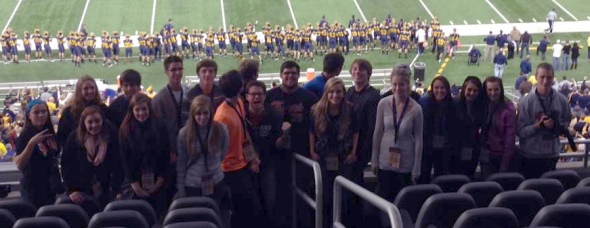
While the three boys were announcing play-by-play, the rest of the class received the opportunity to walk onto the field and sit in press row. After the game the students received the chance to walk through the Fox Sports trailers. These trailers are where all of the action happens. Being able to walk through these trailers was a once-in-a-lifetime experience for the C.S.T.V program.
“I thought looking around the Fox Sports Detroit mobile studio was eye opening. Seeing two of the three trucks that will handle all the production aspects of the Super Bowl was really great. We were able to see all that goes on in that setting, and we were amazed by it,” explains Harnden.
“Getting to tour Fox Sports was crazy because normally the behind the scenes work isn't seen at all, so that opportunity was perfect for the class,” said Hall.
After the students toured the buses, they all headed back up to the seventh floor to grab their things, say their goodbyes, and thank Lengyel and Kolb for the opportunity. Right before the class got ready to leave Lengyel had a few words to say to the class. He told the class how well they were behaved and how well the three boys did at calling the game.
“Getting those compliments from someone who has been in the business for so long was quite overwhelming, especially for myself not knowing much about football and (it) being the first time doing commentary,” said Hughes.
“(I had) a sense of joy and pride. I was so glad that somebody of his job caliber enjoyed how we did,” added Hall.
“When Thom gave us those compliments, I just could not stop smiling. When Thom said that we were just as good on our fourth game as those who have been calling games for four years, (it) just made me believe that this is something I can really do for the rest of my life. I hope that dream comes true,” commented Maka.
Not only did Lengyel and the rest of the class believe they did a great job, Maka, Hughes, and Hall’s teacher also believed they did exceptionally.
“I thought Kyle, Kody, and Alex did a great job. This was only the fourth game that they have called and they went above and beyond our expectations. Everyone involved with the production was impressed with what they did,” stated Harnden.
The students were able to take away many things from traveling to Ford Field. Going behind the scenes of Fox Sports is something not many people get a chance to say that they did. The class and Harden believe it was very beneficial to be able to participate in an experience like this.
“The students were exposed to a lot of aspects within media production. From press row, to the Fox Sports Detroit mobile studio, calling the game on the radio, and being allowed to see every aspect of a big stadium production really was eye opening,” explained Harnden.
The experience of traveling to Ford Field was definitely an experience that none of the class members will ever forget. Not only did they have a blast, but they learned a ton too.
“I definitely think that the trip benefited the class because we (were all able) to see things about professional broadcasting that most people can't. (Also) we (were able) to learn what it takes to make a professional broadcast,” says Maka.
The day after the program traveled to Ford Field, Lengyel emailed Harnden about C.S.T.V. Production and his view on their performance.
“... During the broadcast I knew that they were doing a good job,” expressed Thom. “So I wanted to listen to their broadcast when I got home. I could not put the mp3 player down. I did not pause it until halftime. For their fifth broadcast, listening to their preparation come out in the broadcast, changed my opinion to: THEY HIT IT OUT OF THE PARK.”
Lengyel has been in the business for many years. Having a compliment like that from a man with so much experience really hit home for the C.S.T.V. Production program.
If you would like to see what C.S.T.V. is all about, like us on Facebook, “CSTV”, follow us on Twitter “@CedarSpringsTV”, visit our website, “www.cedarspringstv.com” and make sure to watch our newscasts and listen for our play-by-play on MHSAA.TV.
C.S.T.V. Production truly wants to thank the Student Broadcast Foundation for the opportunity it was given. And a special thanks to Lengyel and Kolb for selecting C.S.T.V. and helping with advancing the program to the next level.
Hughes stated, “I can't thank the Student Broadcast Foundation and the MHSAA enough for letting our class have the opportunity to go to Ford Field and experience everything that we did. I would also like to thank our teacher Justin Harnden for turning around our TV Pro program. … Lastly, I would like to thank our class for always being there for one another and making this year memorable.”
PHOTOS: (Top) Two students call a game during the MHSAA Football Finals. (Below) Some of the students who visited Ford Field pose during a championship game. (Photos courtesy of the School Broadcast Foundation.)
Glen Lake Blazes Trail Back to Finals
November 23, 2016
By Dennis Chase
Special for Second Half
TRAVERSE CITY – Congratulatory messages streamed in Saturday after Maple City Glen Lake defeated Leroy Pine River 34-20 in a Division 6 football Semifinal at snow-covered Thirlby Field – a win that secured the Lakers’ first MHSAA Finals appearance in 20 years.
 Head coach Jerry Angers’ phone was particularly active. Among those calling or texting: Former Traverse City West coach Matt Prisk, who Angers previously worked under as a defensive coordinator; retiring St. Ignace coach Marty Spencer, whose Saints fell to defending Division 8 champion Muskegon Catholic earlier in the day; and Eric Gordon, the former Michigan State linebacker, who played for Prisk and Angers at West.
Angers, who was still fielding calls and texts late into the night Saturday, was “touched” by the show of support for his Glen Lake program.
Most of all, he was proud of his players, who kept improving every week to make this moment possible.
“They have worked hard for this opportunity,” he said. “I told them (after Saturday’s game), ‘You’re going to Ford Field. You’re one of 16 teams still playing. A lot of people will be watching, but I want you to enjoy it.’
“It’s like the Alan Jackson song ‘Remember When.’ I said in 20 years when you come back to see me I want you to say, ‘Remember when.’”
Glen Lake, which faces Jackson Lumen Christi for the title Friday, won the Class DD championship in 1994 under coach Bill Hollenbeck. The Lakers lost in the Class DD Final in 1996. Now, 20 years later, Glen Lake’s back.
“It’s an incredible feeling,” all-state linebacker Duke Angers, the coach’s son, said a few hours after the game. “It seems surreal right now. Growing up as a kid, you dream about playing at Ford Field. Now we get that opportunity. We’ll enjoy this for 24 hours and then get to work for Jackson Lumen Christi.”
Junior quarterback Cade Peterson, who rushed for 179 yards and three touchdowns in the win over Pine River, is also a coach’s son. His father, Tim, was head coach at Lake City for 15 seasons. The family moved into the Glen Lake school system this year. Tim is the quarterbacks coach for the Lakers.
“I’ve been going down to the state finals since I was 12,” Cade said. “And I would always think, ‘I want to play in this (state finals).’ Now it’s happening. You can ask any team in the state, and their ultimate goal would be to go to Ford Field and play for a state title. Only a few teams can say they accomplished that – and we did. As soon as that moment set in (Saturday), it was ‘Hey, we achieved our goal. Now let’s go win a state championship.’”
For Tim Peterson, who led Lake City to nine playoff berths, including Regional appearances in 2012 and 2013, it was a moment to savor.
“You work your whole life as a coach to try to get to the apex – and this is it,” he said. “We’re there. I couldn’t be happier for the kids, the program and the community.”
Now the task for the 11-2 Lakers is to a win a 12th game. Glen Lake will be taking on a program steeped in tradition. This will be Lumen Christi’s eighth MHSAA Finals appearance since 2000. The Titans have won five crowns during that span under coach Herb Brogan.
“Our kids have been facing challenges all year, and people keep underestimating them,” Tim Peterson said. “They just keep doing what they do – and they do it very well.”
Glen Lake’s losses were to Traverse City St. Francis (21-13) and Frankfort (26-21), teams that finished 11-1. The Lakers came in second to Frankfort in the Northern Michigan Football League’s Leaders division. Jerry Angers, now in his eighth season at the helm, said his team learned valuable lessons from those defeats.
“Sometimes losses are good for you,” he said. “We, as coaches and fans, never want to believe that, but in our two losses we had 15 or so penalties in one and five turnovers in the other. So you go back and you work on it. You try to reduce the penalties, reduce the turnovers. That became a great focus for our kids. I think we’ve had eight penalties in four playoff games – total. And we’ve kept our turnovers to a minimum. If you focus on the task at hand, and what’s in front of you, those things are going to be eliminated.”
Cade Peterson said the setbacks brought the team closer together, too.
“People can start pointing fingers (in defeat),” he said. “That didn’t go on here. Everybody picked each other up and kept fighting, kept going.”
 The 16 seniors on the team led the way.
“They set the tone,” Tim Peterson said. “The senior leadership has been phenomenal in keeping the focus.”
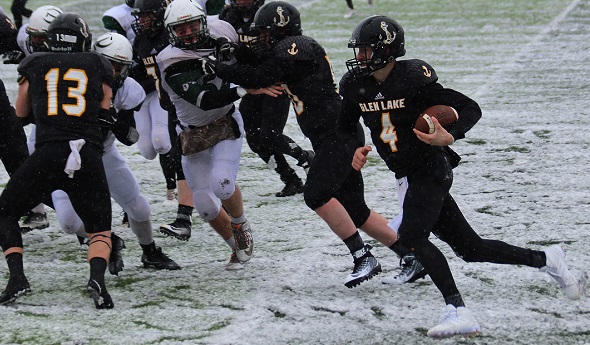
Glen Lake had to go on the road at Roscommon and Calumet to win two of its four playoff games. On Saturday, the Lakers, who were averaging 160 yards passing and 215 yards rushing per contest out of their spread offense, stuck to the ground to beat Pine River in blustery conditions that forced officials to clear snow off the artificial turf before and during the game.
Glen Lake rushed for 309 yards. In addition to Peterson’s 179 yards, Duke Angers picked up 59 and Nick Apsey 54. Apsey also hauled in two catches for 34 yards. The Laker backs – running behind a line that features tackles Jake Palmer and Brandon Tremble, guards Ryan Nadlicki and Zack Gushurst and center Tommy Kendall – averaged nearly five yards a carry. Nadlicki’s uncle, Mike, was a star on Traverse City’s state championship team in 1988.
“The weather forced us to be very one-dimensional (Saturday), but we’re real pleased with our ability to run the football as well as throw it,” Tim Peterson said. “That’s a good combination to have when you go deep into the playoffs because you never know what the weather will be.”
For the season, Cade Peterson’s completed 106 of 207 passes for 1,953 yards and 20 touchdowns. Jared Jackson, last year’s starting quarterback, has caught 30 passes, Apsey 23.
The 6-foot-4, 190-pound Peterson leads the team in rushing with 843 yards. Apsey, also a junior, has added 791 yards.
Defensively, Duke Angers, a four-year starter, is averaging 10 stops a game and Tony Duperon seven. Glen Lake is surrendering less than 200 yards in offense per game. Angers was the Traverse City Record-Eagle’s Defensive Player of the Year a year ago.
“As a football coach, he’s one of the best leaders and overall players that I’ve ever been associated with,” Jerry Angers said.
Jerry Angers led Glen Lake to back-to-back 9-2 seasons in 2012-13. The Lakers reached the District Finals those years.
Glen Lake qualified for the playoffs a year ago, finishing 5-5. This season, with a number of experienced players returning, coupled with the addition of Cade and Drew Peterson, the team has flourished. Drew is a sophomore defensive end and receiver. He had an interception Saturday.
Cade Peterson was a two-year starter at Lake City, throwing for 1,753 yards and 19 touchdowns as a sophomore.
“I feel a big part of why I’ve been successful (at Glen Lake) is because of how welcoming everybody was – not only the team and coaches, but the school and community,” he said.
“When those two (Peterson) boys walked in, our kids just grabbed them and said, ‘Hey, let’s go. You’re part of us now,’” Jerry Angers added.
Tim Peterson retired as a principal in June of 2015. He coached the Trojans that fall, but after the school year the family decided to make a move. Peterson was familiar with the Glen Lake area, since he worked camps with Hollenbeck. He was also good friends with Angers.
“It was time for a change,” Peterson explained. “We came up and looked at the academic piece of it, which is most important to us, and we said this is where we want to go.
“We’ve always said, at some point, we’d like to get here. This community is so supportive of their kids and of their school and that’s what you look for as a parent.”
Now the Lakers are one win away from a second MHSAA title. Regardless of what happens, though, Duke Angers said he believes his senior class has made an impact.
“We raised the bar a little,” he said. “We wanted to leave a trail to follow – and I think we have.”
 Dennis Chase worked 32 years as a sportswriter at the Traverse City Record-Eagle, including as sports editor from 2000-14. He can be reached at [email protected] with story ideas for Manistee, Wexford, Missaukee, Roscommon, Ogemaw, Iosco, Alcona, Oscoda, Crawford, Kalkaska, Grand Traverse, Benzie, Leelanau, Antrim, Otsego, Montmorency, Alpena, Presque Isle, Cheboygan, Charlevoix and Emmet counties.
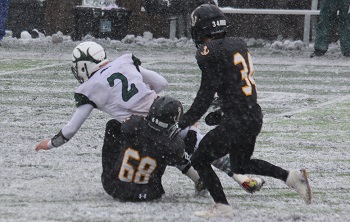
PHOTOS: (Top) Maple City Glen Lake’s Nick Apsey (5) follows his blockers on the way to the end zone during Saturday’s Semifinal win over Leroy Pine River. (Middle) Wes Peplinski (68) drops the Pine River quarterback in the 34-20 victory. (Photos by Kim Jackson.)