

Students Make Championship Calls
By
John Johnson
MHSAA Communications Director emeritus
December 16, 2013
It’s a great thrill each Thanksgiving weekend for those schools that make the trip to the Finals of the MHSAA Football Playoffs at Ford Field.
For the players, they get to occupy the same space as some of their professional favorites did just hours earlier… names like Calvin Johnson and Matthew Stafford … Joe Buck, Troy Aikman and Pam Oliver.
Buck, Aikman and Oliver?!!?!?
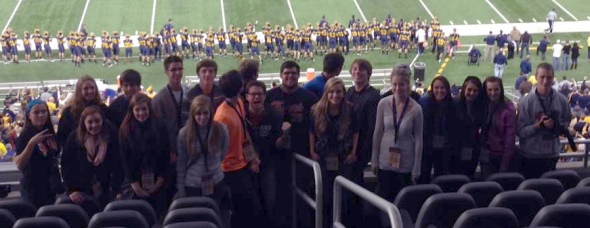
Joining the 16 schools playing the games this year were about 70 students from five other schools getting the experience of a lifetime on their own Ford Field trip as they got insights into the world of professional sports broadcasting.
The newly-founded Student Broadcast Foundation and the MHSAA partnered to provide the same kind of access the media covering the Finals get – and then some. Students visited various parts of Ford Field, including touring the Game Creek Video FX remote television facilities – the same production unit used for the Detroit Lions-Green Bay Packers contest on Thanksgiving Day, which will also originate FOX Sports’ Super Bowl XLVIII coverage at MetLife Stadium in East Rutherford, N.J., in February.
Some of the students were able to meet with media in attendance at the Finals to have their pictures taken and ask questions about careers in sports broadcasting and journalism.
Students, faculty advisors and parent-chaperones from the following schools took part in the experience: Cedar Springs, Davison, Detroit U- D Jesuit, Hillman, Warren DeLaSalle, Birmingham Brother Rice, Montrose and Detroit Catholic Central. Cedar Springs had the largest contingent with 28 students, with a parent covering the travel expenses for the group. Its experience is recapped in this embedded video.
"The whole experience at Ford Field was tremendous for our CSTV students,” said Justin Harnden, a teacher from Cedar Springs. “They were welcomed by the Student Broadcast Foundation, MHSAA, and Ford Field with open arms. Every student that attended had nothing but great things to say about everything. Seeing first-hand what it takes to put on such a big event will truly be beneficial to us as we all go forward in making our program better.”
Hillman had the second largest group with 17 students out of a student body of 151 from this school in Montmorency County, about 35 miles west of Alpena. “Absolutely outstanding job by your kids. You all made the best of your opportunity. Way to go! Your program just woke up a lot of people,” Hillman school board president Brad McLaren said in a text after the event to instructor Erin Brege.
Other videos were produced by students from Davison, Hillman and Montrose, and links to their productions are shown below. You can check out photos from the activities by visiting the Student Broadcasting Foundation’s Facebook page. Also, click to see videos shot by Davison and Montrose that now appear at MHSAA.TV.
“In the many years that Tom Skinner, Ken Kolb and I have been involved with broadcasting high school sports on radio and cable TV, this year’s Football Finals weekend was the most inspiring, satisfying, fun weekend working with these talented students and their dedicated instructors,” said Thom Lengyel, one of the founders of the Student Broadcast Foundation, a private non-profit organization.
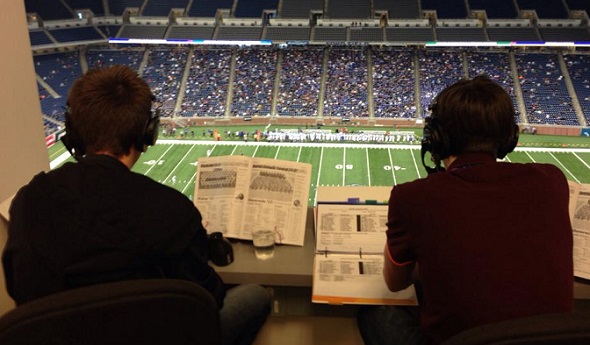
Students from the participating schools also took part in calling the action of the eight championship games on the MHSAANetwork.com website, where an average of 250 people clicked in per contest. Calling the games were:
- Cedar Springs - Kyle Maka, Kody Hall, Alex Hughes (Division 1)
- Davison - Shawn Bednard, Chris Jared, Brandon Snyder (Division 7)
- Detroit U-D Jesuit - Jack Sznewjas, Chris Houle (Division 8)
- Hillman – Mike Klein, Kyle McLaren, Noah Allen, Bubba Banks (Division 4)
- Warren DeLaSalle - Brendan Johnson, Jake O'Donnell (Division 2)
- Birmingham Brother Rice – Miles Hampton, Jeremy Otto - Mentor (Division 6)
- Detroit Catholic Central – Joesph Trojniak, Adam Abraham - Mentor (Division 5)
Several of the schools involved also are part of the MHSAA’s Student Broadcast Program, which produced nearly 1,000 events during the fall sports season for the MHSAA.TV Website.
Read more about Hillman's experience here in reports from the Alpena News and WBKB-TV. And read on for a report on Cedar Springs' experience by student reporter Kendra Coons.
C.S.T.V. Production Program “Hits it out of the park” at Ford Field
Change.
It’s a word that many people don’t deal with well. In this case, it was for the better at Cedar Springs High School.
In 2012, drama teacher, Justin Harnden took over the television program at CSHS. The second he took it over many changes were made to the C.S.T.V. program. The program bought brand new cameras, computers, TVs, and much more. He started working on getting his students to film sporting events, work on Public Service Announcements, capture the latest news in the school; and for the biggest change, start announcing play-by-play.
“We are here to put out more than just news for our school and community. We are doing sports, award shows, graduation, Red Flannel things, and much more. We are destined for great things,” expressed Harnden.
With one year under his belt, Harnden started to submit C.S.T.V.’s work to the MHSAA. After the fall season of 2013, Thom Lengyel and Ken Kolb, who are a part of the Student Broadcast Foundation, heard C.S.T.V. production students Kyle Maka and Kody Hall perform play-by-play for one of Cedar Springs’ football games. After listening to the both of them, Lengyel contacted Harnden and offered for Maka, Hall, and the rest of the class to come down to Ford Field. Lengyel explained to Harnden that the trip to Ford Field would give the class a chance to receive a behind-the-scenes look at what goes on during a broadcast and give Maka and Hall a chance to call the Division 1 championship high school football game.
On Saturday, Nov. 30 the C.S.T.V. Production program traveled out of their little town of Cedar Springs, Michigan, to face the big town of Detroit, Michigan. The day started out with the students boarding the bus at 8:15 am for a three-hour drive to the east side of the state. Once the students stepped off the bus they received their press passes. This gave them full access to walk out onto the field and sit in press row. Once the class arrived at Ford Field, they traveled up to the seventh floor to meet Lengyel. Lengyel then introduced the class to Kolb, showed them where Fox Sports does all of their announcing, and showed them where press row was located. After all of that was done, it was time for Maka and Hall to announce play-by-play for the Division 1 championship. Another member of C.S.T.V. also received a chance to announce play-by-play for the game, Alex Hughes.
Coming from a town with an estimated 3,500 people, the three boys were not used to a big stage. A lot of the community would annually attend our high school football games, but nothing to the caliber of what the three boys were about to announce.
“Doing the play-by-play was just amazing. I felt on top of the world. It was the best experience of my life,” commented Maka.
“It was honestly a feeling that I've never felt before ... It almost didn't seem real at first, but once I opened up (to) the environment I had an amazing time,” stated Hughes.
While the three boys were announcing play-by-play, the rest of the class received the opportunity to walk onto the field and sit in press row. After the game the students received the chance to walk through the Fox Sports trailers. These trailers are where all of the action happens. Being able to walk through these trailers was a once-in-a-lifetime experience for the C.S.T.V program.
“I thought looking around the Fox Sports Detroit mobile studio was eye opening. Seeing two of the three trucks that will handle all the production aspects of the Super Bowl was really great. We were able to see all that goes on in that setting, and we were amazed by it,” explains Harnden.
“Getting to tour Fox Sports was crazy because normally the behind the scenes work isn't seen at all, so that opportunity was perfect for the class,” said Hall.
After the students toured the buses, they all headed back up to the seventh floor to grab their things, say their goodbyes, and thank Lengyel and Kolb for the opportunity. Right before the class got ready to leave Lengyel had a few words to say to the class. He told the class how well they were behaved and how well the three boys did at calling the game.
“Getting those compliments from someone who has been in the business for so long was quite overwhelming, especially for myself not knowing much about football and (it) being the first time doing commentary,” said Hughes.
“(I had) a sense of joy and pride. I was so glad that somebody of his job caliber enjoyed how we did,” added Hall.
“When Thom gave us those compliments, I just could not stop smiling. When Thom said that we were just as good on our fourth game as those who have been calling games for four years, (it) just made me believe that this is something I can really do for the rest of my life. I hope that dream comes true,” commented Maka.
Not only did Lengyel and the rest of the class believe they did a great job, Maka, Hughes, and Hall’s teacher also believed they did exceptionally.
“I thought Kyle, Kody, and Alex did a great job. This was only the fourth game that they have called and they went above and beyond our expectations. Everyone involved with the production was impressed with what they did,” stated Harnden.
The students were able to take away many things from traveling to Ford Field. Going behind the scenes of Fox Sports is something not many people get a chance to say that they did. The class and Harden believe it was very beneficial to be able to participate in an experience like this.
“The students were exposed to a lot of aspects within media production. From press row, to the Fox Sports Detroit mobile studio, calling the game on the radio, and being allowed to see every aspect of a big stadium production really was eye opening,” explained Harnden.
The experience of traveling to Ford Field was definitely an experience that none of the class members will ever forget. Not only did they have a blast, but they learned a ton too.
“I definitely think that the trip benefited the class because we (were all able) to see things about professional broadcasting that most people can't. (Also) we (were able) to learn what it takes to make a professional broadcast,” says Maka.
The day after the program traveled to Ford Field, Lengyel emailed Harnden about C.S.T.V. Production and his view on their performance.
“... During the broadcast I knew that they were doing a good job,” expressed Thom. “So I wanted to listen to their broadcast when I got home. I could not put the mp3 player down. I did not pause it until halftime. For their fifth broadcast, listening to their preparation come out in the broadcast, changed my opinion to: THEY HIT IT OUT OF THE PARK.”
Lengyel has been in the business for many years. Having a compliment like that from a man with so much experience really hit home for the C.S.T.V. Production program.
If you would like to see what C.S.T.V. is all about, like us on Facebook, “CSTV”, follow us on Twitter “@CedarSpringsTV”, visit our website, “www.cedarspringstv.com” and make sure to watch our newscasts and listen for our play-by-play on MHSAA.TV.
C.S.T.V. Production truly wants to thank the Student Broadcast Foundation for the opportunity it was given. And a special thanks to Lengyel and Kolb for selecting C.S.T.V. and helping with advancing the program to the next level.
Hughes stated, “I can't thank the Student Broadcast Foundation and the MHSAA enough for letting our class have the opportunity to go to Ford Field and experience everything that we did. I would also like to thank our teacher Justin Harnden for turning around our TV Pro program. … Lastly, I would like to thank our class for always being there for one another and making this year memorable.”
PHOTOS: (Top) Two students call a game during the MHSAA Football Finals. (Below) Some of the students who visited Ford Field pose during a championship game. (Photos courtesy of the School Broadcast Foundation.)
A Game for Every Fan: Playoffs Week 1
October 28, 2015
By Geoff Kimmerly
Second Half editor
This first week of the 41st MHSAA Football Playoffs will be filled with firsts and familiar faces.
Benton Harbor, Detroit Cesar Chavez Academy and Parma Western will take part in the first playoff games in their football programs’ histories. Ten more teams will be making their first postseason appearance in more than a decade.
Beal City will enjoy the playoffs for the 33rd time, most of any MHSAA school and one of 18 that have appeared in the tournament at least 25 seasons. Rockford will play in its 21st straight playoffs and Menominee in its 20th, those two enjoying the two longest active streaks. Eight of nine champions return from 2014 – and Clarkston, Grand Rapids West Catholic and Muskegon Catholic Central hope to be playing in five weeks for their third straight MHSAA titles.
But first things first – below are some of the most intriguing openers, all to be played Friday, unless noted. Keep up with the MHSAA Score Center all weekend as scores come in, and check out the Football Page for up-to-date pairings and scores by division.
Division 1
Clarkston (7-2) at Romeo (8-1)
A 1-2 start – albeit, with losses to eventual league champions Macomb Dakota and West Bloomfield – knocked Clarkston out of most conversations about the state’s elite this season, despite the Wolves coming off back-to-back Division 1 titles. But Clarkston won its next six games – including over playoff team Oak Park last week – and drew a Romeo team that started 8-0, beat Dakota by two touchdowns, but is coming off an unexpected three-point loss to Utica Eisenhower in Week 9.
Others that caught my eye: Grandville (6-3) at Rockford (6-3), Plymouth (6-3) at Northville (9-0), Ann Arbor Pioneer (6-3) at Belleville (8-1), Utica Eisenhower (6-3) at Clinton Township Chippewa Valley (7-2).
Division 2
Muskegon (7-2) at Traverse City Central (9-0)
Traverse City Central is undefeated for the first time since its Class A championship season of 1988, and at home, hosting a team with a few hours of road time ahead. And yet, it’s fair to assume most will consider the Trojans underdogs against a Muskegon program that has finished each of the last three seasons at Ford Field. The Big Reds are back in Division 2 after finishing Division 3 runner-up a year ago, and have lost only to Detroit Catholic Central and Muskegon Mona Shores – a possible opponent next week for the winner of this game.
Others that caught my eye: Midland (7-2) at Midland Dow (8-1). Farmington Hills Harrison (7-2) at Birmingham Groves (9-0), Lincoln Park (6-3) at Wyandotte Roosevelt (7-2), Detroit East English (7-2) at Warren DeLaSalle (6-3).
Division 3
Grand Rapids Christian (5-4) at East Grand Rapids (6-3)
The Pioneers held a 26-0 lead in the first matchup between these Ottawa-Kent Conference White rivals, in Week 6, before the Eagles outscored them 39-7 the rest of the way. The math worked out such that East Grand Rapids is the host this time after Christian qualified with an at-large bid, and it's fair to expect another close tilt between teams that have split their last eight meetings, including two during the playoffs.
Others that caught my eye: Haslett (6-3) at DeWitt (8-1), Parma Western (6-3) at Coldwater (9-0), Ortonville-Brandon (6-3) at Linden (7-2), Warren Fitzgerald (6-3) at Redford Thurston (5-4).
Division 4
Flint Powers Catholic (7-2) at Goodrich (7-2)
Both of these teams should be among the most prepared to up their games for the postseason. Powers quietly put together one of the most solid defensive performances in the state, giving up only 101 points total while shutting out four teams and finishing second to Division 2 contender Midland Dow in the Saginaw Valley League Blue. Goodrich emerged as one of five playoff teams from the seven-team Genesee Area Conference Red and played two more playoff teams nonleague, so it too is used to playoff-caliber competition.
Others that caught my eye: Dowagiac (6-3) at Benton Harbor (5-4), Big Rapids (6-3) at Escanaba (5-4), Detroit Denby (5-4) at Detroit Collegiate Prep (9-0), Harper Woods Chandler Park (6-3) at Detroit Country Day (8-1), Saturday.
Division 5
Marine City (6-3) at Almont (7-2)
With its proximity to Port Huron, it’s easy to forget that Marine City plays in the Macomb Area Conference Gold and not the Blue Water Area Conference, and actually has faced BWAC power Almont only once over the last 65 seasons – in a District Final a year ago. Both have deceiving records this time around; Marine City’s three losses were by a combined 12 points to three playoff teams, while Almont’s two defeats came by a combined 15 points to two playoff qualifiers (both fell to Algonac).
Others that caught my eye: Muskegon Oakridge (7-2) at Grand Rapids West Catholic (7-2), Hillsdale (6-3) at Buchanan (9-0), Clinton Township Clintondale (5-4) at Algonac (8-1), Harrison (7-2) at Kingsford (6-3), Saturday.
Division 6
Clinton (9-0) at Monroe St. Mary Catholic Central (8-1)
Division 6 might have the most intriguing set of opening games, topped by this matchup of the reigning champion Falcons against one of two undefeated teams that finds itself on the road this week. This is a rematch of last season’s District Final, won by St. Mary; in 2013 it was Clinton that reached Ford Field and finished runner-up in Division 6. St. Mary’s earned this home game with a schedule loaded with Class A and B teams, but that doesn’t mean Clinton doesn’t know how to ramp up for good competition – the Redskins are one of four playoff teams from the Tri-County Conference.
Others that caught my eye: Vassar (8-1) at Ithaca (9-0), Millington (8-1) at Sanford Meridian (9-0), Calumet (7-2) at Negaunee (7-2), Jackson Lumen Christi (6-3) at Vandercook Lake (8-1).
Division 7
Saugatuck (9-0) at Hesperia (9-0)
Matchups of undefeated teams in the first round are rare, but so is having three undefeated teams in the same District, which these two share with Pewamo-Westphalia. Hesperia is one of the incredible stories of this season. The Panthers, known best for their wrestling, were 1-8 a year ago and hadn’t made the playoffs since 2002 – but did have four 0-9 seasons during the drought. Only once this fall, in Week 4 against Morley-Stanwood, did an opponent come within 25 points of Hesperia. But Saugatuck has been both impressive and consistent on offense, scoring no fewer than 42 points in any game and beating their opponents by an average of 48.
Others that caught my eye: Flint Hamady (7-2) at Flint Beecher (6-2), Cass City (7-2) at Ubly (7-2), Concord (7-2) at Dansville (8-1), Harbor Springs (6-3) at Iron Mountain (6-3), Saturday.
Division 8
Mendon (5-4) at Climax-Scotts (9-0)
A first-round game between an at-large qualifier and an undefeated host is generally viewed as a slam dunk for the home team. But it’s doubtful anyone recently has considered Mendon and its eight straight seasons with at least 10 wins an easy out. The four losses this fall were all to playoff teams, three now playing in higher divisions. Climax-Scotts has seen its last four seasons end against the Hornets and is the last team that would take them lightly, even after giving up a total of only 27 points this season.
Others that caught my eye: Mount Pleasant Sacred Heart (6-3) at Muskegon Catholic Central (6-2), Bark River-Harris (7-2) at Munising (7-2), Ottawa Lake Whiteford (7-2) at Petersburg-Summerfield (7-2), Crystal Falls Forest Park (5-3) at Lake Linden-Hubbell (9-0), Saturday.
8-Player
Rapid River (6-3) at Engadine (7-2)
Engadine’s Week 5 62-30 win over Rapid River sent a shockwave through 8-player football, as it was Rapid River’s first regular-season loss since 2012. The Eagles still haven’t lost since Week 3, with only Stephenson coming reasonably close to taking a game. But the short history of 8-player football in this state has shown that this division allows more than any other for massive turnarounds between the regular-season and playoff meetings between teams – and Rapid River knows well the possibility this weekend after beating Cedarville 20-19 during the 2014 regular season and then falling to the Trojans 28-0 five weeks later in a Regional Final.
Others that caught my eye: Cedarville (7-2) at Owendale-Gagetown (9-0), Peck (7-2) at Deckerville (8-1).
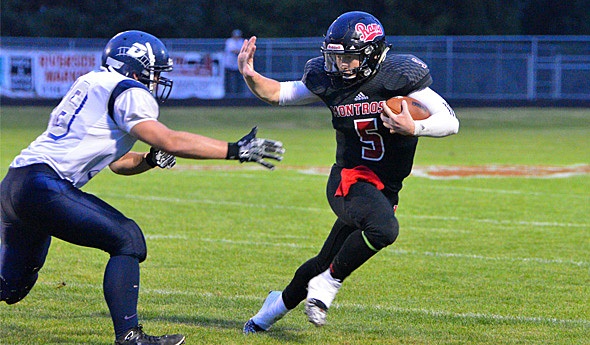
PHOTO: Montrose, carrying the ball, earned an at-large bid to its 23rd MHSAA Playoffs as one of five qualifiers from the Genesee Area Conference Red.