


Summer Safety
August 28, 2012
As we have been considering changes for in-season football practice rules that are more in step with recent recommendations of the National Athletic Trainers Association, the American Academy of Pediatrics and the National Federation of State High School Associations, as well as the actions of several of our counterpart state organizations across the U.S., we have also been looking at the rules that apply out of season to assure they do not work against the preparation of students for a safe experience.
Except during the school’s designated summer dead period of at least seven consecutive days, football coaches may interact with any number of players in voluntary weight training and conditioning sessions as frequently as they desire. Introduce footballs and helmets, and the coach can still work with any number of students on the sideline and up to seven players at a time for any number of days. Add competition, and the coach can still work with up to seven players at a time for a maximum of seven days. In addition, football coaches may participate for a maximum of ten days at bona fide football camps where any number of their players are participating.
Plenty of time for coaches to teach, and even more time for players to train. During this time, the rules permit students to wear helmets, which protect against accidental collisions during drills; but the rules prohibit other pads that would allow activities to escalate to the point where contact is expected, leading to increased blows to the head at a time when the objective from the pros to Pop Warner is to reduce blows to the head.
When the brief preseason down time begins Aug. 1, the coach continues to be able to work with any number of players in conditioning and weight training. The down time prohibits those activities that could be a disguise for practice prior to the earliest allowed practice date – open gyms, camps, clinics and competition. The down time puts the emphasis where it’s most needed for a healthy student experience when practice actually begins: that’s weight training and conditioning.
Some critics may focus on what they can’t do in the summer; but clearly, there’s much they can do, and it’s all designed to help players improve and excel in a safe environment.
Notre Dame Prep Takes to Air, Passes 1st Finals Test to Complete Record Run
By
Paul Costanzo
Special for MHSAA.com
November 30, 2024
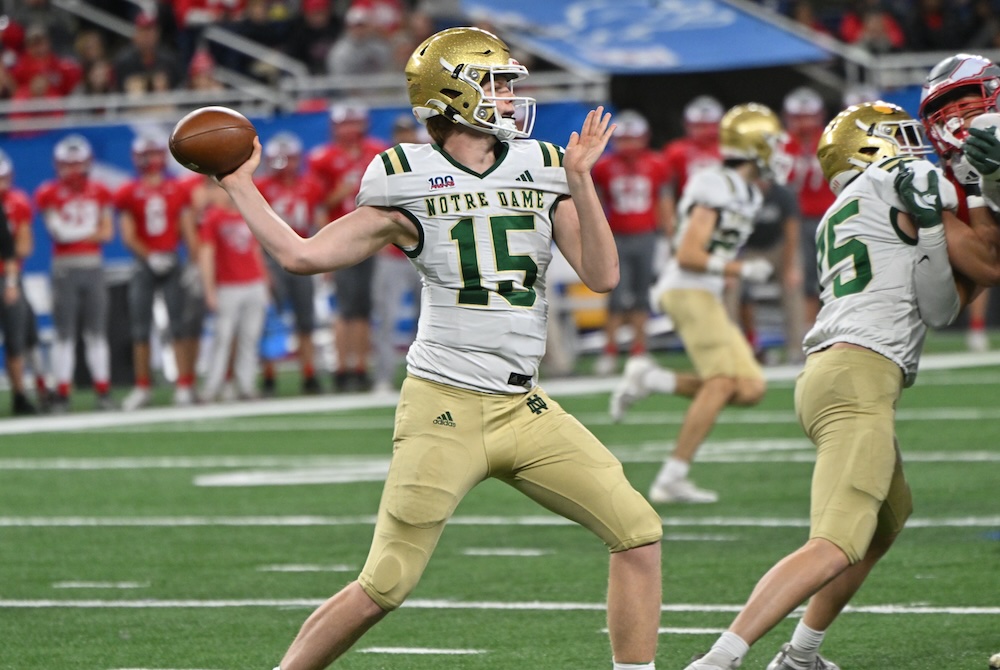
DETROIT – It’s been hard to find room to run against Frankenmuth all season, so on Saturday, Notre Dame Prep went to the air.
Quarterback Sam Stowe threw for 293 yards and four touchdowns as the Fighting Irish made the most of their first Football Finals appearance with a 42-7 victory over the Eagles in the Division 5 title game at Ford Field.
“The lights weren’t too bright for our offense,” Stowe said. “Having playmakers like Joey (Decasas) and Billy (Collins), Drew (Heimbuch) – they make me look good. I couldn’t have asked for a better offense tonight.”
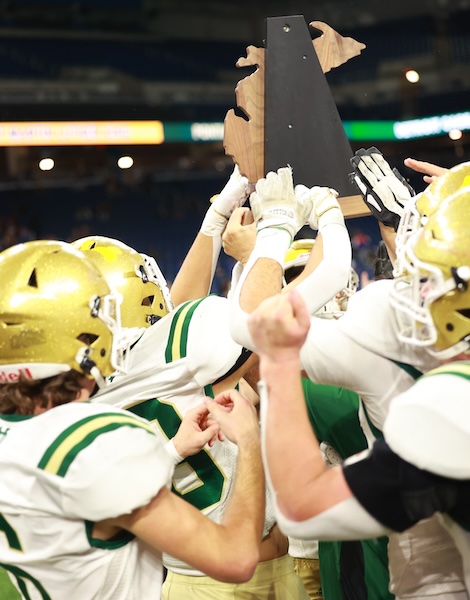
 The win caps off a historic season for the Irish, who won a school-record 12 games and the first Regional title in program history. To end it with a win on the season’s final day was, of course, special for everyone involved, but especially for NDP coach Pat Fox, who finished his 11th season with a Finals title win against his alma mater.
“I actually live there now, too,” Fox said with a smile. “I was the benefit of tremendous coaching, and I played for the greatest head coach in the state, Ralph Munger. He raised all of us in a specific way, and because of him I have a great life. I owe my life to that program. But, I don’t know anybody there anymore except for (Frankenmuth coach Phil Martin), and these are my guys and I was happy to win big. It wasn’t a problem, as long as my house isn’t burned down. … It was hard. It was hard. I love the program.”
Saturday’s game continued a theme for the Irish: winning big in the postseason. They outscored opponents 241-59 over five playoff games on their way to the title.
“We’ve had a great year this year. We have great young men,” Fox said. “I work with tremendous people, and I’m blessed to tell you that we’re very proud of our accomplishments because we do it the right way. We’re a developmental program. A lot of our players, like Drew and Sammy, have been with me since junior kindergarten. We have great student-athletes, and great young men. And we take the time to develop them, and they stay in our program.”
Fox singled out Stowe, who sat behind Jacob Tuttle, a first-team all-state selection a year ago. Rather than look elsewhere to get his talent onto the field, Stowe stuck it out at Notre Dame and had an unforgettable junior season, throwing for nearly 3,000 yards and 37 touchdowns.
“I got to sit behind Jacob Tuttle, one of the Notre Dame greats,” Stowe said. “And he taught me everything I know.”
That was on full display Saturday, as Stowe utilized his weapons on the outside to burn a Frankenmuth defense that has been outstanding all season.
Frankenmuth entered the game having allowed just 473 yards on the ground all season, and the Irish didn’t have a ton more luck for most of the game. But the passing game was lethal, and made all the difference.
 “Honestly, I always trust our offense,” Collins said. “We definitely have the ability to make huge plays. We have some extremely fast guys, a fantastic quarterback in Sam who can get the ball down the field. We just trust our offense, we trust our offensive coordinator, coach (Jason) Whalen. We just trust our team.”
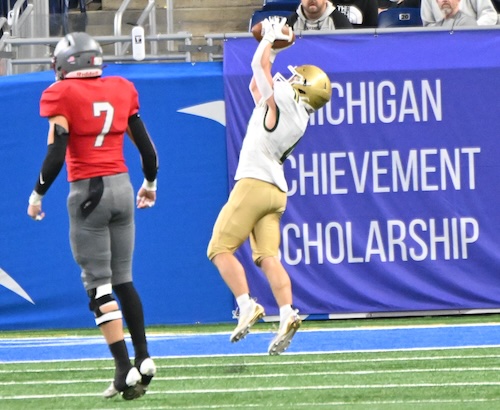
Stowe did most of his damage in the first half, including all four touchdown passes. He hit Collins for 87- and 25-yard scores, Michael Wiebelhaus for a 23-yarder, and Decasas on a 47-yard score.
Collins caught four passes for 126 yards, while Decasas had three catches for 70 yards.
Heimbuch scored the final two touchdowns for Notre Dame Prep on runs of eight and 50 yards in the second half. He finished with 63 yards rushing.
Notre Dame Prep’s defense was equally impressive, holding Frankenmuth to 245 total yards (4.2 per play) and not allowing a score until there was 8:58 to play in the game and the Irish had already built a 35-0 lead.
Luca Gasperoni led the defensive charge, finishing with 13 tackles, while Mark Galle had 11 and Wiebelhaus had 10. Heimbuch added nine tackles, including one sack and three tackles for loss.
Lleyton Hoard scored Frankenmuth’s lone touchdown on an 11-yard run early in the fourth quarter. Cash Tedford had 86 yards rushing to lead the Eagles (13-1), who were making their third Finals appearance over the past five seasons.
Brady Lipka had seven tackles, including two TFLs to lead the Frankenmuth defense.
PHOTOS (Top) Notre Dame Prep quarterback Sam Stowe (15) winds up to throw a pass Saturday as his line holds off the rush. (Middle) The Fighting Irish’s Billy Collins (4) pulls in a touchdown pass. (Below) NDP players hold up their championship trophy toward the crowd. (Photos by Hockey Weekly Action Photos.)