


Summer Safety
August 28, 2012
As we have been considering changes for in-season football practice rules that are more in step with recent recommendations of the National Athletic Trainers Association, the American Academy of Pediatrics and the National Federation of State High School Associations, as well as the actions of several of our counterpart state organizations across the U.S., we have also been looking at the rules that apply out of season to assure they do not work against the preparation of students for a safe experience.
Except during the school’s designated summer dead period of at least seven consecutive days, football coaches may interact with any number of players in voluntary weight training and conditioning sessions as frequently as they desire. Introduce footballs and helmets, and the coach can still work with any number of students on the sideline and up to seven players at a time for any number of days. Add competition, and the coach can still work with up to seven players at a time for a maximum of seven days. In addition, football coaches may participate for a maximum of ten days at bona fide football camps where any number of their players are participating.
Plenty of time for coaches to teach, and even more time for players to train. During this time, the rules permit students to wear helmets, which protect against accidental collisions during drills; but the rules prohibit other pads that would allow activities to escalate to the point where contact is expected, leading to increased blows to the head at a time when the objective from the pros to Pop Warner is to reduce blows to the head.
When the brief preseason down time begins Aug. 1, the coach continues to be able to work with any number of players in conditioning and weight training. The down time prohibits those activities that could be a disguise for practice prior to the earliest allowed practice date – open gyms, camps, clinics and competition. The down time puts the emphasis where it’s most needed for a healthy student experience when practice actually begins: that’s weight training and conditioning.
Some critics may focus on what they can’t do in the summer; but clearly, there’s much they can do, and it’s all designed to help players improve and excel in a safe environment.
Ogemaw Heights Makes Nemesis Latest Hurdle Conquered During Memorable Run
By
Tom Spencer
Special for MHSAA.com
November 3, 2023
Ogemaw Heights found itself in an all too familiar position when the football playoffs opened up last week.
 The Falcons were trailing Gladwin – this time by three touchdowns. Gladwin, the 2022 Division 5 champion, had knocked off Ogemaw Heights 35-20 last year on the way to the title. Gladwin also had topped the Falcons to open this season 42-28.
But this rematch didn’t stay familiar, as things changed fast. The Falcons cut the lead to just one score by halftime and went on to win 28-23.
Another difference is the Falcons (9-1) were at home — the two previous meetings in less than a year were on the Flying Gs’ field. The Falcons are staying home again this weekend, hosting Kingsford at 1 p.m. Saturday with a District title on the line.
Getting a win over Gladwin did not come as a surprise to the Ogemaw’s head coach, Chad Miller, now in his fifth year at the helm. Strong senior leadership has set the tone, and a talented group of underclassmen has arrived to bolster the lineup.
“We were down 21-0 with three minutes left in the first half and scored twice in that three minutes, and then dominated the second half,” Miller said. “We were good last year losing to a very good Gladwin team in a pretty close game in the first round of the playoffs.
“We knew if the sophomores came around we’d be OK this year.”
The Falcons utilize two of the sophomores at fullback, Calvin Marshall and Conner Lambert. Lambert is also the safety on defense, and Marshall plays defensive tackle.
The other sophomores are Eion Jones, Ethan Hock and Jace Peters. Jones starts at tight end and plays a little defense. Hock is the left guard, and Peters plays everywhere, Miller pointed out.
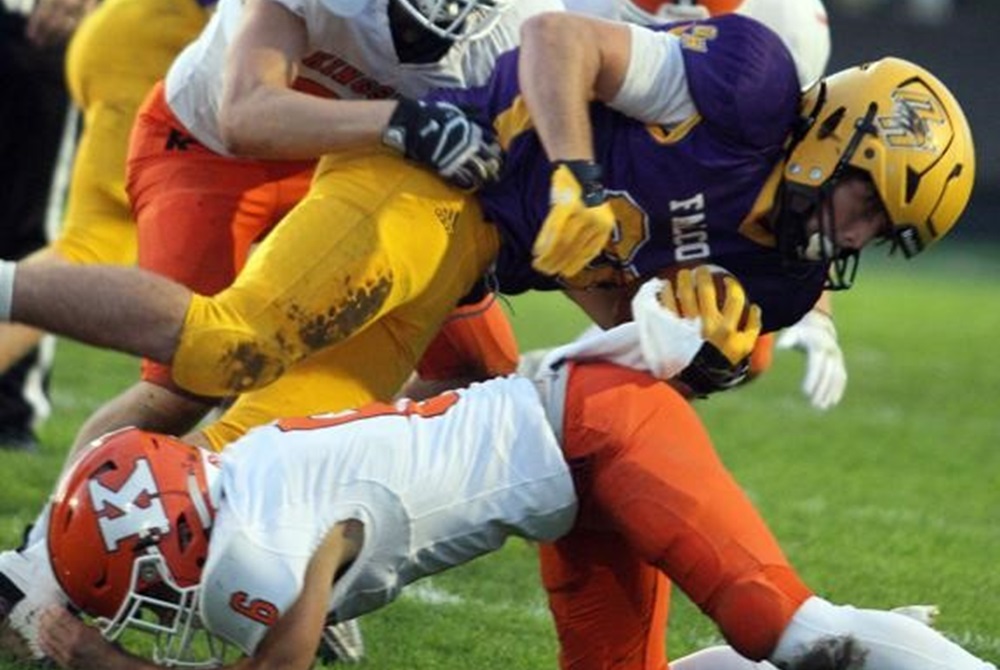
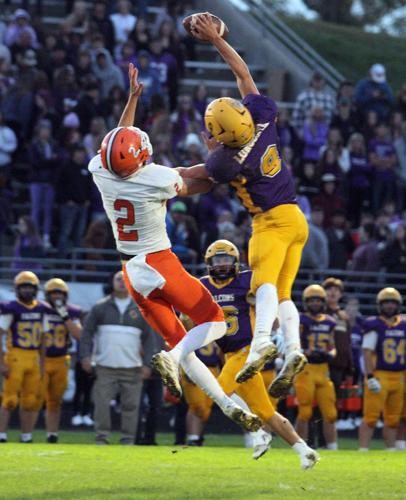 Karter Schmitt is a four-year starter. Week after week, he leads the team in rushing and tackles as a linebacker. Xander Kartes, in his second year as quarterback and third year starting at safety, is the playmaker and game manager, Miller said.
Schmitt started the comeback against Gladwin with two second-quarter touchdowns. The latter was set up by a Lambert interception.
“We don’t come back from 21 down unless our leaders make great plays,” Miller noted.
The Falcons have 11 other seniors on the roster. Multi-year starters are providing a ton of experience. This year’s seniors missed the playoffs only once during their careers. The other seniors starting again this year are right guard Mason Dunn, left tackle Ty Neubecker, linebacker Jack Fachting, and center/defensive tackle Andrew Christner.
Ogemaw Heights clinched the Northern Michigan Football Conference’s Legends title with a 35-12 win over Kingsley in Week 7. Schmitt ran 27 times for 149 yards to lead Ogemaw to the school’s first football league title since 2009. It was also the Falcons’ final game in the NMFC as they will join the Jack Pine Conference – which includes Gladwin – next fall.
That win over the Stags, also hosting a playoff game this week in Division 6, came in the program’s annual Purple Game. The Falcons wore purple jerseys against the Stags instead of their traditional brown as each player displayed a family member or friend’s name on the back of the uniform in honor of someone fighting cancer.
The Purple Game originated after the loss of previous coaches and community members to cancer, Miller indicated. The game date is set in advance of the season, just like Homecoming.
“We dedicate one game to anybody with or who has cancer,” Miller said. “The players choose someone in their lives, and we wear purple jerseys with the person’s relative or family name on the back and we present it to the family afterwards.
“It was a big night,” Miller continued. “Kingsley is a machine.”
Kingsford also will bring a 9-1 record over the Mackinac Bridge and down I-75 to the West Branch exit. The Flivvers’ only loss was 13-12 at Negaunee, a team battling this weekend for a District championship in Division 6.
“Kingsford is a very good team with a running back that has over 900 yards and 17 touchdowns the last three games,” Miller said of his team’s next opponent. “He’s probably the best running we’ve seen this year — he is going to be an issue.
“We won’t back down from anything,” Miller added. “The kids are cornfield tough – they are tough guys, man.”
 Tom Spencer is a longtime MHSAA-registered basketball and soccer official, and former softball and baseball official, and he also has coached in the northern Lower Peninsula area. He previously has written for the Saginaw News, Bay County Sports Page and Midland Daily News. He can be reached at [email protected] with story ideas for Manistee, Wexford, Missaukee, Roscommon, Ogemaw, Iosco, Alcona, Oscoda, Crawford, Kalkaska, Grand Traverse, Benzie, Leelanau, Antrim, Otsego, Montmorency, Alpena, Presque Isle, Cheboygan, Charlevoix and Emmet counties.
PHOTOS (Top) Ogemaw Heights’ Karter Schmitt is tackled by Gavin Dear and Gavyn Merchant during the Falcons’ win over Kingsley this season. (Middle) Xander Kartes (9) tips a pass intended for Eli Graves. (Photos courtesy of the Traverse City Record-Eagle.)