


Summer Safety
August 28, 2012
As we have been considering changes for in-season football practice rules that are more in step with recent recommendations of the National Athletic Trainers Association, the American Academy of Pediatrics and the National Federation of State High School Associations, as well as the actions of several of our counterpart state organizations across the U.S., we have also been looking at the rules that apply out of season to assure they do not work against the preparation of students for a safe experience.
Except during the school’s designated summer dead period of at least seven consecutive days, football coaches may interact with any number of players in voluntary weight training and conditioning sessions as frequently as they desire. Introduce footballs and helmets, and the coach can still work with any number of students on the sideline and up to seven players at a time for any number of days. Add competition, and the coach can still work with up to seven players at a time for a maximum of seven days. In addition, football coaches may participate for a maximum of ten days at bona fide football camps where any number of their players are participating.
Plenty of time for coaches to teach, and even more time for players to train. During this time, the rules permit students to wear helmets, which protect against accidental collisions during drills; but the rules prohibit other pads that would allow activities to escalate to the point where contact is expected, leading to increased blows to the head at a time when the objective from the pros to Pop Warner is to reduce blows to the head.
When the brief preseason down time begins Aug. 1, the coach continues to be able to work with any number of players in conditioning and weight training. The down time prohibits those activities that could be a disguise for practice prior to the earliest allowed practice date – open gyms, camps, clinics and competition. The down time puts the emphasis where it’s most needed for a healthy student experience when practice actually begins: that’s weight training and conditioning.
Some critics may focus on what they can’t do in the summer; but clearly, there’s much they can do, and it’s all designed to help players improve and excel in a safe environment.
Long Losing Streak Becoming Distant Memory as Adrian Football Re-Emerges
By
Doug Donnelly
Special for MHSAA.com
October 10, 2023
It’s hard to point to one particular move that led to the resurgence of the Adrian High School football program, but there’s no doubt the Maples are back.
 Just a few years ago, they were in the throngs of a 30-game losing streak, had a difficult time fielding a junior varsity team and the school’s administration conducted a survey about possibly leaving the Southeastern Conference.
Now, Adrian is 6-1, finished just a game out of first place in the SEC White and is primed for a Division 4 playoff run.
“There are a lot of really good things going on with the football program, the school and athletic program,” said second-year varsity football coach Joel Przygodski. “We have great kids who love to work hard. I’m glad to see them being successful because they work so hard.”
Przygodski is part of an overhaul at Adrian, which has seen a new superintendent, high school principal and athletic director over the last couple of years.
“The leadership is all in line with a similar point of view about how high school athletics should be a positive experience for kids,” Przygodski said. “It’s really fun to be a part of a school district like Adrian when everybody is rowing in the same direction.”
Historically, Adrian has had success on the football field. From 1999 to 2011, the Maples missed the playoffs just twice. Then came a series of 2-7 and 3-6 years, but a bounce-back 7-5 in 2016.
The program took a downturn after that.
Adrian didn’t win a game during the 2018, 2019 and 2020 seasons. The Maples lost 30 straight in all before defeating Brooklyn Columbia Central in Week 2 of the 2021 season. Those losses included the Maples forfeiting a 2020 playoff game – when almost all teams made the postseason due to COVID-19 – due to a lack of available players.
Przygodski was one of the Adrian assistants during the playoff years, then left to become an assistant coach at Saline. He remained a teacher in the district, however.
When the Adrian head coaching job opened after the 2021 season, Przygodski didn’t hesitate to throw his name into the candidate pool.
“I taught the same kids who are playing now in middle school, so it’s not like I had to meet these kids for the first time,” he said. “It was more of a re-introduction to them. They only knew me as Mr. P, not as Coach P.
“The kids wanted to win, they wanted that discipline and structure, and they just hadn’t had it for one reason or another.”
Chad O’Brien, in his third year as the Adrian athletic director, is pleased with the progress of the athletic program. The baseball team won an SEC title last year, and the basketball team has had success as well.
 “I think we have a lot of good people in good positions right now, and that makes a huge difference,” he said. “The continuity of the staff is huge. We have everyone on the same page. We discuss it as a group. We interact a ton. We aren’t separated. Everyone is moving in the same direction.
“There are still things that need to be addressed, but it’s definitely different than it was two years ago.”
The biggest turnaround has been in the football program. With some of the same players who were part of the 30-game losing streak, the Maples went 5-5 last year and are 6-1 this fall.
The Maples opened the season with four straight wins before falling 28-18 to Chelsea, the only blemish on a great season so far. They followed up the loss to the Bulldogs with back-to-back conference wins over Jackson and Pinckney to finish 4-1 in the SEC White. They have two nonleague games left to get ready for the postseason.
Quarterback Sean Parker is the unquestioned leader of the team. A four-year starter, Parker has thrown for 1,147 yards and 13 touchdowns this season while completing 65 percent of his passes. He has also rushed for 356 yards.
“He’s one of the smartest kids I’ve ever coached,” Przygodski said. “He has 4.1 GPA. He’s a very intelligent young man who works very hard. He’s kind of a silent leader, but a fun kid to be around. He’s gotten better each and every day.”
Chase Henline is the rushing leader with 780 yards and eight touchdowns. Five Maples have more than 100 yards receiving and are in double digits for catches.
Parker is one of 15 seniors.
“The majority of them have played all four years, and a handful of them are four-year starters,” Przygodski said. “When you have kids who have been battle-tested and have endured some of the things they did as freshmen and sophomores, then having a pretty decent year as juniors, it sets the stage for a pretty good senior campaign with everything falling in line.”
Przygodski is an Ann Arbor native who was head coach at his alma mater – Ann Arbor Huron – for four years before coming to Adrian in 2010. He served time as an assistant with the Maples under Phil Jacobs and was in Milan for a year. He then worked under Joe Palka at Saline for four years.
“I learned a lifetime of football working for Joe for those four years,” he said. “I think the biggest thing I got from him is how he organized. Everything was down to the details. If you put our practice plan and their practice plan next to each other, it would probably look similar. That’s probably the thing I learned the most.”
Przygodski isn’t worried about an encore just yet, but praised Adrian for its facilities and strength and conditioning program under Toby Ernst, now in his second year.
“They check all of the boxes of what you need to be competitive and successful in high school sports,” Przygodski said. “The community support has been phenomenal. It’s a place where you can compete and win.”
O’Brien said Adrian will continue to move forward with its athletic program.
“We’ve always had good kids here. We just had to have the right people directing them,” O’Brien said. “The biggest thing is we are going to do what’s right for kids, do what’s right for our district and do what’s right for our league. Every decision we make, we make sure we are following that.”
 Doug Donnelly has served as a sports and news reporter and city editor over 25 years, writing for the Daily Chief-Union in Upper Sandusky, Ohio from 1992-1995, the Monroe Evening News from 1995-2012 and the Adrian Daily Telegram since 2013. He's also written a book on high school basketball in Monroe County and compiles record books for various schools in southeast Michigan. E-mail him at [email protected] with story ideas for Jackson, Washtenaw, Hillsdale, Lenawee and Monroe counties.
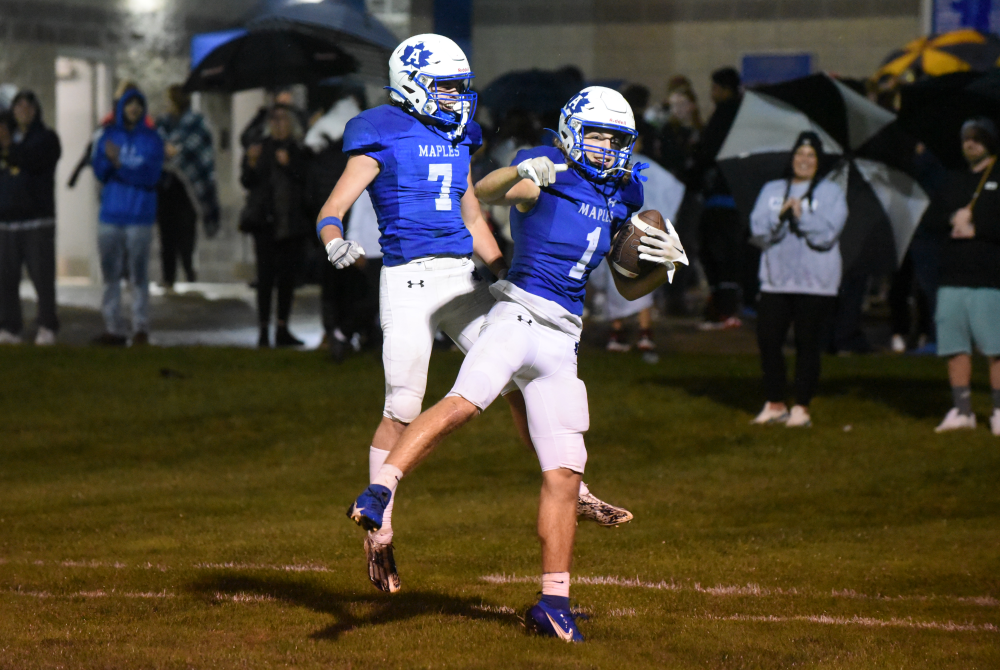
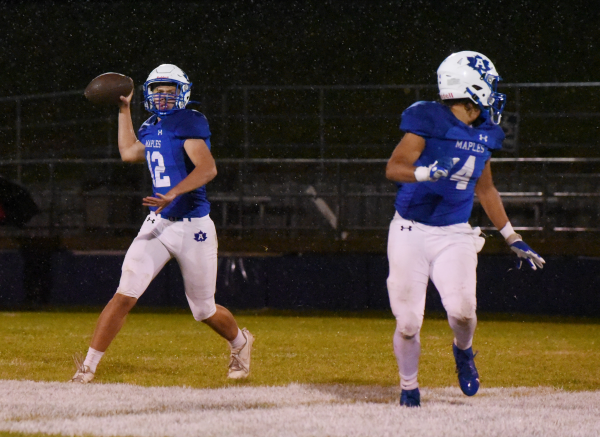
PHOTOS (Top) Adrian’s Carson DeKeyser (7) and Thomas Dayharsh celebrate a touchdown during Friday’s 34-0 win over Pinckney. (Middle) Maples quarterback Sean Parker rolls right behind the protection of Antonio Brown. (Photos by Deloris Clark-Osborne.)