


Summer Safety
August 28, 2012
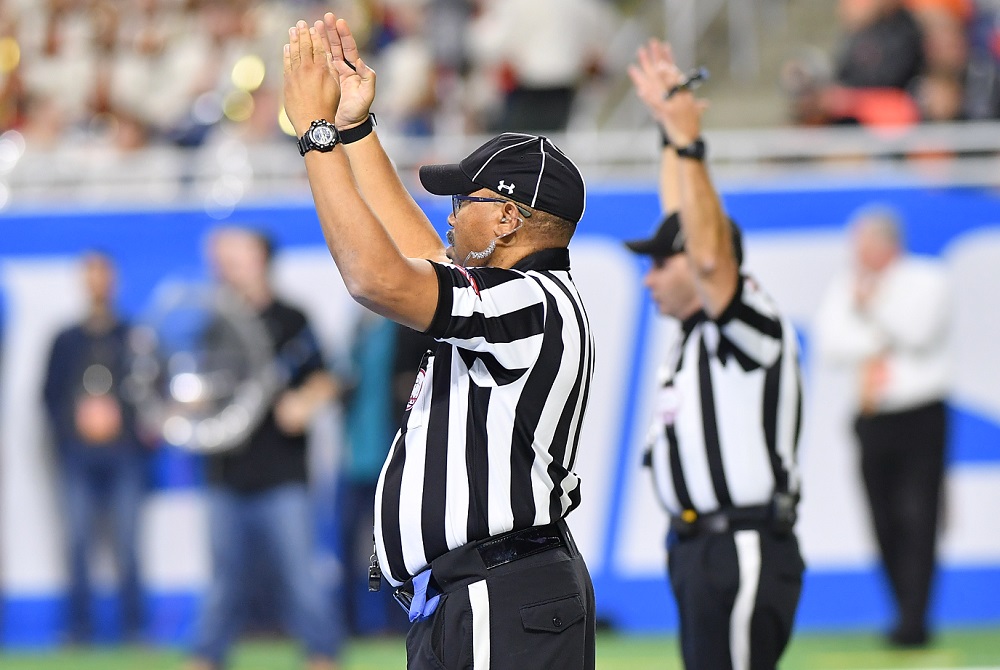
As we have been considering changes for in-season football practice rules that are more in step with recent recommendations of the National Athletic Trainers Association, the American Academy of Pediatrics and the National Federation of State High School Associations, as well as the actions of several of our counterpart state organizations across the U.S., we have also been looking at the rules that apply out of season to assure they do not work against the preparation of students for a safe experience.
Except during the school’s designated summer dead period of at least seven consecutive days, football coaches may interact with any number of players in voluntary weight training and conditioning sessions as frequently as they desire. Introduce footballs and helmets, and the coach can still work with any number of students on the sideline and up to seven players at a time for any number of days. Add competition, and the coach can still work with up to seven players at a time for a maximum of seven days. In addition, football coaches may participate for a maximum of ten days at bona fide football camps where any number of their players are participating.
Plenty of time for coaches to teach, and even more time for players to train. During this time, the rules permit students to wear helmets, which protect against accidental collisions during drills; but the rules prohibit other pads that would allow activities to escalate to the point where contact is expected, leading to increased blows to the head at a time when the objective from the pros to Pop Warner is to reduce blows to the head.
When the brief preseason down time begins Aug. 1, the coach continues to be able to work with any number of players in conditioning and weight training. The down time prohibits those activities that could be a disguise for practice prior to the earliest allowed practice date – open gyms, camps, clinics and competition. The down time puts the emphasis where it’s most needed for a healthy student experience when practice actually begins: that’s weight training and conditioning.
Some critics may focus on what they can’t do in the summer; but clearly, there’s much they can do, and it’s all designed to help players improve and excel in a safe environment.
St. Mary's Standout McLaurin Becomes Chinese Football Pioneer
By
Tom Markowski
Special for Second Half
August 19, 2021
The eight years Chris McLaurin spent in China not only changed his life, but they changed the perception of American football in China and elsewhere – and just may have opened the door to a whole new market.
We're talking “American football,” not soccer. Most of us are familiar with NFL Europe, but NFL China? Not so much. When McLaurin went to China in 2011, the thought of teaching the locals American football never occurred to him. He went there to work for a private company, and circumstances just seemed to fall in place.
Some might say McLaurin was in the right place at the right time, but it can also be said he was the right person at the right time to lead this undertaking. McLaurin had the background, both athletically and organizationally, to take on such an endeavor.
“I met a lot of people who were interested in football,” McLaurin said. “I thought, football? I had a limited understanding of what they knew. I was very surprised they would reach out to me. I quickly found out they were hungry to learn.”
A 2005 graduate of Orchard Lake St. Mary's, McLaurin started at tight end and linebacker, and helped the Eaglets reach the MHSAA Division 2 Final in 2004 (where they lost to Muskegon). McLaurin went on to play four seasons at Michigan and graduated in 2009 with a degree in history and minor in urban and community studies. He had thoughts of entering law school when other opportunities interceded.
During his time in Ann Arbor, McLaurin worked with an organization that focused on disadvantaged youth in the area and helped open doors for them. They were allowed to attend lectures at the university as well as sporting events.
Upon graduation, the seeds that would blossom in Asia began being sown in other parts of the world.
McLaurin received a Fulbright Scholarship and went to Johannesburg, South Africa, to work with underprivileged youth as part of a program called Tomorrow Trust. During this time he worked with the United Nations Development Programme and Harvard Law School in their pursuit of promoting economic rights for the poor.
Following his work in South Africa, McLaurin began his post-graduate work at the London School of Economics. He earned his degree after working in the House of Commons and as a research assistant for the Runnymede Trust. Then came a six-month internship within the Obama Administration as part of the White House Domestic Policy Council.
And after that, he was off to Chongqing in western China to work for a private equity company as a project manager. Two years later, he started his own company in addition to a non-profit organization. Much of his work centered on the automobile industry and global technology.
During this time he learned to speak Mandarin and, in doing so, was introduced to more of the local customs – including American football.
What McLaurin found was a rudimental brand of football, what we would term a recreational type of competition. McLaurin began his involvement gradually, on weekends.
“After that first year (2012), I took it up a notch,” McLaurin said. “We started recruiting players and bought new equipment. They watched football on TV, but it's not an easy game to understand. You have to play football to learn it. You don't get that from watching TV.”
A year of training, recruiting and, yes, some frustration, led McLaurin to start a league, the American Football League of China (now known as the China National Football League). The rules are similar to those at the U.S. college level. There are 11 players a side, and when a ball carrier's knee touches the ground the play is over.
In the beginning “it was successful,” he said. “There were no leagues when I got there. There was no one to organize it. We went from (fewer than) 10 teams to, 3-to-4 years later, there are 80-90.”
McLaurin quickly learned he needed help if this adventure was to succeed. USA Football had a footprint in Shanghai, and McLaurin reached out to the organization. McLaurin contacted a handful of former teammates including Prescott Burgess and Morgan Trent for advice. Former NFL player Bruce Plummer and NFL coach and scout Jerry Hardaway worked some of the camps and clinics with McLaurin and added much-needed experience and expertise.
After playing at Southern Illinois, Hardaway’s first coaching position was at Memphis State as an assistant, and then he went to Grambling State to coach under the legendary Eddie Robison for six seasons. He also coached at the University of California under Joe Kapp prior to working in the NFL and then heading to China.
“I was told, through another guy, that (McLaurin) needed some help,” Hardaway said. “It was all about getting back to basics. That's what made it fun. They had no clue when you'd say to them, control the ground at impact when you're making a block. They had no idea of the terms that you'd use. To see the young kids, to see on their faces, they were absorbing everything.
“Yes, yes, yes, it was worthwhile. First of all, people had no clue about what it takes to do something like this. They were learning. Some of the parents thought it was a violent sport. That's what they heard. Then they switched. They saw me, us, teach the basics and they saw what we were doing. For me, it gave me a sense, like hey, you have to teach and you have to enjoy it.”
Soon after that first season, the NFL got involved as did the National Committee on United States - China Relations. McLaurin credits the NFL for advising him on the business end of starting a new league and structuring. After 18 months, McLaurin got out of coaching and became the commissioner.
“(The NFL) wanted to expand,” he said. “They saw how their brand was quite low (in China). China is a natural.”
Progress was slow, but it was still progress. The 2015 championship game was played in Shanghai, and McLaurin estimates it drew 3,500 spectators.
He continued to work with the AFLC through 2019 but then decided to make a career move. He returned to the U.S. and, this fall, is pursuing a dream he's held since leaving U-M. At age 34, McLaurin entered Harvard Law School.
“When I started, the last thing we wanted was a U.S. version of football,” he said. “We wanted it to be Chinese football. There were limitations on how many foreigners would compete. At first it was five (per team), then three. We wanted it to be a Chinese experience."
2020-21 Made in Michigan
August 5: Herremans' Focus on 'Dadding,' Giving Kids Similar Small-Town Childhood - Read
July 29: Loy Norrix Career Prepped Crocker for U-M Success, Law Degree Pursuit - Read
July 19: Top PGA Pro Finish Latest Greatest Highlight as Cook Continues Climb - Read
July 16: TC West Standout Renews Ties to Titans, Cheers Past Teammates' Gold Pursuit - Read
July 8: Caro Champs Find Common Ground Again as Mental Health Providers - Read
June 28: Michigan's Minor Leaguers Making Up for Lost Season - Read
PHOTOS: (Top) Former Orchard Lake St. Mary's standout Chris McLaurin started an American football league in China and remained part of its leadership through 2019. (Middle) McLaurin was a two-way starter for St. Mary's 2004 Division 2 runner-up team. (Below) McLaurin runs drills for one of the Chinese teams. (Top and below photos courtesy of Chris McLaurin; middle photo from MHSAA archives.)