


Summer Safety
August 28, 2012
As we have been considering changes for in-season football practice rules that are more in step with recent recommendations of the National Athletic Trainers Association, the American Academy of Pediatrics and the National Federation of State High School Associations, as well as the actions of several of our counterpart state organizations across the U.S., we have also been looking at the rules that apply out of season to assure they do not work against the preparation of students for a safe experience.
Except during the school’s designated summer dead period of at least seven consecutive days, football coaches may interact with any number of players in voluntary weight training and conditioning sessions as frequently as they desire. Introduce footballs and helmets, and the coach can still work with any number of students on the sideline and up to seven players at a time for any number of days. Add competition, and the coach can still work with up to seven players at a time for a maximum of seven days. In addition, football coaches may participate for a maximum of ten days at bona fide football camps where any number of their players are participating.
Plenty of time for coaches to teach, and even more time for players to train. During this time, the rules permit students to wear helmets, which protect against accidental collisions during drills; but the rules prohibit other pads that would allow activities to escalate to the point where contact is expected, leading to increased blows to the head at a time when the objective from the pros to Pop Warner is to reduce blows to the head.
When the brief preseason down time begins Aug. 1, the coach continues to be able to work with any number of players in conditioning and weight training. The down time prohibits those activities that could be a disguise for practice prior to the earliest allowed practice date – open gyms, camps, clinics and competition. The down time puts the emphasis where it’s most needed for a healthy student experience when practice actually begins: that’s weight training and conditioning.
Some critics may focus on what they can’t do in the summer; but clearly, there’s much they can do, and it’s all designed to help players improve and excel in a safe environment.
1st & Goal: Week 9 Preview
By
Geoff Kimmerly
MHSAA.com senior editor
October 22, 2020
Over the next 72 hours, endings will be followed by new beginnings for just about every high school football team in Michigan.
Today and Saturday, the great majority will kick off for the final time this shortened regular season. On Sunday, for the first time, nearly all will be able to begin preparing for the start of this fall's MHSAA Playoffs.
Pairings in 11 and 8-player will be posted to the MHSAA Website during early afternoon Sunday. In the meantime, more than 270 games will be played to help determine those postseason matchups, with more than 60 available to watch on MHSAA.tv; click the link for listings
Below are some of the games you may want to check out in your corner of the state. Find the full schedule and then results this weekend as they’re reported via the MHSAA Score Center.
Bay & Thumb
Midland Dow (4-1) at Midland (5-0)
Dow’s loss last week to Mount Pleasant rubbed some of the luster off this week’s neighborly meet-up with the Chemics. But this could still significantly impact the Saginaw Valley League Blue championship, as Midland is the only team without a league loss – but a Dow win would leave three one-loss teams (along with the Oilers) at the top of the standings. Dow won this matchup 42-7 last season, breaking a three-game losing streak to its rival.
Keep an eye on these: FRIDAY Ortonville Brandon (5-0) at Fenton (5-0), Saline (5-0) at Grand Blanc (4-1), Davison (5-0) at Lapeer (3-2), Clare (5-0) at Sanford Meridian (4-1).
Greater Detroit
Detroit Loyola (5-0) at Detroit Catholic Central (5-0), Saturday
These teams both have won MHSAA Finals championship over the last 11 seasons, but this Detroit Catholic League Bishop Championship game will pit them against each other for the first time. This is likely a matter of significant difference in enrollment size – the Shamrocks are a Division 1 playoff team, and the Bulldogs will play in Division 7. But they are undefeated champions of the two divisions of largest schools in the league, DCC in the Central and Loyola in the AA, and their past successes no doubt will make this a much-anticipated matchup.
Keep an eye on these: FRIDAY Livonia Churchill (4-1) at Belleville (5-0), Bloomfield Hills Brother Rice (4-1) at Detroit Country Day (3-1), Marine City (5-0) at Pontiac Notre Dame Prep (4-1). SATURDAY Clarkston Everest Collegiate (5-0) vs. Riverview Gabriel Richard (5-0) at Detroit Catholic Central.
Mid-Michigan
Mason (5-0) at Williamston (5-0)
The Bulldogs are attempting to finish a second-straight perfect run through the Capital Area Activities Conference Red. But they’re up against a Williamston team off to its best start since 2014, which is saying something extra given the Hornets’ annual success. This will match strength on strength; Williamston has given up 45 points total (nine per game), while Mason is averaging nearly 38 per contest. The Bulldogs won last year’s meeting 20-9.
Keep an eye on these: FRIDAY Stevensville Lakeshore (4-1) at DeWitt (5-0), Pewamo-Westphalia (5-0) at Lansing Catholic (3-2), Holt (2-2) at Grand Ledge (3-2), Stockbridge (2-3) at Olivet (4-1).
Northern Lower Peninsula
Charlevoix (5-0) at Maple City Glen Lake (4-1)
The Northern Michigan Football Conference Leaders and Legacy championships are up for grabs this weekend, and we’ll focus on the Leaders as the only loss between these two contenders was Glen Lake’s by five to unbeaten Clarkston Everest Collegiate. Glen Lake has won 12 straight league games and three straight championships, and defeated the Red Rayders 42-18 last season when they also met with the title on the line. But a dominant Charlevoix defense could give Glen Lake trouble this time; the Rayders haven’t given up a point over their last two games and only 42 total this fall.
Keep an eye on these: FRIDAY Johannesburg-Lewiston (5-0) at Harbor Springs (3-2), Oscoda (5-0) at Houghton Lake (4-1), East Jordan (3-2) at Frankfort (2-3). SATURDAY Jackson Lumen Christi (2-3) at Traverse City St. Francis (3-2).
Southeast & Border
Addison (5-0) at Grass Lake (4-1)
The Panthers quietly have put themselves in position to clinch a second-straight Cascades Conference championship, outscoring their three league opponents so far by a combined 169-28. Grass Lake trails Addison by a game, thanks to a Week 7 loss to Michigan Center, and also will be looking to avenge last season’s 20-16 defeat that decided the Cascades title.
Keep an eye on these: FRIDAY Chelsea (5-0) at Monroe (4-1), Clinton (4-1) at Hillsdale (4-1), Homer (4-1) and Jonesville (4-1), Brownstown Woodhaven (4-1) at Temperance Bedford (3-2).
Southwest Corridor
Paw Paw (4-1) at Edwardsburg (5-0)
The Wolverine Conference isn’t awarding a championship this season because of the abbreviated schedule, but if it was the title would be coming down to these two again. Paw Paw’s only loss was last week to Detroit Country Day; otherwise the Wolves have again dominated, outscoring their four Wolverine opponents by an average of 48-9. The Eddies, who defeated Paw Paw to claim the league title last year, have yet to be held under 52 points or allow more than 16.
Keep an eye on these: FRIDAY St. Joseph (4-1) at Battle Creek Lakeview (4-1), Schoolcraft (4-1) at Delton Kellogg (3-2), Saugatuck (3-2) at Lawton (4-1), Portage Northern (4-1) a Kalamazoo Central (2-3).
Upper Peninsula
Marquette (4-1) at Calumet (2-2)
At the end of an unpredictable six weeks in the Upper Peninsula, this could be a much more intriguing game than the records might indicate. These teams recently have been among the best above the Bridge, but in substantially different playoff brackets – Marquette will play in Division 3 and Calumet in Division 6 next weekend. The Copper Kings have played only three games on the field, winning two and losing the third to Kingsford by just a point. Marquette defeated Kingsford 10-0 and also has just one close loss, early to Sault Ste. Marie.
Keep an eye on these: FRIDAY Escanaba (0-2) at Gladstone (2-2), Bark River-Harris (2-2) at L'Anse (1-4), Iron Mountain (5-0) at Manistique (1-3), Gwinn (2-3) at Bessemer (0-4).
West Michigan
Grand Rapids Catholic Central (5-0) at Grand Rapids South Christian (5-0)
These two were frequent league or playoff foes until 2016, when GRCC moved for a few seasons into the Ottawa-Kent Conference Blue. This fall the Cougars moved back into the Gold, and they’ll face the Sailors with the championship on the line. Most notably, both have wins over Cedar Springs, and defensively they’ve given up nearly the same number of points – although GRCC is scoring eight more per game, on average.
Keep an eye on these: FRIDAY Grandville (5-0) at Rockford (3-0), Hudsonville Unity Christian (5-0) at Allendale (3-2), Whitehall (4-1) at Muskegon Oakridge (4-1). SATURDAY Detroit Martin Luther King (3-2) at Muskegon Mona Shores (5-0).
8-Player
Portland St. Patrick (5-0) at Burr Oak (5-0)
Shortened schedule or not, Burr Oak has a lot to celebrate. The Bobcats have guaranteed a winning season, their second straight and something of a rarity for many year before that. Burr Oak has won all of its games by at least 32 points. But defeating annual power St. Patrick – and by doing so avenging last year's playoff loss – would be the best victory yet.
Keep an eye on these: FRIDAY Morrice (5-0) at Deckerville (4-1), Mayville (5-0) at Kinde North Huron (5-0), Cedarville (4-1) at Rudyard (3-2). SATURDAY Indian River Inland Lakes (5-0) at Merrill (4-1).
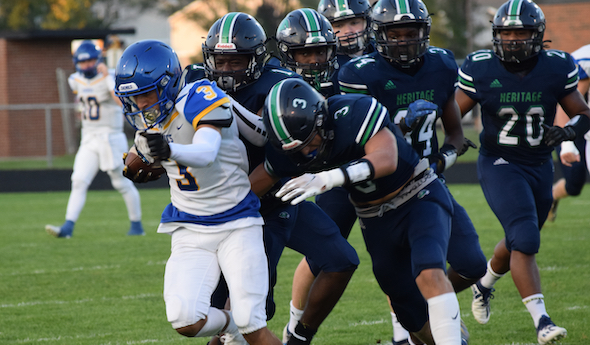
PHOTO: Midland pulled away from Saginaw Heritage for a 42-20 win on Sept. 25. (Click to see more from HighSchoolSportsScene.com.)