

Surge Becoming Storied as Boyne City Continues Memorable Playoff March
By
Tom Spencer
Special for MHSAA.com
November 22, 2024
Not many would say Boyne City’s football team followed the script this season.
 After the way the Ramblers started this fall, only a scriptwriter could have envisioned the season they’ve enjoyed.
Boyne City started with just 17 varsity players in August. After moving up some from the JV squad and losing their opener to Standish-Sterling 33-14, the Ramblers picked up a couple of wins. They then fell in Week 4 to Kingsley, last year’s Division 6 champion, 26-20.
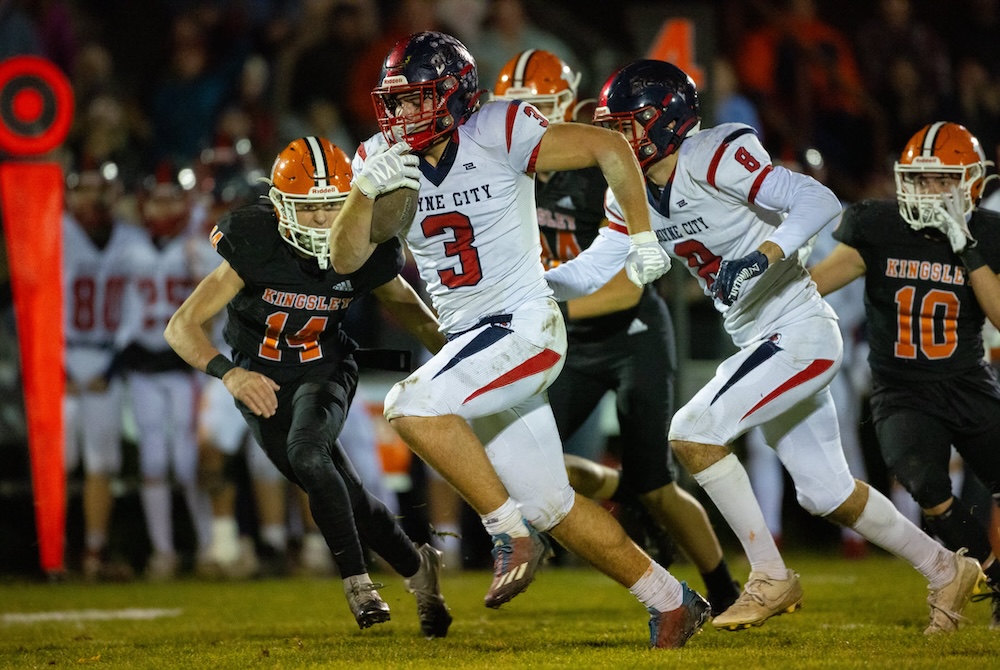
But that’s where the losses stopped. Boyne City is on an eight-game winning streak – which included a 21-15 victory over Kingsley in the District Final two weeks ago.
And when the Ramblers found themselves down 14-0 to Reed City midway through the second quarter last week in their Division 6 Regional Final, nobody would have blamed them for abandoning the script.
But if there is one, it called junior Owen Hewitt’s number. He took over, scoring four touchdowns to lead Boyne to a 35-28 win that advanced the Ramblers to Saturday’s Semifinal against Lansing Catholic.
 “It wasn’t a dire situation,” said Boyne City coach Dave Suttle. “Our quarterback Drew Neer all year long has run our offense very well, and when we need a big play he’s always there. We threw a little curl, dig route over the middle to Owen and he went 63 yards for the score and kind of rejuvenated our team.”
Neer, also a junior, has connected with Hewitt and senior Jaden Alger the most this season. Hewitt’s first TD came with 1:22 left in the first half. Hewitt’s second was Boyne’s first offensive play of the second half and tied the game at 14-14.
It may have been Suttle scripting Hewitt’s performance.
Suttle expected Reed City to focus on stopping senior running back Ryan Spade, who has nearly 1,800 yards on the ground this season.
“Owen looked too good in practice last week, and we knew Owen was going to have a game,” Suttle said. “They were keying so hard on Ryan. We figured this was going to be the week, and we put some things in the game plan for him.”
Hewitt was extremely fired up coming out of halftime break, the sixth-year coach noted.
“Owen’s been our big-play guy all year,” said Suttle. “He’s got probably 600 yards receiving, and I think he’s scored 15 touchdowns between receiving and rushing. He’s been there but hadn’t had that wow game yet, that ‘Hey, who is this kid?’ And that was his game.”
The tough times this season from the small numbers to early losses united the team and created success, their coach proudly noted.
 “From football specifically, we have made lifelong friends,” Suttle said. “We’ve learned how to help other people and depend on each other. The boys keep throwing out there they truly feel like they are all one family now. There’s all kinds of kids in this group. They have each other’s back. They’re not looking to blame anybody or point fingers. They’re just a solid group of gritty kids.”
Defensively, the Ramblers also have been led by Spate. He’s been involved in nearly 100 tackles. Sophomore Hyker McKinney has been involved in more than 70 tackles and Alger, junior Thomas Ager, senior Ryan Chapp, Hewitt and sophomore Ben Stanek are right behind them in solo tackles and assists.
Chapp and senior Leon Xiong have anchored the defensive line for the third straight year, Suttle pointed out.
“They’ve really stepped up this year, and they have pretty good stats,” Suttle said. “They are big-time leaders.”
The offensive line, in particular seniors Wiley Belcher and Zach Herrick, also continue to impress.
“They keep getting better every week and just keep pushing on,” Suttle said.
Win or lose this week or next, this team’s legacy already is solidified.
“I want this group to be remembered as the group that may have been counted out by a lot of other people or may have been overlooked,” Shuttle indicated. “We have a pretty good tradition of having a winning program, and we’ll make the playoffs and things like this, but this team sticks together and gets through the rough times and just never gives up.”
 Tom Spencer is a longtime MHSAA-registered basketball and soccer official, and former softball and baseball official, and he also has coached in the northern Lower Peninsula area. He previously has written for the Saginaw News, Bay County Sports Page and Midland Daily News. He can be reached at [email protected] with story ideas for Manistee, Wexford, Missaukee, Roscommon, Ogemaw, Iosco, Alcona, Oscoda, Crawford, Kalkaska, Grand Traverse, Benzie, Leelanau, Antrim, Otsego, Montmorency, Alpena, Presque Isle, Cheboygan, Charlevoix and Emmet counties.
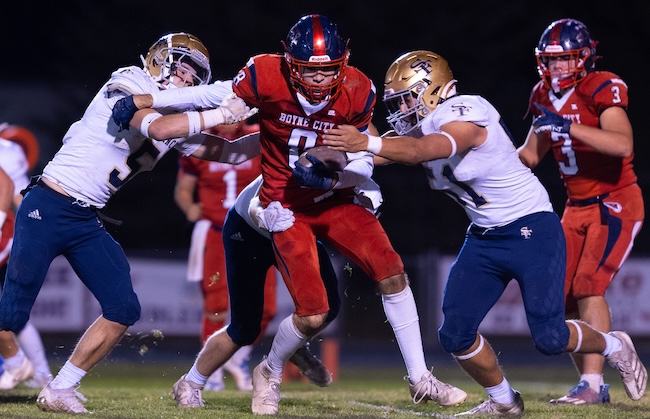
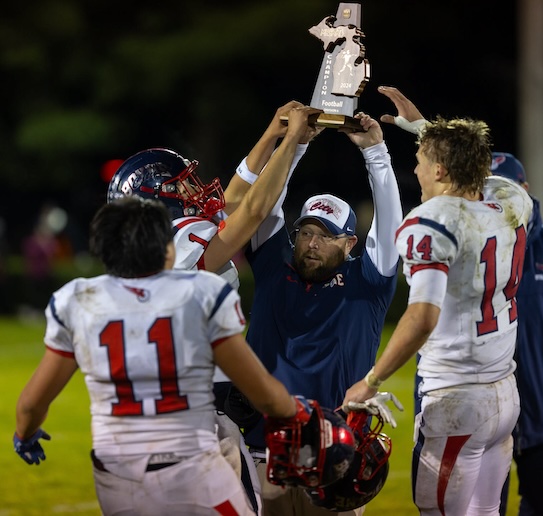
PHOTOS (Top) Boyne City’s Ryan Spade (3) breaks into the open during his team’s 21-15 District Final win over Kingsley. (Middle) Ben Stanek (8) works to break free from a pair of Traverse City St. Francis defenders during a 23-20 Week 9 win over Traverse City St. Francis. (Below) Ramblers coach Dave Suttle, middle, raises the District championship trophy with senior Leon Xiong (11) and junior Owen Hewitt (14). (Photos by Brandon Kish.)
1st & Goal: 2026 Week 1 Review
By
Geoff Kimmerly
MHSAA.com senior editor
August 31, 2026
The 2026 Michigan high school football season wasted no time reminding us of the best from a year ago – while hinting as well at what’s potentially to come this fall.
 Two rematches of 2025 MHSAA Finals highlighted the statewide schedule, as Dearborn Divine Child downed Hudsonville Unity Christian again after defeating the Crusaders in last year’s 11-Player Division 4 championship game, and Blanchard Montabella took advantage of another opportunity against Martin, defeating the Clippers after falling to them in 8-Player Division 1 last November.
Those are just two of several results highlighted below as a new season brings as well a new series of “1st & Goal” reports.
Bay & Thumb
HEADLINER Goodrich 10, Frankenmuth 7 Jacob Daggett’s 33-yard field goal with 7:32 remaining was the difference at Michigan Stadium as Goodrich defeated the Eagles by three in their season opener for the second-straight season. The teams were nearly even in total yardage and first downs as well, but the Martians held Frankenmuth scoreless during the second half after the Eagles got on the board first a minute into the second quarter. Click for more from the Saginaw News.
Watch list Cass City 34, Harbor Beach 0 The Red Hawks broke a four-game losing streak against the reigning Division 8 champion Pirates, who hadn’t lost a regular-season game since Week 4 of 2023 and claimed last year’s matchup 42-8.
On the move Grand Blanc 24, Belleville 23 The Bobcats held on with less than a minute to play, stopping the Tigers on a 2-point conversion try to secure the victory. Holly 15, Lapeer 12 Holly is coming off one of its best seasons of late and Lapeer off one of its least successful, but a win over a regular Saginaw Valley League contender is a big deal for the Bronchos regardless. Saginaw Nouvel Catholic Central 25, Allen Park Cabrini 21 The Panthers started with a significant stride as Cabrini reached the Division 8 Semifinals a year ago.
Greater Detroit
HEADLINER Dearborn Divine Child 56, Hudsonville Unity Christian 28 The victor of this rematch of last season’s Division 4 Final was the same, but the margin significantly different after Divine Child won by just a point at Ford Field in November. Drew Sheridan threw five touchdown passes as the Falcons outscored Unity 29-6 during the fourth quarter.
Divine Child domination 💪
No. 10 Divine Child (@DCHS_Football14) came out firing defeating Unity Christian 56-28!
Powered by @CallSam pic.twitter.com/SSKjgEDtYX— STATE CHAMPS! Michigan (@statechampsmich) August 29, 2026
Watch list North Farmington 14, Birmingham Groves 13 The Raiders have reached the playoffs two straight seasons but most recently fell to Groves 36-3 in their 2023 opener – and Groves reached the Division 2 Semifinals the last two years.
On the move Romeo 17, Rochester Adams 10 Adams had defeated Romeo both on opening night and in a Division 1 Regional Final last season, and in their 2024 opener as well. Detroit Central 12, Pontiac Notre Dame Prep 7 Notre Dame Prep is coming off finishing Division 5 runner-up a year ago and kicked off last season with a 55-0 win over the Trail Blazers, who are 1-0 for the first time since 2022 but have strung together 12 straight playoff seasons. Bloomfield Hills Brother Rice 30, Macomb Dakota 20 Brother Rice avenged last season’s 14-10 loss to the Cougars, jumping out to a 17-point halftime lead and holding on in a matchup of top Metro Detroit teams.
Mid-Michigan
HEADLINER Brighton 49, Dexter 7 The Bulldogs avenged last season’s 50-27 opening loss to Dexter, which went on last fall to finish runner-up in Division 2 but also is replacing a pair of record-setting playmakers among a strong group of graduates. Click for more from the Chelsea Sun Times News.
Watch list Middleville Thornapple Kellogg 25, Hastings 16 The Trojans’ broke a five-game opening-night losing streak against Hastings as they look to build on last year’s first playoff appearance this decade.
On the move DeWitt 59, Grand Rapids Kenowa Hills 21 The Panthers showed they’ve got plenty of offense left after last season’s Division 3 title run, and the defense also locked down a Kenowa Hills attack that could put up big numbers this fall. Pewamo-Westphalia 17, North Muskegon 9 The Pirates ran their winning streak against North Muskegon to four, building on last year’s opening-night and Division 7 District Final wins. Lansing Sexton 33, Lansing Everett 0 Sexton ended a two-year opening-night losing streak against the rival Vikings in a matchup of programs that have both reached the playoffs the last three seasons.
Northern Lower Peninsula
HEADLINER Charlevoix 36, East Jordan 30 Charlevoix trailed 22-6 midway through the second quarter before coming all the way back to run its recent winning streak against East Jordan to 11 going back to 2014. Both teams have made the playoffs every season this decade. Click for more from the Petoskey News-Review.
Watch list Alpena 27, Boyne City 8 The Wildcats entered this season with four wins total over the last six seasons and after losing to Boyne City 18-13 in last year’s opener. But they are off and running after downing a Ramblers team that has made the playoffs every season this decade as well.
On the move Kingsley 22, Reed City 0 The reigning Division 6 runner-up Stags added to last year’s season-opening and Regional Final wins over Reed City. Ogemaw Heights 27, Freeland 14 Ogemaw Heights put its best foot forward coming off last season’s Division 5 Semifinals run with an impressive win over a regular Division 4 playoff team in Freeland. Petoskey 35, Croswell-Lexington 8 After just missing making the Division 3 playoffs last season, Petoskey is 1-0 for the fourth-straight thanks to a nice win over another regular playoff qualifier in Croswell-Lexington that’s also looking to get back after missing last fall.
Southeast & Border
HEADLINER Chelsea 29, Harper Woods 20 Chelsea’s Gibby Ichesco ran the first play from scrimmage 72 yards for a touchdown to set the tone as the Bulldogs defeated a Harper Woods team that lost only once last season – in its Division 4 Regional Final to eventual champion Divine Child. Click for more from the Ann Arbor News.
UPSET ALERT🚨
Chelsea ended up on top in their matchup against No. 11 Harper Woods upsetting them 29-20!
Powered by @LawrenceTechU pic.twitter.com/D3NivmqZfU— STATE CHAMPS! Michigan (@statechampsmich) August 28, 2026
Watch list Saline 39, Rockford 12 This wasn’t necessarily a stunner as Saline won last year’s matchup as well, but the margin is notable as the Hornets seek to add to last year’s run to the Division 1 Regional Finals.
On the move Hudson 56, Hanover-Horton 6 The Tigers lost only once last season, in the Division 8 championship game, and this win likely points to good things this fall as the Comets made the Division 7 Regional Finals in 2025. Monroe St. Mary Catholic Central 37, Ottawa Lake Whiteford 28 These two small-school powers met for the first time, and SMCC broke away in part with two kickoff return touchdowns. Clinton 43, Olivet 21 This matchup of annual playoff teams was deadlocked 14-14 at halftime but Clinton pulled away in part by outscoring Olivet 21-7 during the fourth quarter.
Southwest Corridor
HEADLINER St. Joseph 29, Niles 20 These two continued to trade wins for the fourth-straight year, St. Joseph this time avenging its 10-point loss to Niles from a year ago. The Vikings led 14-0 during the second quarter, but Caden LeClear ended up throwing for three touchdowns including two to Nate Schmitt. Click for more from the St. Joseph Herald-Palladium.
Watch list Hartford 60, White Pigeon 0 The numbers alone make this a story; Hartford had been outscored by White Pigeon a combined 108-0 over the last two seasons and didn’t even have a team in 2022 and 2023.
On the move Kalamazoo United 29, Constantine 27 This season opener also was an opener in the Southwestern Athletic Conference and could prove to be one of the most important results in determining the champion this fall. Edwardsburg 55, McBain 20 The Eddies won this opener for the second-straight season as both look to continue playoff streaks and contend for league titles. Paw Paw 13, Big Rapids 7 Paw Paw bounced back from an opening loss to Big Rapids and 0-3 start last year to reach the playoffs and kept things rolling in downing a Cardinals team coming off a Division 4 Regional Finals berth.
Upper Peninsula
HEADLINER Negaunee 30, Marquette 28 After last season renewing its 130-year rivalry with Marquette with an eight-point win, Negaunee held off a late Sentinels charge this time to extend its all-time lead in the series to 72-60-11. Both are returning playoff teams. Click for more from Upper Michigan’s Source.
Watch list Kingsford 35, Escanaba 16 These are both returning playoff teams as well, and Kingsford avenged its 2025 opening loss to Escanaba with Western Peninsula Athletic Conference Copper play beginning this week.
On the move Calumet 14, Houghton 7 Although Calumet ran its winning streak over the Gremlins to 12, this was a close one and notable after the Copper Kings won the last two meetings by a combined 75-0. L’Anse 54, West Iron County 6 The West-PAC Iron got underway with this one of two league matchups in Week 1 and L’Anse avenging last year’s nine-point league loss. Gladstone 30, Gwinn 6 Gladstone is 1-0 for the first time since 2023, but there’s good news in Gwinn as well as the Modeltowners are back after not playing a year ago.
West Michigan
HEADLINER Grandville 29, Muskegon 28 (OT) Grandville scored first in overtime and Muskegon answered, but the Big Reds faked an extra point to go for the win and the Bulldogs stopped them as these two played to nearly a stalemate for the second-straight year. Grandville also emerged last season with a 44-40 win. Click for more from the Grand Rapids Press.
Watch list East Grand Rapids 27, Lowell 21 After the Red Arrows won big last year, East Grand Rapids stormed back to claim its fourth victory in this series over the last five seasons, with Tripp Hoekstra scoring on a quarterback keeper during the final minute to give the Pioneers their lead.
On the move Byron Center 41, Hudsonville 20 Two of the Grand Rapids area’s best kicked off against each other for the second-straight season, Byron Center avenging a six-point loss from 2025. Grand Rapids West Catholic 48, Grand Rapids Northview 21 The reigning Division 5 champion Falcons lost only once last season, and they avenged that 11-point defeat with this 27-point win. Zeeland West 46, Cedar Springs 20 These two 2025 playoff teams met after two years off, and West built a 10-point halftime lead before pulling away over the final two quarters.
8-Player
HEADLINER Blanchard Montabella 62, Martin 12 After falling to Martin 52-8 in last season’s Division 1 championship game, Montabella started this fall with a statement. The Mustangs didn’t throw a pass but ran for 433 yards with Austin Jensen and Josh Agranbright both rushing for four touchdowns. Click for more from the Mount Pleasant Morning Sun.
Watch list Rudyard 22, Onekama 6 The Bulldogs are seeking their first winning season since 2023 and were off to the right start with this win over a Portagers team coming off two straight trips to the Division 2 Semifinals.
On the move Britton Deerfield 38, Pittsford 20 These two have seen each other on opening night and during the playoffs the last two seasons, and the Patriots are up to 5-0 in those matchups. Morrice 28, Brown City 21 Coming off a season during which its two losses were by a combined eight points, Morrice played another close one but on the winning side against another playoff team from last fall. Grand Rapids Sacred Heart 20, Kingston 16 These two combined to go 18-4 a year ago, and this matchup could pick up even more significance as this season progresses.
MHSAA.com's weekly “1st & Goal” previews and reviews are powered by MI Student Aid, a division within the Department of Lifelong Education, Advancement, and Potential (MiLEAP). MI Student Aid encourages students to pursue postsecondary education by providing access to student financial resources and information. MI Student Aid administers the state’s scholarship and grant programs that help make college Accessible, Affordable and Attainable for you. Click to connect with MI Student Aid and find more information on Facebook and Twitter @mistudentaid.
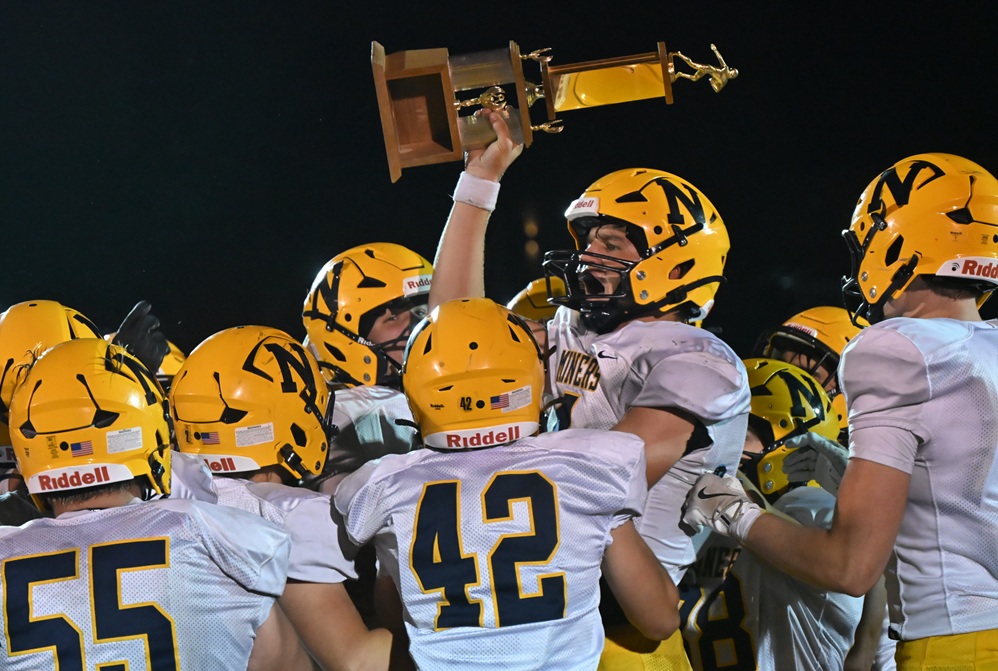
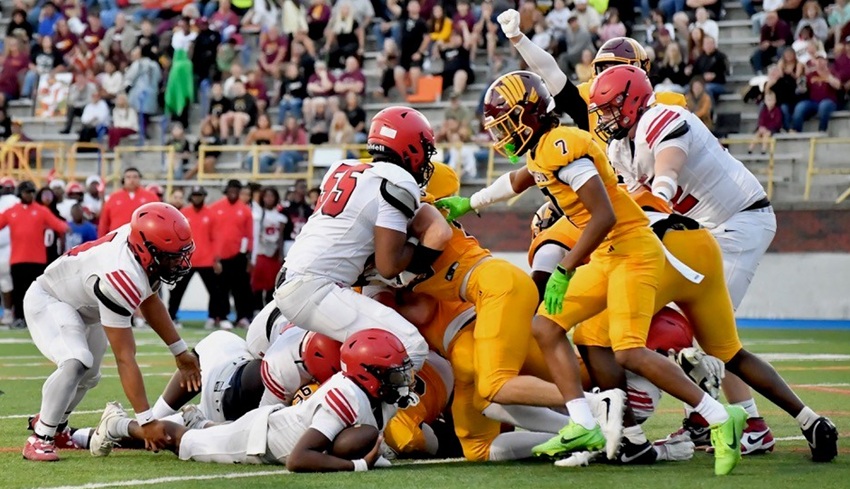
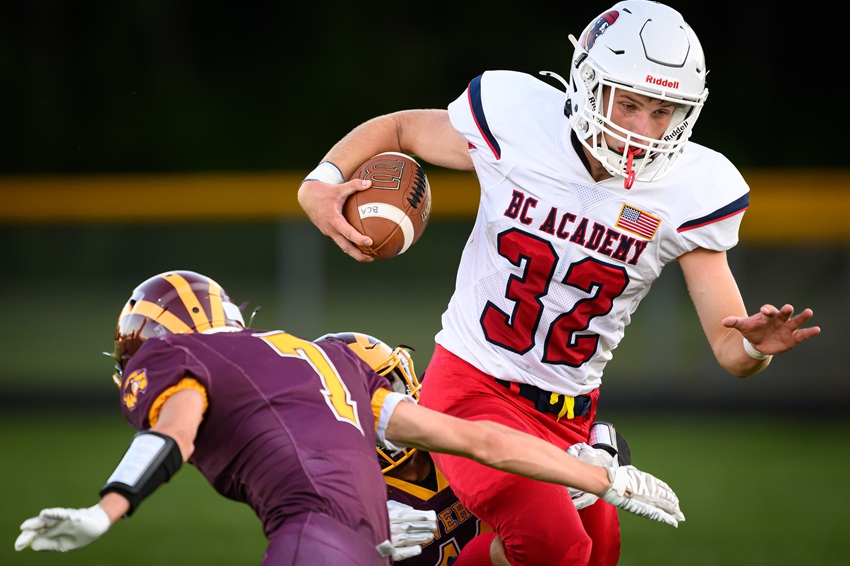
PHOTOS (Top) Negaunee's Kyle Waterman hoists the Jubilee trophy over his head after his team defeated Marquette. (Middle) A Roseville ball carrier stretches for extra yardage during his team’s 28-8 loss to Davison at the Vehicle City Gridiron Classic. (Below) Bay City Academy senior running back Brody Trudell (32) takes on a pair of defenders during his team’s inaugural game on Thursday, a 20-18 loss to Au Gres-Sims. (Negaunee/Marquette photo by Cara Kamps. Davison/Roseville photo by Terry Lyons. Bay City Academy/Au Gres-Sims photo by Kolleth Photo.)