


Tales of the Tape from Bygone Days
September 10, 2014
By Rob Kaminski
MHSAA benchmarks editor
How’s this for a new reality/espionage TV series? Participants have just hours to exchange valuable video to counter-intelligence representatives at random drop points along state highways, then return to home base, study the footage and devise an action plan that same day.
Oh, and there are no cell phones or any other form of portable communication should plans go awry en route.
For longtime Escanaba High School football coach Dan Flynn, it’d be like watching reruns of his days as an assistant coach for the Eskymos. As one of the largest schools in the Upper Peninsula, Escanaba’s road through the MHSAA Playoffs almost always meant facing opponents from below the bridge, which made film exchange a challenge to say the least.
“I’ve logged thousands of miles, maybe more than anyone ever, exchanging film, tapes and DVDs with our opponents during the MHSAA Playoffs,” Flynn said.
“Being in Region 1 geographically, we knew we’d travel,” Flynn added. “And you couldn’t afford to just look at anyone and everyone that you might play. You had to do your homework to narrow down possible opponents if you wanted to go and scout.”
Today, with the MHSAA publishing Football Playoff Points on a weekly basis following Week 4, much of the guesswork as to potential first-round opponents has disappeared.
Additionally, most schools upload game footage to the web within 24 hours following each contest. On Selection Sunday, within minutes after a school’s Pre-District foe is announced, a coaching staff and players can be watching video of their opponent.
“We’d started calling coaches or they’d call me in Week 8 or 9, looking at possible matchups and also planning a place to meet to exchange film,” Flynn said.
Plans had to be firm and communications had to be clear, because once hitting the road, there was no way to contact one another.
“This was before cell phones,” Flynn explained. “I had one of first cell phones, which actually was an old bag phone. I’d accumulate outrageous rates for roaming charges going tower to tower.”
Old-school video exchange might be a thing of the past, but a generation of high school football coaches will never forget gas stations, fast-food joints and 24-hour stores nestled off exit ramps across Michigan.
“On that Sunday night, I’d get in the car, and typically drive to Gaylord, or maybe Grayling. In Gaylord it would be the McDonald’s. In Grayling, it’d be Glen’s Food Market. You’d try to arrange to meet at a place that was open 24 hours,” Flynn recalled. “I always got in the car understanding the meeting would be below the (Mackinac) Bridge. Sometimes we’d get lucky and the meeting place would be the Shell gas station just below the bridge on the Mackinaw City side.”
The 200-mile drive to Gaylord routinely took four hours. The further Escanaba advanced in the playoffs, the more times Flynn wore down the tread on his tires. He specifically recalls a hectic weekend in 1979, when Escanaba traveled to Lansing Sexton and defeated Livonia Stevenson in the MHSAA Semifinals to earn a berth in the Finals the following weekend vs. Detroit Catholic Central. Part of the reward for Flynn was another trip to McDonald’s.
“We came from behind in that Semifinal, and we were thrilled that we were going to the Finals. We got back home late Saturday night, then I got in the car the next morning to meet the Catholic Central coaches at 1 p.m.,” Flynn said.
“Coach (head coach Jerry) Cvengros had a meeting set for 5 or 6 that night. I made it back in time, but our guys were still feeling good about the win, so I suggested we hold off a day before showing them the CC film (16 mm film, by the way). Those guys were pretty good.”
Indeed they were, winning the Class A title the following weekend. The Eskymos, however, would return to the Final in 1981, winning the crown, 16-6 over Fraser, as Flynn no doubt logged more miles in preparation.
The most pressing concern today might be quality of the online video, lighting at the fields, or angle of the camera.
Back in the day, just getting a tape felt like victory.
“One year, I traveled all the way to the southeast part of the state, and the opposing coach simply wouldn’t exchange,” said Flynn, explaining that playoff film exchange at the time was only a recommendation, not a regulation. “I learned later that the coach had video of us from a friend who lived in Escanaba. I left on Saturday morning and came back Sunday night. We did eventually get some film later in the week. We lost by two points, but as coaches we didn’t make it a big vendetta and were up front with our kids.”
The MHSAA Representative Council, which included Flynn at the time, upgraded film exchange from a recommendation to a playoff policy in 1990, when schools were required to supply one another with the two most recent game films.
Even so, and as 16 mm film evolved to VHS tapes and then DVDs, coaching delegates still had to make itineraries for October and November weekends. Sometimes twice in the same weekend.
“Even with advancements in technology as we progressed from DVDs to digital, you still need people to operate the devices,” Flynn said. “I met another coach at the Shell station at the Bridge, but he said our software wasn’t compatible with theirs. I drove back the next day, pushed a button, and it worked. I drove all that way to push a button; 16 mm film would have been better.”
Today’s coaches might be a bit more well-versed in technology than those of Flynn’s era, and it’s a good thing. They likely need MapQuest and a GPS to traverse the regions in Northern Michigan that Flynn and his cohorts knew like the back of their hands.
Drive for Detroit: Week 3 in Review
September 10, 2012
By Geoff Kimmerly
Second Half editor
Mid-September is not the logical time to announce a league championship has been decided.
But this season, games played during Week 3 eventually may determine at least nine league championships.
A number of results could've been considered the most intriguing – and we've tried to hit all of the possibilities in this week's Drive for Detroit report.
West Michigan
Muskegon 21, Rockford 9
The Big Reds are rivaling Detroit Cass Tech as the most impressive team in the state so far after motoring past Rockford on the legs of a 400-21 rushing yards advantage. Muskegon (3-0) now owns wins over Rockford, Orchard Lake St. Mary and Ohio power Sylvania Southview. The Rams face a 1-2 start for the first time since 1999. But rest assured, Ram Nation: the last time Rockford opened 1-2, it still made the Division 1 Semifinals. Click to read more from the Muskegon Chronicle.
Also noted:
Holland West Ottawa 24, East Grand Rapids 17 – These teams met for the first time since 1983; West Ottawa beat the Pioneers for the first time since 1980.
Muskegon Oakridge 35, Montague 7 – After two straight one-point games between these two, Oakridge won big to take the upper hand in the West Michigan Conference.
Zeeland East 15, Hudsonville 14 – East is off to a 3-0 start again, but the Eagles are 1-2 with those losses by a combined four points.
Grand Rapids South Christian 42, Grand Rapids West Catholic 7 – Beating this 2011 Division 5 Semifinalist, plus losing to Grand Rapids Christian by only 10 in Week 1, makes the Sailors look lined up to challenge Grand Rapids Catholic Central in the O-K Gold.
Mid-Michigan
Pinckney 36, Brighton 14
The Pirates had lost 18 straight to Brighton. In fact, they hadn’t beaten the Bulldogs since 1977 before scoring 29 unanswered points Friday in the Kensington Lakes Activities Association West opener. Pinckney is 2-1, just a win off last season’s total and halfway to their best season since 2001. Brighton fell to 1-2. Click to read more from the Livingston Daily.
Also noted:
Alma 14, Freeland 6 – The Panthers opened the Tri-Valley Conference Central season by avenging a loss that kept them from winning a share of the title in 2011.
Grand Ledge 35, Lansing Sexton 8 – The Comets scored more than 30 points for the third straight week and look good to cruise into an Oct. 5 showdown with Lansing Everett that could decide the Capital Area Activities Conference Blue title.
Portland St. Patrick 58, Burr Oak 14 – The Shamrocks appear to have struck gold with the 8-player format, averaging nearly 61 points per game during a 3-0 start.
Owosso 25, Haslett 22 – This was arguably Owosso’s most impressive win since 2006 and will help as the Trojans go for a first playoff berth since 2001.
Greater Detroit
Oxford 34, Farmington Hills Harrison 31 (2 OT)
The Wildcats had lost by an average of 31 points to the Hawks over the last two seasons, their first together in the Oakland Activities Association White. But Oxford (2-1) broke Harrison’s 21-game regular-season winning streak in what has to be considered an upset although both teams made the playoffs in 2011. The Wildcats also beat a 2011 playoff team, North Farmington, in Week 2. Click to read more from NorthOaklandSports.com.
Also noted:
Livonia Churchill 35, Plymouth 31 – Churchill had lost its first four matchups with Plymouth since the start of the KLAA, including 41-0 in 2011.
Warren DeLaSalle 40, Dearborn Fordson 19 – After a loss to one of the best in Ohio, Cleveland St. Ignatius, the Pilots bounced back for a solid win heading into the Catholic League season.
Clinton Township Chippewa Valley 21, Utica Eisenhower 7 – The Big Reds avenged a 45-0 shutout from last season to get to 2-1 and only a win shy of last season’s victory total.
Oak Park 34, Rochester Adams 22 – The Knights are 3-0 and equaled last season’s win total; combine this with an opening-weekend win over Detroit East English, and Oak Park is looking good to make some noise in the OAA White.
Thumb and Bay
Frankenmuth 12, Millington 8
The Eagles (3-0) had lost four straight to their rival, and appeared in trouble of making it five after giving up a safety in the fourth quarter. But Frankenmuth recovered an onside kick and scored, and with the win earned an an early upper hand in the Tri-Valley Conference East. Millington fell to 2-1. Click to read more from the Saginaw News.
Also noted:
Capac 12, Almont 7 – The Chiefs avenged a 28-0 loss from 2011 and gained what could be a significant step toward its playoff hopes.
Peck 44, Carsonville-Port Sanilac 13 – The Pirates downed the reigning MHSAA 8-player champion to move to 3-0.
Midland Dow 27, Saginaw 16 – Dow avenged last season’s 18-13 loss and moved to 2-0 in the tough Saginaw Valley Association North.
Saginaw Michigan Lutheran Seminary 28, Merrill 14 – The Cardinals needed this one to keep pace in a league that sent five of eight teams, including both of these squads, to the playoffs last season.
Southwest and Border
Schoolcraft 21, Olivet 20
Schoolcraft knocked out two Kalamazoo Valley Association favorites over the last two weeks and at 3-0 is now the team to beat. Olivet led by 10 points during the fourth quarter, but couldn’t hold on despite some significant statistical advantages and fell to 2-1. Click to read more from the Kalamazoo Gazette.
Also noted:
Battle Creek Harper Creek 35, Sturgis 3 – This was looking like a must-win for the 1-2 Beavers, and turned into an impressive win as well.
Stevensville Lakeshore 21, Portage Northern 14 (2 OT) – This was the best of the Southwestern Michigan Athletic Conference openers, and could have title implications later on.
Blissfield 32, Hudson 13 – The Royals got their first win by avenging a 39-point loss from 2011.
Dowagiac 30, Plainwell 13 – Dowagiac extended its winning streak over Plainwell to seven straight and looks set for another run in the Wolverine B South.
Lower Up North
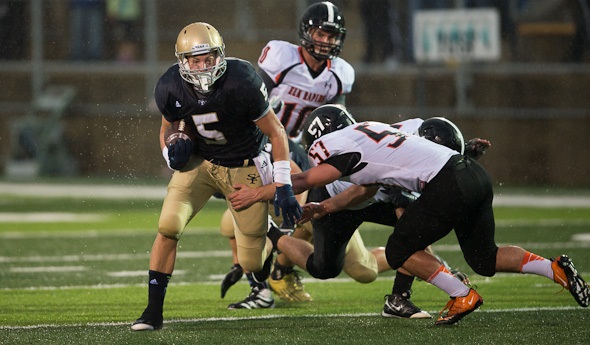
Traverse City St. Francis 12, Elk Rapids 7
The Gladiators have bounced back well since an opening-night loss to Kingsley, moving to 2-1 against an Elk Rapids team that is likely better than its 1-2 record. The Elks also fell on opening night, to Mancelona, which won 10 games in 2011. With St. Francis not playing in the Lake Michigan Conference this season after winning it a year ago, Elk Rapids could be the team that pushes Grayling for the league title. Click to read more from the Traverse City Record-Eagle.
Also noted:
Pellston 7, Rogers City 6 – The Hornets made a first-quarter touchdown stand to move to 3-0 for the first time since 1995 and equal their highest win total of the last decade.
Benzie Central 8, Frankfort 6 – This was looking like a bit of a must-win for Benzie Central after an 0-2 start, and is a big first step toward defending the Northwest Conference title.
McBain 19, Manton 14 – The Ramblers stopped a Manton offense that had scored at least 40 points in each of its first two games this season.
Cadillac 44, Petoskey 14 – One of these two has won the Big North Conference every season dating to 2008; Cadillac is the favorite now.
Upper Peninsula
Negaunee 36, Gladstone 34
The Miners (3-0) pushed their winning streak over Gladstone to three straight with this second consecutive win over the Braves by a field goal or less. Negaunee entered the fourth quarter trailing by 14 points, but scored twice during the final six minutes to stay perfect this fall. Gladstone fell to 2-1, but has plenty to be pleased about after finishing winless in 2011. Click to read more from the Marquette Mining Journal.
Also noted:
Crystal Falls Forest Park 13, Hurley 12 – The Trojans avenged last season’s lone regular-season loss and became favorites in the Great Western Conference.
L’Anse 45, Ontonagon 6 – The Purple Hornets eclipsed last season’s win total and moved to 3-0 by beating a team with three straight playoff appearances.
Norway 14, Stephenson 8 – The Knights equaled last season’s win total by moving to 2-1, also by beating a team that is coming off three straight playoff berths.
Eben Junction Superior Central 61, Posen 40 – The 8-player game has proven high-scoring, but this is the first matchup this season to result in more than 100 combined points with the losing team scoring at least 40.
Trophy Games
Each week, the MHSAA highlights trophy games around the state. Here's one from Week 3.
- The Wooden Oar Trophy: Fruitport and Spring Lake launched this award last week, dubbing their matchup the Bayou Battle. Final: Fruitport 15, Spring Lake 6.
PHOTO: Traverse City St. Francis' Byron Bullough (5) works to break a tackle by Elk Rapids' Ryan Simpson (57) during Friday's 12-7 Gladiators win. (Click to see more at Terry McNamara Photography.)