


Tales of the Tape from Bygone Days
September 10, 2014
By Rob Kaminski
MHSAA benchmarks editor
How’s this for a new reality/espionage TV series? Participants have just hours to exchange valuable video to counter-intelligence representatives at random drop points along state highways, then return to home base, study the footage and devise an action plan that same day.
Oh, and there are no cell phones or any other form of portable communication should plans go awry en route.
For longtime Escanaba High School football coach Dan Flynn, it’d be like watching reruns of his days as an assistant coach for the Eskymos. As one of the largest schools in the Upper Peninsula, Escanaba’s road through the MHSAA Playoffs almost always meant facing opponents from below the bridge, which made film exchange a challenge to say the least.
“I’ve logged thousands of miles, maybe more than anyone ever, exchanging film, tapes and DVDs with our opponents during the MHSAA Playoffs,” Flynn said.
“Being in Region 1 geographically, we knew we’d travel,” Flynn added. “And you couldn’t afford to just look at anyone and everyone that you might play. You had to do your homework to narrow down possible opponents if you wanted to go and scout.”
Today, with the MHSAA publishing Football Playoff Points on a weekly basis following Week 4, much of the guesswork as to potential first-round opponents has disappeared.
Additionally, most schools upload game footage to the web within 24 hours following each contest. On Selection Sunday, within minutes after a school’s Pre-District foe is announced, a coaching staff and players can be watching video of their opponent.
“We’d started calling coaches or they’d call me in Week 8 or 9, looking at possible matchups and also planning a place to meet to exchange film,” Flynn said.
Plans had to be firm and communications had to be clear, because once hitting the road, there was no way to contact one another.
“This was before cell phones,” Flynn explained. “I had one of first cell phones, which actually was an old bag phone. I’d accumulate outrageous rates for roaming charges going tower to tower.”
Old-school video exchange might be a thing of the past, but a generation of high school football coaches will never forget gas stations, fast-food joints and 24-hour stores nestled off exit ramps across Michigan.
“On that Sunday night, I’d get in the car, and typically drive to Gaylord, or maybe Grayling. In Gaylord it would be the McDonald’s. In Grayling, it’d be Glen’s Food Market. You’d try to arrange to meet at a place that was open 24 hours,” Flynn recalled. “I always got in the car understanding the meeting would be below the (Mackinac) Bridge. Sometimes we’d get lucky and the meeting place would be the Shell gas station just below the bridge on the Mackinaw City side.”
The 200-mile drive to Gaylord routinely took four hours. The further Escanaba advanced in the playoffs, the more times Flynn wore down the tread on his tires. He specifically recalls a hectic weekend in 1979, when Escanaba traveled to Lansing Sexton and defeated Livonia Stevenson in the MHSAA Semifinals to earn a berth in the Finals the following weekend vs. Detroit Catholic Central. Part of the reward for Flynn was another trip to McDonald’s.
“We came from behind in that Semifinal, and we were thrilled that we were going to the Finals. We got back home late Saturday night, then I got in the car the next morning to meet the Catholic Central coaches at 1 p.m.,” Flynn said.
“Coach (head coach Jerry) Cvengros had a meeting set for 5 or 6 that night. I made it back in time, but our guys were still feeling good about the win, so I suggested we hold off a day before showing them the CC film (16 mm film, by the way). Those guys were pretty good.”
Indeed they were, winning the Class A title the following weekend. The Eskymos, however, would return to the Final in 1981, winning the crown, 16-6 over Fraser, as Flynn no doubt logged more miles in preparation.
The most pressing concern today might be quality of the online video, lighting at the fields, or angle of the camera.
Back in the day, just getting a tape felt like victory.
“One year, I traveled all the way to the southeast part of the state, and the opposing coach simply wouldn’t exchange,” said Flynn, explaining that playoff film exchange at the time was only a recommendation, not a regulation. “I learned later that the coach had video of us from a friend who lived in Escanaba. I left on Saturday morning and came back Sunday night. We did eventually get some film later in the week. We lost by two points, but as coaches we didn’t make it a big vendetta and were up front with our kids.”
The MHSAA Representative Council, which included Flynn at the time, upgraded film exchange from a recommendation to a playoff policy in 1990, when schools were required to supply one another with the two most recent game films.
Even so, and as 16 mm film evolved to VHS tapes and then DVDs, coaching delegates still had to make itineraries for October and November weekends. Sometimes twice in the same weekend.
“Even with advancements in technology as we progressed from DVDs to digital, you still need people to operate the devices,” Flynn said. “I met another coach at the Shell station at the Bridge, but he said our software wasn’t compatible with theirs. I drove back the next day, pushed a button, and it worked. I drove all that way to push a button; 16 mm film would have been better.”
Today’s coaches might be a bit more well-versed in technology than those of Flynn’s era, and it’s a good thing. They likely need MapQuest and a GPS to traverse the regions in Northern Michigan that Flynn and his cohorts knew like the back of their hands.
Dow Charged to Make Deep Playoff Run
November 10, 2015
By Bill Khan
Special for Second Half
MIDLAND — When Midland Dow football players looked at the playoff accomplishments of past Chargers teams, it felt like they were getting a lesson in ancient history.
 There was the 1976 team that won the MHSAA Class A championship back when there were only two rounds in the playoffs. There was the 1997 squad that reached the Class A title game, winning three times in the postseason before losing to Farmington Hills Harrison at the Pontiac Silverdome.
And that's it.
For a program as consistently solid as Dow, it seems strange that only two teams in school history were able to win more than one playoff game.
"Sometimes it's matchups, sometimes it's getting a couple breaks to go your way," Dow coach Jason Watkins said. "When you get to this round of the playoffs, all the teams are going to be good."
So far, none of the teams in their path have been better than the Chargers.
They have made a task that has been difficult for past Dow teams look easy, winning 42-7 over crosstown rival Midland in the first round before beating Fenton, 41-14, in the District championship game.
"It's a big win for the development of the program," Watkins said after eliminating Fenton for the second time in three years. "Since 2010, this is our fourth trip to this round; we came away empty each time. It's nice to be able to finish that and get that District championship. It's a good landmark for us. Let's try to grow the program."
The 10th-ranked Chargers (10-1) will travel to second-ranked Walled Lake Western (11-0) on Saturday to play for the Regional championship.
"It's awesome," Dow junior quarterback Bruce Mann said. "We're gonna be on the board for a long time. People are going to be able to see us and remember us."
It hasn't been a lack of opportunities that has made this season's achievement so rare for Dow. Beginning with the unbeaten 1976 MHSAA championship team, Dow has 30 winning seasons in the last 40. The Chargers have made the playoffs nine times in the last 19 years.
They won their playoff opener each of the past two years and in three of the previous five years, but had their seasons end in the second round.
"It feels great," Dow senior receiver Justin Cook said. "I've been on two losing teams in the District Finals the past two years. The third time's the charm, I guess. It feels really good to finally get the (second-round) win. We're clicking at the right time. We're getting better each week."
Those currently wearing the green and gold of Dow are mindful of those who went before them, laying the foundation for such a strong program.
"It's huge for everyone that is involved, all of the past classes who didn't make it this far or got beat at this step," senior receiver Mike Robb said. "It's a big deal."
 The season didn't begin like one that was shaping up to be special. The Chargers lost their opener to Mount Pleasant, 34-20. Not that there's any shame in that — the Oilers are 9-2 and still alive in Division 3.
In that game, Mann had only 26 yards of offense in the first half, as Dow fell behind 21-0 by halftime. He had 281 yards in the second half — and hasn't slowed up since.
It was Mann's first game in a Dow uniform after playing varsity as a freshman and sophomore for Bay City Western, where his dad, also Bruce Mann, formerly was the coach.
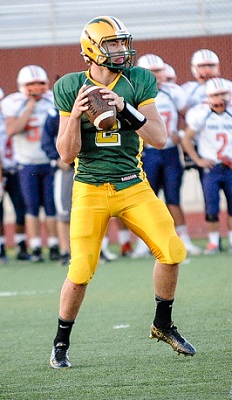
Led by Mann, the Chargers have scored at least 41 points in each of the last five games. Over that span, he is 81 for 109 (74.3 percent) passing for 1,451 yards and 24 touchdowns. For the season, he has 35 touchdown passes and only four interceptions in leading Dow to 10 consecutive victories.
"Coming into Dow, I had a bunch of friends, so it didn't take long to jell," Mann said. "It was just me calming down and realizing I'm not the only player and I have 10 other teammates behind me helping me succeed."
Mann has spread the wealth, throwing 11 touchdown passes to Robb, and nine apiece to Cook and Devontae Stine.
"Bruce has been picking up the offense each week," Cook said. "He's playing out of his mind. Every week, he's getting better. You can tell by the way he plays. He doesn't turn the ball over anymore."
Robb, the team's most dangerous receiving weapon, has become a dual threat in recent weeks.
Watkins moved him to defense for the regular-season finale against Midland. In that game, Robb returned an interception for a touchdown, in addition to catching four touchdown passes. In the playoff rematch a week later, Robb had two interceptions, returning one for a touchdown. Robb's hot streak continued against Fenton, as he caught two touchdown passes, blocked a punt and grabbed his fourth interception in three games.
"Right time, right place," Robb said of his newfound knack for picking off passes. "I love playing football. Wherever coach wants to put me, that's where I'll play."
"He's always been a special teams and offensive player for us," Watkins said. "We only moved him up to defense two weeks ago. It's something we saw in the scheme of things and the teams we were playing against. There was an opportunity to use his athleticism and some of his natural instincts. He's been on a pretty good little run the last couple weeks."
The same could be said for the Chargers as a whole, as they attempt to further enhance their legacy.
Years from now, perhaps 2015 will be spoken of with the same sense of awe as 1976 and 1997.
 Bill Khan served as a sportswriter at The Flint Journal from 1981-2011 and currently contributes to the State Champs! Sports Network. He can be reached at [email protected] with story ideas for Genesee, Lapeer, St. Clair, Sanilac, Huron, Tuscola, Saginaw, Bay, Arenac, Midland and Gladwin counties.
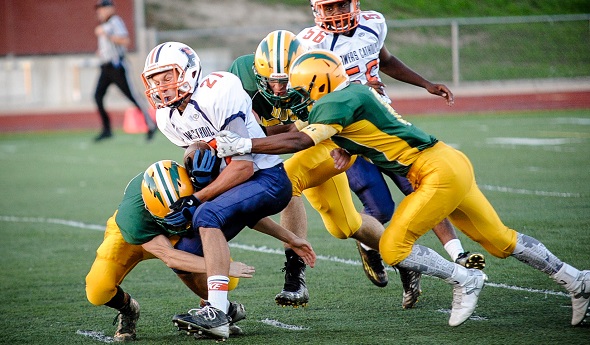
PHOTOS: (Top) A collection of Dow defenders makes a tackle during a win this season against Flint Powers Catholic. (Middle) Chargers quarterback Bruce Mann has thrown 35 touchdown passes this fall. (Click for more from HighSchoolSportsScene.com.)