

Tales of the Tape from Bygone Days
September 10, 2014
By Rob Kaminski
MHSAA benchmarks editor
How’s this for a new reality/espionage TV series? Participants have just hours to exchange valuable video to counter-intelligence representatives at random drop points along state highways, then return to home base, study the footage and devise an action plan that same day.
Oh, and there are no cell phones or any other form of portable communication should plans go awry en route.
For longtime Escanaba High School football coach Dan Flynn, it’d be like watching reruns of his days as an assistant coach for the Eskymos. As one of the largest schools in the Upper Peninsula, Escanaba’s road through the MHSAA Playoffs almost always meant facing opponents from below the bridge, which made film exchange a challenge to say the least.
“I’ve logged thousands of miles, maybe more than anyone ever, exchanging film, tapes and DVDs with our opponents during the MHSAA Playoffs,” Flynn said.
“Being in Region 1 geographically, we knew we’d travel,” Flynn added. “And you couldn’t afford to just look at anyone and everyone that you might play. You had to do your homework to narrow down possible opponents if you wanted to go and scout.”
Today, with the MHSAA publishing Football Playoff Points on a weekly basis following Week 4, much of the guesswork as to potential first-round opponents has disappeared.
Additionally, most schools upload game footage to the web within 24 hours following each contest. On Selection Sunday, within minutes after a school’s Pre-District foe is announced, a coaching staff and players can be watching video of their opponent.
“We’d started calling coaches or they’d call me in Week 8 or 9, looking at possible matchups and also planning a place to meet to exchange film,” Flynn said.
Plans had to be firm and communications had to be clear, because once hitting the road, there was no way to contact one another.
“This was before cell phones,” Flynn explained. “I had one of first cell phones, which actually was an old bag phone. I’d accumulate outrageous rates for roaming charges going tower to tower.”
Old-school video exchange might be a thing of the past, but a generation of high school football coaches will never forget gas stations, fast-food joints and 24-hour stores nestled off exit ramps across Michigan.
“On that Sunday night, I’d get in the car, and typically drive to Gaylord, or maybe Grayling. In Gaylord it would be the McDonald’s. In Grayling, it’d be Glen’s Food Market. You’d try to arrange to meet at a place that was open 24 hours,” Flynn recalled. “I always got in the car understanding the meeting would be below the (Mackinac) Bridge. Sometimes we’d get lucky and the meeting place would be the Shell gas station just below the bridge on the Mackinaw City side.”
The 200-mile drive to Gaylord routinely took four hours. The further Escanaba advanced in the playoffs, the more times Flynn wore down the tread on his tires. He specifically recalls a hectic weekend in 1979, when Escanaba traveled to Lansing Sexton and defeated Livonia Stevenson in the MHSAA Semifinals to earn a berth in the Finals the following weekend vs. Detroit Catholic Central. Part of the reward for Flynn was another trip to McDonald’s.
“We came from behind in that Semifinal, and we were thrilled that we were going to the Finals. We got back home late Saturday night, then I got in the car the next morning to meet the Catholic Central coaches at 1 p.m.,” Flynn said.
“Coach (head coach Jerry) Cvengros had a meeting set for 5 or 6 that night. I made it back in time, but our guys were still feeling good about the win, so I suggested we hold off a day before showing them the CC film (16 mm film, by the way). Those guys were pretty good.”
Indeed they were, winning the Class A title the following weekend. The Eskymos, however, would return to the Final in 1981, winning the crown, 16-6 over Fraser, as Flynn no doubt logged more miles in preparation.
The most pressing concern today might be quality of the online video, lighting at the fields, or angle of the camera.
Back in the day, just getting a tape felt like victory.
“One year, I traveled all the way to the southeast part of the state, and the opposing coach simply wouldn’t exchange,” said Flynn, explaining that playoff film exchange at the time was only a recommendation, not a regulation. “I learned later that the coach had video of us from a friend who lived in Escanaba. I left on Saturday morning and came back Sunday night. We did eventually get some film later in the week. We lost by two points, but as coaches we didn’t make it a big vendetta and were up front with our kids.”
The MHSAA Representative Council, which included Flynn at the time, upgraded film exchange from a recommendation to a playoff policy in 1990, when schools were required to supply one another with the two most recent game films.
Even so, and as 16 mm film evolved to VHS tapes and then DVDs, coaching delegates still had to make itineraries for October and November weekends. Sometimes twice in the same weekend.
“Even with advancements in technology as we progressed from DVDs to digital, you still need people to operate the devices,” Flynn said. “I met another coach at the Shell station at the Bridge, but he said our software wasn’t compatible with theirs. I drove back the next day, pushed a button, and it worked. I drove all that way to push a button; 16 mm film would have been better.”
Today’s coaches might be a bit more well-versed in technology than those of Flynn’s era, and it’s a good thing. They likely need MapQuest and a GPS to traverse the regions in Northern Michigan that Flynn and his cohorts knew like the back of their hands.
Ida Builds Greatest Season 'Brick by Brick'
By
Chip Mundy
Special for Second Half
November 5, 2015
By Chip Mundy
Special for Second Half
IDA – As the greatest football season in Ida High School history rolls into the second week of the MHSAA playoffs, it could be said that winning isn’t even the best thing the Bluestreaks have done this year.
 Winning certainly hasn’t been the most important thing they did this season.
With the community strongly backing the program throughout its undefeated season to date, which continues tonight in a Division 5 District Final at home against Dearborn Heights Robichaud, the team has given back – while building a collection of memories they will cherish no matter how long this history-making trip rolls on.
From hosting a fundraiser that hit much closer to home than they anticipated, to welcoming back a beloved member of the program after a health scare – and all while putting together the most successful run in school history – Ida has had a season to remember, even as it works to add more moments before the run is done.
Supporting a new teammate
The regular-season finale was designated as a fundraiser for childhood cancer awareness, and the game against rival Erie-Mason raised more than $4,000 for the St. Baldrick's Foundation, a private institution in California that gives grants to children who are battling cancer.
“I had seen something on Facebook and looked into it and decided that we needed to do something other than just get ready for football games,” Ida coach Tom Walentowski said. “We scheduled our Game 9 as a gold-out game with one of our rivals, Erie-Mason, and we raised money for childhood cancer awareness. The kids got big into that.”
Unknown at the time of the decision to raise funds for childhood cancer awareness, Chloe Arnold, a 5-year-old resident of the Ida community, was battling leukemia.
The close-knit Bluestreaks had room in their hearts to join another team. They joined Team Chloe. And in the regular-season finale, Team Chloe also was able to raise money through sales of merchandise.
One unique item was a helmet that had an Ida decal on one side and an Erie-Mason decal on the other. Players from both teams signed the helmets, which then were donated to Team Chloe for a silent auction that raised $665. A total of $2,315.42 was raised that night for Team Chloe.
“Gold is the color for cancer childhood awareness, and gold is in our school colors and it’s also in Erie-Mason’s school colors, so that’s why we decided that would be the game to do the gold-out,” Walentowski said. “We sold over 500 T-shirts. The kids were really into it.”
The greatest season
Entering the 2011 season, Ida had made the playoffs just three times and finished a regular season undefeated just once – in 1971. The Bluestreaks suddenly have made making the postseason a habit, going 6-3 before losing in the first round in 2011, just missing the postseason at 5-4 in 2012 and then returning to the playoffs each of the past three seasons. Last year, the team finished 8-3, tying the program record for victories with its most since 1991.
That is quite a turnaround for a program that had just three winning seasons from 1999-2010. The reversal of fortunes has been impressive. Prior to 2013, Ida had never scored more than 259 points in a season. The Bluestreaks scored 346 in 2013 and 349 in 2014, and they already have scored 428 this year.
This isn’t just an offensive juggernaut, either. Ida has allowed only 87 points through 10 games.
When asked what has made the difference, Walentowski opened the door to the weight room, where the players were busy doing their lifting on a Monday afternoon, and simply said, “These guys.”
Ida steamrolled its first seven opponents by a combined score of 310-40. Then, in the eighth week, Ida was tested. The Bluestreaks trailed Hillsdale 7-0 at halftime and pulled out a 20-17 victory in double overtime.
 “I think when you come out at halftime and you’re down 7-0 and you win the game, obviously that helps your confidence,” Walentowski said. “They never got rattled, they just went about their game.
“When you do that, it just reaffirms to them that you just keep playing your game and things will be fine.”
Ida completed the perfect regular season with a 63-7 victory over Erie-Mason and then won its first playoff game 35-23 over Ann Arbor Father Gabriel Richard. It was just the second home playoff game in school history, and tonight’s game will be the third.
“I love hearing all of our fans roar when we get a first down or a touchdown,” senior quarterback David Kolakowski said.
Needless to say, the Ida community has gotten behind the winning football team in a big way.
“We hear from a lot of coaches from other teams that they have never known a football team that had such a good community like we do,” senior guard/linebacker Mike Zlonkovicz said. “We drove into town on playoff day, and there was the score from every game on the light posts.
“It was really touching to see that. We’re not only representing the entire school but the entire town.”
The Bluestreaks run an odd-front defense and an offense that so heavily relies on the running game that Walentowski said the old saying of “three yards and a cloud of dust” offense applies to this team in phrase only.
“We don’t like three yards, though,” he said. “We prefer to average eight or nine.”
Ida boasts a pair of 1,000-yard running backs in Eric Bugg and Nick Levicki. Bugg broke the single-season rushing record and also has scored the most touchdowns in school history. Levicki is second on the all-time touchdown list.
“Eric is, I guess for lack of a better term, he’s the poster boy of this team,” Walentowski said. “He is really a good young man. He’s a 3.5 student, he’s solid in the classroom, he’s a great citizen, he’s humble, he just works hard. He doesn’t particularly care for all the fanfare.”
Bugg said the pressure from last season’s success weighed on his mind this season.
“I didn’t know how to live up to it since we did so well last year,” he said. “We’re just trying to beat how we progressed last year, and so far we have.
“We have to get past districts and keep doing what we’re doing.”
Brick by brick
Defensive line coach Gary Deland delivers a motivating speech prior to every game. His topic this week was “brick by brick.” The players listen to him, and that message had extra importance because Deland is experiencing it in his personal life.
Midway through the season, Deland had to undergo emergency triple-bypass heart surgery, but he is back on the sidelines coaching the team and progressively getting better from week to week. In his words, he is improving brick by brick.
“He didn’t know it at the time, but in the first half of our first game against Jefferson, he was having a heart attack,” Walentowski said of Deland. “He got through the game and said his chest was bothering him, but he thought it was indigestion.
“A couple of weeks later it was still kind of bothering him on and off, and he said he should get it checked. We were getting ready to play Blissfield, which was Game 4, and he went to the hospital on Wednesday morning, and they said you’re not leaving, you are having open-heart surgery Thursday morning.”
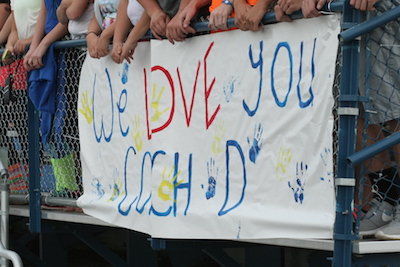 A week after triple-bypass heart surgery, Deland was back, giving a motivational speech to the players.
“It was a great talk,” Walentowski said. “He has quite a personality, and the kids love him. For us, it was like we hadn’t better screw anything up before Coach D gets back here. I think we all had that attitude.
“The following week, he was back on the sidelines.”
It seemed like nothing was going to keep Deland from returning to his boys.
“It was a blur,” Deland said. “I was less than a few weeks out of surgery, and I was back on the sidelines. My doctor did not approve, but he knew I was going to be on the sidelines and he wasn’t going to be able to stop me.
“I was there; I was with my team. These are a great group of kids. They work hard, and they deserve everything the coaching staff can give them, and that’s why I wanted to be there for them. They have been there for this school and this community all year long.”
Although Deland said he blocks out thinking about his health on the sidelines, the players remain very aware of it.
“The kids have gone out of their way to protect me on the sidelines,” he said. “When a play is coming out of bounds, I have to get out of the way. I cannot get run over. So they do protect me on the sidelines so I don’t get run over by any play out of bounds.
“The doctor doesn’t want me to get too excited, and I try not to. Each week I can feel the momentum of my strength coming back, and I get a little more vocal and a little more animated on the sidelines.
“I have a passion for football, and the kids know it. They know I can blow up at any time, or I can be the grandfather for them.”
And, every week, he is the motivator with his speeches.
“From that very first practice in the summer to the last game as a senior, everything is built brick by brick,” Deland said. “I can draw a correlation between that and my recovery, what I’ve gone through. It’s the same thing. It’s brick by brick.
“You might take two steps forward, and you think you’re getting on to where you want to be as a team, and I might be getting on to how I want to feel, and the next thing you take that giant step backwards. You don’t feel so great, or all of a sudden you were praised by the coach the day before and now you’re screwing up every which way.
“But you’re still going forward, and that is how I paint my recovery, brick by brick, the same as this team. They will progress in the season and the playoffs brick by brick.”
Nobody knows how the season will end, but it already is the greatest football season in school history. The Bluestreaks are giving back to the community with their work for childhood cancer awareness, and they are banding together to win football games.
It is the time of their young lives.
“Being a quarterback was not always my intention,” Kolakowski said. “I was a wide receiver, but in my JV season I had to play quarterback. Then, in the playoff game, I was like, ‘It would be so sweet to be able to run this offense,’ and now I’m getting to live out my dream, which is awesome.”
It is a season that has been building, excuse the expression, brick by brick.
“I think these guys have had a lot of goals,” Walentowski said. “Six of the seniors were with us as sophomores, and there were two freshmen who were with us back then, so those eight kids, they’re still here, and they’ve been building every year.
“They expected to work hard and do well, and that’s what they’re doing. They don’t just like to play football, they like to play football together. There’s a big difference.”
 Chip Mundy served as sports editor at the Brooklyn Exponent and Albion Recorder from 1980-86, and then as a reporter and later copy editor at the Jackson Citizen-Patriot from 1986-2011. He also co-authored Michigan Sports Trivia. E-mail him at [email protected] with story ideas for Jackson, Washtenaw, Hillsdale, Lenawee and Monroe counties.
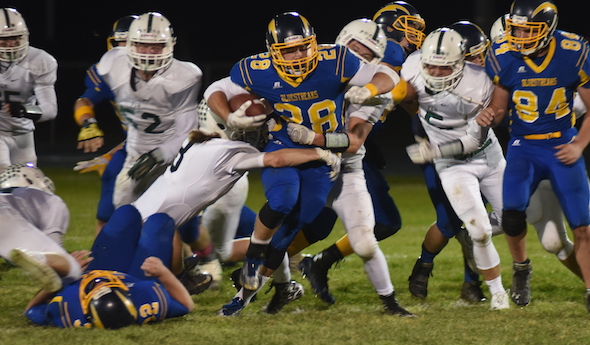
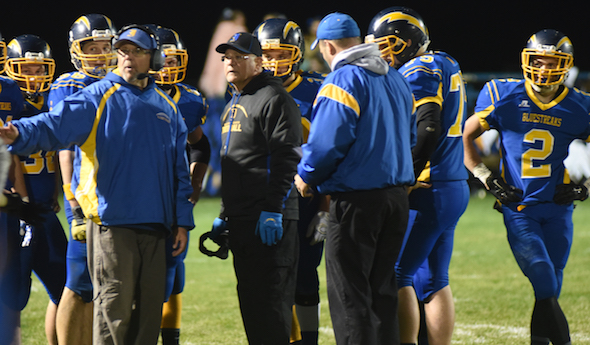
PHOTOS: (Top) Ida running back Nick Levicki attempts to run through tacklers during his team's win over Ann Arbor Gabriel Richard last week. (Middle) Head coach Tom Walentowski, far left, and assistant Gary Deland talk things over with the team looking on. (Below) Fans hung a sign supporting Deland upon his return. (Top and middle photos by Ray Leighton. Bottom photo by Kim Farver.)