

Talking Practice: Texas, Illinois Revise Policies
December 20, 2013
By Rob Kaminski
MHSAA benchmarks editor
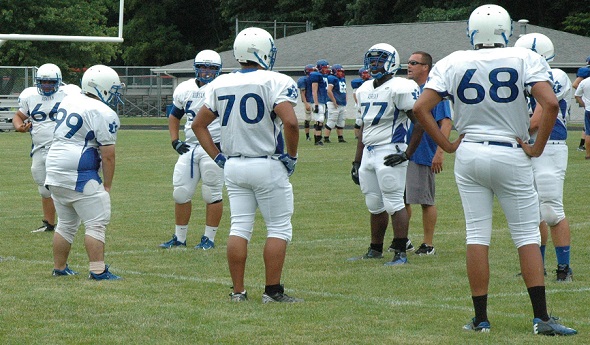
Coaches and players in Texas and Illinois adapted to new football practice limitations this fall, with the Texas policy focusing on contact, and the Illinois regulation emphasizing length of preseason practices.
Following are the main changes those states put in place heading into the 2013-14 season:
The University Interscholastic League, which governs school sports in Texas, put into writing that, “During the regular season and postseason, no football player is allowed to participate in more than ninety (90) minutes of full contact practice per week,” effective with the first day of practice this fall.
The complete policy follows:
For the purposes of the of rule, "full contact" is defined as football drills or live game simulations where "live action" occurs. Live action, as defined by USA Football, is contact at game speed where players execute full tackles at a competitive pace taking players to the ground. A team may continue to dress in full pads for practice, but may only participate in live action drills and game time simulations no more than ninety minutes per athlete per week. It is assumed that when players are in shells (shorts, shoulder pads, and helmets) no live action drills or simulations will occur. This rule is intended to limit live action drills and simulations and not the number of practices a team may participate in full pads. A team may participate in "air," "bags," "wrap," and "thud" drills and simulations at any point. These contact levels are defined below:
• Air - Players should run unopposed without bags or any opposition
• Bags - activity is executed against a bag, shield or pad to allow for a soft-contact surface, with or without the resistance of a teammate or coach standing behind the bag.
• Wrap - Drills run at full speed until contact, which is above the waist with the players remaining on their feet.
• Thud - Same as wrap but tempo is competitive with no pre-determined winner and the players are not tackling to the ground.
 The rule came to the UIL Legislative Council as a recommendation from the UIL Medical Advisory Committee, a permanent advisory committee to the Legislative Council which meets twice each year to discuss and review safety policies for UIL participants. The committee, which is made up of leading medical professionals in various specialties and includes representatives from the Texas High School Coaches Association, the Texas Girls Coaches Association, and the Texas State Athletic Trainer Association, unanimously recommended this limitation in full-contact football practice.
The rule formulates into a formal policy the existing actions of the majority of coaches across Texas, and most coaches have had to make few adjustments, if any. In fact, according to a story on statesman.com, the proposal caused more of an uproar on social media than from coaches.
“It’s not going to affect us in anyway,” Vandegrift HS coach Drew Sanders said in the story. “Most good coaches were way below that 90-minute amount already. Prior to legislation we still monitored it ourselves – the only change is now we have to keep up a log more publicly.”
Illinois put standards in place for its first 14 days of football practices, known as the state’s Preseason Football Acclimatization Practice Period. At the core of the policy is a three-hour practice limit for the first five days, during which teams can also conduct a one-hour walk-through.
 Teams must observe a minimum two hours rest between the practices and walk-throughs. Players may wear helmets only on the first two days, then helmets and shoulder pads for the next three. From days seven through 14 of the acclimatization period, schools may practice for a maximum of five hours per day, as long as that day is followed by a three-hour day, or an off day. During the five-hour days, no session can last more than three hours and must include a two-hour break between practices. Full pads may be worn for the final seven dates leading up to the first contest.
“This policy was the result of a collaborative effort between the IHSA Sports Medicine Advisory Committee and the Football Advisory Committee,” said SMAC committee member and University of Illinois Associate Professor of Orthopedic Surgery Dr. Preston M. Wolin. “The guidelines are based on the most recent scientific evidence, as well as the expertise of the coaches who will help implement them. Both committees believe the guidelines represent a significant positive contribution to the health of our athletes.”
“This new policy undoubtedly changes the way we, as coaches, approach preseason practice,” said Metamora HS coach Pat Ryan, who is a member of the FAC and a past President of the Illinois High School Football Coaches Association. “Coaches have to get more creative with when and how they schedule practices, as well what they do with their time. The proposals were strongly supported by both committees. It is a crucial final step to the process of being able to effectively prepare our teams in a safe manner. Change is always difficult, but the game is changing and we need to adapt to continue to put the safety of our players first.”
The IHSA offered multiple interactive online webinar meetings for high school coaches leading up to the start of practice where questions were answered, along with further clarifications on the policy and the science behind it.
“I think most coaches understood that changes were on the horizon,” said IHSA Executive Director Marty Hickman. “We wanted to be in a position to give our coaches as much information as possible to make sure they are comfortable with the new policy. Their input will be critical moving forward as we develop educational materials, like a best practices presentation. I commend our committees on a policy that is supported by medical experts, football coaches and school administrators.”
Drive for Detroit: Week 5 Preview
September 26, 2019
By Geoff Kimmerly
Second Half editor
With 600 high school teams in Michigan and good games always to be found, just about any week could be called “Rivalry Week” as the term is often hyped at the college and pro levels.
 But this week in this state is a little more special this fall.
A number of the best rivalries – longtime or emerging – will be played out over the next two days, and we offer a glance at a number of those games below. You’ll have a chance to check out a bunch, as seven of the games mentioned in this preview are among the 32 that will be broadcast live on MHSAA.tv – click here for the schedule.
"Drive for Detroit" is sponsored by MI Student Aid.
Bay & Thumb
Grand Blanc (4-0) at Davison (4-0)
These teams entered this game last season under almost identical circumstances – and Davison exited with a 49-7 win on the way to finishing second to Lapeer in the Saginaw Valley League Blue. Those three appear to be the main title contenders again, and Davison has won its first two Blue games by a combined 104-0 while Grand Blanc also opened league play last week with a shutout. Last season’s loss started a rough finish for the Bobcats, and they face a tough regular-season second half again with Lapeer, Flint Powers Catholic and Saline coming up. Obviously, a win tonight would provide a sizable lift heading into that string.
Keep an eye on these: FRIDAY Harbor Beach (4-0) at Ubly (4-0), Saginaw Swan Valley (3-1) at Frankenmuth (4-0), Fenton (3-1) at Flint Kearsley (4-0), Breckenridge (3-1) at Merrill (3-1).
Greater Detroit
Macomb Dakota (3-1) at Clinton Township Chippewa Valley (4-0)
One of the best rivalries in the state again matches up the teams tied for first in the Macomb Area Conference Red. Chippewa Valley is riding an 18-game winning streak after claiming last season’s Division 1 championship and has won four straight over Dakota – with victories over the Cougars during the playoffs as well the last two seasons. Dakota’s only slip-up this fall came Week 1 against still-unbeaten Orchard Lake St. Mary’s, and it will be interesting to see how this meeting shakes out. The Big Reds won by only seven, 24-17, the first time they played in 2018 but 51-10 in the District Final rematch.
Keep an eye on these: FRIDAY West Bloomfield (3-1) at Lake Orion (4-0), Brownstown Woodhaven (4-0) at Allen Park (3-1), North Farmington (4-0) at Auburn Hills Avondale (3-1), Warren De La Salle Collegiate (2-2) at Orchard Lake St. Mary's (4-0).
Mid-Michigan
Portland (4-0) at Lansing Catholic (4-0)
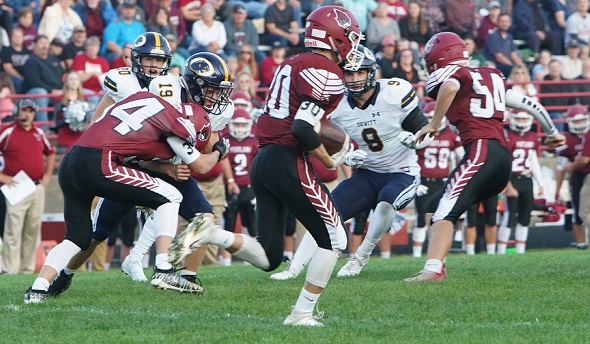
This one gets top billing by just a smidge over East Lansing/DeWitt, as Portland can claim supremacy in the Lansing area so far thanks to its two-point Week 2 win over the Panthers. The Raiders have otherwise dominated coming off last year’s Division 5 runner-up finish, but Lansing Catholic surely has been looking forward to this opportunity. Not only will tonight’s game likely eventually decide the Capital Area Activities Conference White champion, but Portland handed the Cougars their only two losses last season – by a combined 12 points.
Keep an eye on these: FRIDAY East Lansing (3-1) at DeWitt (3-1), Sanford Meridian (4-0) at Clare (4-0), St. Johns (3-1) at Mason (4-0), Laingsburg (3-1) at Pewamo-Westphalia (4-0).
Northern Lower Peninsula
Johannesburg-Lewiston (4-0) at Tawas (3-1)
The Cardinals are tied for first in the Northern Michigan Football League Legacy division after winning the title outright a year ago, and they’ve dominated for most of 2019 so far. But this nonleague meeting starts a string of games against four straight playoff hopefuls. Tawas was a qualifier last season and this fall is just a two-point opening-night loss to Alcona from a perfect start as well.
Keep an eye on these: FRIDAY Charlevoix (3-1) at Frankfort (2-2), Mancelona (2-2) at Elk Rapids (2-2). SATURDAY Alpena (2-2) at Traverse City West (2-2), Gaylord (2-2) at Traverse City Central (3-1).
Southeast & Border
Marshall (3-1) at Jackson Lumen Christi (4-0)
By nature of this kind of success, as Lumen Christi’s state-best 27-game winning streak continues to grow, every matchup will be scrutinized that much more. The Titans have beaten Marshall in three straight but scored a season low in last year’s 21-0 shutout of the Redhawks. And this is a better Marshall team; after three straight seasons winning three or four games, Marshall is a one-point opening-night loss to Freeland from 4-0. Meanwhile, another win could just about seal up the Interstate 8 Athletic Conference title for Lumen – its final three league opponents are a combined 3-9.
Keep an eye on these: FRIDAY Chelsea (4-0) at Jackson (3-1), Britton Deerfield (3-1) at Sand Creek (3-1), Hillsdale (4-0) at Hudson (2-2), Brooklyn Columbia Central (3-1) at Onsted (2-2).
Southwest Corridor
Battle Creek Lakeview (4-0) at Kalamazoo Central (2-2)
Lakeview has had a nice run through the 2010s with five playoff appearances in a row from 2012-16. But last season the Spartans won two games, their fewest since 2002 – although that should be fading from memory with this start. A win tonight would bury it further, as defeating reigning champion Kalamazoo Central would earn Lakeview a share of the Southwestern Michigan Athletic Conference East title – its first since 2015. But making it happen might take the Spartans’ best performance so far. The Maroon Giants have suffered their two losses by just a combined seven points, and the last three meetings with Lakeview all have been decided by eight points or fewer.
Keep an eye on these: FRIDAY Cassopolis (4-0) at Decatur (2-2), Portage Central (2-2) at Stevensville Lakeshore (2-2), Benton Harbor (2-2) at Battle Creek Central (1-3). SATURDAY Delton Kellogg (3-1) at Schoolcraft (4-0).
Upper Peninsula
Lake Linden-Hubbell (3-1) at L'Anse (3-1)
These teams are enjoying similar jumpstarts this fall but with this nonleague matchup key to their postseason hopes. The Lakes were 10-1 as recently as 2016, but won just two games last season. A two-point Week 2 loss to Ishpeming is all that’s kept them from 4-0, but their next two games are against the leaders of their Western Peninsula Athletic Conference Iron division. Despite opening with a loss to Hancock, the Purple Hornets have equaled their win total from all of last season as they pursue a first playoff berth since 2013 – but with a tough slate of West PAC Copper games coming up to finish the regular season.
Keep an eye on these: FRIDAY Escanaba (3-1) at Kingsford (2-2), Iron Mountain (4-0) at Bark River-Harris (3-1), Boyne City (2-2) at Menominee (3-1), Ogemaw Heights (3-1) at Sault Ste. Marie (3-1).
West Michigan
Muskegon Oakridge (4-0) at Montague (4-0)
This has as much claim to being Michigan’s best matchup of the weekend as any listed above or below, after Montague won last year’s meeting 25-24 on a touchdown and 2-point conversion with no time left. Oakridge went on to win out before falling by three to eventual Division 5 champion Hudsonville Unity Christian in the District Final – meaning the Eagles’ two defeats were by a combined four points to teams that ended up at Ford Field. Montague was runner-up in Division 6 and opened 2019 by avenging last season’s loss to Reed City.
Keep an eye on these: FRIDAY Hudsonville Unity Christian (3-1) at Grand Rapids South Christian (3-1), Byron Center (4-0) at Zeeland West (4-0), East Kentwood (3-1) at Grandville (4-0), Manistee (3-1) at Muskegon Orchard View (4-0).
8-Player
Colon (4-0) at Climax-Scotts (4-0)
As expected, things got a little more competitive last week for Climax-Scotts as it continued to march through its first season of 8-player. But a 16-12 win over Camden-Frontier set the Panthers up to take on reigning Southern Central Athletic Association A champion Colon with an opportunity to win a share of the league title. The Magi have outscored their opponents by a combined 197-18 and have a few reasons to be amped. Not only does this stack up as one of the top 8-player matchups of the regular season statewide, but Climax-Scotts beat Colon in 11 straight 11-player games from 2008 through 2017.
Keep an eye on these: FRIDAY Vestaburg (4-0) at Portland St. Patrick (4-0), Mio (3-1) at Hillman (4-0), Cedarville (2-2) at Brimley (4-0), Martin (4-0) at St. Joseph Lake Michigan Catholic (2-2).
Second Half’s weekly “Drive for Detroit” previews are powered by MI Student Aid, a part of the Office of Postsecondary Financial Planning located within the Michigan Department of Treasury. MI Student Aid encourages students to pursue postsecondary education by providing access to student financial resources and information. MI Student Aid administers the state’s 529 college savings programs (MET/MESP), as well as scholarship and grant programs that help make college Accessible, Affordable and Attainable for you. Connect with MI Student Aid at www.michigan.gov/mistudentaid and find more information on Facebook and Twitter @mistudentaid.
PHOTO: Portland edged DeWitt 29-27 in Week 2. Both play this weekend in games that eventually could decide their leagues’ champions. (Click for more from HighSchoolSportsScene.com.)