

Talking Practice: Texas, Illinois Revise Policies
December 20, 2013
By Rob Kaminski
MHSAA benchmarks editor
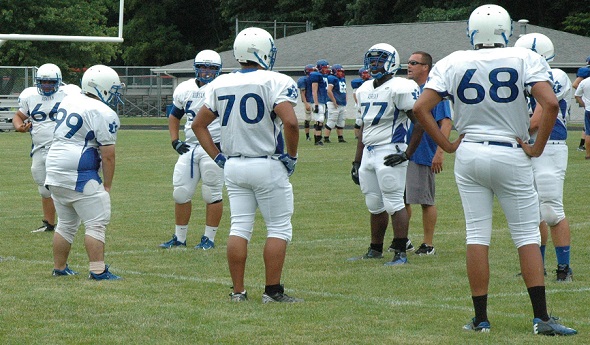
Coaches and players in Texas and Illinois adapted to new football practice limitations this fall, with the Texas policy focusing on contact, and the Illinois regulation emphasizing length of preseason practices.
Following are the main changes those states put in place heading into the 2013-14 season:
The University Interscholastic League, which governs school sports in Texas, put into writing that, “During the regular season and postseason, no football player is allowed to participate in more than ninety (90) minutes of full contact practice per week,” effective with the first day of practice this fall.
The complete policy follows:
For the purposes of the of rule, "full contact" is defined as football drills or live game simulations where "live action" occurs. Live action, as defined by USA Football, is contact at game speed where players execute full tackles at a competitive pace taking players to the ground. A team may continue to dress in full pads for practice, but may only participate in live action drills and game time simulations no more than ninety minutes per athlete per week. It is assumed that when players are in shells (shorts, shoulder pads, and helmets) no live action drills or simulations will occur. This rule is intended to limit live action drills and simulations and not the number of practices a team may participate in full pads. A team may participate in "air," "bags," "wrap," and "thud" drills and simulations at any point. These contact levels are defined below:
• Air - Players should run unopposed without bags or any opposition
• Bags - activity is executed against a bag, shield or pad to allow for a soft-contact surface, with or without the resistance of a teammate or coach standing behind the bag.
• Wrap - Drills run at full speed until contact, which is above the waist with the players remaining on their feet.
• Thud - Same as wrap but tempo is competitive with no pre-determined winner and the players are not tackling to the ground.
 The rule came to the UIL Legislative Council as a recommendation from the UIL Medical Advisory Committee, a permanent advisory committee to the Legislative Council which meets twice each year to discuss and review safety policies for UIL participants. The committee, which is made up of leading medical professionals in various specialties and includes representatives from the Texas High School Coaches Association, the Texas Girls Coaches Association, and the Texas State Athletic Trainer Association, unanimously recommended this limitation in full-contact football practice.
The rule formulates into a formal policy the existing actions of the majority of coaches across Texas, and most coaches have had to make few adjustments, if any. In fact, according to a story on statesman.com, the proposal caused more of an uproar on social media than from coaches.
“It’s not going to affect us in anyway,” Vandegrift HS coach Drew Sanders said in the story. “Most good coaches were way below that 90-minute amount already. Prior to legislation we still monitored it ourselves – the only change is now we have to keep up a log more publicly.”
Illinois put standards in place for its first 14 days of football practices, known as the state’s Preseason Football Acclimatization Practice Period. At the core of the policy is a three-hour practice limit for the first five days, during which teams can also conduct a one-hour walk-through.
 Teams must observe a minimum two hours rest between the practices and walk-throughs. Players may wear helmets only on the first two days, then helmets and shoulder pads for the next three. From days seven through 14 of the acclimatization period, schools may practice for a maximum of five hours per day, as long as that day is followed by a three-hour day, or an off day. During the five-hour days, no session can last more than three hours and must include a two-hour break between practices. Full pads may be worn for the final seven dates leading up to the first contest.
“This policy was the result of a collaborative effort between the IHSA Sports Medicine Advisory Committee and the Football Advisory Committee,” said SMAC committee member and University of Illinois Associate Professor of Orthopedic Surgery Dr. Preston M. Wolin. “The guidelines are based on the most recent scientific evidence, as well as the expertise of the coaches who will help implement them. Both committees believe the guidelines represent a significant positive contribution to the health of our athletes.”
“This new policy undoubtedly changes the way we, as coaches, approach preseason practice,” said Metamora HS coach Pat Ryan, who is a member of the FAC and a past President of the Illinois High School Football Coaches Association. “Coaches have to get more creative with when and how they schedule practices, as well what they do with their time. The proposals were strongly supported by both committees. It is a crucial final step to the process of being able to effectively prepare our teams in a safe manner. Change is always difficult, but the game is changing and we need to adapt to continue to put the safety of our players first.”
The IHSA offered multiple interactive online webinar meetings for high school coaches leading up to the start of practice where questions were answered, along with further clarifications on the policy and the science behind it.
“I think most coaches understood that changes were on the horizon,” said IHSA Executive Director Marty Hickman. “We wanted to be in a position to give our coaches as much information as possible to make sure they are comfortable with the new policy. Their input will be critical moving forward as we develop educational materials, like a best practices presentation. I commend our committees on a policy that is supported by medical experts, football coaches and school administrators.”
1st & Goal: 2025 Week 9 Preview
By
Geoff Kimmerly
MHSAA.com senior editor
October 23, 2025
This is it – the final football weekend for more than half of Michigan’s high school teams, and also the final opportunity for a few hundred playoff hopefuls to earn their way into this year’s playoffs – or affect who they might play and where on their MHSAA championship drives.
 A pair of late Saturday games will conclude this fall’s regular-season schedule. Follow the ever-changing playoff picture as scores are reported on the Football Playoff Point Summary page, which includes playoff-point averages and how teams rank as they hope to reach the fields of 32 teams in 11-player divisions and 16 teams in the 8-player brackets.
The announcement of the qualifiers and first-round pairings for both will take place at 5 p.m. Sunday on the “Selection Sunday Show” on the NFHS Network (no subscription required). The playoff qualifiers and pairings will be posted to the MHSAA Website following the show, and times and dates will be added Monday.
Below are several games this weekend that surely will impact where teams will land.
Bay & Thumb
Harbor Beach (8-0) at Millington (7-1) WATCH
This is a meeting of Big Thumb Conference champions with aspirations for more trophies next month. Harbor Beach won the BTC Black and hasn’t ranked lower that sixth on the Division 8 playoff list since at least Week 3. The Pirates also haven’t given up more than 14 points in a game and 62 total over eight, making for an intriguing matchup for the Cardinals – last season’s Division 7 champion, who shared the BTC White title this fall and have scored more than 50 three times but also 14 three times.
Keep an eye on these FRIDAY Midland (4-4) at Midland Dow (7-1) WATCH, Detroit Edison (7-1) at Almont (8-0) WATCH, Saginaw Valley Lutheran (8-0) at Unionville-Sebewaing (6-2) WATCH, Marysville (6-2) at Marine City (6-2).
Greater Detroit
Detroit Catholic Central (8-0) vs. Detroit Martin Luther King (5-3) at Ford Field, Saturday WATCH
The final kickoff of the 2025 regular season features a pair of teams facing off at Ford Field and hoping to return there for Thanksgiving weekend. This Catholic High School League Prep Bowl matchup will actually be King’s second-straight game on the Detroit Lions’ home field, as they fell in last week’s Detroit Public School League Blue city championship game to Cass Tech – the only in-state team to defeat King this season, and a possible playoff opponent for DCC at some point in the Division 1 bracket. The Shamrocks’ closest games this season have been a pair decided by 13 points.
Keep an eye on these FRIDAY Howell (7-1) at Belleville (7-1) WATCH, Birmingham Groves (5-3) at Birmingham Seaholm (5-3) WATCH, Utica Eisenhower (5-3) at Clarkston (7-1) WATCH, Grand Blanc (8-0) at Romeo (6-2) WATCH.
Mid-Michigan
DeWitt (8-0) at Lansing Everett (5-3) WATCH
The Capital Area Activities Conference Blue is one of the final leagues still deciding its champion(s) for this season, and DeWitt already has clinched a share as it looks to extend its winning streak over the Vikings to five. Grand Ledge is in second place and would benefit from an Everett upset, but the challenge will be mighty as the Panthers have scored 50 or more points in every league game and given up 14 total over their last five. Everett did break a three-game losing streak last week with a 28-21 win over Holt, and has faced another still-undefeated contender in Grand Blanc.
Keep an eye on these FRIDAY Durand (6-2) at Bath (4-4) WATCH, McBain (6-2) at Fowler (6-2) WATCH, Beal City (8-0) at Ithaca (6-2) WATCH, White Pigeon (6-2) at Stockbridge (4-4) WATCH.
Northern Lower Peninsula
Charlevoix (8-0) at Kingsley (6-2) WATCH
This should be an excellent playoff primer for both. Charlevoix has won two straight games by three points or fewer to keep its perfect regular season hopes alive and is third on the Division 7 playoff list. Kingsley, with losses only to undefeated Gaylord and rival Traverse City St. Francis by a point, sits 10th on the Division 6 list and one spot ahead of the Gladiators – meaning a home game if they can maintain that advantage and meet again in the playoffs. The Stags won 47-28 when these two met in Week 9 a year ago.
Keep an eye on these FRIDAY Kalkaska (5-3) at Boyne City (5-3) WATCH, Elk Rapids (4-4) at East Jordan (5-3) WATCH, Maple City Glen Lake (6-1) at Mancelona (5-3) WATCH, Traverse City Central (5-3) at Traverse City West (4-4).
Southeast & Border
Ann Arbor Father Gabriel Richard (8-0) vs. Allen Park Cabrini (8-0) at Ford Field, Saturday WATCH
For the second week in a row, FGR will puts its perfect record on the line against another undefeated opponent – this time as part of the Prep Bowl at Ford Field. The Irish clinched the CHSL Intersectional 1 championship last week by handing Macomb Lutheran North its lone defeat, 44-19. Cabrini is the champion from the Intersectional 2 and aspiring to complete its first perfect regular season since 1967, when it finished 7-0-1 according the Michigan-Football.com. The Monarchs finished 5-5 a year ago and already have their most wins since 2007.
Keep an eye on these FRIDAY Linden (6-2) at Chelsea (7-1) WATCH, Bronson (7-1) at Springport (8-0) WATCH. SATURDAY Hanover-Horton (6-2) at Michigan Center (8-0) WATCH, Jackson Lumen Christi (5-3) vs. Center Line (7-1) at Ford Field.
Southwest Corridor
Portage Central (8-0) at St. Joseph (5-3) WATCH
The Southwestern Michigan Athletic Conference West also is finishing up league play, with Portage Central owning a share of the title but a St. Joseph win tonight creating a three-team share with these two and Portage Northern. The Mustangs may have the most impressive defense in the state with seven shutouts and only 10 points allowed. That said, St. Joseph won last year’s meeting 15-0 to create a shared league title between the two, and has scored 35 points or more every game since a Week 1 loss to last season’s Division 4 runner-up and still-undefeated Niles.
Keep an eye on these FRIDAY Hudson (8-0) at Berrien Springs (5-1) WATCH, Lawton (6-2) at Constantine (6-2) WATCH, Niles (8-0) at Edwardsburg (6-2) WATCH, Kalamazoo United (6-2) at Schoolcraft (7-1) WATCH.
Upper Peninsula
Kingsford (6-2) at Marquette (5-3) WATCH
These two are now three years removed from being longtime league rivals in the Great Northern Conference, but this game continues to carry significant weight and especially when it comes to Marquette’s playoff future. Kingsford has won the last three meetings, and last year’s 27-17 victory contributed to keeping the Sentinels out of the postseason. Marquette sits No. 27 on the Division 3 list this week with losses to opponents that are a combined 20-4. The Flivvers are No. 16 in Division 5 but coming off a tough league-deciding defeat against Menominee.
Keep an eye on these THURSDAY Iron Mountain (5-2) at Negaunee (5-3) WATCH. FRIDAY Gladstone (3-5) at Escanaba (7-1) WATCH, Calumet (6-2) at L’Anse (5-3) WATCH, Hancock (1-7) at West Iron County (3-4) WATCH.
West Michigan
Wyoming Godwin Heights (7-1) at Belding (7-1)
This is a winner-take-all for the Ottawa-Kent Conference Silver title, as Belding looks to extend its league championship streak to four and Godwin Heights seeks to add a historic accomplishment to what also will be its first playoff season since 2018 (not counting COVID-shortened 2020, when nearly all teams qualified). Although Belding has won the last three meetings between these two, Godwin did claim it as recently as 2021 – the last time the Black Knights didn’t win the Silver.
Keep an eye on these FRIDAY Grand Rapids South Christian (4-4) at Grand Rapids Catholic Central (8-0) WATCH, Zeeland West (6-2) at Grand Rapids West Catholic (7-1), Pontiac Notre Dame Prep (6-2) at Hudsonville Unity Christian (8-0) WATCH, North Muskegon (6-2) at Muskegon Oakridge (5-3) WATCH.
8-Player
Indian River Inland Lakes (8-0) at Gaylord St. Mary (7-1)
The Ski Valley Conference title is at stake, and Inland Lakes has won all four of those since joining the league in 2021 – with St. Mary finishing runner-up the last three seasons. They played one-score games against each other in 2022 and 2023 before the Bulldogs won big a year ago. Inland Lakes also has an argument for most impressive defense in the state this season, with its 14 points allowed to Hillman in Week 5 the only points the team has surrendered all fall. The Snowbirds have three shutouts in league play and their only loss came two weeks ago to a likely playoff team in Breckenridge.
Keep an eye on these FRIDAY Blanchard Montabella (8-0) at Portland St. Patrick (8-0), Marion (6-2) at Kingston (7-1) WATCH, Bridgman (7-1) at Brown City (6-2) WATCH, Climax-Scotts (6-2) at Pittsford (7-1) WATCH.
MHSAA.com's weekly “1st & Goal” previews and reviews are powered by MI Student Aid, a division within the Department of Lifelong Education, Advancement, and Potential (MiLEAP). MI Student Aid encourages students to pursue postsecondary education by providing access to student financial resources and information. MI Student Aid administers the state’s scholarship and grant programs that help make college Accessible, Affordable and Attainable for you. Click to connect with MI Student Aid and find more information on Facebook and Twitter @mistudentaid.
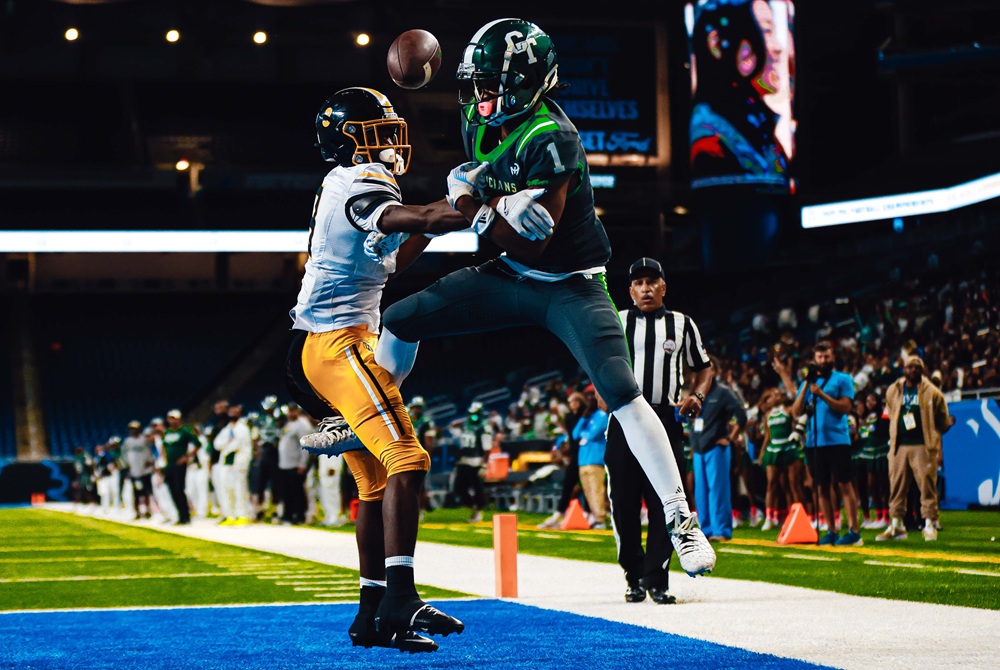
PHOTO Detroit Martin Luther King and Cass Tech players contend for a pass in the end zone during last week's PSL Blue city championship game. (Photo by Olivia B. Photography.)