

Talking Practice: Texas, Illinois Revise Policies
December 20, 2013
By Rob Kaminski
MHSAA benchmarks editor
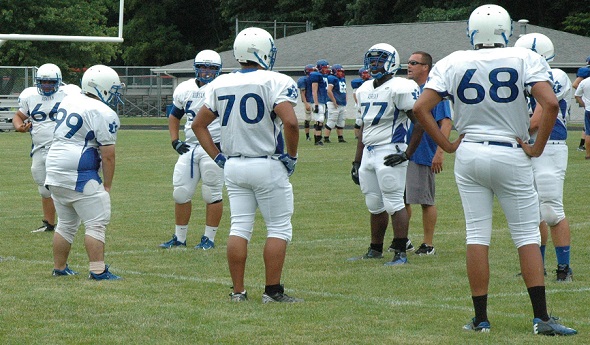
Coaches and players in Texas and Illinois adapted to new football practice limitations this fall, with the Texas policy focusing on contact, and the Illinois regulation emphasizing length of preseason practices.
Following are the main changes those states put in place heading into the 2013-14 season:
The University Interscholastic League, which governs school sports in Texas, put into writing that, “During the regular season and postseason, no football player is allowed to participate in more than ninety (90) minutes of full contact practice per week,” effective with the first day of practice this fall.
The complete policy follows:
For the purposes of the of rule, "full contact" is defined as football drills or live game simulations where "live action" occurs. Live action, as defined by USA Football, is contact at game speed where players execute full tackles at a competitive pace taking players to the ground. A team may continue to dress in full pads for practice, but may only participate in live action drills and game time simulations no more than ninety minutes per athlete per week. It is assumed that when players are in shells (shorts, shoulder pads, and helmets) no live action drills or simulations will occur. This rule is intended to limit live action drills and simulations and not the number of practices a team may participate in full pads. A team may participate in "air," "bags," "wrap," and "thud" drills and simulations at any point. These contact levels are defined below:
• Air - Players should run unopposed without bags or any opposition
• Bags - activity is executed against a bag, shield or pad to allow for a soft-contact surface, with or without the resistance of a teammate or coach standing behind the bag.
• Wrap - Drills run at full speed until contact, which is above the waist with the players remaining on their feet.
• Thud - Same as wrap but tempo is competitive with no pre-determined winner and the players are not tackling to the ground.
 The rule came to the UIL Legislative Council as a recommendation from the UIL Medical Advisory Committee, a permanent advisory committee to the Legislative Council which meets twice each year to discuss and review safety policies for UIL participants. The committee, which is made up of leading medical professionals in various specialties and includes representatives from the Texas High School Coaches Association, the Texas Girls Coaches Association, and the Texas State Athletic Trainer Association, unanimously recommended this limitation in full-contact football practice.
The rule formulates into a formal policy the existing actions of the majority of coaches across Texas, and most coaches have had to make few adjustments, if any. In fact, according to a story on statesman.com, the proposal caused more of an uproar on social media than from coaches.
“It’s not going to affect us in anyway,” Vandegrift HS coach Drew Sanders said in the story. “Most good coaches were way below that 90-minute amount already. Prior to legislation we still monitored it ourselves – the only change is now we have to keep up a log more publicly.”
Illinois put standards in place for its first 14 days of football practices, known as the state’s Preseason Football Acclimatization Practice Period. At the core of the policy is a three-hour practice limit for the first five days, during which teams can also conduct a one-hour walk-through.
 Teams must observe a minimum two hours rest between the practices and walk-throughs. Players may wear helmets only on the first two days, then helmets and shoulder pads for the next three. From days seven through 14 of the acclimatization period, schools may practice for a maximum of five hours per day, as long as that day is followed by a three-hour day, or an off day. During the five-hour days, no session can last more than three hours and must include a two-hour break between practices. Full pads may be worn for the final seven dates leading up to the first contest.
“This policy was the result of a collaborative effort between the IHSA Sports Medicine Advisory Committee and the Football Advisory Committee,” said SMAC committee member and University of Illinois Associate Professor of Orthopedic Surgery Dr. Preston M. Wolin. “The guidelines are based on the most recent scientific evidence, as well as the expertise of the coaches who will help implement them. Both committees believe the guidelines represent a significant positive contribution to the health of our athletes.”
“This new policy undoubtedly changes the way we, as coaches, approach preseason practice,” said Metamora HS coach Pat Ryan, who is a member of the FAC and a past President of the Illinois High School Football Coaches Association. “Coaches have to get more creative with when and how they schedule practices, as well what they do with their time. The proposals were strongly supported by both committees. It is a crucial final step to the process of being able to effectively prepare our teams in a safe manner. Change is always difficult, but the game is changing and we need to adapt to continue to put the safety of our players first.”
The IHSA offered multiple interactive online webinar meetings for high school coaches leading up to the start of practice where questions were answered, along with further clarifications on the policy and the science behind it.
“I think most coaches understood that changes were on the horizon,” said IHSA Executive Director Marty Hickman. “We wanted to be in a position to give our coaches as much information as possible to make sure they are comfortable with the new policy. Their input will be critical moving forward as we develop educational materials, like a best practices presentation. I commend our committees on a policy that is supported by medical experts, football coaches and school administrators.”
Three Rivers Takes Run at District Together
October 31, 2017
By Wes Morgan
Special for Second Half
J.J. Wagner is economical with his words, stoic on the sideline, and not preoccupied with statistical trends. All he really asks of his Three Rivers football players is to play and sacrifice for one another.
 It’s been a pretty good recipe throughout his 13-year tenure as the head varsity coach of the Wildcats, at least in the years when the players truly held up their end of the bargain. With an 82-50 career record since 2005, Wagner has seen what can happen when everyone is pulling in the same direction, like a 13-0 run that ended with a loss in the 2009 Division 4 Final.
He’s also witnessed how complacency can cut a program right back down, as was the case in 2010 when an experienced Three Rivers squad went 4-5 and missed the postseason.
The Wildcats have been noticeably hungrier the last two years, with a 7-3 mark in 2016 and an 8-2 record this year as they prepare for Friday’s Division 4 District championship game against Edwardsburg.
Eleven games into the year, Three Rivers has been unable to break out of a Wolverine Conference bubble. The Wildcats went 7-2 in the league, with losses to Dowagiac (Week 2) and Vicksburg (Week 9). Revenge was sweet last Friday as Three Rivers beat Vicksburg in the Pre-District game (20-10).
Now, the difficult task of beating the league’s most dominant team for the second time in one year is what’s required to move on in the playoffs. If Three Rivers can beat the Eddies (after also doing so 21-18 in Week 7), there’s a chance they’ll face Wolverine Conference member Plainwell in the Regional Round.
“You get through the Wolverine (schedule) and then you’re suddenly in a mini Wolverine tournament,” Wagner joked.
There are no secrets in terms of playoff prep against such familiar foes, so it’s all about the basics.
“Our offense has been moving the sticks, our defense has been playing well, our special teams have played well and we play well when we don’t turn the ball over,” he said.
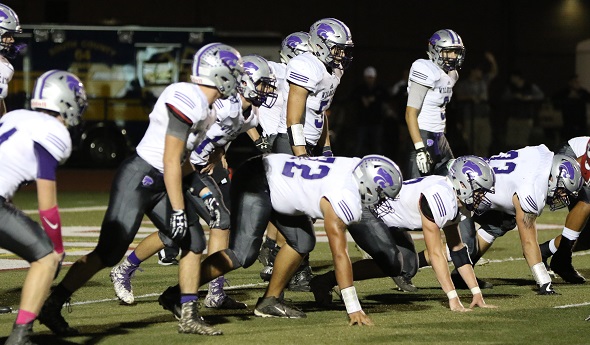
Having played for perennial power Mendon, where he registered 253 tackles as an outside linebacker during the 1987-89 seasons, Wagners’ emphasis on that side of the ball has been a hallmark of the 2017 campaign. Three Rivers has only allowed 11.7 points and 203 yards per game. The Wildcats have stopped opponents on third down 79.8 percent of the time.
A lot of that has to do with big and athletic senior defensive end Tirrell Hausmanis (6-foot-4, 245 pounds), senior defensive tackle Tyler Moore (5-11, 235) and the linebacker duo of senior Chris Morrill (5-10, 160) and Traven Van Oss (6-1, 165). That group alone has accounted for 34.5 tackles for loss this season. Morrill and Van Oss are tied for a team-best 61 tackles.
“Anytime you’re playing good defense, you can take a few more chances on offense,” Wagner said. “I don’t know how many times we’ve gone for it on fourth down this year, but it’s probably more than most (years). You can take a chance at midfield or the 40 that maybe you wouldn’t normally.”
Perhaps no player has embraced Wagner’s rule of doing what’s best for the team more than Hausmanis, who likely would have garnered a lot more attention from college coaches had he stayed at tight end. Instead, he’s anchored both lines the past two seasons.
“We all just do our jobs,” he said. “This happened and we weren’t big enough (on the offensive line) for me to play tight end. They needed me at tackle. At first I didn’t really like it, but I had to get used to it because it was what was best for the team. It helped us succeed and win, so I had to do it.”
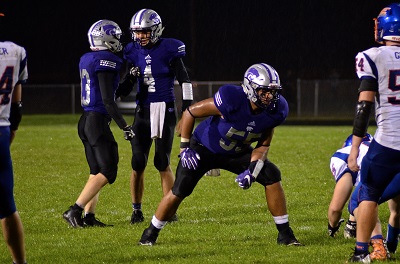 His defensive stats might not seem that impressive — 30 tackles with two sacks — but it’s what he’s capable of that impacts the game so severely.
“It helps when you know people are going to run away from (Hausmanis), so you can stunt and play games on the other side that can mess with their protections and blocking schemes,” Wagner said.
Wagner admitted he’s not big on stats, but for those who were wondering about how many times the offense has felt comfortable gambling on fourth down because of a belief in the defense, it’s 27. The Wildcats have converted 15 times (55.6 percent).
Other than knowing the defense could likely bail it out if needed, there’s been plenty of confidence in the offense under the leadership of junior quarterback Jalen Heivilin.
With a 22-6 touchdown-to-interception ratio, an average of 214.6 passing yards per game and a completion rate of 61 percent, the first-year starter has settled in nicely. Classmate Gavin Charvat has been Heivilin’s favorite target as the two have connected 42 times for 562 yards and six touchdowns. Bryce Morlan was next in line with 32 receptions for 549 yards and a team-high 11 TDs, but the senior went down in Week 9 with a torn anterior cruciate ligament. Fortunately for the Wildcats they also have reliable receivers in Jett Haifley and Zac Meyer; each has hauled in 23 passes for around 400 yards.
“When we play mistake-free, which is what we harp on, and eliminate pre- and post-snap penalties, you can win a lot of games,” Wagner said. “That’s what we focus on every week. If you can do that, you’re going to keep yourself in a lot of games.”
That was exactly the difference in Three Rivers’ home win against Edwardsburg on Oct. 6, which snapped a 34-game Wolverine Conference winning streak by the Eddies.
“We have to play with that same energy and effort (against Edwardsburg),” Wagner added. “In both of our losses, we came out kind of flat. If I knew why, we wouldn’t do it. We think we can go in there (at Edwardsburg) and play them tough again. It boiled down to mistakes in that (first meeting). We made our extra points, and we held them on all theirs. If we go in there with the same discipline, there’s no reason we can’t beat them again.”
 Wes Morgan has reported for the Kalamazoo Gazette, ESPN and ESPNChicago.com, 247Sports and Blue & Gold Illustrated over the last 12 years and is the publisher of JoeInsider.com. He can be reached at [email protected] with story ideas for Berrien, Cass, St. Joseph and Branch counties.
PHOTOS: (Top) Three Rivers’ defense lines up for a play; it’s been stifling this season giving up only 11.7 points per game. (Middle) Receiver Nolan Mark and quarterback Jalen Heivilin (4) talk things over against Edwardsburg. (Photos courtesy of JoeInsider.com.)