

Talking Practice: Texas, Illinois Revise Policies
December 20, 2013
By Rob Kaminski
MHSAA benchmarks editor
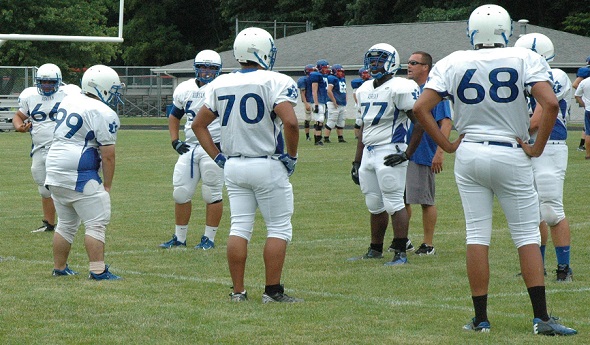
Coaches and players in Texas and Illinois adapted to new football practice limitations this fall, with the Texas policy focusing on contact, and the Illinois regulation emphasizing length of preseason practices.
Following are the main changes those states put in place heading into the 2013-14 season:
The University Interscholastic League, which governs school sports in Texas, put into writing that, “During the regular season and postseason, no football player is allowed to participate in more than ninety (90) minutes of full contact practice per week,” effective with the first day of practice this fall.
The complete policy follows:
For the purposes of the of rule, "full contact" is defined as football drills or live game simulations where "live action" occurs. Live action, as defined by USA Football, is contact at game speed where players execute full tackles at a competitive pace taking players to the ground. A team may continue to dress in full pads for practice, but may only participate in live action drills and game time simulations no more than ninety minutes per athlete per week. It is assumed that when players are in shells (shorts, shoulder pads, and helmets) no live action drills or simulations will occur. This rule is intended to limit live action drills and simulations and not the number of practices a team may participate in full pads. A team may participate in "air," "bags," "wrap," and "thud" drills and simulations at any point. These contact levels are defined below:
• Air - Players should run unopposed without bags or any opposition
• Bags - activity is executed against a bag, shield or pad to allow for a soft-contact surface, with or without the resistance of a teammate or coach standing behind the bag.
• Wrap - Drills run at full speed until contact, which is above the waist with the players remaining on their feet.
• Thud - Same as wrap but tempo is competitive with no pre-determined winner and the players are not tackling to the ground.
 The rule came to the UIL Legislative Council as a recommendation from the UIL Medical Advisory Committee, a permanent advisory committee to the Legislative Council which meets twice each year to discuss and review safety policies for UIL participants. The committee, which is made up of leading medical professionals in various specialties and includes representatives from the Texas High School Coaches Association, the Texas Girls Coaches Association, and the Texas State Athletic Trainer Association, unanimously recommended this limitation in full-contact football practice.
The rule formulates into a formal policy the existing actions of the majority of coaches across Texas, and most coaches have had to make few adjustments, if any. In fact, according to a story on statesman.com, the proposal caused more of an uproar on social media than from coaches.
“It’s not going to affect us in anyway,” Vandegrift HS coach Drew Sanders said in the story. “Most good coaches were way below that 90-minute amount already. Prior to legislation we still monitored it ourselves – the only change is now we have to keep up a log more publicly.”
Illinois put standards in place for its first 14 days of football practices, known as the state’s Preseason Football Acclimatization Practice Period. At the core of the policy is a three-hour practice limit for the first five days, during which teams can also conduct a one-hour walk-through.
 Teams must observe a minimum two hours rest between the practices and walk-throughs. Players may wear helmets only on the first two days, then helmets and shoulder pads for the next three. From days seven through 14 of the acclimatization period, schools may practice for a maximum of five hours per day, as long as that day is followed by a three-hour day, or an off day. During the five-hour days, no session can last more than three hours and must include a two-hour break between practices. Full pads may be worn for the final seven dates leading up to the first contest.
“This policy was the result of a collaborative effort between the IHSA Sports Medicine Advisory Committee and the Football Advisory Committee,” said SMAC committee member and University of Illinois Associate Professor of Orthopedic Surgery Dr. Preston M. Wolin. “The guidelines are based on the most recent scientific evidence, as well as the expertise of the coaches who will help implement them. Both committees believe the guidelines represent a significant positive contribution to the health of our athletes.”
“This new policy undoubtedly changes the way we, as coaches, approach preseason practice,” said Metamora HS coach Pat Ryan, who is a member of the FAC and a past President of the Illinois High School Football Coaches Association. “Coaches have to get more creative with when and how they schedule practices, as well what they do with their time. The proposals were strongly supported by both committees. It is a crucial final step to the process of being able to effectively prepare our teams in a safe manner. Change is always difficult, but the game is changing and we need to adapt to continue to put the safety of our players first.”
The IHSA offered multiple interactive online webinar meetings for high school coaches leading up to the start of practice where questions were answered, along with further clarifications on the policy and the science behind it.
“I think most coaches understood that changes were on the horizon,” said IHSA Executive Director Marty Hickman. “We wanted to be in a position to give our coaches as much information as possible to make sure they are comfortable with the new policy. Their input will be critical moving forward as we develop educational materials, like a best practices presentation. I commend our committees on a policy that is supported by medical experts, football coaches and school administrators.”
Football Kicks Off Again, 129 Years Later
By
Ron Pesch
MHSAA historian
August 25, 2017
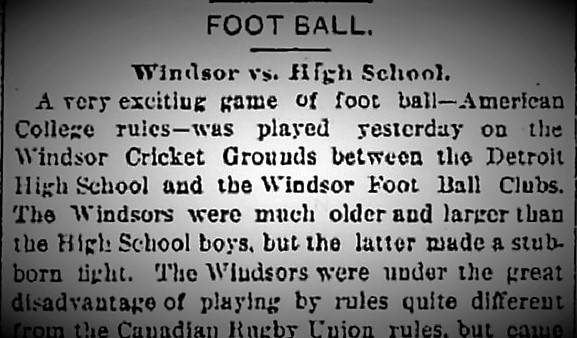
Buried in the text on the fourth page of the Saturday, October 27, 1888, Detroit Free Press is a single, concise sentence bearing a minimum amount of detail.
“The Windsor foot ball team will play the Detroit High School team this afternoon at 3.”
To date, this is the earliest account of a Michigan high school playing the game of “foot ball.”
The following day’s paper provides only a few more details. The game was played on the Windsor Cricket Grounds. Despite the great disadvantage of playing under “American Football rules … quite different from the Canadian Rugby Union rules …” the “older and larger” Windsors won the contest, 12-6. Rosters for each squad were provided.
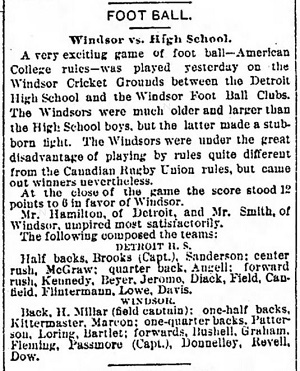 Under American rules of the time, a touchdown was worth four points, with a conversion kick following a touchdown worth two additional points. At the time, a field goal counted for five points and a safety was worth two. The teams, however, may have agreed to a different scoring system before the contest.
Was this the first football game for a Michigan high school? That’s unlikely, but it is certainly among the earliest published accounts involving a prep game in the state.
It’s a fair assumption that foot ball, or some version of the game, was being played in neighborhoods before that time, at least based on the following statement found in the Jackson Citizen Patriot, dated June 18, 1867. Only days before, Dorrance & Goodwin’s, a store on Main Street in Jackson, had placed advertisements in the newspaper’s classifieds noting the pending arrival of this new product.
“Foot Ball – The pastime was inaugurated on our streets yesterday. Three or four balls were kept in motion all day on Main street alone. It affords no little amusement to the little boys, and is certainly a healthy exercise for the larger ones. It’s all right as long as no windows are broken or horses scared. Both calamities were barely escaped scores of times during the day.”
Rutgers and Princeton are credited with playing the first college football game in 1869. A decade later, in 1879, the University of Michigan established a football team.
Detroit High School played a number of games in 1888, besides the Windsor match, including a contest with the Tappen School from the Corktown area of Detroit. Played at the Detroit Athletic Club grounds on the afternoon of Thursday November 15, a final score was not mentioned in the following day’s Free Press.
For those unfamiliar with the sport, an account of the University of Michigan versus Detroit Athletic Club contest that appeared in the November 18 Free Press served as a fine introduction to the game, and the determination behind securing “possession of a leather-covered foot ball.”
“It was very interesting to see one speedy young man, after a desperate struggle in which the spectators fully expected to see him lose an arm or a leg, get away from his captors and start like a deer, with eight or ten of the opposite side in full pursuit. He is overtaken and the leader of the pursuing party springs upon the back of the man with the inflated trophy, bearing him to the ground with a dull thud … It is also an inspiring sight to see a fleet-footed player seize the ball and run at full speed in the direction of the goal of his opponents. Then a wing-footed opponent cuts across to intercept him, makes a flying leap, grasps the fugitive around the neck or waist and both go to grass with a suddenness and velocity that transforms them into human wheels …
 “While one unaccustomed to foot ball will naturally be startled by some of the acrobatic feats, still it is impossible to watch the game for any length of time without a tingling of the blood and holding of the breath. It is most intensely exciting, continuous in action and replete with fine points of play.
“It may be explained that the goals in a foot ball game are set at a distance of 330 feet from each other. The goal is made by placing two pieces of scantling twenty feet long upright in the ground, eighteen and one-half feet apart. Another piece runs midway horizontally between the uprights, and the ball must go over the horizontal piece and between the uprights to count a goal. There are eleven men on each side and the object is, of course, to get the ball through the goal of the other. The time of game is an hour and a half each side playing forty-five minutes from each goal, with an intermission of ten minutes between halves.”
A player who ran over an opponent’s goal line, “with the ball and touched it down” was then entitled to “bring the ball in front of the goal and attempt to kick it through”…
Among those playing for the Athletic Club squad that day was “little Hugh Brooks (captain) of the high school team.” Eligibility rules for players would evolve over time.
On Saturday, November 24, Detroit High School squared off for the first of two contests with Ann Arbor High School, this one at the Detroit Athletic Club grounds. Admission to the 2:45 p.m. contests was 25 cents. A crowd of around 300 watched “an exciting illustration of how Rugby foot ball is played. The exhibition by the Ann Arbor boys was considerably better than that of the Detroiters,” noted the Free Press, “the result of that being that Detroit’s banners have been kicked into the dust.”
Ann Arbor returned home with a 12-0 victory.
A second game with Ann Arbor was quickly scheduled.
In between, on Thursday, November 29, the Detroit High School squad played the Athletic Club before a crowd of about 200.
 “While the Athletics won by 12 to 0, still their playing was very loose, probably the result of over confidence. The Athletics will have to rid themselves of this by Saturday or the Albions will make short work of them.”
A large crowd gathered in the drizzling rain in Ann Arbor on Saturday, December 8, for what appears to be the final contest of the 1888 season for the high school teams of Detroit and Ann Arbor.
“It was a fine game. (Captain) Brooks, McGraw and Wisner, for Detroit, and Jewett, Diggert, Dupont, and Rathbone for Ann Arbor, made fine plays for their respective sides.” The result was an 8 to 2 win, and redemption, for the Detroit squad.
Today, 129 years later, “football” has seen wild expansion, numerous rule changes, and huge advancement in equipment worn when compared to those pioneer days of the sport. In 2017, more than 1 million individuals will suit up for high school teams across the United States. In Michigan alone, more than 36,000 participate in prep football.
And our state’s original programs live on. On Friday, Detroit Central opened its season with a win over Detroit Loyola. Ann Arbor High School, renamed Ann Arbor Pioneer in the late 1960s, fell in its Friday opener to Muskegon.
Welcome to another season of America’s favorite pastime.
 Ron Pesch has taken an active role in researching the history of MHSAA events since 1985 and began writing for MHSAA Finals programs in 1986, adding additional features and "flashbacks" in 1992. He inherited the title of MHSAA historian from the late Dick Kishpaugh following the 1993-94 school year, and resides in Muskegon. Contact him at [email protected] with ideas for historical articles.
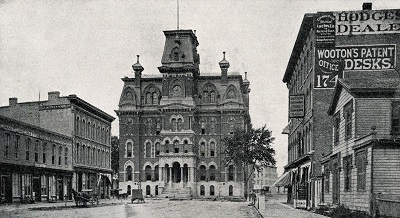
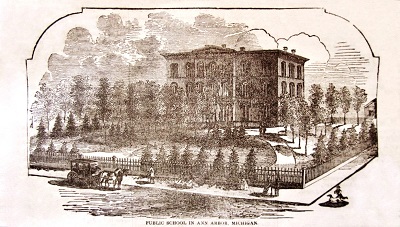
PHOTOS: (Top) The Detroit Free Press included brief coverage of the first "reported" game on Oct. 28, 1888. (Middle) When Michigan’s state government moved from Detroit to Lansing in 1847, the old Capitol building was re-opened as the Detroit’s first city high school in 1863. To better accommodate Detroit’s growing population, the old two-story structure was remodeled into a four-story building, unrecognizable to most. The school served the city well until January 1893, when it burned to the ground. (Below) Erected in 1856 at the cost of $27,000, Ann Arbor High School at State and Huron (now site of the North Quad of the University of Michigan) was destroyed by fire in 1904. (Photos courtesy of Ron Pesch.)