

Talking Practice: Texas, Illinois Revise Policies
December 20, 2013
By Rob Kaminski
MHSAA benchmarks editor
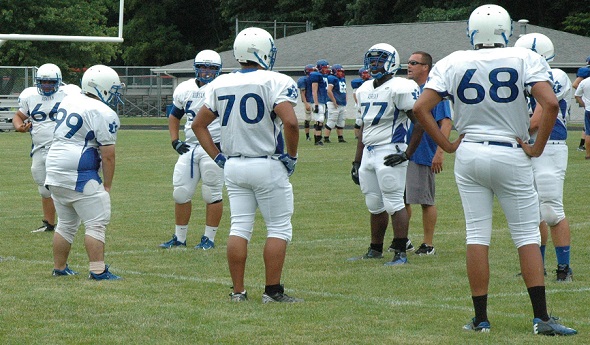
Coaches and players in Texas and Illinois adapted to new football practice limitations this fall, with the Texas policy focusing on contact, and the Illinois regulation emphasizing length of preseason practices.
Following are the main changes those states put in place heading into the 2013-14 season:
The University Interscholastic League, which governs school sports in Texas, put into writing that, “During the regular season and postseason, no football player is allowed to participate in more than ninety (90) minutes of full contact practice per week,” effective with the first day of practice this fall.
The complete policy follows:
For the purposes of the of rule, "full contact" is defined as football drills or live game simulations where "live action" occurs. Live action, as defined by USA Football, is contact at game speed where players execute full tackles at a competitive pace taking players to the ground. A team may continue to dress in full pads for practice, but may only participate in live action drills and game time simulations no more than ninety minutes per athlete per week. It is assumed that when players are in shells (shorts, shoulder pads, and helmets) no live action drills or simulations will occur. This rule is intended to limit live action drills and simulations and not the number of practices a team may participate in full pads. A team may participate in "air," "bags," "wrap," and "thud" drills and simulations at any point. These contact levels are defined below:
• Air - Players should run unopposed without bags or any opposition
• Bags - activity is executed against a bag, shield or pad to allow for a soft-contact surface, with or without the resistance of a teammate or coach standing behind the bag.
• Wrap - Drills run at full speed until contact, which is above the waist with the players remaining on their feet.
• Thud - Same as wrap but tempo is competitive with no pre-determined winner and the players are not tackling to the ground.
 The rule came to the UIL Legislative Council as a recommendation from the UIL Medical Advisory Committee, a permanent advisory committee to the Legislative Council which meets twice each year to discuss and review safety policies for UIL participants. The committee, which is made up of leading medical professionals in various specialties and includes representatives from the Texas High School Coaches Association, the Texas Girls Coaches Association, and the Texas State Athletic Trainer Association, unanimously recommended this limitation in full-contact football practice.
The rule formulates into a formal policy the existing actions of the majority of coaches across Texas, and most coaches have had to make few adjustments, if any. In fact, according to a story on statesman.com, the proposal caused more of an uproar on social media than from coaches.
“It’s not going to affect us in anyway,” Vandegrift HS coach Drew Sanders said in the story. “Most good coaches were way below that 90-minute amount already. Prior to legislation we still monitored it ourselves – the only change is now we have to keep up a log more publicly.”
Illinois put standards in place for its first 14 days of football practices, known as the state’s Preseason Football Acclimatization Practice Period. At the core of the policy is a three-hour practice limit for the first five days, during which teams can also conduct a one-hour walk-through.
 Teams must observe a minimum two hours rest between the practices and walk-throughs. Players may wear helmets only on the first two days, then helmets and shoulder pads for the next three. From days seven through 14 of the acclimatization period, schools may practice for a maximum of five hours per day, as long as that day is followed by a three-hour day, or an off day. During the five-hour days, no session can last more than three hours and must include a two-hour break between practices. Full pads may be worn for the final seven dates leading up to the first contest.
“This policy was the result of a collaborative effort between the IHSA Sports Medicine Advisory Committee and the Football Advisory Committee,” said SMAC committee member and University of Illinois Associate Professor of Orthopedic Surgery Dr. Preston M. Wolin. “The guidelines are based on the most recent scientific evidence, as well as the expertise of the coaches who will help implement them. Both committees believe the guidelines represent a significant positive contribution to the health of our athletes.”
“This new policy undoubtedly changes the way we, as coaches, approach preseason practice,” said Metamora HS coach Pat Ryan, who is a member of the FAC and a past President of the Illinois High School Football Coaches Association. “Coaches have to get more creative with when and how they schedule practices, as well what they do with their time. The proposals were strongly supported by both committees. It is a crucial final step to the process of being able to effectively prepare our teams in a safe manner. Change is always difficult, but the game is changing and we need to adapt to continue to put the safety of our players first.”
The IHSA offered multiple interactive online webinar meetings for high school coaches leading up to the start of practice where questions were answered, along with further clarifications on the policy and the science behind it.
“I think most coaches understood that changes were on the horizon,” said IHSA Executive Director Marty Hickman. “We wanted to be in a position to give our coaches as much information as possible to make sure they are comfortable with the new policy. Their input will be critical moving forward as we develop educational materials, like a best practices presentation. I commend our committees on a policy that is supported by medical experts, football coaches and school administrators.”

Preview: Favorites to Meet in Final
November 18, 2016
By Geoff Kimmerly
Second Half editor
It’s easy to promote tonight’s MHSAA 8-Player Football Final at Legacy Field in Greenville as the meeting of the two best teams in the state this season.
Powers North Central and Deckerville entered the playoffs both undefeated and with the highest and second-highest playoff-point averages, respectively, in the division. And both have surged through the playoffs despite impressive opponents attempting to get in the way.
 The Jets are known for a high-flying offense, while the Eagles are powered by a stifling defense – and yet, both are pretty strong on the other sides of the ball as well. See below for a glance at both teams, and if you can’t make it to Greenville the game also will be broadcast live on FoxSportsDetroit.com, with live audio streaming on MHSAANetwork.com. On-demand video will be available shortly after the game’s conclusion at MHSAA.tv.
(Statistics below are through Regional Finals unless noted. Rankings are based on playoff-point averages at the end of the regular season.)
DECKERVILLE
Record: 11-0, No. 2
Coach: Bill Brown, 24th season (190-69)
League finish: First in North Central Thumb League.
Championship history: 8-Player champion 2012.
Best wins: 36-6 over No. 4 Wyoming Tri-unity Christian in the Semifinal, 58-12 over No. 6 New Haven Merritt in the Regional Final, 40-0 over No. 11 Webberville in the Regional Semifinal.
Players to watch: RB/DB Austin Fritch, 6-0/175 sr. (1,305 yards/23 TDs rushing); FB/LB Wade Saldana, 5-8/170 sr. (596 yards/13 TDs rushing); QB/DB Brandon Pattullo, 6-0/180 sr. (379 yards/9 TDs rushing, 496 yards/8 TDs passing); LB/OG Reese Bays-Kramer, 5-11/180 sr.; DT/SE Austin Spaetzel, 6-0/210 sr.
Outlook: Deckerville’s defense has gotten a lot of attention this week, and rightfully so – the Eagles have given up a mere 50 points this season and only 18 combined the last two weeks against previously-undefeated playoff teams. Bays-Kramer and Spaetzel lead on that side of the ball, playing massive roles in helping the team to five shutouts while never giving up more than 12 points in a game. But we shouldn’t forget the offense, which was especially dominant last week running for more than 400 yards without attempting a pass. Fritch added 263 yards and four touchdowns to his totals above, giving him 1,568 yards and 27 scores rushing this season, and the team as a whole has run for 3,417 yards while needing to throw for only 517. All 11 wins have been by at least 22 points.
POWERS NORTH CENTRAL
Record: 12-0, No. 1
Coach: Kevin Bellefeuil, 11th season (64-52)
League finish: First in Western 8 Conference.
Championship history: 8-Player champion 2015.
Best wins: 60-50 (Regional Final) and 60-42 over No. 8 Crystal Falls Forest Park, 68-32 over No. 12 Stephenson, 62-22 over No. 9 Pickford in the Semifinal, 76-18 and 64-0 (Regional Semifinal) over No. 16 Rapid River.
Players to watch: QB/DB Jason Whitens, 6-4/210, sr. (2,170 yards/40 TDs passing, 536 yards/15 TDs rushing, 2 punt return TDs); RB/DB Bobby Kleiman, 5-9/175, sr. (594 yards/9 TDs rushing, 452 yards/10 TDs receiving, 3 interception return TDs, 3 punt return TDs); WR/DT Dylan Gagne, 5-8/175, sr. (439 yards/10 TDs receiving, 290 yards/4 TDs rushing); WR/DB Marcus Krachinski, 6-0/170 sr. (549 yards/10 TDs receiving); RB/LB Tyler Bentley, 5-7/175 sr. (541 yards/9 TDs rushing, 351 yards/3 TDs receiving).
Outlook: North Central remains undefeated in two seasons of 8-player football, bolstered by a Whitens-led offense averaging 67.4 points per game – only a few off last season’s average of 70.4. In fact, a loss would be the first for these seniors in either football or basketball since 2014 – Whitens, Kleiman, Krachinski, junior linebacker Lucas Dombrowski and senior center Ryan Plunger all also saw time in last winter’s Class D hoops Final as the Jets finished a second straight undefeated run in that sport. For the second straight football season, no opponent has come within single digits of North Central; only Forest Park got the deficit down to 10. Whitens added another 226 yards and three scores passing last week, giving him 2,396 and 43 total this fall.
The MHSAA Football Finals are sponsored by the Michigan National Guard.