

Talking Practice: Texas, Illinois Revise Policies
December 20, 2013
By Rob Kaminski
MHSAA benchmarks editor
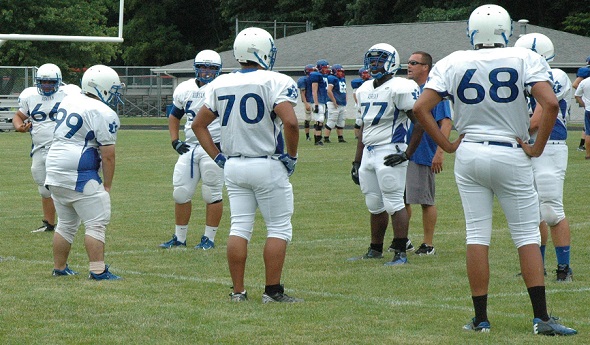
Coaches and players in Texas and Illinois adapted to new football practice limitations this fall, with the Texas policy focusing on contact, and the Illinois regulation emphasizing length of preseason practices.
Following are the main changes those states put in place heading into the 2013-14 season:
The University Interscholastic League, which governs school sports in Texas, put into writing that, “During the regular season and postseason, no football player is allowed to participate in more than ninety (90) minutes of full contact practice per week,” effective with the first day of practice this fall.
The complete policy follows:
For the purposes of the of rule, "full contact" is defined as football drills or live game simulations where "live action" occurs. Live action, as defined by USA Football, is contact at game speed where players execute full tackles at a competitive pace taking players to the ground. A team may continue to dress in full pads for practice, but may only participate in live action drills and game time simulations no more than ninety minutes per athlete per week. It is assumed that when players are in shells (shorts, shoulder pads, and helmets) no live action drills or simulations will occur. This rule is intended to limit live action drills and simulations and not the number of practices a team may participate in full pads. A team may participate in "air," "bags," "wrap," and "thud" drills and simulations at any point. These contact levels are defined below:
• Air - Players should run unopposed without bags or any opposition
• Bags - activity is executed against a bag, shield or pad to allow for a soft-contact surface, with or without the resistance of a teammate or coach standing behind the bag.
• Wrap - Drills run at full speed until contact, which is above the waist with the players remaining on their feet.
• Thud - Same as wrap but tempo is competitive with no pre-determined winner and the players are not tackling to the ground.
 The rule came to the UIL Legislative Council as a recommendation from the UIL Medical Advisory Committee, a permanent advisory committee to the Legislative Council which meets twice each year to discuss and review safety policies for UIL participants. The committee, which is made up of leading medical professionals in various specialties and includes representatives from the Texas High School Coaches Association, the Texas Girls Coaches Association, and the Texas State Athletic Trainer Association, unanimously recommended this limitation in full-contact football practice.
The rule formulates into a formal policy the existing actions of the majority of coaches across Texas, and most coaches have had to make few adjustments, if any. In fact, according to a story on statesman.com, the proposal caused more of an uproar on social media than from coaches.
“It’s not going to affect us in anyway,” Vandegrift HS coach Drew Sanders said in the story. “Most good coaches were way below that 90-minute amount already. Prior to legislation we still monitored it ourselves – the only change is now we have to keep up a log more publicly.”
Illinois put standards in place for its first 14 days of football practices, known as the state’s Preseason Football Acclimatization Practice Period. At the core of the policy is a three-hour practice limit for the first five days, during which teams can also conduct a one-hour walk-through.
 Teams must observe a minimum two hours rest between the practices and walk-throughs. Players may wear helmets only on the first two days, then helmets and shoulder pads for the next three. From days seven through 14 of the acclimatization period, schools may practice for a maximum of five hours per day, as long as that day is followed by a three-hour day, or an off day. During the five-hour days, no session can last more than three hours and must include a two-hour break between practices. Full pads may be worn for the final seven dates leading up to the first contest.
“This policy was the result of a collaborative effort between the IHSA Sports Medicine Advisory Committee and the Football Advisory Committee,” said SMAC committee member and University of Illinois Associate Professor of Orthopedic Surgery Dr. Preston M. Wolin. “The guidelines are based on the most recent scientific evidence, as well as the expertise of the coaches who will help implement them. Both committees believe the guidelines represent a significant positive contribution to the health of our athletes.”
“This new policy undoubtedly changes the way we, as coaches, approach preseason practice,” said Metamora HS coach Pat Ryan, who is a member of the FAC and a past President of the Illinois High School Football Coaches Association. “Coaches have to get more creative with when and how they schedule practices, as well what they do with their time. The proposals were strongly supported by both committees. It is a crucial final step to the process of being able to effectively prepare our teams in a safe manner. Change is always difficult, but the game is changing and we need to adapt to continue to put the safety of our players first.”
The IHSA offered multiple interactive online webinar meetings for high school coaches leading up to the start of practice where questions were answered, along with further clarifications on the policy and the science behind it.
“I think most coaches understood that changes were on the horizon,” said IHSA Executive Director Marty Hickman. “We wanted to be in a position to give our coaches as much information as possible to make sure they are comfortable with the new policy. Their input will be critical moving forward as we develop educational materials, like a best practices presentation. I commend our committees on a policy that is supported by medical experts, football coaches and school administrators.”
Marine City Focused on Comeback Quest
By
Paul Costanzo
Special for MHSAA.com
October 11, 2016
Ryan Alexander was in a familiar place this past Thursday.
 The Marine City senior running back was at East China Stadium, the junior varsity team on the field in front of him playing against Warren Woods-Tower and a group of junior program football players behind him, preparing to get onto the big field and play at halftime.
He and his Mariners teammates were coming off a win against archrival St. Clair, and had just finished their last practice in preparation for a Week 7 game against Warren Woods-Tower, one they would also win.
All of that is familiar for Alexander and the Mariners. The start of the season, however, was far from it.
“It was different than anything I’ve ever experienced,” Alexander said of Marine City’s first 0-4 start since 1971. “I’ve been on varsity for three years now, and to start 0-4, it was the first time I’ve ever felt anything like that since I’ve been in the program, since I’ve been in Marine City.
“It was a new feeling, but it was also a sense of motivation. It pushed me harder knowing that we had something to prove and that everyone was doubting us because we were 0-4. It’s hard to go through, but I think it made us a better team.”
Alexander and his teammates are on the road back, sitting at 3-4 and eyeing two more wins which could possibly preserve the school’s streak of qualifying for the postseason, which started in 1998. He said getting there would show those junior program players that by coming together as a team, you can accomplish anything.
The Mariners have already shown their coach plenty.
“I wondered, because our program has had so much success, what would happen if we had a bad start like this, how would that team be and how difficult would it be to coach,” Marine City coach Ron Glodich, who is in his fifth season as head coach after serving as a longtime assistant in the program. “What I found is these kids are incredible. Their perseverance and their work ethic has not changed. Nobody has quit, even though I challenge them week in and week out, nobody has quit. The bigger the challenge I give them, the bigger they step up.”
‘We live football’
Football in Marine City has a bit of a “Friday Night Lights” feel to it.
The town with a population of a little more than 4,000 essentially shuts down on game nights to support its team. Not long ago, it moved trick-or-treating because it conflicted with a Friday night playoff game. When the team went to Ford Field for MHSAA championship games in 2007, 2011 and 2013, it filled its entire side of the lower bowl with fans clad in orange and black.
“It’s a football crazy town,” Alexander said. “We live football.”
Kids grow up wanting to be Mariners as much as they grow up wanting to be Wolverines or Spartans, and you can’t even go to a JV game without seeing groups of them playing a side game of touch – or tackle – at East China Stadium.
“They were always winning, ever since I’ve been a kid and ever since my parents have been around,” senior lineman Andrew Steinmetz said. “It’s a great feeling to grow up here, live here and then play here.”
Always winning isn’t hyperbole, especially for someone Steinmetz’s age. The playoff streak is only scratching the surface of the Mariners’ success in the past few decades.
The program won MHSAA championships in 2007 and 2013, and – prior to this year – had lost more than two games in a season only three times since 1992.
From 2006 through 2009, Marine City had three undefeated regular seasons, and in the only exception, it went 13-1 with a Division 4 championship. The Mariners’ last losing season came in 1982.
There have been stars who went onto play Division I college football – Brendon Kay, a 2008 graduate went to Cincinnati and was the Most Valuable Player of the Belk Bowl, and Anthony Scarcelli, who was the Associated Press Division 3-4 Player of the Year in 2011 and is currently a senior on Central Michigan University’s football team – but most of Marine City’s success has come thanks to players who don’t have a recruiting site ranking.
“When you mention the name Marine City outside the area, it’s common for someone to say, ‘Oh, you’ve got a great football program,’” Glodich said. “And we’re proud of that. It’s been a long time since we built it, and a lot of people are proud of it in the area and they come out to support it. It’s nice that that’s linked to the town, and that people believe we have a great football program. And I believe we do.”
 In Marine City, even 8-1 teams catch flack. At 0-4, the loud minority of the fan base gets more vocal.
“As any coach who doesn’t win, there are critics out there,” Glodich said. “I happened to get a letter and I shared it with the kids. I told them, ‘We’re all in this together. You’re being criticized in the stands, I’m being criticized, so understand that we’re all in this together and it’s all about getting better.’
“The good news is, I’m at the point in my career where I know that this staff does a great job. So when you get letters like that, you chuckle and say, ‘OK, this person is venting, but they don’t know what the hell they’re talking about.’ And I would tell that person if they ever had the guts to look me in the eye, I would tell them, ‘You don’t know what the hell you’re talking about.’”
Glodich’s players said they were able to shut out the outside noise, for the most part, and anything that did enter their brains was used as motivation. Alexander said it went in one ear and out the other, because practicing with a clear mind was much more necessary than reacting to insults.
Even better, however, was the fact there was much more support than derision. Marine City may be football crazy and unaccustomed to waking up on a Saturday after a loss, but its love for football goes beyond a stunning win-loss record.
“The parents and the past players, they really had our backs,” senior lineman Tom Kaminski said. “(Former player) Ethan Cleve made a nice Facebook message on the Marine City football fans page, and (former player) Jarrett Mathison was saying, ‘Don’t worry about it, it will get better.’”
Writing the final chapter
The message within the team was similar to Mathison’s, but the players knew they were the ones who would have to make things better.
“A lot of it came from themselves,” Glodich said. “After that fourth loss, we challenged them and said you guys make a decision of how you want to move forward. That’s where your senior leadership and the guys that really care about the program, they kind of step forward and they rally the troops. We challenged them come Monday, and they responded to the challenge.”
The change could be seen in practice, and it translated into a 37-29 win against Madison Heights Madison in Week 5. That was followed by a 27-6 win against St. Clair in Week 6 and most recently a 49-31 win against Warren Woods-Tower in Week 7.
“We just had to put our heads down and keep fighting for it, because we knew we were better than what we were,” Kaminski said. “It’s big on your shoulders, because everyone’s used to 9-0 teams here, so that was a big wake-up call, but I think we’ve got it.”
As stated above, while this is a position Glodich never wanted to be in, he said he’s always wondered what would happen if a Marine City team had a start like this one. He’s wondered how the players would react. He’s wondered how difficult it would be to coach a team that no longer held its playoff destiny in its own hands before the midpoint of the season.
“I’m amazed that these kids are working this hard – I don’t know if any other team that was 0-4 is working as hard as we do,” Glodich said. “It’s just a credit to these kids and their background; they’re not afraid to work. The kids that come to school here in this community are not afraid to work, and that’s why I’m one of the luckiest guys in the state to be able to coach in this community.”
The 0-4 start may have put the Mariners on the brink of playoff extinction, but their opponents in weeks 1-4 could wind up helping push them over the top when it comes to playoff selection, should Marine City get to 5-4.
Algonac, Port Huron Northern, Detroit Loyola and Marysville were a combined 25-3 through seven weeks, with one of those losses a Northern defeat against Marysville.
The Mariners are taking the one-game-at-a-time approach to the end of the season, but they know that can help. They know they can do something special to close it out, and accomplish something no Marine City team has done before – rebound from a start that could cause some to pack it in.
Glodich said he can’t look past the next game, but admits he and his coaches have talked to the players about writing the final chapter in their book, and how they want their story to end.
Alexander has already started writing in his head.
“It would mean the world (to finish 5-4) especially because it’s my senior year and I’d love to end on a high note,” he said. “I’d love to be the team that started 0-4, won the last five games and then proved what we have in the playoffs. We have a good team, we have a good shot.
“We just want to get to 5-4. We don’t really focus on anything else (in terms of playoff points). If we get there, it doesn’t matter, we’ll be happy.”
 Paul Costanzo served as a sportswriter at The Port Huron Times Herald from 2006-15, including three years as lead sportswriter, and prior to that as sports editor at the Hillsdale Daily News from 2005-06. He can be reached at [email protected] with story ideas for Genesee, Lapeer, St. Clair, Sanilac, Huron, Tuscola, Saginaw, Bay, Arenac, Midland and Gladwin counties.
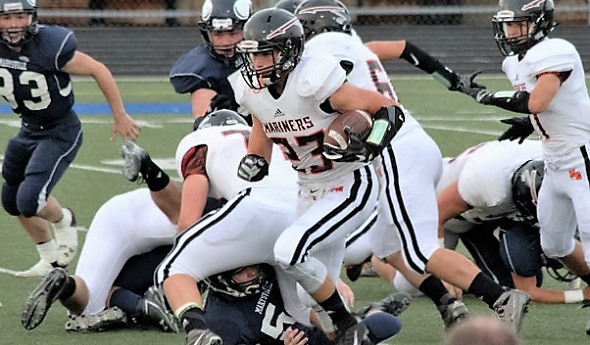
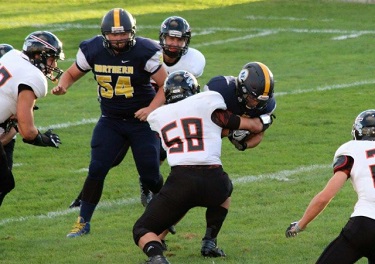
PHOTOS: (Top) Marine City's MJ Frank cuts through an opening against Marysville this season. (Middle) A group of Mariners surround and take down a Port Huron Northern ball carrier. (Photos courtesy of the Marine City football program.)