

#TBT: End of an Era in Saginaw
October 23, 2014
By Geoff Kimmerly
Second Half editor
Michigan will wave farewell this weekend to one of its longest-running high school football rivalries as Saginaw High and Arthur Hill play one last time before one of the schools is closed in December.
The 120-year-old rivalry is tied for second-oldest in Michigan history, ranks third with 128 games played and first among rivalries between Lower Peninsula schools.
The Saginaw News reported last month that the district’s Board of Education will vote on which to close in December after voting in July to shut down one of the two.
The schools – first called simply West Side and East Side – have met annually dating to 1894, save for four years – including in 1897 when it was deemed too large a mismatch and 1910 because of a smallpox outbreak. That fall marked the last the two didn’t play at least once – they played each other twice in 1895 and 1974.
Arthur Hill owns a 58-49 advantage in the series, and the teams tied 11 times. The Lumberjacks won last season’s Week 9 tilt, 43-22, but Saginaw holds a 12-8 edge over the last two decades.
Saginaw won the 1999 MHSAA Division 2 championship under coach Donald Durrett, while Arthur Hill claimed the Class AA title in 1991 under coach Jim Eurick and finished runner-up in 1992 – winning the 1991 game over Detroit Catholic Central 13-12 before losing to DCC in the following year's championship game rematch 21-20.
Sadly, both are finishing on softer notes; Saginaw has lost 16 straight games since winning on opening night 2013, while Arthur Hill has lost 13 of its last 14 with that lone win in between coming against the Trojans last fall.
Click to read select pages from the 1994 game program, itself a history book recalling a proud era in Saginaw history.
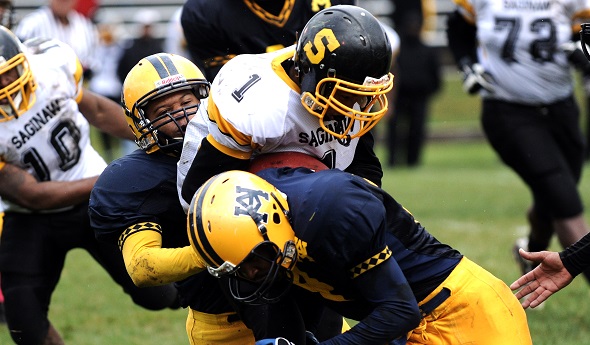
PHOTO: Arthur Hill defeated Saginaw 43-22 in last season's meeting between the longtime rivals. (Click to see more from HighSchoolSportsScene.com.)
A Game for Every Fan: Regional Finals
November 15, 2013
By Geoff Kimmerly
Second Half editor
It’s both notable, yet logical, that 25 undefeated teams remain among the 68 still alive in the MHSAA football playoffs heading into this weekend.
At this point in the season, the best teams rise to the top. But maintaining perfection over 11 weeks is something worth celebrating regardless – even as at least three of those teams are guaranteed to fall this weekend.
Three of 32 11-player Regional Finals will feature matchups of undefeateds this weekend. Both 8-player Semifinals also feature one team that hasn't lost.
A total of 13 games will be played tonight, with the other 21 – including both 8-player games – kicking off Saturday. See below for all 34 matchups, plus a little extra on the headliner from each 11-player division and both 8-Player semis.
Remember to follow all of the action again on MHSAA Score Center. And check out our four games live on Fox Sports Detroit’s Prep Zone: Battle Creek Pennfield at Grand Rapids South Christian, Saginaw Swan Valley at Lansing Sexton, Melvindale at St. Clair and St. Ignace at Beal City.
Division 1
Macomb Dakota (11-0) at Detroit Cass Tech (11-0)
Cass Tech has won three games by 10 or fewer points, and might need to draw on that experience again in this Regional Final. Dakota’s success coming out of the solid Macomb Area Conference Red mirrors that of the Technicians, even as its stars are a little less known statewide. Cass Tech has won the last two Division 1 titles, and that know-how no doubt will come in handy in this titanic clash.
Other Regional Finals: Hudsonville (8-3) at Flint Carman-Ainsworth (10-1), Rochester Adams (8-3) at Clarkston (10-1), Detroit Catholic Central (9-2) at Temperance Bedford (11-0).
Division 2
Detroit Martin Luther King (9-1) at Wyandotte Roosevelt (11-0)
This is Roosevelt’s third straight Regional Final and it is playing for a second straight Semifinal berth against a team that lost only to Cass Tech this fall. The difference this time might be the Bears’ offense, which is averaging 45 points per game and already has scored 100 more than in any season of its modern history. They’ll need to light up the board to keep up with King playmakers Jalen Embry and Avonte Maddox, who both will play at high-major schools at the college level.
Other Regional Finals: Midland (10-1) at Muskegon (10-1), Farmington Hills Harrison (10-1) at Portage Central (11-0), Detroit U-D Jesuit (7-4) at Birmingham Brother Rice (11-0).
Division 3
Zeeland West (10-1) at Mount Pleasant (10-1)
This has the feel of a Semifinal, with these two having survived wild runs already to get to this point. West avenged a Week 2 loss to Zeeland East to start the playoffs and then eliminated reigning champion Grand Rapids Christian last week – after closing the regular season with a 36-13 win over Byron Center, a possible opponent next week. Mount Pleasant bounced back this fall after finishing Division 3 runner-up in 2011 and then falling to 2-7 a year ago. The Oilers’ only loss was on opening night to DeWitt, which has emerged as the favorite in this division.
Other Regional Finals: Byron Center (8-3) at Stevensville Lakeshore (8-3), Eaton Rapids (7-4) at DeWitt (11-0), Melvindale (9-2) at St. Clair (10-1).
Division 4
Saginaw Swan Valley (11-0) at Lansing Sexton (11-0)
This game could be over in less than two hours with the way these two run the ball. Swan Valley junior Alex Grace is approaching the MHSAA single-season rushing record of 2,890 yards after also topping 2,000 last season. Sexton, meanwhile, hasn't scored fewer than 32 points since September and blends a strong inside running game with plenty of speed on the perimeter.
Other Regional Finals: Cadillac (11-0) at Comstock Park (11-0), Battle Creek Pennfield (10-1), at Grand Rapids South Christian (10-1), Detroit Country Day (8-3) at Marine City (10-1).
Division 5
Monroe St. Mary Catholic Central (10-1) at Livonia Clarenceville (11-0)
The last time Clarenceville made this kind of run was in 2001, when superstar Tim Shaw was finishing off a record-setting effort that would take him to Penn State and then the NFL. The Trojans have been rolling since opening this fall with three wins by seven or fewer points during the season’s first five weeks, although they had to survive a tough test in the District Final against Detroit University Prep. This is usual territory for St. Mary, which has won 10 games for the fifth time in six seasons and is playing for its second straight Semifinal berth.
Other Regional Finals: Standish-Sterling (9-1) at Menominee (11-0), Millington (9-2) at Muskegon Oakridge (10-1), Grand Rapids West Catholic (7-4) at Olivet (10-1).
Division 6
Madison Heights Madison (11-0) at Montrose (11-0)
Since the brackets came out four weeks ago, this has been seen as the likely matchup to decide which team might have the best chance to end Ithaca’s national-best winning streak (53 games). Coming off four straight shutouts, Madison barely survived last week against Flint Beecher, which plays in Montrose’s league and lost to the Rams by 16 in their matchup this fall. Montrose has crushed two strong opponents – Reese and Saginaw Nouvel – to start the playoffs and no doubt would love to see the Yellowjackets again after falling to them in the playoffs the last three years.
Other Regional Finals: Negaunee (10-1) at Ithaca (11-0), Schoolcraft (10-1) at Shelby (10-1), Constantine (7-4) at Clinton (11-0).
Division 7
Pewamo-Westphalia (10-1) at Harbor Beach (10-1)
Keyed by veteran quarterback Eli Kraft and a sturdy defense, Harbor Beach has made a nice jump into Division 7 after winning Division 8 in 2012. But Pewamo-Westphalia likely will be Harbor Beach’s strongest test to this point. P-W had to come back at the end last week to beat Carson City-Crystal but also beat a league champion the week before in Saugatuck.
Other Regional Finals: Lake City (10-1) at Ishpeming (11-0), Decatur (8-3) at Homer (10-1), Southfield Christian (10-1) at Detroit Loyola (11-0).
Division 8
Muskegon Catholic Central (9-2) at Mendon (11-0)
These southwestern powers are plenty familiar with each other – this will be their third straight playoff meeting and fifth in seven seasons. Muskegon Catholic hasn't lost since Week 2, also the last time it scored fewer than 40 points or gave up more than 16. Mendon is riding double figure wins for the seventh straight season with a combined score of 526-19 against its 11 opponents. That defensive effort is headed toward going down as one of the best in Michigan history.
Other Regional Finals: Felch North Dickinson (8-2) at Crystal Falls Forest Park (11-0), St. Ignace (9-2) at Beal City (11-0), Ottawa Lake Whiteford (9-2) at New Lothrop (11-0).
8-Player (Semifinals)
Kinde-North Huron (8-3) at Rapid River (11-0)
Rapid River has become an 8-player power, going 31-5 since making the switch three seasons ago. The Rockets are keyed by quarterback Jake Pearson, who has run for 2,166 yards and 39 touchdowns and throw for 963 yards and 13 more scores. North Huron is a great story as well; the Warriors were 0-9 in 2011 before improving to 6-5 last fall and then adding two more wins this season.
Lawrence (8-2) at Peck (11-0)
Peck rivals Rapid River as the most dominant team in 8-player this season, with all but two games decided by 20 points or more despite a schedule that included two matchups each against the first two 8-player MHSAA champions – Carsonville-Port Sanilac and Deckerville. The Pirates did beat Lawrence 61-38 all the way back in Week 4 – but the Tigers are primed to avenge. Last week they beat Battle Creek St. Philip after falling to St. Phil only two weeks prior.
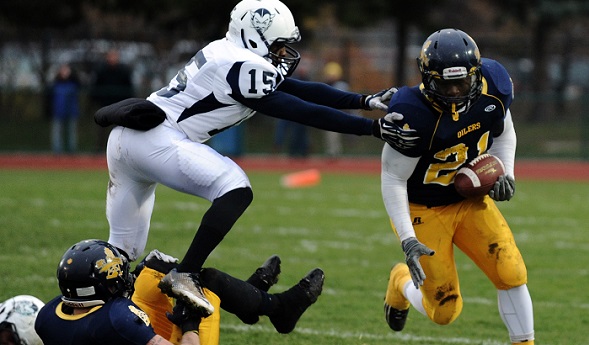
PHOTO: Mount Pleasant (blue jerseys) ran away from Sault Ste. Marie 42-27 last week to earn this weekend’s matchup against Zeeland West. (Click to see more from High School Sports Scene.)