

#TBT: End of an Era in Saginaw
October 23, 2014
By Geoff Kimmerly
Second Half editor
Michigan will wave farewell this weekend to one of its longest-running high school football rivalries as Saginaw High and Arthur Hill play one last time before one of the schools is closed in December.
The 120-year-old rivalry is tied for second-oldest in Michigan history, ranks third with 128 games played and first among rivalries between Lower Peninsula schools.
The Saginaw News reported last month that the district’s Board of Education will vote on which to close in December after voting in July to shut down one of the two.
The schools – first called simply West Side and East Side – have met annually dating to 1894, save for four years – including in 1897 when it was deemed too large a mismatch and 1910 because of a smallpox outbreak. That fall marked the last the two didn’t play at least once – they played each other twice in 1895 and 1974.
Arthur Hill owns a 58-49 advantage in the series, and the teams tied 11 times. The Lumberjacks won last season’s Week 9 tilt, 43-22, but Saginaw holds a 12-8 edge over the last two decades.
Saginaw won the 1999 MHSAA Division 2 championship under coach Donald Durrett, while Arthur Hill claimed the Class AA title in 1991 under coach Jim Eurick and finished runner-up in 1992 – winning the 1991 game over Detroit Catholic Central 13-12 before losing to DCC in the following year's championship game rematch 21-20.
Sadly, both are finishing on softer notes; Saginaw has lost 16 straight games since winning on opening night 2013, while Arthur Hill has lost 13 of its last 14 with that lone win in between coming against the Trojans last fall.
Click to read select pages from the 1994 game program, itself a history book recalling a proud era in Saginaw history.
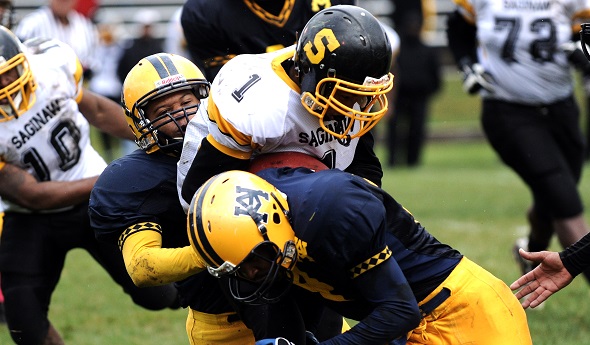
PHOTO: Arthur Hill defeated Saginaw 43-22 in last season's meeting between the longtime rivals. (Click to see more from HighSchoolSportsScene.com.)
Drive for Detroit: Week 8 in Review
October 15, 2012
By Geoff Kimmerly
Second Half editor
As the old cliché goes, Week 8 was why they play the games.
Sure, some of the weekend’s results could be anticipated. But others – think Detroit Martin Luther King over Cass Tech, Oxford over Oak Park and Bessemer over Crystal Falls Forest Park to mention a few – no doubt caught some high school football fans by surprise.
Following are the most significant results from all corners of Michigan during the second-to-last weekend of the regular season. The final games finish off this week, with playoff brackets to be announced during the Selection Sunday Show at 6 p.m. on Fox Sports Detroit.
Greater Detroit
Clarkston 21, Lake Orion 14
In a game pitting the two top-ranked teams in Division 1 according to The Associated Press, No. 1 Clarkston scored with 14.3 seconds to play to move to 8-0 and win the Oakland Activities Association Red championship. Lake Orion fell to 7-1. Click to read more from The Oakland Press.
Also noted:
Detroit Catholic Central 35, Orchard Lake St. Mary 13 – DCC’s win created a three-way tie atop the Detroit Catholic League Central standings, and set up these two to meet again in this week’s Prep Bowl. St. Mary (6-2) is in the playoffs for sure, while DCC (5-3) can earn an automatic berth.
Detroit Martin Luther King 44, Detroit Cass Tech 13 – King might be the best 5-3 team in Michigan, but it’s fair to call this an upset with Cass Tech (6-2) considered among the state’s elite all season. King now will face Detroit East English in Friday’s Public School League championship game.
Walled Lake Northern 55, Hartland 52 – Northern (6-2) not only handed Hartland (7-1) its first loss, but most importantly earned its first playoff berth ever.
Oxford 14, Oak Park 12 – Oak Park (7-1) still won the Oakland Activities Association White title, but Oxford (5-3) kept the Knights from doing so perfectly while keeping its automatic playoff berth chances alive.
Bay and Thumb
Midland 42, Bay City Western 15
Midland had fallen just shy of a league title over the last four seasons, with a combined five league losses during that stretch. But the Chemics (8-0) made it seven wins over Western in their last nine meetings, and earned a share of the Saginaw Valley Association North championship with Midland Dow coming up this week. The Warriors (7-1) must hope for a Midland loss and beat rival Bay City Central to also earn a share. Click to read more from the Bay City Times.
Also noted:
Fenton 55, Swartz Creek 28 – By beating Swartz Creek (7-1), Fenton (7-1) created a four-way tie atop the Flint Metro League standings with a league game to play.
Marine City 35, St. Clair 34 – After opening this season with a nonleague loss, Marine City (7-1) has won seven straight and clinched the Macomb Area Conference Gold title with this nail-biter over second-place St. Clair (7-1)
Merrill 35, Saginaw Valley Lutheran 27 – The Vandals (5-3) kept their automatic playoff berth hopes alive, while dealing a blow to Valley Lutheran (5-3) as it goes for its first berth ever.
Burton Bendle 20, Genesee 16 – Bendle (7-1) has earned a third-straight playoff berth, and remains a win behind New Lothrop in the Genesee Area Conference Blue standings. Genesee (5-3) can still earn an automatic berth, but needs to beat New Lothrop to do so.
Southwest and Border
Stevensville Lakeshore 28, Mattawan 16
It’s something that both of these teams were undefeated heading into this game, given the competitiveness of the Southwestern Michigan Athletic Conference West this fall. But Mattawan (7-1) couldn’t make it two in a row over Lakeshore (8-0), which earned a share of the league title. Click to read more from the Kalamazoo Gazette.
Also noted:
Dowagiac 28, Edwardsburg 8 – The Wolverine Conference West came down to the final league game of the season, with Dowagiac (8-0) edging runner-up Edwardsburg (6-2).
Watervliet 26, Decatur 19 – Four of six teams in the Southwestern Athletic Conference South have made the playoffs, and a fifth can this week; Watervliet (8-0) leads them all and earned a share of the title, while knocking Decatur (6-2) into a tie for third.
Paw Paw 46, Otsego 23 – Paw Paw (8-0) avoided being part of a three-way championship in the Wolverine Conference East by knocking off formerly second-place Otsego (6-2).
Mendon 33, Buchanan 28 – Mendon (8-0) got its biggest scare with its first win by fewer than 20 points, but also big playoff points because Buchanan (6-2) is a Class B school.
West Michigan
Lowell 14, Caledonia 7
Caledonia (6-2) nearly crashed Lowell’s run at the O-K White title. But the Red Arrows (7-1) – despite five turnovers – held on to earn the right to play Grand Rapids Christian this weekend for the league championship. Click to read more from the Grand Rapids Press.
Also noted:
Grand Rapids West Catholic 25, Cedar Springs 20 – This close call earned West Catholic (7-1) the opportunity to play Grand Rapids Northview this week for the O-K Bronze title, and might’ve dropped Cedar Springs (4-4) out of playoff contention.
Hamilton 42, Zeeland West 38 – The Hawkeyes (5-3) edged a win closer to their first playoff berth since 2009, while knocking Zeeland West (5-3) into a three-way tie atop the O-K Green with a league game to play.
Grand Rapids Catholic Central 28, Hastings 14 – The Cougars (8-0) clinched a share of the O-K Gold championship, although Hastings (6-2) can still earn another share in the unlikely scenario that GRCC falls this week to winless Wayland.
Fruitport 24, Muskegon Catholic Central 21 (OT) – The Trojans (8-0) hadn’t faced MCC (5-3) since 1976, but are now one win away from a 9-0 season for the first time since 2006.
Mid-Michigan
Lansing Waverly 38, Mason 16
The Warriors (5-3) need another win Friday over Fowlerville to earn an automatic playoff berth. But it’s fair to say this was their best win since 2002, the last time Waverly made the postseason. Mason (5-3) has beaten the Warriors by an average of 21 points per game over the last four seasons. Click to read more from Mlive Lansing.
Also noted:
Clare 27, Sanford Meridian 7 – After opening 0-2, Clare (6-2) has stormed back to win a share of the Jack Pine Conference title while putting Sanford Meridian (5-3) in a must-win situation to earn an automatic playoff berth.
Grand Ledge 40, East Lansing 0 – This was expected to be much closer with both 5-2 coming in; the Comets (6-2) are no doubt relieved to have a playoff berth in hand with a tough game against Holt coming up, while the Trojans (5-3) should still get in with two-win Okemos next on the schedule.
Williamston 25, Haslett 22 – A late score kept playoff hopes alive for Williamston (5-3), while potentially derailing those of Haslett (4-4).
Portland 37, DeWitt 7 – When these teams were in the same league a decade ago, few would have believed Portland (7-1) could beat DeWitt (6-2) twice in row; this made it so.
Lower Up North
Maple City Glen Lake 26, Traverse City St. Francis 20
Glen Lake (8-0) hadn’t won more than five games in a season since 2001, but lined itself up for its first perfect regular season since that season with a late score to claim this nonleague game. In doing so, the Lakers also might’ve finished St. Francis’ MHSAA-best 22-season playoff streak – the Gladiators fell to 4-4. Click to read more from the Traverse City Record-Eagle.
Also noted:
Boyne City 44, Elk Rapids 30 – Boyne City (8-0) remained tied for first in the Lake Michigan Conference with a league game to play, while dropping Elk Rapids (4-4) into a tough spot for playoff qualification.
Grayling 63, East Jordan 29 – Grayling (8-0) didn’t have as much to stress with East Jordan (0-8), but will face Boyne City this week for the Lake Michigan Conference title.
West Branch Ogemaw Heights 56, Traverse City West 39 – Ogemaw Heights kept automatic playoff berth hopes alive by moving to 5-3, and made life a little less comfortable for Traverse City West, also 5-3.
Lake City 49, Manton 12 – Lake City (7-1) can only hope for a Beal City loss this week that would split the Highland Conference title. Manton (4-4) hopes to get into the playoffs if it can finish with a victory.
Upper Peninsula
Bessemer 46, Crystal Falls Forest Park 15
Bessemer (5-2) hadn’t celebrated a winning season since 2006. Now the Speedboys also can celebrate a league title, with this win giving it a shared championship in the Great Western Conference with Hurley (Wis.). Bessmer (also referred to as Gogebic because it is a co-op with Wakefield) also qualified for the playoffs, something Forest Park (6-2) had already secured. Click to read more from the Iron Mountain Daily News.
Also noted:
Kingsford 49, Gladstone 28 – Kingsford (7-1) finished a perfect 4-0 in the Great Northern UP Conference by knocking off fifth-place Gladstone (2-6)
Eagle River Northland Pines (Wis.) 68, L'Anse 24 – Northland Pines (8-0) avoided a three-way tie in the Western Peninsula Athletic Conference, while dropping L’Anse (6-2) to third in the final league standings.
Marquette 34, Negaunee 26 – Marquette (4-4), playing eight games this regular season, kept a slim hope of playoffs alive by beating Mid-Peninsula Athletic Conference champion Negaunee (7-1, with a share of the title so far). Marquette also claimed the Diamond Jubilee Trophy, which originated in 1969.
Menominee 48, Marinette (Wis.) 26 – This was the 106th meeting between the two, dating back to 1894.
Trophy Games
Every week, the MHSAA highlights trophy games played throughout the state. Here are a few more from Week 8:
- Brown Jug – This trophy contended by Center Line and Warren Lincoln dates back to 1947. Final: Warren Lincoln 52, Center Line 13.
- Oak Chest – Lansing Everett beat the Big Reds for the first time since 2008, and after losing by 32 to Sexton in 2011. Final: Everett 32, Sexton 0.
- Sugar Bowl – Reese made it seven straight wins in this series against Unionville-Sebewaing for a trophy that originated in 1994. Final: Reese 55, USA 42.
- Spirit Bell – Ithaca at St. Louis - Originated in 1972, this is an all-sports traveling trophy. The Bell goes on the line again next week when the two schools meet in volleyball. Final: Ithaca 70, St. Louis 0.
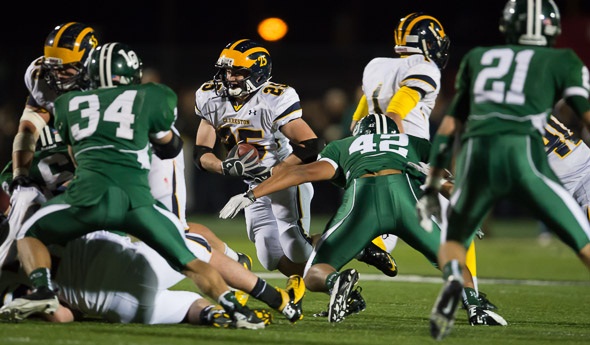
PHOTO: Clarkston junior running back Ian Eriksen (25) searches for an opening during Friday's win against Lake Orion. (Click to see more at Terry McNamara Photography.)