

#TBT: End of an Era in Saginaw
October 23, 2014
By Geoff Kimmerly
Second Half editor
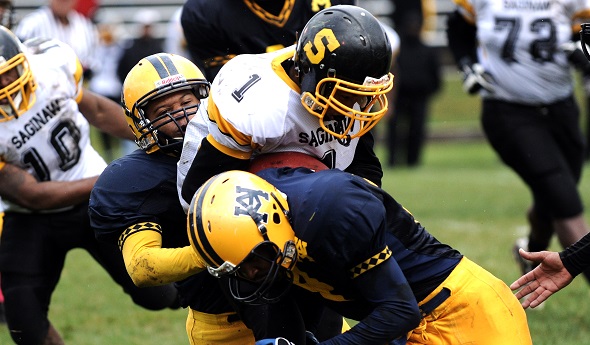
Michigan will wave farewell this weekend to one of its longest-running high school football rivalries as Saginaw High and Arthur Hill play one last time before one of the schools is closed in December.
The 120-year-old rivalry is tied for second-oldest in Michigan history, ranks third with 128 games played and first among rivalries between Lower Peninsula schools.
The Saginaw News reported last month that the district’s Board of Education will vote on which to close in December after voting in July to shut down one of the two.
The schools – first called simply West Side and East Side – have met annually dating to 1894, save for four years – including in 1897 when it was deemed too large a mismatch and 1910 because of a smallpox outbreak. That fall marked the last the two didn’t play at least once – they played each other twice in 1895 and 1974.
Arthur Hill owns a 58-49 advantage in the series, and the teams tied 11 times. The Lumberjacks won last season’s Week 9 tilt, 43-22, but Saginaw holds a 12-8 edge over the last two decades.
Saginaw won the 1999 MHSAA Division 2 championship under coach Donald Durrett, while Arthur Hill claimed the Class AA title in 1991 under coach Jim Eurick and finished runner-up in 1992 – winning the 1991 game over Detroit Catholic Central 13-12 before losing to DCC in the following year's championship game rematch 21-20.
Sadly, both are finishing on softer notes; Saginaw has lost 16 straight games since winning on opening night 2013, while Arthur Hill has lost 13 of its last 14 with that lone win in between coming against the Trojans last fall.
Click to read select pages from the 1994 game program, itself a history book recalling a proud era in Saginaw history.
PHOTO: Arthur Hill defeated Saginaw 43-22 in last season's meeting between the longtime rivals. (Click to see more from HighSchoolSportsScene.com.)
Drive for Detroit: Week 5 Preview
September 21, 2017
By Geoff Kimmerly
Second Half editor
Big things are ahead in Michigan high school football.
 Not much will be decided this week as we cruise into the midpoint of the regular season. But teams all over Michigan are setting the foundations to celebrate soon – either as league champions or playoff qualifiers (and AuGres-Sims, 4-0 and playing eight games this season, can become our first this weekend).
Below is our weekly look at the games that appear most intriguing from every region of the state, powered by MI Student Aid. Keep these links handy for the weekend: MHSAA Score Center for scores as they come in (and links to each team’s schedule, league standings and playoff-points average), and MHSAA.tv, which again will broadcast nine games this weekend – click here for the schedule.
Bay & Thumb
New Lothrop (4-0) at Flint Hamady (3-1), Friday
The Genesee Area Conference Blue was decided last season by New Lothrop’s 51-16 Week 4 win over Hamady, and this matchup could be the eventual clincher again. The Hornets have now won 65 of their last 66 regular-season games going back to the start of 2010, and they haven’t given up a point this fall since downing GAC Red leader Lake Fenton in Week 1. But Hamady has held its last three opponents to single-digit scoring since losing to still-undefeated Cass City on opening night, signaling this might be closer than last year’s meeting.
Others that caught my eye: FRIDAY Byron (3-1) at Lake Fenton (3-1), Midland (3-1) at Bay City Central (3-1), Flint Beecher (2-2) at Saginaw Nouvel (4-0), Harbor Beach (3-1) at Sandusky (2-2).
Greater Detroit
Birmingham Groves (3-1) at Farmington Hills Harrison (3-1), Friday
After falling to Oakland Activities Association White co-leader Oak Park last week, Groves has one more chance to mix up the top of the standings as it hopes to repeat as the league champion – this time likely sharing the title. Harrison is the other team currently in first, and longtime coach John Herrington is just two wins from tying retired Birmingham Brother Rice coach Al Fracassa for most wins (430) in MHSAA football history. A victory tonight for the Hawks could make Week 7 versus Oak Park the first opportunity for Herrington to break the record.
Others that caught my eye: FRIDAY Utica Eisenhower (4-0) at Romeo (3-1), Clinton Township Clintondale (4-0) at Hazel Park (3-1), Marine City (4-0) at Madison Heights Madison (4-0), West Bloomfield (2-2) at Rochester Adams (4-0).
Mid-Michigan
Portland (3-1) at Lansing Catholic (4-0), Friday
The Cougars kept this rivalry game as a potential league title decider by surviving a one-point game against Williamston last week. Portland won the last two Capital Area Activities Conference White titles after handing Lansing Catholic its lone league loss both seasons. Both teams are led by dynamic quarterbacks again – Michael Lynn III for Lansing Catholic and Austin Allison for Portland – and both also are giving up only 15 points per game.
Others that caught my eye: FRIDAY Okemos (4-0) at Grand Ledge (3-1), Montrose (3-1) at Corunna (3-1), Clare (3-1) at Harrison (3-1), Fulton (3-1) at Pewamo-Westphalia (3-1).
Northern Lower Peninsula
Grayling (4-0) at Boyne City (4-0), Friday
The Northern Michigan Football League’s Legends division is again loaded, with three undefeated teams and two more at 3-1 out of seven teams total. This matchup should help break up some of the top pack. These two and two-time reigning champion Traverse City St. Francis are the co-leaders, after St. Francis downed Boyne City in Week 9 last year to secure the title. Grayling’s last league title came in 2013 in the old Lake Michigan Conference and Boyne won the Legends in 2014 – making it hardly surprising they’re among those battling the Gladiators again. Grayling gets St. Francis next week; Boyne City has its shot in Week 9.
Others that caught my eye: FRIDAY Frankfort (3-1) at Johannesburg-Lewiston (3-1), Beal City (3-1) at Lake City (4-0), Whittemore-Prescott (2-2) at Lincoln Alcona (3-1), SATURDAY Gaylord (2-2) at Traverse City Central (2-2).
Southeast & Border
Michigan Center (3-1) at Addison (4-0), Friday
Addison’s best start since 2006 has made the Cascades Conference race one of the most intriguing of the first half of the regular season. Last season’s co-champions, Grass Lake and Napoleon, remain in the mix, but Addison’s two-point win over Napoleon last week put the Panthers in first place alone. After six straight sub-.500 seasons, Addison is a win from breaking that streak. Michigan Center, meanwhile, is one of three teams tied for second in the league and only a three-point loss to Napoleon in Week 3 from being tied for first.
Others that caught my eye: FRIDAY Adrian (3-1) at Chelsea (3-1), Quincy (3-1) at Reading (3-1), Homer (3-1) at Springport (2-2), SATURDAY Temperance Bedford (3-1) at Ann Arbor Pioneer (2-2).
Southwest Corridor
Kalamazoo Hackett (4-0) at Watervliet (4-0), Friday
The Southwestern Athletic Conference Valley is another league that has enjoyed a great nonconference run – five teams are 3-1 or 4-0, and the sixth is 2-2. Watervliet has won or shared its league’s championship six straight seasons and is on pace to break 500 points offensively for the third straight year. Hackett’s path has been different – the four wins this fall tie their most in nine of the last 10 seasons. But the Fighting Irish clearly are up to the challenge this year – and both will have to be up to the challenges of Constantine, Coloma, Delton Kellogg and new league foe Schoolcraft over the next five weeks.
Others that caught my eye: FRIDAY White Pigeon (3-1) at Mendon (4-0), Athens (4-0) at Climax-Scotts (3-1), St. Joseph (3-1) at Mattawan (3-1), Three Rivers (3-1) at Paw Paw (3-1).
Upper Peninsula
Bark River-Harris (3-1) at Norway (4-0), Friday
The Mid-Eastern Conference continues to produce some of the U.P.’s top matchups every week, and this one again could go far in figuring out the eventual champion. Norway is the only one of five teams that hasn’t played a league game; it’s also the only one undefeated and has the highest playoff-point average of the five. Bark River-Harris’ loss came to current M-EC leader Newberry; the Broncos interestingly have wins over teams from multiple states – Wisconsin and Illinois – a rarity on either peninsula.
Others that caught my eye: FRIDAY Hancock (3-1) at Calumet (3-1), Gladstone (4-0) at Ishpeming (2-2), Negaunee (1-3) at Gwinn (2-2), Newberry (3-1) at Lake Linden-Hubbell (0-3).
West Michigan
Grandville (3-1) at East Kentwood (4-0), Friday
The Ottawa-Kent Conference Red easily could be headed for another split title – three teams shared last year, two in 2015 and 2014. And there appear to be four contenders again – these two obviously included. Grandville was one of those three champs a year ago, and minus a painful defeat to Warren DeLaSalle has given up only 27 points over its three wins. The Falcons have been nearly as stellar on that side of the ball, shutting out reigning Division 3 champion Orchard Lake St. Mary’s in Week 2 and despite giving up 32 last week to Grand Rapids Forest Hills Northern (which is averaging 30 per game).
Others that caught my eye: FRIDAY Cedar Springs (3-1) at Grand Rapids Christian (4-0), Coopersvile (3-1) at Grand Rapids West Catholic (3-1), Grant (3-1) at Remus Chippewa Hills (3-1), Montague (4-0) at Whitehall (3-1).
8-Player
Morrice (4-0) at Flint International Academy (4-0), Friday
Similar to last season, no one has slowed down Deckerville yet. But the winner of this game will have the most meaningful chance. All three are 3-0 in the North Central Thumb League Stars division, Morrice bouncing back from a 4-5 finish last season and Flint International picking right back up after going 6-3 in its first season of 8-player football in 2016. The Flames already have put up 190 points, more than half their total over nine games a year ago. They’ll face a great challenge in a Morrice defense that is giving up 4.5 points per game – a rarity in this high-scoring, wide-open format.
Others that caught my eye: FRIDAY Rudyard (3-1) at Brimley (3-1), North Adams-Jerome (2-2) at Camden-Frontier (4-0), Lawrence (3-1) at Kingston (2-2), Onekama (4-0) at Suttons Bay (3-1).
Second Half’s weekly “Drive for Detroit” previews are powered by MI Student Aid, a part of the Student Financial Services Bureau located within the Michigan Department of Treasury. MI Student Aid encourages students to pursue postsecondary education by providing access to student financial resources and information, including various student financial assistance programs to help make college more affordable for Michigan students. MI Student Aid administers the state’s 529 savings programs (MET/MESP) and eight additional aid programs within its Student Scholarships and Grants division. Click for more information and connect with MI Student Aid on Facebook and Twitter @mistudentaid.
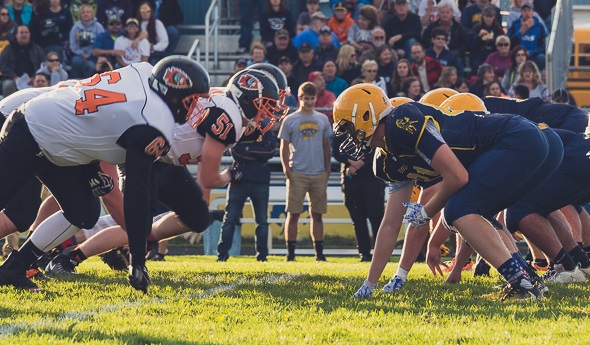
PHOTO: Bark River-Harris, right, will take on Norway in this weekend’s most intriguing game in the Upper Peninsula. (Photo by Jeff Rochefort.)