

#TBT: End of an Era in Saginaw
October 23, 2014
By Geoff Kimmerly
Second Half editor
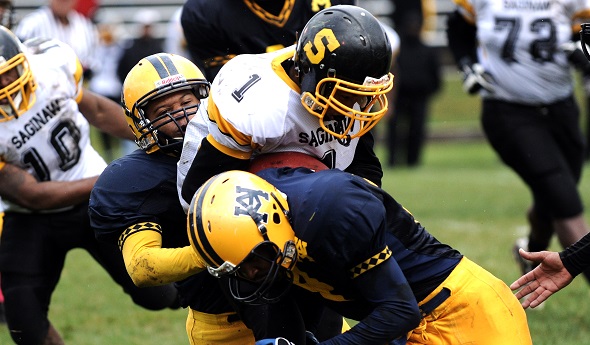
Michigan will wave farewell this weekend to one of its longest-running high school football rivalries as Saginaw High and Arthur Hill play one last time before one of the schools is closed in December.
The 120-year-old rivalry is tied for second-oldest in Michigan history, ranks third with 128 games played and first among rivalries between Lower Peninsula schools.
The Saginaw News reported last month that the district’s Board of Education will vote on which to close in December after voting in July to shut down one of the two.
The schools – first called simply West Side and East Side – have met annually dating to 1894, save for four years – including in 1897 when it was deemed too large a mismatch and 1910 because of a smallpox outbreak. That fall marked the last the two didn’t play at least once – they played each other twice in 1895 and 1974.
Arthur Hill owns a 58-49 advantage in the series, and the teams tied 11 times. The Lumberjacks won last season’s Week 9 tilt, 43-22, but Saginaw holds a 12-8 edge over the last two decades.
Saginaw won the 1999 MHSAA Division 2 championship under coach Donald Durrett, while Arthur Hill claimed the Class AA title in 1991 under coach Jim Eurick and finished runner-up in 1992 – winning the 1991 game over Detroit Catholic Central 13-12 before losing to DCC in the following year's championship game rematch 21-20.
Sadly, both are finishing on softer notes; Saginaw has lost 16 straight games since winning on opening night 2013, while Arthur Hill has lost 13 of its last 14 with that lone win in between coming against the Trojans last fall.
Click to read select pages from the 1994 game program, itself a history book recalling a proud era in Saginaw history.
PHOTO: Arthur Hill defeated Saginaw 43-22 in last season's meeting between the longtime rivals. (Click to see more from HighSchoolSportsScene.com.)
Highlight Reel: Friday Football Finals
November 26, 2016
By John Johnson
MHSAA Communications Director
A pair of repeat champions took center stage Friday at the first day of the MHSAA 11-Player Football Finals, powered by the Michigan Army National Guard, at Ford Field in Detroit.
Division 8
Muskegon Catholic Central 35, Ottawa Lake Whiteford 6
Due to technical difficulties, highlights of this game will be posted at a later date.
Division 2
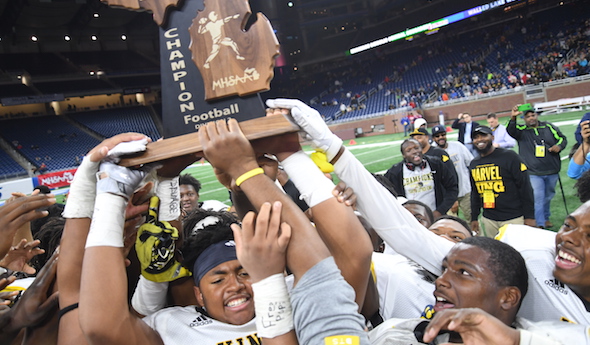
Detroit Martin Luther King 18, Walled Lake Western 0
Finn Hits Thomas for King TD - Late in the first half, Dequan Finn hit Ambry Thomas with a 9-yard touchdown pass for Detroit Martin Luther King.
Tip Drill Turns Into King TD - A tipped ball turned into a pick-six for Detroit Martin Luther King, as Jesse Scarber came up with this second interception of the game returned this one 56 yards for a score.
More Pick-Six Action By Morton - Detroit Martin Luther King returned a second interception for a score in the fourth quarter when Jay-Veyon Morton took this pick back for a TD.
Division 6
Jackson Lumen Christi 26, Maple City Glen Lake 14
Lakers Back In The Game - Trailing in the second quarter, Maple City Glen Lake gets back into the Division 6 Final when QB Cade Peterson finds a streaking Nick Rice going down the sideline for 57 yards and a score.
Ring The Bell - Jackson Lumen Christi's Bo Bell came up big with 238 yards rushing. Here's his longest run of the day, a 46-yard jaunt in the third quarter which set up a 3-yard scoring run – his lone TD of the game.
Division 4
Grand Rapids Catholic Central 10, Detroit Country Day 7
Yellowjackets Score On The Interception - Trailing in the second quarter, Detroit Country Day seized the lead when Roy McCree intercepted a pass and returned it 82 yards for a score.
Finding Its Offense At The Right Time - Early in the fourth quarter, Grand Rapids Catholic Central gets its lone first down of the Division 4 title game on this 44-yard pitch-and-catch from Jack Bowen to Michael Brown.
The MHSAA Football Finals are sponsored by the Michigan National Guard.
PHOTO: Detroit Martin Luther King players hoist the Division 2 championship trophy Friday at Ford Field.