


#TBT: Searching for The Hinker Bell
September 28, 2017
By Geoff Kimmerly
Second Half editor
Menominee will host Escanaba on Friday in the 121st meeting between two of the Upper Peninsula’s largest high schools and proudest football programs – but with the trophy celebrating the game still missing after it first disappeared more than half a century ago.
The two teams from 1948-1962 played for the The Hinker Bell, a locomotive bell that hasn’t been seen since 1963.
A decade ago, Escanaba Daily Press sports editor (and now Second Half correspondent) Denny Grall wrote about a newfound search for The Hinker Bell. But the mystery continues, and Grall’s story below tells of many of the twists and turns that to that point that had come in trying to locate it.
ESCANABA — Another search is underway to find the Hinker Bell.
The former locomotive bell went to the winner of the Escanaba-Menominee football game for about 15 years but has been missing for more than 40 years. It came from a locomotive owned by the Bay de Noquet Company and used on the LS&I Railroad that operated in Delta and Menominee counties.
The locomotive was built in 1906 by Baldwin Locomotive Works in Philadelphia and the bell was believed to have been cast in the railroad foundry, according to a 1953 newspaper clipping.
In 1948, one of the locomotive owners presented the bell to his friend, John Hinker of Menominee, an ardent sports fan who donated materials for the press box at Menominee’s Walton Blesch Field.
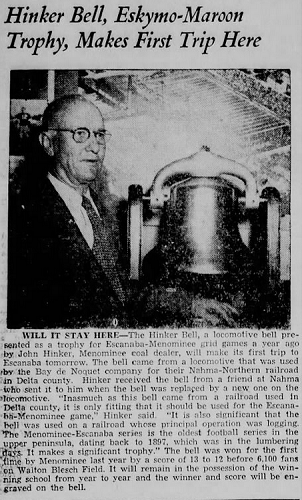 Hinker gave the bell to then Menominee coach Mickey McCormick and indicated proper use for the bell would be as an award for the gridiron rivalry.
Now Hinker’s great great nephew is trying to find the bell, which has not been seen since Escanaba’s current high school opened in 1963.
Tim Waters of Land O’ Lakes, Wis., who has launched the search, became interested by researching his family tree. “It is a big trophy (between 80 and 150 pounds by various estimates) and it is odd that it is missing,” Waters said in a recent telephone chat.
“One theory is that it is in somebody’s hunting camp or a home and they are using it as their own trophy,” said Waters.
“We have a pretty good investigation going on and all help is appreciated. If somebody does have it, we’re not looking to prosecute them. We’re just looking to get the darn thing back. Nobody will be in trouble.”
Waters refuted the old idea the bell was melted down. He has contacted numerous bell collectors, and they said a junk yard would have known it was worth a lot more than melted metal.
“The bell was not destroyed. We’ve come to that conclusion,” he said. “It was not put in a scrap yard.”
Waters contacted Coplan Iron and Metal of Escanaba and learned that bells were not melted or crushed and said the firm never accepted a bell with engravings matching the Hinker Bell.
Waters learned those businesses would sell them for the weight value to people who wanted them for yard ornaments/dinner bells, or to collectors.
“It is a treasure and it needs to be found,” said Waters.
Waters said the last known photo of the bell was with then EHS football coach Al Sigman and Esky players John Fisher and Phil Davidson in 1960. Escanaba beat Menominee from 1959-63 but could not find the bell in 1964 when the Maroons won. No one he has talked to remembers seeing the bell present at the first three games during the tenure of coach Jerry Cvengros.
The current Escanaba High School opened in 1963 and Bay de Noc Community College then occupied the old facility, which has since been demolished.
“Records indicate there was no report (of a missing bell) filed by Escanaba school district to the police department,” Waters said.
“The Hinker Bell is part of U.P. Michigan’s history, as is football and the railroads,” Waters said. “The people of Escanaba and Menominee deserve to have this trophy returned to their high schools.”
Waters, who has never seen an Escanaba or Menominee football game but is planning to rectify that omission this season, is hoping students at the two schools will join in the treasure hunt and talk about it with their parents and grandparents.
He has already contacted EHS athletic director Rob Ryan, who plans to thoroughly search the school basement.
He would like to find a photo of the bell to help collectors in their search. “Each bell was for a special locomotive,” said Waters.
“If they have a good picture we can pass it around and say we are looking for this bell. If they can pinpoint what this bell was on, they can help get the word out.”
He has also extended the search to the website at upfootball.com, which has generated interest but no bell. “If the bell is in the area still today, I don’t think it will take long to surface,” he said.
“If we don’t find this bell, we are going to try to make up a replacement as close as possible if the two schools are interested in that,” he said.
Waters is hoping that real estate agents, postal workers, delivery personnel, construction workers, etc., may have seen the bell during their travels and can help retrieve it.
Notre Dame Prep Takes to Air, Passes 1st Finals Test to Complete Record Run
By
Paul Costanzo
Special for MHSAA.com
November 30, 2024
DETROIT – It’s been hard to find room to run against Frankenmuth all season, so on Saturday, Notre Dame Prep went to the air.
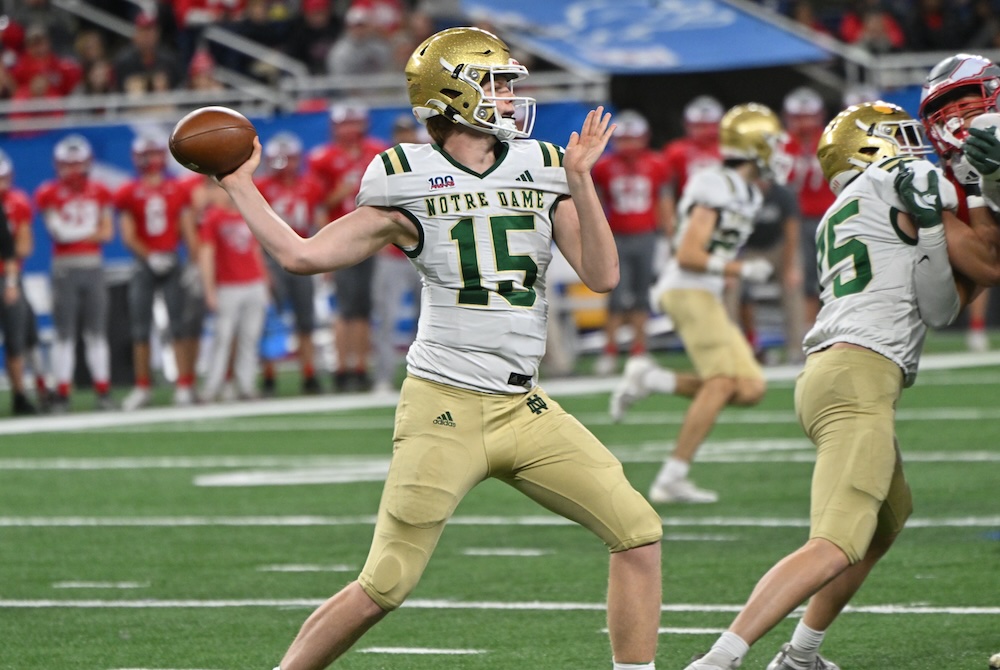
Quarterback Sam Stowe threw for 293 yards and four touchdowns as the Fighting Irish made the most of their first Football Finals appearance with a 42-7 victory over the Eagles in the Division 5 title game at Ford Field.
“The lights weren’t too bright for our offense,” Stowe said. “Having playmakers like Joey (Decasas) and Billy (Collins), Drew (Heimbuch) – they make me look good. I couldn’t have asked for a better offense tonight.”
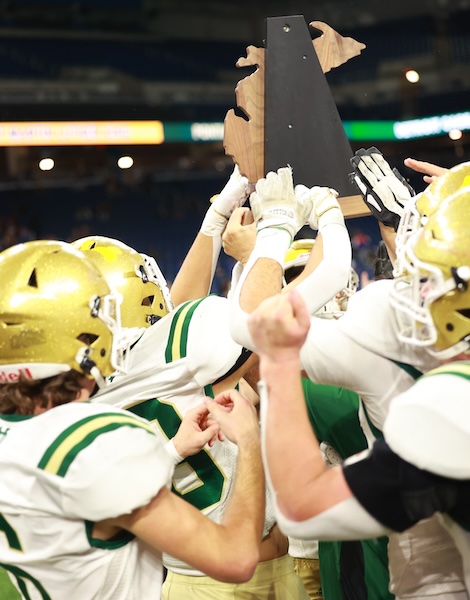
 The win caps off a historic season for the Irish, who won a school-record 12 games and the first Regional title in program history. To end it with a win on the season’s final day was, of course, special for everyone involved, but especially for NDP coach Pat Fox, who finished his 11th season with a Finals title win against his alma mater.
“I actually live there now, too,” Fox said with a smile. “I was the benefit of tremendous coaching, and I played for the greatest head coach in the state, Ralph Munger. He raised all of us in a specific way, and because of him I have a great life. I owe my life to that program. But, I don’t know anybody there anymore except for (Frankenmuth coach Phil Martin), and these are my guys and I was happy to win big. It wasn’t a problem, as long as my house isn’t burned down. … It was hard. It was hard. I love the program.”
Saturday’s game continued a theme for the Irish: winning big in the postseason. They outscored opponents 241-59 over five playoff games on their way to the title.
“We’ve had a great year this year. We have great young men,” Fox said. “I work with tremendous people, and I’m blessed to tell you that we’re very proud of our accomplishments because we do it the right way. We’re a developmental program. A lot of our players, like Drew and Sammy, have been with me since junior kindergarten. We have great student-athletes, and great young men. And we take the time to develop them, and they stay in our program.”
Fox singled out Stowe, who sat behind Jacob Tuttle, a first-team all-state selection a year ago. Rather than look elsewhere to get his talent onto the field, Stowe stuck it out at Notre Dame and had an unforgettable junior season, throwing for nearly 3,000 yards and 37 touchdowns.
“I got to sit behind Jacob Tuttle, one of the Notre Dame greats,” Stowe said. “And he taught me everything I know.”
That was on full display Saturday, as Stowe utilized his weapons on the outside to burn a Frankenmuth defense that has been outstanding all season.
Frankenmuth entered the game having allowed just 473 yards on the ground all season, and the Irish didn’t have a ton more luck for most of the game. But the passing game was lethal, and made all the difference.
 “Honestly, I always trust our offense,” Collins said. “We definitely have the ability to make huge plays. We have some extremely fast guys, a fantastic quarterback in Sam who can get the ball down the field. We just trust our offense, we trust our offensive coordinator, coach (Jason) Whalen. We just trust our team.”
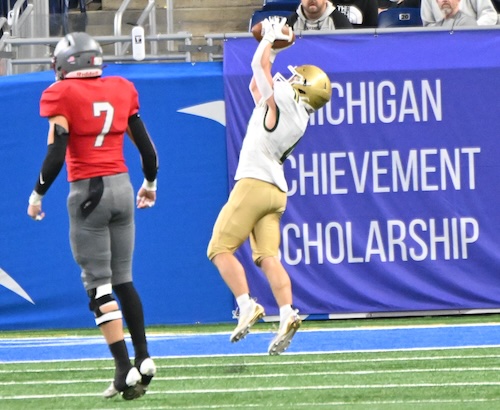
Stowe did most of his damage in the first half, including all four touchdown passes. He hit Collins for 87- and 25-yard scores, Michael Wiebelhaus for a 23-yarder, and Decasas on a 47-yard score.
Collins caught four passes for 126 yards, while Decasas had three catches for 70 yards.
Heimbuch scored the final two touchdowns for Notre Dame Prep on runs of eight and 50 yards in the second half. He finished with 63 yards rushing.
Notre Dame Prep’s defense was equally impressive, holding Frankenmuth to 245 total yards (4.2 per play) and not allowing a score until there was 8:58 to play in the game and the Irish had already built a 35-0 lead.
Luca Gasperoni led the defensive charge, finishing with 13 tackles, while Mark Galle had 11 and Wiebelhaus had 10. Heimbuch added nine tackles, including one sack and three tackles for loss.
Lleyton Hoard scored Frankenmuth’s lone touchdown on an 11-yard run early in the fourth quarter. Cash Tedford had 86 yards rushing to lead the Eagles (13-1), who were making their third Finals appearance over the past five seasons.
Brady Lipka had seven tackles, including two TFLs to lead the Frankenmuth defense.
PHOTOS (Top) Notre Dame Prep quarterback Sam Stowe (15) winds up to throw a pass Saturday as his line holds off the rush. (Middle) The Fighting Irish’s Billy Collins (4) pulls in a touchdown pass. (Below) NDP players hold up their championship trophy toward the crowd. (Photos by Hockey Weekly Action Photos.)