


#TBT: Searching for The Hinker Bell
September 28, 2017
By Geoff Kimmerly
Second Half editor
Menominee will host Escanaba on Friday in the 121st meeting between two of the Upper Peninsula’s largest high schools and proudest football programs – but with the trophy celebrating the game still missing after it first disappeared more than half a century ago.
The two teams from 1948-1962 played for the The Hinker Bell, a locomotive bell that hasn’t been seen since 1963.
A decade ago, Escanaba Daily Press sports editor (and now Second Half correspondent) Denny Grall wrote about a newfound search for The Hinker Bell. But the mystery continues, and Grall’s story below tells of many of the twists and turns that to that point that had come in trying to locate it.
ESCANABA — Another search is underway to find the Hinker Bell.
The former locomotive bell went to the winner of the Escanaba-Menominee football game for about 15 years but has been missing for more than 40 years. It came from a locomotive owned by the Bay de Noquet Company and used on the LS&I Railroad that operated in Delta and Menominee counties.
The locomotive was built in 1906 by Baldwin Locomotive Works in Philadelphia and the bell was believed to have been cast in the railroad foundry, according to a 1953 newspaper clipping.
In 1948, one of the locomotive owners presented the bell to his friend, John Hinker of Menominee, an ardent sports fan who donated materials for the press box at Menominee’s Walton Blesch Field.
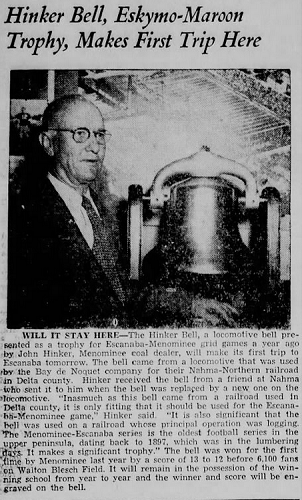 Hinker gave the bell to then Menominee coach Mickey McCormick and indicated proper use for the bell would be as an award for the gridiron rivalry.
Now Hinker’s great great nephew is trying to find the bell, which has not been seen since Escanaba’s current high school opened in 1963.
Tim Waters of Land O’ Lakes, Wis., who has launched the search, became interested by researching his family tree. “It is a big trophy (between 80 and 150 pounds by various estimates) and it is odd that it is missing,” Waters said in a recent telephone chat.
“One theory is that it is in somebody’s hunting camp or a home and they are using it as their own trophy,” said Waters.
“We have a pretty good investigation going on and all help is appreciated. If somebody does have it, we’re not looking to prosecute them. We’re just looking to get the darn thing back. Nobody will be in trouble.”
Waters refuted the old idea the bell was melted down. He has contacted numerous bell collectors, and they said a junk yard would have known it was worth a lot more than melted metal.
“The bell was not destroyed. We’ve come to that conclusion,” he said. “It was not put in a scrap yard.”
Waters contacted Coplan Iron and Metal of Escanaba and learned that bells were not melted or crushed and said the firm never accepted a bell with engravings matching the Hinker Bell.
Waters learned those businesses would sell them for the weight value to people who wanted them for yard ornaments/dinner bells, or to collectors.
“It is a treasure and it needs to be found,” said Waters.
Waters said the last known photo of the bell was with then EHS football coach Al Sigman and Esky players John Fisher and Phil Davidson in 1960. Escanaba beat Menominee from 1959-63 but could not find the bell in 1964 when the Maroons won. No one he has talked to remembers seeing the bell present at the first three games during the tenure of coach Jerry Cvengros.
The current Escanaba High School opened in 1963 and Bay de Noc Community College then occupied the old facility, which has since been demolished.
“Records indicate there was no report (of a missing bell) filed by Escanaba school district to the police department,” Waters said.
“The Hinker Bell is part of U.P. Michigan’s history, as is football and the railroads,” Waters said. “The people of Escanaba and Menominee deserve to have this trophy returned to their high schools.”
Waters, who has never seen an Escanaba or Menominee football game but is planning to rectify that omission this season, is hoping students at the two schools will join in the treasure hunt and talk about it with their parents and grandparents.
He has already contacted EHS athletic director Rob Ryan, who plans to thoroughly search the school basement.
He would like to find a photo of the bell to help collectors in their search. “Each bell was for a special locomotive,” said Waters.
“If they have a good picture we can pass it around and say we are looking for this bell. If they can pinpoint what this bell was on, they can help get the word out.”
He has also extended the search to the website at upfootball.com, which has generated interest but no bell. “If the bell is in the area still today, I don’t think it will take long to surface,” he said.
“If we don’t find this bell, we are going to try to make up a replacement as close as possible if the two schools are interested in that,” he said.
Waters is hoping that real estate agents, postal workers, delivery personnel, construction workers, etc., may have seen the bell during their travels and can help retrieve it.
Ruddy, Whiteford Run Into Record Book with Championship Rushing Attack
By
Geoff Kimmerly
MHSAA.com senior editor
August 25, 2023
Ottawa Lake Whiteford won its second Finals championship in 2022 with a power rushing attack that’s become expected of the program, but also with a record-setting quarterback leading the way.
Senior Shea Ruddy was added to the MHSAA record book for 4,461 yards and 52 touchdowns passing over four seasons, plus five touchdown passes in a half last season against Kalamazoo Loy Norrix.
Whiteford, meanwhile, made the record book for 664 points scored, 5,756 total yards and 87 total touchdowns, 4,515 rushing yards, 635 rushing attempts and 68 rushing scores. Whiteford’s 2021 team also was added for 64 rushing touchdowns, 5,468 total yards and 628 points after a Semifinal run. Ruddy is playing now at Hillsdale College.
See below for more recent updates to the 11-player record book.
11-Player Football
Portland lost a 39-34 heartbreaker to DeWitt on Sept. 1, 2022, but a pair of Raiders top a record book list for one of the game’s biggest highlights. Marc Nobis found receiver Chris Battley for a 99-yard touchdown reception, tying the record for longest scoring pass. Nobis was a senior, and Battley was a sophomore.
Rochester Hills Stoney Creek senior Quentin Ubaydi earned a record book listing for a flawless kicking performance last Aug. 25. He made all 10 of his extra-point tries in his team’s 70-0 win over Detroit Mumford.
The list of football programs with at least 500 wins over their histories is short – but growing. St. Joseph was added with a 563-376-34 record dating to its first season in 1913. The Bears also were added for 706 total yards in their Sept. 30, 2022, game against Portage Northern, a 62-49 win.
Walled Lake Western’s Jaxon Lippert became the 21st player to return a kickoff 99 yards for a touchdown when he did so against Davison on Sept. 30, 2022. Lippert is a senior this fall.
Kalamazoo Loy Norrix was part of one of the highest-scoring games of the 2021 season, and a pair of then-senior standouts earned individual record listings that day. Quarterback Tyler Roberts threw for 424 yards, and received Kevin Lucas had 223 yards and four touchdowns through the air, although Whiteford prevailed 76-40. Roberts is playing football and baseball at Hope College, and Lucas is playing football at Albion College.
Four decades later, Flint Kearsley standout John Yancer had been added for his 19 sacks over nine games in 1983, including five in the season finale against Flushing. Yancer was a senior that fall.
Holton quarterback Austin Fowler capped his high school career in a big way as a senior in 2021, making the record book seven times for passing – most notably for 2,265 yards, 153 completions and 33 touchdown tosses over nine games. He threw for 463 yards on 32 completions as Holton and Muskegon Heights Academy combined for 108 points that Oct. 30. He’s played baseball at Muskegon Community College this spring.
Tarik Ahmetbasic finished his high school career in 2022 having made 48 straight extra points dating back to the final game of his junior season, and he made the record book three times total for Clinton Township Chippewa Valley. He was added also for 87 extra points over 90 attempts over two seasons as the team’s point-after kicker, and for making all nine of his field goal attempts last fall. Ahmetbasic also just missed the career field goals list with 16 in 18 attempts, having kicked all 16 over the last two seasons after attempting one as a sophomore. He is continuing at Michigan State.
Boyne City seniors Jack Neer and Alex Calcaterra didn’t take long to make memories last season. Both made the record book in an opening 51-35 win over Benzie Central, Neer with seven touchdown passes (tied for eighth-most in a game) and Calcaterra catching five of those (tied for third). Neer signed with Hillsdale College, and Calcaterra is playing basketball at Michigan Tech.
Hudson’s 43-0 win over Blissfield on Oct. 8, 2021, was memorable for a few reasons. But arguably the most notable was achieved by the Tigers’ defense, which held Blissfield without a first down.
Mio’s Grant Price earned two listings over a month near the end of the 2010 season, rushing for six touchdowns in a win over Au Gres-Sims on Oct. 8 and then six again in a win over Cedarville that Nov. 5. He was a junior that season.
Mason set a school record for wins in finishing 12-1 last fall, and expectations are high again with junior Cason Carswell and senior Derek Badgley among returnees this season. Carswell was added to the record book three times including for 2,403 yards and 34 passing touchdowns, and Badgley was added for catching four of Carswell’s six touchdown passes in a Regional Final win over Trenton. Sophomore Collin Winters also was added after connecting on 58 of 62 extra-point tries, and the Bulldogs as a whole made the season scoring list with 554 points.
Senior Charlie Martyn joined a group of accomplished Ithaca kickers with his achievements over the last three seasons, earning record book entries for nine straight extra points in a game last fall, 53 extra points in 57 tries total over 11 games and 82 extra points in 95 tries over a three-year career with nearly all of those points coming as a junior and senior. He will next play baseball at Alma College. Ithaca also was added for holding St. Louis to only three first downs during their 2022 meeting.
A pair of Coopersville standouts capped their careers last fall with multiple entries in the record book. Four-year varsity quarterback Colton Bosch was added for 329 completions, 572 attempts and 4,574 passing yards, while three-year receiver Ryan Serba was added for 129 receptions and 1,975 yards for his career. Additionally, then-junior teammate Nick Gordon was added for 14 receptions in a game against Hudsonville Unity Christian on Sept. 9 and four touchdowns against Allendale on Oct. 7. Bosch will continue his career at Concordia-Chicago.
Semaj Morgan capped a magnificent three-season career at West Bloomfield last fall with four record book entries, most notably for his receiving. Morgan was added for 116 receptions and 1,876 yards over 34 career games, including 1,015 yards as a junior in 2021. He also earned a listing for a 100-yard interception return against Lake Orion last Sept. 24. He is continuing his career at Michigan.
Brandon Soltis completed his DeWitt football career in the fall with the career-record 207 extra points over his 47 games and four seasons – 46 more than the previous record holder. He drilled 55 of 57 tries last season to move to the top of the list, including a stretch of 38 consecutive. Teammate Bryce Kurncz was added for his 23 touchdown catches over 21 games and two seasons, and DeWitt as a team was added for 623 yards in a game against Grand Ledge, 5,056 yards over its 12 games for the season and for allowing only four first downs in its season-opening win over Haslett. Soltis is continuing at Hope College, and Kurncz is playing at Michigan Tech.
M'Khi Guy became the latest Muskegon star quarterback to reach the record book, doing so with six rushing touchdowns in his team’s 49-21 Division 3 Semifinal win over DeWitt on Nov. 19. Guy is a senior this fall.
A trio of Bloomfield Hills Brother Rice standouts were added for accomplishments last season or over careers that finished in 2022. Senior Henry Garrity made the single-game receiving yardage list with 225 against Warren De La Salle Collegiate on Sept. 16, and senior Griffin Pardi made the longest-punt list that game with a 72-yarder. Senior Owen Pardi finished his three-season varsity career last fall with 85 extra points in 95 tries. Jake Coulter also was added to the longest-punt list for his 71-yarder in 2020. Garrity is continuing at Notre Dame, and Owen Pardi is continuing at Sacred Heart University in Connecticut. Coulter plays baseball at Central Michigan.
Belleville kicker Brayden Lane made the single-season extra point list for the second time last season, connecting on 74 of 79 attempts. He’s also now on the career list with 126 in 144 attempts heading into his junior season this fall.
Edwardsburg continued to achieve among the state’s highest-producing offenses the last two seasons, ranking among the all-time leaders with 5,227 total yards, 4,634 rushing, and 89 total touchdowns with 78 rushing in 2021, plus 4,343 rushing yards in 2022. Trevor Houseworth was a senior on the 2021 team and made individual lists with 73 extra points in 79 attempts and a long punt of 81 yards. He’s kicking at Saginaw Valley State.
Reed City continued its run of success in 2022, finishing 11-2 and making the MHSAA record book with 544 points total including 73 touchdowns – with 54 rushing, 13 passing, four on special teams and two scored while playing defense.
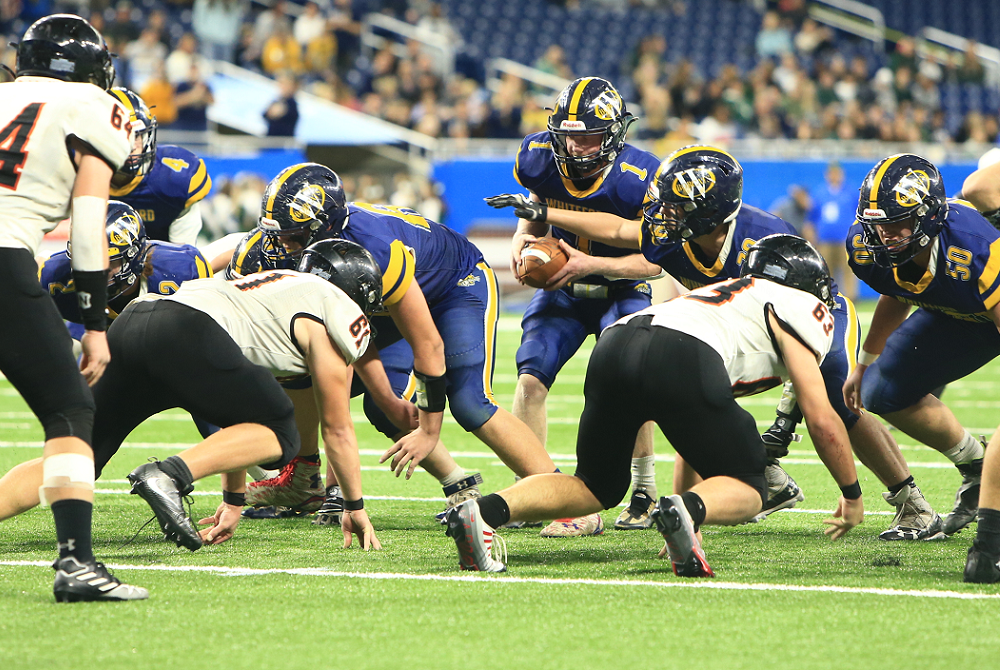
PHOTO Ottawa Lake Whiteford quarterback Shea Ruddy takes a snap to start an eventual touchdown run during last season’s Division 8 Final at Ford Field.