


#TBT: Searching for The Hinker Bell
September 28, 2017
By Geoff Kimmerly
Second Half editor
Menominee will host Escanaba on Friday in the 121st meeting between two of the Upper Peninsula’s largest high schools and proudest football programs – but with the trophy celebrating the game still missing after it first disappeared more than half a century ago.
The two teams from 1948-1962 played for the The Hinker Bell, a locomotive bell that hasn’t been seen since 1963.
A decade ago, Escanaba Daily Press sports editor (and now Second Half correspondent) Denny Grall wrote about a newfound search for The Hinker Bell. But the mystery continues, and Grall’s story below tells of many of the twists and turns that to that point that had come in trying to locate it.
ESCANABA — Another search is underway to find the Hinker Bell.
The former locomotive bell went to the winner of the Escanaba-Menominee football game for about 15 years but has been missing for more than 40 years. It came from a locomotive owned by the Bay de Noquet Company and used on the LS&I Railroad that operated in Delta and Menominee counties.
The locomotive was built in 1906 by Baldwin Locomotive Works in Philadelphia and the bell was believed to have been cast in the railroad foundry, according to a 1953 newspaper clipping.
In 1948, one of the locomotive owners presented the bell to his friend, John Hinker of Menominee, an ardent sports fan who donated materials for the press box at Menominee’s Walton Blesch Field.
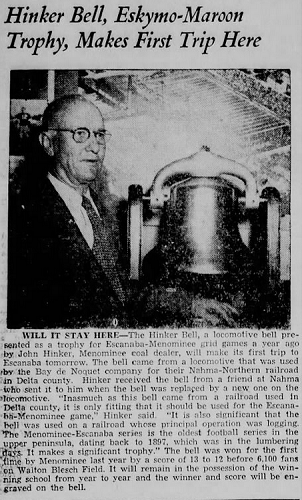 Hinker gave the bell to then Menominee coach Mickey McCormick and indicated proper use for the bell would be as an award for the gridiron rivalry.
Now Hinker’s great great nephew is trying to find the bell, which has not been seen since Escanaba’s current high school opened in 1963.
Tim Waters of Land O’ Lakes, Wis., who has launched the search, became interested by researching his family tree. “It is a big trophy (between 80 and 150 pounds by various estimates) and it is odd that it is missing,” Waters said in a recent telephone chat.
“One theory is that it is in somebody’s hunting camp or a home and they are using it as their own trophy,” said Waters.
“We have a pretty good investigation going on and all help is appreciated. If somebody does have it, we’re not looking to prosecute them. We’re just looking to get the darn thing back. Nobody will be in trouble.”
Waters refuted the old idea the bell was melted down. He has contacted numerous bell collectors, and they said a junk yard would have known it was worth a lot more than melted metal.
“The bell was not destroyed. We’ve come to that conclusion,” he said. “It was not put in a scrap yard.”
Waters contacted Coplan Iron and Metal of Escanaba and learned that bells were not melted or crushed and said the firm never accepted a bell with engravings matching the Hinker Bell.
Waters learned those businesses would sell them for the weight value to people who wanted them for yard ornaments/dinner bells, or to collectors.
“It is a treasure and it needs to be found,” said Waters.
Waters said the last known photo of the bell was with then EHS football coach Al Sigman and Esky players John Fisher and Phil Davidson in 1960. Escanaba beat Menominee from 1959-63 but could not find the bell in 1964 when the Maroons won. No one he has talked to remembers seeing the bell present at the first three games during the tenure of coach Jerry Cvengros.
The current Escanaba High School opened in 1963 and Bay de Noc Community College then occupied the old facility, which has since been demolished.
“Records indicate there was no report (of a missing bell) filed by Escanaba school district to the police department,” Waters said.
“The Hinker Bell is part of U.P. Michigan’s history, as is football and the railroads,” Waters said. “The people of Escanaba and Menominee deserve to have this trophy returned to their high schools.”
Waters, who has never seen an Escanaba or Menominee football game but is planning to rectify that omission this season, is hoping students at the two schools will join in the treasure hunt and talk about it with their parents and grandparents.
He has already contacted EHS athletic director Rob Ryan, who plans to thoroughly search the school basement.
He would like to find a photo of the bell to help collectors in their search. “Each bell was for a special locomotive,” said Waters.
“If they have a good picture we can pass it around and say we are looking for this bell. If they can pinpoint what this bell was on, they can help get the word out.”
He has also extended the search to the website at upfootball.com, which has generated interest but no bell. “If the bell is in the area still today, I don’t think it will take long to surface,” he said.
“If we don’t find this bell, we are going to try to make up a replacement as close as possible if the two schools are interested in that,” he said.
Waters is hoping that real estate agents, postal workers, delivery personnel, construction workers, etc., may have seen the bell during their travels and can help retrieve it.
Moore Finishes Legendary King Career by Leading Crusaders to D3 Repeat
By
Scott DeCamp
Special for MHSAA.com
November 27, 2022
DETROIT – Dante Moore had no tears left to cry Saturday night, even happy tears, after he played his final high school football game for Detroit Martin Luther King at Ford Field.
“Everybody sees I’m not crying – I really cried before I got here to the game. Before I walked to the gate, I was crying and I cried last night,” Moore said.
King’s four-year starting quarterback cemented his legacy, leading the Crusaders to their second-straight MHSAA Division 3 championship with a 56-27 victory over Muskegon.
The Oregon commit finished 21-of-26 passing for 275 yards with four touchdowns and no interceptions to power King (10-3) to its sixth Finals title overall and fifth in eight years.
Before Moore even took the field for his first offensive series against Muskegon (11-3), junior Jameel Croft Jr. staked King to an immediate lead with an electrifying 96-yard return of the game’s opening kickoff.
The Crusaders never looked back.
“I wasn’t expecting that. I just followed my blocks. Guys were blocking for me and the coaches set it up perfectly for me, for real,” Croft said. “It gave us a lot of momentum in the beginning of the game. It helped us out a lot.”
 Muskegon pulled within 14-7 midway through the first quarter and 21-14 three minutes into the second, but Moore & Co. always seemed to have an answer.
Croft scored the game’s first two TDs, as he added a 13-yard scoring catch from Moore to make it 14-0 with 6:28 left in the first quarter.
“We started out chasing. We gave up that opening kickoff for a touchdown and we just got ourselves chasing and kind of things went from there,” said Muskegon coach Shane Fairfield, whose team trailed 35-14 at halftime and pulled within 14 with five minutes left in the third but got no closer.
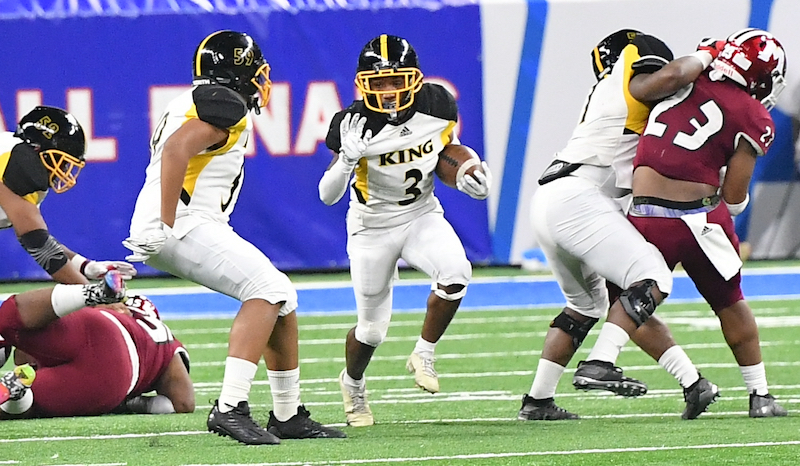
Croft was Moore’s top pass-catcher, finishing with six receptions for 64 yards and two TDs. Senior Sterling Anderson Jr. was a blur as King’s top rusher, totaling 207 yards on only 13 carries, highlighted by his 80-yard scoring sprint that gave the Crusaders a 49-27 lead with 10:55 remaining.
Seniors Samuel Washington and Tim Ruffin paced King defensively with nine and eight tackles, respectively. For Muskegon, senior Julian Neely registered a team-high seven stops, while junior Stanley Cunningham recorded two sacks among his six tackles.
Muskegon junior quarterback M’Khi Guy ran 20 times for 135 yards with two TDs, including a 60-yard breakaway to pull the Big Reds within 14-7 midway through the first quarter. He also completed 2-of-4 passes for 97 yards, including a 71-yard scoring strike to junior Destin Piggee.
Muskegon junior Jakob Price added 93 rushing yards and a TD on 17 carries, but the night belonged to King and Moore.
“There’s no excuse: That kid is amazing. He threw balls that we haven’t seen probably in my career,” said Fairfield, whose program was seeking its first Finals title since 2017. His Big Reds teams have been to the Finals to finish eight of his 13 seasons at the helm.
“Only one other guy threw touchdown passes like (Moore) and passes and balls like that in my career here, and that was (Bloomfield Hills Brother Rice’s) Alex Malzone – went to Michigan. Seems like we always see the (Dequan) Finns and the Dantes and Malzones and stuff when we get here, but you know, we’re here,” added Fairfield, whose 2018 squad lost to Finn and King, 41-25, in the Division 3 championship game.
King coach Tyrone Spencer said that his team overcame a lot of adversity this season. The Crusaders could not practice on their field because it’s undergoing a makeover, so they bussed to practice. They lost their season opener to Warren Central (Ind.), 44-26, and dropped the final two games of the regular season to Detroit Cass Tech (28-14) and Cincinnati Moeller (30-14).
 The Crusaders got it going in the playoffs, however. They threatened the Finals record for points by one team, established Friday night by Grand Rapids West Catholic with 59.
“(The season) was up and down, but the kids, I mean, they trust us and we got it back going,” Spencer said. “They’re a resilient group of kids. It speaks to their character.”
Moore mentioned the “championship culture” at King, how one expects to be a champion once he puts on that jersey.
It’s also about giving back and respecting the game, too, which has been a custom of Moore’s since his freshman year when King lost to Muskegon Mona Shores in the Division 2 Final, 35-26.
“My freshman year, me playing against Brady Rose and Muskegon Mona Shores, I remember Brady Rose pulled me to the side and that’s where I really got it from – him taking me to the side, telling me things I can work on, and me congratulating him for what he’s done and being one of the best players to come through Michigan to be honest and leading his team on his back,” Moore recalled.
“I just knew that I had to carry that on through this past year and really pull the (opposing) quarterbacks to the side, especially (those) younger than me. Me being a senior, I’ve been through a lot. I just want to give them the keys and terms to help them be the best they can be in high school.”
Croft called the 6-foot-2, 210-pound Moore a “great leader,” who is “so poised” and one who will leave “a great legacy right here for sure.”
“Special, man,” is how Spencer reflected on Moore’s four-year run.
“You know, he’ll be the one that they’ll talk about maybe the greatest we’ve ever had here,” Spencer said. “Just really proud of him and the person that he is. He deserves it. He works hard for it, and I just couldn’t be more pleased. It couldn’t happen to a better person.”
Meanwhile, Muskegon got off to a bit of a slow start this season by Big Reds standards. They lost two of their first five games, including a 49-16 road defeat to eventual Division 2 champion Warren De La Salle Collegiate, but got healthy and played their best football at the right time leading up to Saturday night.
Fairfield said the Big Reds battled and left it all on the field.
“They played 14 and when you play 14 games, of course this is going to hurt more because it’s the very last one and now you’ve got 364 days to get back,” he said.
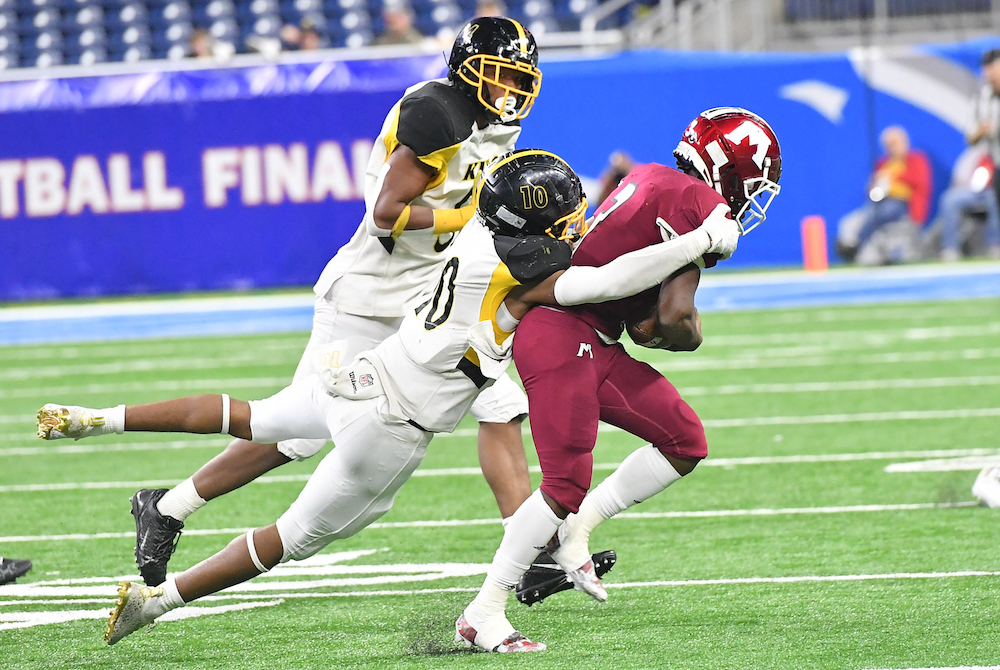
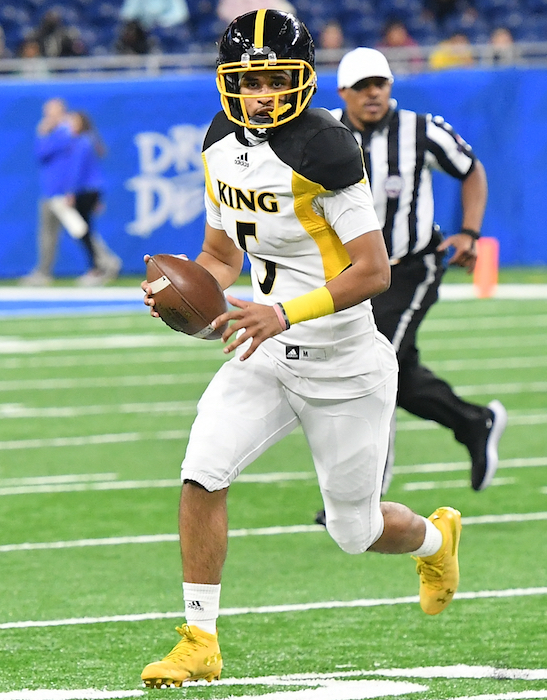
PHOTOS (Top) Detroit King’s Samuel Washington (10) wraps up Muskegon’s M’Khi Guy during Saturday’s night’s Division 3 Final. (Middle) Crusaders quarterback Dante Moore rolls out looking for a receiver. (Below) King’s Sterling Anderson Jr. (3) follows his blockers through a sizable opening. (Click for more from Hockey Weekly Action Photos.)