


#TBT: Searching for The Hinker Bell
September 28, 2017
By Geoff Kimmerly
Second Half editor
Menominee will host Escanaba on Friday in the 121st meeting between two of the Upper Peninsula’s largest high schools and proudest football programs – but with the trophy celebrating the game still missing after it first disappeared more than half a century ago.
The two teams from 1948-1962 played for the The Hinker Bell, a locomotive bell that hasn’t been seen since 1963.
A decade ago, Escanaba Daily Press sports editor (and now Second Half correspondent) Denny Grall wrote about a newfound search for The Hinker Bell. But the mystery continues, and Grall’s story below tells of many of the twists and turns that to that point that had come in trying to locate it.
ESCANABA — Another search is underway to find the Hinker Bell.
The former locomotive bell went to the winner of the Escanaba-Menominee football game for about 15 years but has been missing for more than 40 years. It came from a locomotive owned by the Bay de Noquet Company and used on the LS&I Railroad that operated in Delta and Menominee counties.
The locomotive was built in 1906 by Baldwin Locomotive Works in Philadelphia and the bell was believed to have been cast in the railroad foundry, according to a 1953 newspaper clipping.
In 1948, one of the locomotive owners presented the bell to his friend, John Hinker of Menominee, an ardent sports fan who donated materials for the press box at Menominee’s Walton Blesch Field.
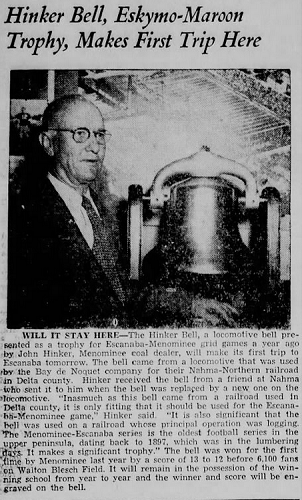 Hinker gave the bell to then Menominee coach Mickey McCormick and indicated proper use for the bell would be as an award for the gridiron rivalry.
Now Hinker’s great great nephew is trying to find the bell, which has not been seen since Escanaba’s current high school opened in 1963.
Tim Waters of Land O’ Lakes, Wis., who has launched the search, became interested by researching his family tree. “It is a big trophy (between 80 and 150 pounds by various estimates) and it is odd that it is missing,” Waters said in a recent telephone chat.
“One theory is that it is in somebody’s hunting camp or a home and they are using it as their own trophy,” said Waters.
“We have a pretty good investigation going on and all help is appreciated. If somebody does have it, we’re not looking to prosecute them. We’re just looking to get the darn thing back. Nobody will be in trouble.”
Waters refuted the old idea the bell was melted down. He has contacted numerous bell collectors, and they said a junk yard would have known it was worth a lot more than melted metal.
“The bell was not destroyed. We’ve come to that conclusion,” he said. “It was not put in a scrap yard.”
Waters contacted Coplan Iron and Metal of Escanaba and learned that bells were not melted or crushed and said the firm never accepted a bell with engravings matching the Hinker Bell.
Waters learned those businesses would sell them for the weight value to people who wanted them for yard ornaments/dinner bells, or to collectors.
“It is a treasure and it needs to be found,” said Waters.
Waters said the last known photo of the bell was with then EHS football coach Al Sigman and Esky players John Fisher and Phil Davidson in 1960. Escanaba beat Menominee from 1959-63 but could not find the bell in 1964 when the Maroons won. No one he has talked to remembers seeing the bell present at the first three games during the tenure of coach Jerry Cvengros.
The current Escanaba High School opened in 1963 and Bay de Noc Community College then occupied the old facility, which has since been demolished.
“Records indicate there was no report (of a missing bell) filed by Escanaba school district to the police department,” Waters said.
“The Hinker Bell is part of U.P. Michigan’s history, as is football and the railroads,” Waters said. “The people of Escanaba and Menominee deserve to have this trophy returned to their high schools.”
Waters, who has never seen an Escanaba or Menominee football game but is planning to rectify that omission this season, is hoping students at the two schools will join in the treasure hunt and talk about it with their parents and grandparents.
He has already contacted EHS athletic director Rob Ryan, who plans to thoroughly search the school basement.
He would like to find a photo of the bell to help collectors in their search. “Each bell was for a special locomotive,” said Waters.
“If they have a good picture we can pass it around and say we are looking for this bell. If they can pinpoint what this bell was on, they can help get the word out.”
He has also extended the search to the website at upfootball.com, which has generated interest but no bell. “If the bell is in the area still today, I don’t think it will take long to surface,” he said.
“If we don’t find this bell, we are going to try to make up a replacement as close as possible if the two schools are interested in that,” he said.
Waters is hoping that real estate agents, postal workers, delivery personnel, construction workers, etc., may have seen the bell during their travels and can help retrieve it.
Performance: Morrice's Hunter Nowak
November 15, 2018
 Hunter Nowak
Morrice senior - Football
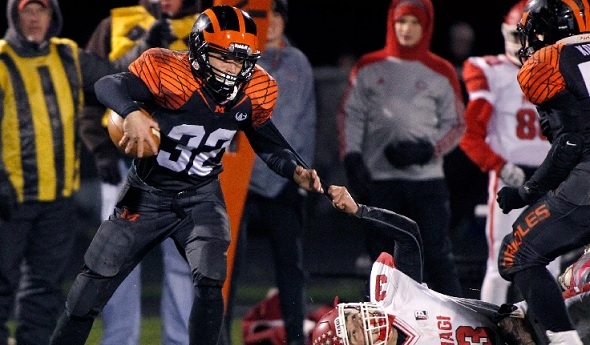
Morrice’s third-year varsity quarterback continued the play Friday that has helped his team to the best season in program history. Nowak ran 28 times for 158 yards and three touchdowns to lead the Orioles to a 40-8 win over Colon in an 8-Player Division 1 Semifinal, earning the senior signal-caller the Michigan Army National Guard “Performance of the Week.”
Nowak has run 204 times for 1,922 yards (9.4 yards per carry) and 33 touchdowns this season, and completed 24 of 49 passes for 529 yards and eight more scores. His 232 points rank third all-time since MHSAA-sponsored 8-player football was added a decade ago. He took over the QB spot in 2016, and Morrice went 4-5, but the Orioles improved to 9-2 last season and this fall finished the regular season 9-0 for the first time in the program’s 11 or 8-player history. Last week’s Semifinal was the team’s second ever and first since 1996, and this Saturday’s championship game against Pickford at Northern Michigan University’s Superior Dome will be the Orioles’ first trip to the MHSAA Finals in this sport. Along the way, Morrice avenged last season’s playoff loss to North Central Thumb League Red rival Deckerville – which went on to finish 2017 Division 1 runner-up – and handed Wyoming Tri-unity Christian its only defeat this fall in the Regional Final two weeks ago.
 Nowak plays only football at Morrice, but does also play on a high school-level rugby club team based in Howell. He carries a 4.0 grade-point average while dually enrolled at Lansing Community College, and hopes to study aviation after high school with aspirations of becoming a commercial airline pilot.
Performance Point: “The defense played great. They played shutout. The defense really won us the game, I think,” Nowak said of the Semifinal win over Colon. “We were able to put up 40 points, but that was a great offense they had. … It’s the first time we ever went to a state final for this, and we’re just really excited about it. We’ve been playing football since third grade, and we’ve always had successful seasons. We always thought that especially our senior year, we always thought, man, we really need to do really good that year. For it to happen, I think it’s great, because we’ve been working hard all year (and) ever since we started playing varsity. We’re thankful to the town for showing up at the games. Everyone comes out. It’s a big deal.”
That’s when we knew: “Our sophomore year, we didn’t do too great. We got four wins as sophomores; we could’ve done better. Last year we were OK – we lost to Deckerville in the second round (38-0). … Our first game (this season), we beat Deckerville (34-14). I think that was big. We went there, we won by 20 points, and that’s when we realized we’re a good team this year – we really have a shot to go far. We had lost the second round of playoffs the year before by a lot there. So to have our first game, since playing there, be right there again, and to be able to win – it put behind all the doubt that we had last year.”
 Taking this on together: “I think it’s the combination of a lot of us have been playing since third grade together. And there’s not a whole lot of us, so that bond has just grown through the years. And I think we’re just really good at football, and the whole speed thing really helps too. … I think it’s just knowing what someone else is going to do. If I’m running the ball, I can get a sense of where my lead blockers are going to go, what they’re going to do. We can try to get a sense of what other people are going to do. We can communicate easier. If something happens, we can fix it real quick, because we know how to talk to each other.”
It’s a speed thing: “I think 11-man was more about who’s going to be bigger on the line and then trying to work around that. (Eight-player) is not so much who is bigger on the line, it’s who can get off the line quicker and find the hole faster. We’re not the biggest team, but we’re a very fast team. That definitely helps us out.”
Revved and rallying: “When you’re done with the game and you’re walking back to the stands, there’s a lot of people I’ve never met before. But they’re all congratulating us, and they seem really excited about it. They’re there. They don’t know us personally, but they’re excited for the football team and they want to tell us, ‘Good job.’ There’s a lot of people talking about coming up (for the Final).”
- Geoff Kimmerly, Second Half editor
Every week during the 2018-19 school year, Second Half and the Michigan Army National Guard will recognize a “Performance of the Week" from among the MHSAA's 750 member high schools.
The Michigan Army National Guard provides trained and ready forces in support of the National Military Strategy, and responds as needed to state, local, and regional emergencies to ensure peace, order, and public safety. The Guard adds value to our communities through continuous interaction. National Guard soldiers are part of the local community. Guardsmen typically train one weekend per month and two weeks in the summer. This training maintains readiness when needed, be it either to defend our nation's freedom or protect lives and property of Michigan citizens during a local natural disaster.
Past 2018-19 honorees
November 8: Jon Dougherty, Detroit Country Day soccer - Read
November 1: Jordan Stump, Camden-Frontier volleyball - Read
October 25: Danielle Staskowski, Pontiac Notre Dame Prep golf - Read
October 18: Adam Bruce, Gladstone cross country - Read
October 11: Ericka VanderLende, Rockford cross country - Read
October 4: Kobe Clark, Schoolcraft football - Read
September 27: Jonathan Kliewer, Grand Rapids Forest Hills Northern soccer - Read
September 20: Kiera Lasky, Bronson volleyball - Read
September 13: Judy Rector, Hanover-Horton cross country - Read
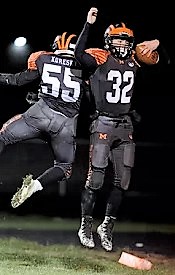
PHOTOS: (Top) Morrice quarterback Hunter Nowak (32) pulls away from a Colon defender during last week’s Semifinal win over the Magi. (Middle) Nowak and teammate Sam Koresky celebrate one of his touchdowns. (Photos courtesy of the Lansing State Journal.)