


#TBT: Searching for The Hinker Bell
September 28, 2017
By Geoff Kimmerly
Second Half editor
Menominee will host Escanaba on Friday in the 121st meeting between two of the Upper Peninsula’s largest high schools and proudest football programs – but with the trophy celebrating the game still missing after it first disappeared more than half a century ago.
The two teams from 1948-1962 played for the The Hinker Bell, a locomotive bell that hasn’t been seen since 1963.
A decade ago, Escanaba Daily Press sports editor (and now Second Half correspondent) Denny Grall wrote about a newfound search for The Hinker Bell. But the mystery continues, and Grall’s story below tells of many of the twists and turns that to that point that had come in trying to locate it.
ESCANABA — Another search is underway to find the Hinker Bell.
The former locomotive bell went to the winner of the Escanaba-Menominee football game for about 15 years but has been missing for more than 40 years. It came from a locomotive owned by the Bay de Noquet Company and used on the LS&I Railroad that operated in Delta and Menominee counties.
The locomotive was built in 1906 by Baldwin Locomotive Works in Philadelphia and the bell was believed to have been cast in the railroad foundry, according to a 1953 newspaper clipping.
In 1948, one of the locomotive owners presented the bell to his friend, John Hinker of Menominee, an ardent sports fan who donated materials for the press box at Menominee’s Walton Blesch Field.
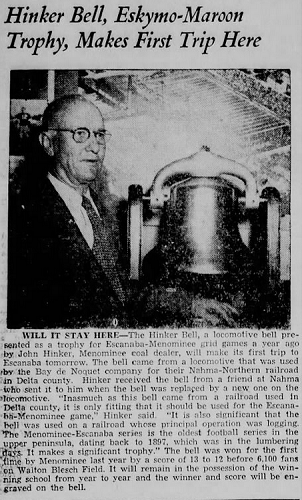 Hinker gave the bell to then Menominee coach Mickey McCormick and indicated proper use for the bell would be as an award for the gridiron rivalry.
Now Hinker’s great great nephew is trying to find the bell, which has not been seen since Escanaba’s current high school opened in 1963.
Tim Waters of Land O’ Lakes, Wis., who has launched the search, became interested by researching his family tree. “It is a big trophy (between 80 and 150 pounds by various estimates) and it is odd that it is missing,” Waters said in a recent telephone chat.
“One theory is that it is in somebody’s hunting camp or a home and they are using it as their own trophy,” said Waters.
“We have a pretty good investigation going on and all help is appreciated. If somebody does have it, we’re not looking to prosecute them. We’re just looking to get the darn thing back. Nobody will be in trouble.”
Waters refuted the old idea the bell was melted down. He has contacted numerous bell collectors, and they said a junk yard would have known it was worth a lot more than melted metal.
“The bell was not destroyed. We’ve come to that conclusion,” he said. “It was not put in a scrap yard.”
Waters contacted Coplan Iron and Metal of Escanaba and learned that bells were not melted or crushed and said the firm never accepted a bell with engravings matching the Hinker Bell.
Waters learned those businesses would sell them for the weight value to people who wanted them for yard ornaments/dinner bells, or to collectors.
“It is a treasure and it needs to be found,” said Waters.
Waters said the last known photo of the bell was with then EHS football coach Al Sigman and Esky players John Fisher and Phil Davidson in 1960. Escanaba beat Menominee from 1959-63 but could not find the bell in 1964 when the Maroons won. No one he has talked to remembers seeing the bell present at the first three games during the tenure of coach Jerry Cvengros.
The current Escanaba High School opened in 1963 and Bay de Noc Community College then occupied the old facility, which has since been demolished.
“Records indicate there was no report (of a missing bell) filed by Escanaba school district to the police department,” Waters said.
“The Hinker Bell is part of U.P. Michigan’s history, as is football and the railroads,” Waters said. “The people of Escanaba and Menominee deserve to have this trophy returned to their high schools.”
Waters, who has never seen an Escanaba or Menominee football game but is planning to rectify that omission this season, is hoping students at the two schools will join in the treasure hunt and talk about it with their parents and grandparents.
He has already contacted EHS athletic director Rob Ryan, who plans to thoroughly search the school basement.
He would like to find a photo of the bell to help collectors in their search. “Each bell was for a special locomotive,” said Waters.
“If they have a good picture we can pass it around and say we are looking for this bell. If they can pinpoint what this bell was on, they can help get the word out.”
He has also extended the search to the website at upfootball.com, which has generated interest but no bell. “If the bell is in the area still today, I don’t think it will take long to surface,” he said.
“If we don’t find this bell, we are going to try to make up a replacement as close as possible if the two schools are interested in that,” he said.
Waters is hoping that real estate agents, postal workers, delivery personnel, construction workers, etc., may have seen the bell during their travels and can help retrieve it.
Northmen Stadium Opens to Excitement, 'Awe'
September 1, 2016
By Dennis Chase
Special for Second Half
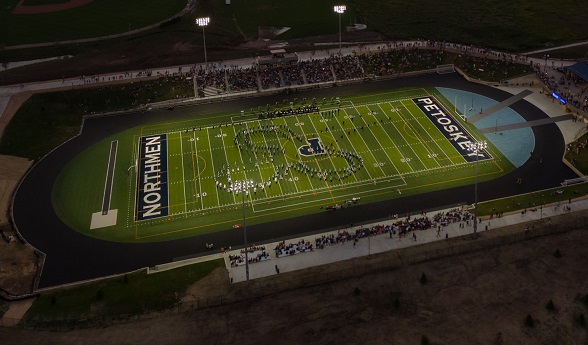
PETOSKEY – Petoskey kicked off a new era in football last Thursday with the unveiling of Northmen Stadium, a multi-use facility that will be home for football, soccer, lacrosse, band and track & field.
 More than 4,000 spectators turned out on a beautiful late August night to watch Petoskey open its season against Ada Forest Hills Eastern. School officials believe it was the largest home football crowd in Petoskey history.
Even a 35-14 setback could not dampen the enthusiasm and pride displayed by those in attendance.
“To see the stadium from the road is one thing – and that excited people,” Superintendent John Scholten said. “But once they got inside and saw it first-hand, there was an awe factor. It was like, ‘Wow!’”
Northmen Stadium replaces Curtis Field, which was built in 1927 and served as the home for Petoskey football for 88 years.
“Our community is very tradition-oriented, very values-oriented,” Dan Ledingham, president of the football boosters, said. “Curtis Field means a lot to us. It’s very symbolic – the roots from where we started. Multiple generations played on that field. I know families who go three to four generations deep. But it was time.”
“It’s time” was actually the theme for the $10 million bond proposal that the electorate approved by a 64 to 36 percent vote in 2014.
“It (Curtis Field) served the community well, but it was pretty tired,” Scholten said.
In addition to the $10 million bond, the school received significant donations and coordinated efforts with other sinking fund projects.
“The whole (campus) renovation is closer to $15 million,” Scholten said.
The project includes the stadium, reconstruction of six tennis courts, a rebuilt softball field, two new soccer practice fields, and a cross country 5K trail that ties into a community walkway and includes three culvert tunnels under realigned Northmen Drive.
It’s all part of a concerted effort to bring the school’s athletic facilities – once scattered around the city – to the campus location. The school had already built a stunning new high school gymnasium and an on-site baseball field.
“When I moved up here (from Maple City Glen Lake) two of the old icons from the Glen Lake days, Denny Dame and Ivan Ford, said you’re moving to the nicest gym in the north,” Scholten said. “I’m a little biased, but I think we now have one of the nicest football facilities in the north, too.”
 The stadium is the centerpiece of the latest project. The property’s topography featured a “semi-natural bowl” on the southeast side. Construction workers moved 300,000 cubic yards of dirt to build up the other side, creating a complete bowl appearance.
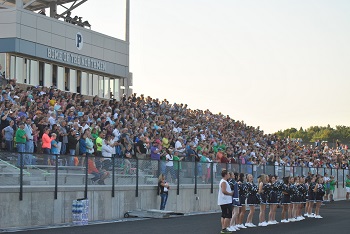
“The fact it sits down in a bowl makes it unique,” athletic director Dave Smith said. “There are lots of places that have nice stadiums, but they’re flat and the bleachers go up. With this, there’s not a bad seat in the house because it sits down in that bowl.”
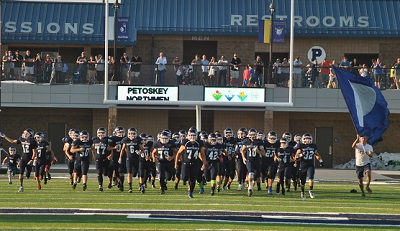
The main entrance is near the mezzanine in the north end zone, which is where the concessions and restrooms are located. It features a plaza that overlooks the field. A tunnel runs underneath the mezzanine where the players and band enter and exit the field.
“It’s a very cool place to see a game,” football coach Kerry VanOrman said. “When the band marches through the tunnel, it’s like you’re at Michigan State or Michigan.”
Team rooms, a training room and an officials room are located off the tunnel.
A 40-foot video scoreboard anchors the south end zone. There’s also a messaging board attached to the mezzanine.
The synthetic turf is lined for football, soccer and lacrosse. The soccer team opens its home season Tuesday.
The stadium seats 2,950, but there is additional lawn seating on the hillside. Plus, based on opening night, fans seem to enjoy watching from the mezzanine.
“That elevation overlooking the field gives you the best view,” Ledingham said. “You can see everything, and you can feel the energy coming from the crowd.”
Workers scrambled to get the stadium ready for opening night. In fact, just 48 hours beforehand Ledingham wondered if it would be game ready.
 “There were tractors and trucks, concrete and tiles,” he said. “Everything was everywhere. It looked like a true construction site that maybe in a month would be close (to done). I was wondering, ‘What’s Plan B?’ Kent (Cartwright, the school’s chief financial officer) said, ‘There is no Plan B. We are on this field.’ It was neat to see it all come together.”
Smith agreed.
“It was unbelievable the number of people there, from the construction crew to the subcontractors, working extra hours, late hours, that last month to make sure we could get in there and play on that (Thursday),” he said. “Two days out, I was also wondering how this is going to happen. But it did.”
The school received a temporary occupancy permit to open the stadium. Finishing touches were still being completed this week.
The opening culminates nearly 10 years of work. A bond proposal to fund separate football and soccer stadiums was rejected by voters in 2007.
“We had a nice plan,” Scholten said, “but it was just when the recession was starting. We did all the pre-work with the surveys and it looked like the confidence was there, but when the economy went south, (the vote) went south, too.”
Officials regrouped and, after the lingering recession ended, pared back the plan and took it to the voters.
“It was unfortunate timing (in 2007),” VanOrman said. “They were smart in waiting for things to pick up. They did a good job planning it, locating it and even tying it into the city walkways. It kind of includes everybody into it.”
Officials changed the location of the stadium, building it on what was two practice fields so it could utilize existing locker rooms and showers at the school. Two additional locker rooms will be added.
“We listened to the community,” Scholten said. “We were a little extravagant (in 2007) so we came back with a different plan. We worked real hard to say, ‘We listened to you, we trimmed it back, we feel we’re being responsible.’ We worked hard to build that confidence back up.”
The cross country trail will facilitate skiers as well as runners and walkers. The new eight-lane track replaces the outdated six-lane version at Curtis Field.
“We couldn’t host anything big because of that,” Scholten said.
Scholten expects the new facility will make Petoskey an attractive choice for hosting MHSAA tournaments.
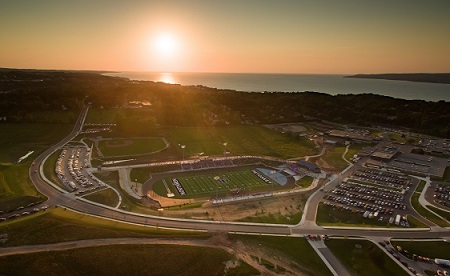 Parking, an issue at Curtis Field, was addressed, too. Spectators can now use the high school and middle school lots, as well as new parking spaces near the stadium.
The improvements now leave hockey and downhill skiing as the only sports played off campus, Smith said.
“From an athletic director’s standpoint, I love how most of our facilities are now on school grounds,” he said.
He also loves the positive buzz the stadium’s generated. Ledingham called opening night “surreal.”
“It was amazing to see our community come together to enjoy it,” he said.
The unveiling attracted fans from nearby communities as well.
“The energy and support was great,” junior kicker Noah Ledingham said. “You run on to that field, see the lights, see (the crowd) and it just makes you want to play harder.
“To be the first team to play on that field is an amazing feeling because it’s a new chapter (in Petoskey football) and you know you’re making history.”
The Northmen, with just two key returnees back, struggled early, falling behind Forest Hills Eastern 28-0 before rallying to make it a game.
“I was pleased with the way we played in the second half,” VanOrman said. “It was 28-14 with 3:30 left in the game. We went for an onside kick and it blew up in our face. They recovered and ran it back to our 15 and then scored. (Eastern’s) a good football team. It was a good measuring stick for us to see where we have to get better.”
The night might also pay dividends. Forest Hills Eastern officials are talking about extending the two-year deal with Petoskey that is set to expire after the Northmen travel down there next season.
“They liked it so much they want to come back in two years,” Smith said. “I would say that’s a compliment right there.”
 Dennis Chase worked 32 years as a sportswriter at the Traverse City Record-Eagle, including as sports editor from 2000-14. He can be reached at [email protected] with story ideas for Manistee, Wexford, Missaukee, Roscommon, Ogemaw, Iosco, Alcona, Oscoda, Crawford, Kalkaska, Grand Traverse, Benzie, Leelanau, Antrim, Otsego, Montmorency, Alpena, Presque Isle, Cheboygan, Charlevoix and Emmet counties.
PHOTOS: (Top) Petoskey's stadium, at dusk, hosted Ada Forest Hills Eastern for its debut. (Middle above) The Northmen take to their new field for the first time. (Middle below) Fans packed the home stands, which are part of a "bowl" circling the playing surface. (Below) The new football field is just one part of the renovated Petoskey athletic complex. (Aerial photos by Charles Dawley/Up North Imaging. Game photos by Scott Moore.)