

Thank Roosevelt for Football Weekends
December 20, 2013
By Rob Kaminski
MHSAA benchmarks editor
The next time you find yourself immersed in a tense crosstown football rivalry on a Friday night followed by a Saturday pilgrimage to the nearest college campus and a Sunday afternoon with a remote and your favorite snacks and beverages, take a moment to consider what the weekend would be like if it weren’t for Teddy Roosevelt.
The man who became our 26th President shortly after the turn of the 20th Century following the assassination of William McKinley in 1901 was a football fan like you. Maybe more so.
Today’s game of football has reached a critical crossroads. Player size and speed have increased across the board. Savage use of equipment as weapons rather than protective gear has been glorified on television networks and social media. Leaders of the game at all levels have recognized the need for change, employing new rules and widespread educational efforts to aid in preserving the sport.
History, as they say, is repeating itself.
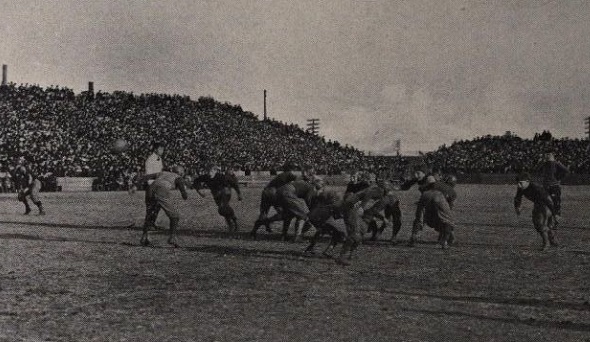
In an ironic twist, it was Roosevelt who saved the then-brutally violent game of football from itself more than 100 years ago. Yes, the same “Rough and Ready Teddy” who led the charge up San Juan Hill during the Spanish-American War and often sparred in the boxing ring while in office from 1901-09 opined that football was becoming so gruesome that he delivered an ultimatum: clean up the game or it would be outlawed.
The Chicago Tribune reported that in 1904 alone, there were 18 football deaths and 159 serious injuries, mostly among prep school players. Football deaths suffered by younger players were reported on a nearly weekly basis, as outraged citizens called on colleges and high schools to banish football outright.
In stepped Roosevelt, who called head coaches and representatives from Harvard, Yale and Princeton – college powers at the time – to the White House in 1905 urging them to eliminate excessive violence and set an example of fair play for the rest of the country. When the casualties actually rose by one during the ensuing season, Roosevelt reacted with greater resolve and convened leading football authorities for the purpose of authoring drastic rules changes. What emerged was an intercollegiate conference which was the predecessor of the NCAA.
Among the most effective changes for the 1906 season were the legalization of the forward pass, the elimination of mass formations, and the creation of a neutral zone. Football fatalities fell to 11 in each of the next two seasons, and severe injuries fell drastically.
Thanks to the introduction of protective equipment and ever-evolving rules changes, football during the 100-plus years to follow has become an exponentially safer game. Yet, the game’s leaders always will need to adjust and react to scrutiny that comes with the territory.
So, as the game once again undergoes rules modifications in the name of safety, give a tip of the cap to President Roosevelt while you enjoy college bowl season and the NFL playoffs and begin to think ahead to the first high school practice of 2014.
Drive for Detroit: Playoff R1 Preview
October 28, 2016
By Geoff Kimmerly
Second Half editor
The 42nd MHSAA Football Playoffs begin tonight with most of this season’s 272 qualifiers taking the field across both peninsulas and nine divisions.
 And there certainly is an air of familiarity in these first-round matchups.
This week’s Drive for Detroit preview – powered by MI Student Aid – touches on five games of intrigue in every division, including a number of rematches of meetings from earlier this season – or in the case of our top Division 1 contest, a rematch of a league title-deciding game played only a week ago.
Division 1
Rockford (6-3) at Hudsonville (8-1)
There isn’t much to say that hasn’t been over the last week. These teams met seven days ago, with Hudsonville claiming a 14-7 win to create a three-way championship in the Ottawa-Kent Conference Red between the Eagles, former lone leader Rockford and Grandville. These two also met in the playoffs the last three seasons; Rockford avenged a one-point Week 9 loss a year ago by beating Hudsonville 21-13 for a District title.
Others that caught my eye: Lapeer (7-2) at Clarkston (7-2), Canton (7-2) at Northville (7-2), Macomb Dakota (6-3) at Clinton Township Chippewa Valley (6-3), Dearborn Fordson (8-1) at Detroit Cass Tech (9-0) on Saturday.
Division 2
Traverse City West (6-3) vs. Traverse City Central (8-1) at Thirlby Field
These neighbors will meet at their shared stadium for the first time in the playoffs, and in front of a crowd that could approach 10,000. Central’s 10-8 win over West in Week 3 ended up giving the Trojans’ a one-win edge over the Titans for the Big North Conference championship. West has lost three in a row to Central, and went on this season to fall close to Benton Harbor and then to Coldwater last week. Central’s only defeat was two weeks ago in triple overtime at Birmingham Brother Rice – and this could be close again too with these teams knowing each other so well.
Others that caught my eye: Portage Northern (5-4) at Portage Central (8-1), Flint Carman-Ainsworth (6-3) at Fenton (7-2), Oak Park (6-3) vs. Detroit U-D Jesuit (6-2) at Hazel Park, Birmingham Brother Rice (6-3) at Warren Cousino (8-1).
Division 3
Battle Creek Harper Creek (7-2) 73.222 at Coldwater (7-2)
Coldwater handed Harper Creek its only loss this season in the Interstate 8 Athletic Conference – 19-7 in Week 7 – but then watched the Beavers share the league title as the Cardinals finished third. But with a schedule that included five games against teams with winning records and three wins over playoff qualifiers, Coldwater earned the right to host this week as it looks to build on last season’s Division 3 Semifinal run. Harper Creek, meanwhile, is back in the playoffs after going 3-6 a year ago and has secured its best record since 2013.
Others that caught my eye: Zeeland West (7-2) at Grand Rapids Christian (8-1), Zeeland East (6-3) at Byron Center (8-1), St. Joseph (6-3) at Stevensville Lakeshore (6-3), East Lansing (6-3) at DeWitt (8-1).
Division 4
Bloomfield Hills Cranbrook Kingswood (7-2) at Detroit Country Day (9-0), Saturday
Successful in many sports, Cranbrook Kingswood hasn’t had the same kind of long-standing championship tradition in football – but has put together a 22-8 record over the last three seasons under coach Joe D’Angelo, who earned most of his 222 career wins at Detroit Country Day from 1977-97. These two met in the District Final a year ago and Country Day won 42-7. The Yellowjackets dominated most of this fall too but have had to work through close wins the last two weeks against Detroit U-D Jesuit and Temperance Bedford.
Others that caught my eye: Allendale (7-2) at Wyoming Kelloggsville (8-1), Grand Rapids South Christian (5-4) at Benton Harbor (9-0), Flint Powers Catholic (5-4) at Lake Fenton (8-1), St. Clair Shores South Lake (7-2) at Marysville (9-0).
Division 5
Grand Rapids West Catholic (7-2) at Lansing Catholic (8-1)
A rematch of a Division 5 Semifinal from last season kicks off opening night, with more familiar faces on the Falcons’ side but offensive weapons of similar skills leading both. Quarterback Gaetano Vallone and running back/previous quarterback David Fox are the recognizable names from last year’s playoff run, while Lansing Catholic quarterback Michael Lynn has stepped in this season to provide similar run/pass dual threat ability. West Catholic is coming off a tough three-point loss to Allendale last week that cost the Falcons an outright O-K Blue title, and they face the prospect of three road games to get back to the Semifinals. Lansing Catholic’s only loss was by a point in Week 4 to rival Portland, which plays on the other side of this District bracket.
Others that caught my eye: Clare (8-1) at Remus Chippewa Hills (8-1), Saginaw Swan Valley (6-3) at Freeland (9-0), Buchanan (5-3) 56.069 at Dowagiac (6-3), Algonac (8-1) 81.667 at Detroit Denby (8-1).
Division 6
Watervliet (7-2) at Jackson Lumen Christi (7-2)
Watervliet has scored at a school record-setting pace the last two seasons, averaging 52 points per game in 2015 and 55 this fall – with 30 and 58 in its losses. The Panthers will get the chance to see how that prowess transfers against an opponent that’s seen and contained its share of strong offenses. The Titans have given up just fewer than 17 points per game against a schedule that’s included four playoff teams and a couple more that contended for bids.
Others that caught my eye: Montague (7-2) at Kent City (7-2), Montrose (6-3) at Laingsburg (8-1), Constantine (6-3) at Schoolcraft (9-0), Boyne City (6-3) at Calumet (8-1) on Saturday.
Division 7
Madison Heights Madison (6-3) vs. Detroit Loyola (7-2), Saturday at Hazel Park
Neither of these teams would be a surprise finalist at Ford Field next month; Loyola is a regular on championship weekend and claimed a Detroit Catholic League AA title this fall, while Madison shared the Macomb Area Conference Silver title with teams playing in the Division 3 and Division 4 brackets. The Bulldogs have reached the Semifinals each of the last four seasons, while Madison is seeking its first run that deep since 2007 – but has played in Division 5 and 6 over the last decade.
Others that caught my eye: Gwinn (6-3) at Iron Mountain (7-2), Elkton-Pigeon-Bay Port Laker (7-2) at Ubly (9-0), Springport (7-2) at Concord (7-2), Clinton (6-3) at Sand Creek (8-1).
Division 8
Saginaw Nouvel (6-3) at Breckenridge (9-0)
Breckenridge already has achieved the most incredible turnaround in MHSAA playoff-era history, becoming the first team to from 0-9 (in 2015) to 9-0. The Huskies have accomplished this following a sophomore quarterback who should keep the program rolling forward. Nouvel, meanwhile, has played itself into a sixth playoff berth over the last seven seasons, with a big win over Mount Pleasant Sacred Heart in Week 9 getting the Panthers back in the hunt. The Irish are the only common opponent between the two; Nouvel won 35-7, while Breckenridge won 40-32 but way back in Week 3 as it was just starting to catch stride.
Others that caught my eye: Mendon (7-2) vs. St. Joseph Lake Michigan Catholic (8-1) at Bridgman, Pittsford (6-3) at Morenci (6-3), Iron River West Iron County (6-3) at Norway (7-2), Clarkston Everest Collegiate (7-2) at Waterford Our Lady (6-3) on Saturday.
8-Player
Lawrence (8-1) at Wyoming Tri-unity Christian (9-0) at Wyoming Lee
Tri-unity Christian is welcomed to its first playoffs tonight by having to face 2014 champion Lawrence – but should feel pretty good about that match-up after downing the Tigers 53-14 in Week 7. That was Lawrence’s only loss, and it’s beaten two other playoff teams over the last four weeks. But the Tigers must score; their 14 points against the Defenders were the most given up this season by Tri-unity, which is allowing only 4.7 points per game.
Others that caught my eye: Cedarville (6-3) at Engadine (9-0). Owendale-Gagetown (8-1) at New Haven Merritt (9-0).
Second Half’s weekly “Drive for Detroit” previews are powered by MI Student Aid, a part of the Student Financial Services Bureau located within the Michigan Department of Treasury. MI Student Aid encourages students to pursue postsecondary education by providing access to student financial resources and information, including various student financial assistance programs to help make college more affordable for Michigan students. MI Student Aid administers the state’s 529 savings programs (MET/MESP) and eight additional aid programs within its Student Scholarships and Grants division. Click for more information and connect with MI Student Aid on Facebook and Twitter @mistudentaid.
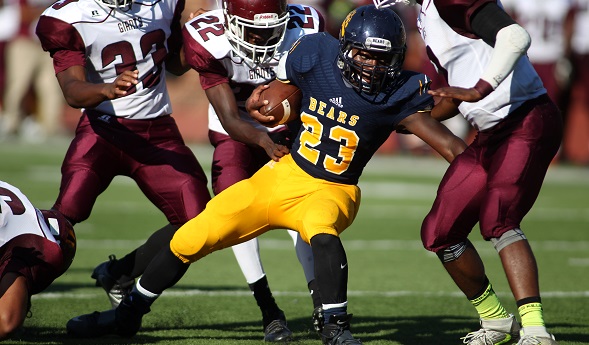
PHOTO: St. Joseph will kick off its ninth playoff appearance over the last 11 seasons tonight against Stevensville Lakeshore, which beat the Bears 31-12 in Week 4. (Click to see more from HighSchoolSportsScene.com.)