

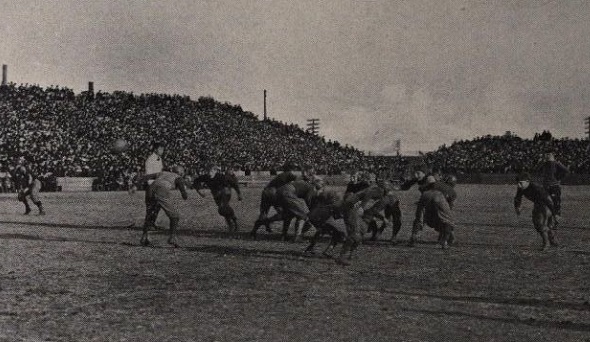
Thank Roosevelt for Football Weekends
December 20, 2013
By Rob Kaminski
MHSAA benchmarks editor
The next time you find yourself immersed in a tense crosstown football rivalry on a Friday night followed by a Saturday pilgrimage to the nearest college campus and a Sunday afternoon with a remote and your favorite snacks and beverages, take a moment to consider what the weekend would be like if it weren’t for Teddy Roosevelt.
The man who became our 26th President shortly after the turn of the 20th Century following the assassination of William McKinley in 1901 was a football fan like you. Maybe more so.
Today’s game of football has reached a critical crossroads. Player size and speed have increased across the board. Savage use of equipment as weapons rather than protective gear has been glorified on television networks and social media. Leaders of the game at all levels have recognized the need for change, employing new rules and widespread educational efforts to aid in preserving the sport.
History, as they say, is repeating itself.
In an ironic twist, it was Roosevelt who saved the then-brutally violent game of football from itself more than 100 years ago. Yes, the same “Rough and Ready Teddy” who led the charge up San Juan Hill during the Spanish-American War and often sparred in the boxing ring while in office from 1901-09 opined that football was becoming so gruesome that he delivered an ultimatum: clean up the game or it would be outlawed.
The Chicago Tribune reported that in 1904 alone, there were 18 football deaths and 159 serious injuries, mostly among prep school players. Football deaths suffered by younger players were reported on a nearly weekly basis, as outraged citizens called on colleges and high schools to banish football outright.
In stepped Roosevelt, who called head coaches and representatives from Harvard, Yale and Princeton – college powers at the time – to the White House in 1905 urging them to eliminate excessive violence and set an example of fair play for the rest of the country. When the casualties actually rose by one during the ensuing season, Roosevelt reacted with greater resolve and convened leading football authorities for the purpose of authoring drastic rules changes. What emerged was an intercollegiate conference which was the predecessor of the NCAA.
Among the most effective changes for the 1906 season were the legalization of the forward pass, the elimination of mass formations, and the creation of a neutral zone. Football fatalities fell to 11 in each of the next two seasons, and severe injuries fell drastically.
Thanks to the introduction of protective equipment and ever-evolving rules changes, football during the 100-plus years to follow has become an exponentially safer game. Yet, the game’s leaders always will need to adjust and react to scrutiny that comes with the territory.
So, as the game once again undergoes rules modifications in the name of safety, give a tip of the cap to President Roosevelt while you enjoy college bowl season and the NFL playoffs and begin to think ahead to the first high school practice of 2014.
Harrison Comes Back to Win Classic
August 23, 2016
By John Johnson
MHSAA Communications Director
As a new season of events launches this week on MHSAA.tv, this summer’s 80s Finals Flashback series concludes with one of the classic Football Finals of all time.
Our ninth and final game in the Flashback series is the 1989 Class B Final at the Pontiac Silverdome between Farmington Hills Harrison and DeWitt. Here’s a look at this week’s game, and click the score below to watch:
Week of August 22 – Farmington Hills Harrison 28, DeWitt 27 – 1989 Class B Football Final - In Class B, Farmington Hills Harrison scored a 28-27 victory over DeWitt in what many consider the greatest game of Michigan's 25-year playoff history. The defending Class B champions and top-ranked Hawks had their hands full with the Panthers. Tied 7-7 after one quarter, DeWitt grabbed a two-touchdown lead in the second on 32-yard run by John Tellford and a 35-yard pass play from Tellford to John Cowan. Harrison responded with a Matt Conley 1-yard run to cut the margin to 21-14 at the half. Hawks quarterback Mill Coleman knotted the score at 21 with a dazzling 16-yard run early in the fourth quarter, but DeWitt stormed back again, driving 75 yards on 13 plays. The series was highlighted by tight end Dave Riker's 24-yard, one-handed catch to the Hawks’ 3-yard line. Two plays later, quarterback Chris Berkimer slipped over from the 1, and DeWitt again took the lead, 27-21. With 2:12 remaining on the clock and the ball at the Harrison 33, Coleman went to work. Three quick completions moved the ball to the DeWitt 16, then Coleman let his legs do the rest of the work. Following a Hawks timeout, Coleman dashed right for seven more yards to the Panthers’ 9. Facing a 2nd-and-three, Coleman dropped back to pass, escaped the rush at the DeWitt 17, then scampered up the middle and dove into the end zone for the tying points. Steve Hill added his fourth PAT of the game with 1:34 remaining for the final margin, then secured the victory with an interception on the next series. (Watch Coleman’s game-winning touchdown by Clicking Here.)
DVDs may be purchased directly from the MHSAA.tv Website – just click the “Get DVD” button below the player. See the bottom of this screen for the rest of this summer’s “Flashbacks.”
The new season of games produced by members of the School Broadcast Program begins this week with live video of two football games scheduled as of noon Monday. Coming up on Thursday, the SBP at Montrose High School follows its Rams on the road for a game at Byron beginning at 6:40 p.m. At 7 p.m., Marquette High School will cover its home contest against Traverse City St. Francis. Check this release on the MHSAA Website for updates throughout the week as additional games are scheduled.
The NFHS Network has announced new pricing for 2016-17, eliminating the Day Pass and lowering the cost of a Month Pass to $9.95. Subscribers will have access to all live video and streaming statistics across the country. All content becomes available for free, on demand viewing 72 hours after being shown live. Some schools also will be selling Annual Passes at a discounted rate. A portion of every subscription sold by a school goes to benefit its program.
Now in its eighth year, the School Broadcast Program gives members an opportunity to showcase excellence in their schools by creating video programming of athletic and non-athletic events with students gaining skills in announcing, camera operation, directing/producing and graphics. The program also gives schools the opportunity to raise money through advertising and viewing subscriptions.
Schools interested in becoming a part of the School Broadcast Program should contact John Johnson at the MHSAA Office.
Previous Flashbacks
August 15: St. Joseph Lake Michigan Catholic 41, Ontonagon 39 – 1988 Class C Girls Basketball Final - Watch
August 8: Grand Rapids South Christian 69, Redford Bishop Borgess 66 – 1988 Class B Boys Basketball Final - Watch
August 1: Dearborn Divine Child 50, Okemos 45 (OT) – 1986 Class B Girls Basketball Final - Watch
July 25: Muskegon 16, Detroit Martin Luther King 13 – 1988 Class A Football Final - Watch
July 19: Northport 80, Beal City 78 – 1988 Class D Boys Basketball Final - Watch
July 12: Detroit Cass Tech 52, Saginaw 51 – 1987 Class A Girls Basketball Final - Watch
July 5: Traverse City 24, Detroit Catholic Central 14 – 1988 Class A Football Final - Watch
June 28: Saginaw Buena Vista 33, Flint Beecher 32 – 1986 Class B Boys Basketball Final - Watch