

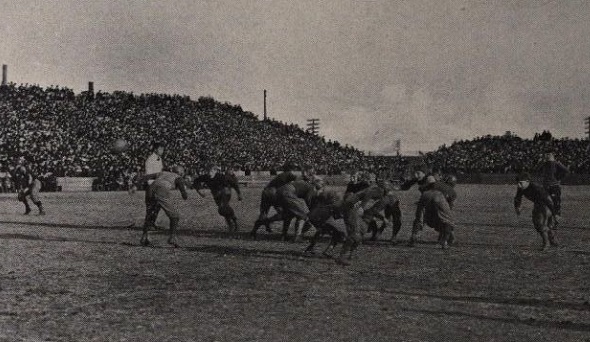
Thank Roosevelt for Football Weekends

December 20, 2013

By Rob Kaminski
MHSAA benchmarks editor

The next time you find yourself immersed in a tense crosstown football rivalry on a Friday night followed by a Saturday pilgrimage to the nearest college campus and a Sunday afternoon with a remote and your favorite snacks and beverages, take a moment to consider what the weekend would be like if it weren’t for Teddy Roosevelt.

The man who became our 26th President shortly after the turn of the 20th Century following the assassination of William McKinley in 1901 was a football fan like you. Maybe more so.

Today’s game of football has reached a critical crossroads. Player size and speed have increased across the board. Savage use of equipment as weapons rather than protective gear has been glorified on television networks and social media. Leaders of the game at all levels have recognized the need for change, employing new rules and widespread educational efforts to aid in preserving the sport.

History, as they say, is repeating itself.

In an ironic twist, it was Roosevelt who saved the then-brutally violent game of football from itself more than 100 years ago. Yes, the same “Rough and Ready Teddy” who led the charge up San Juan Hill during the Spanish-American War and often sparred in the boxing ring while in office from 1901-09 opined that football was becoming so gruesome that he delivered an ultimatum: clean up the game or it would be outlawed.

The Chicago Tribune reported that in 1904 alone, there were 18 football deaths and 159 serious injuries, mostly among prep school players. Football deaths suffered by younger players were reported on a nearly weekly basis, as outraged citizens called on colleges and high schools to banish football outright.

In stepped Roosevelt, who called head coaches and representatives from Harvard, Yale and Princeton – college powers at the time – to the White House in 1905 urging them to eliminate excessive violence and set an example of fair play for the rest of the country. When the casualties actually rose by one during the ensuing season, Roosevelt reacted with greater resolve and convened leading football authorities for the purpose of authoring drastic rules changes. What emerged was an intercollegiate conference which was the predecessor of the NCAA.

Among the most effective changes for the 1906 season were the legalization of the forward pass, the elimination of mass formations, and the creation of a neutral zone. Football fatalities fell to 11 in each of the next two seasons, and severe injuries fell drastically.

Thanks to the introduction of protective equipment and ever-evolving rules changes, football during the 100-plus years to follow has become an exponentially safer game. Yet, the game’s leaders always will need to adjust and react to scrutiny that comes with the territory.

So, as the game once again undergoes rules modifications in the name of safety, give a tip of the cap to President Roosevelt while you enjoy college bowl season and the NFL playoffs and begin to think ahead to the first high school practice of 2014.

St. Mary's Repeats in St. Mary's Fashion

November 28, 2015

By Bill Khan
Special for Second Half

DETROIT — Glamorous moments come rarely for wide receivers in Orchard Lake St. Mary's offense. 

To play receiver for the Eaglets requires patience, a selfless attitude and a player who doesn't mind doing the little things that only get noticed within the inner circle of the team.

Junior K.J. Hamler would be the primary weapon in many offenses, but he knows his role with St. Mary’s — make the blocks that keep the chains moving for a pound-and-ground attack. 

When his number is called, he needs to make the most of it — and he usually does.

Hamler caught four passes for 63 yards and two touchdowns, as the Eaglets repeated as MHSAA Division 3 champions with a 29-12 victory over Chelsea on Saturday at Ford Field. 

He hauled in a 34-yard pass from Brendan Tabone on a go route to give St. Mary's a 15-0 lead with 4:09 left in the first quarter. Hamler’s 16-yard catch-and-run of a screen pass from Tabone made it a 22-6 game with 7:31 to go in the third quarter.

"I'm always prepared for anything," Hamler said. "I know we're a running powerhouse team. I've just got to prepare to block better. As soon as coach (George) Porritt gives our team a chance to pass the ball, I try my best." 

A year ago, Hamler didn't have a catch in the championship game. Tabone had a minimal role as a passer, going 3 for 11 for 31 yards in a 7-0 victory over Muskegon.

St. Mary's ran the ball on its first 15 plays of this game before Tabone got the green light to go deep to Hamler. The Eaglets ran eight more plays before the next pass was called. They finished with 293 rushing yards on 56 carries, while Tabone went 5 for 9 passing for 79 yards, two touchdowns and an interception. 

"I look forward to every pass play, because we don't throw a ton," Tabone said. "We have such great backs. It was really special to be able to have an impact on the game; I'll remember it forever."

Tabone said Hamler has the right mental framework to play wide receiver in St. Mary's offense. 

"K.J.'s such a great guy," he said. "He's selfless. Whenever his number gets called, our eyes light up and we do our best to make a big play when we can."

The flashes of brilliance in the passing game added to a championship performance that was typical for St. Mary's — grind down the opponent with the running game and stifle it with defense. 

Justin Myrick had 108 yards and two touchdowns on 20 carries, Troy Marks had 105 yards on 17 carries, Rashawn Allen had 55 yards on 13 carries, and Ryan Johnson had 22 yards on three carries to lead the balanced ground game.

"We have depth in our running backs, so if somebody gets hurt we can put in somebody else," said Myrick, who missed the Semifinal victory over East Grand Rapids with an injured hamstring. 

Brandon Adams, who ran for the only touchdown in last year's championship victory, missed the game because of an injury sustained on his only carry in the Semifinal.

The Eaglets repeated as MHSAA champions for only the second time in 13 Finals appearances. They won back-to-back titles in 1999 and 2000, missing out on their three-peat bid in a 14-7 loss to Chesaning in 2001. 

"At the beginning of the season, we were ranked No. 1 and all that good stuff," said junior linebacker Josh Ross, who had six tackles and an interception. "It was a lot of pressure. We had to come through it. We suffered a bad loss (31-8 to Warren DeLaSalle), which made us bond together as brothers. We came through all that adversity and won the state championship. I couldn't be prouder of our team."

It looked like St. Mary's might run away with it early. The Eaglets were leading 15-0 when they elected to go for a 33-yard field goal on fourth-and-inches from Chelsea's 17-yard line on their third possession. John Kwiecinski missed for only the second time in 10 field goal tries this season, opening the door for the Bulldogs (12-2) to get back in the game. 

It took them only four plays to get into the end zone, as Graham Kuras took a reverse and heaved a 47-yard touchdown pass to Noah vanReesema with 8:22 left in the second quarter. Ralph Holley blocked the extra point, leaving the score at 15-6.

"That's our go-to trick play," Kuras said. "I was looking over for Noah. Usually, he's halfway across the field. This time, he wasn't. I was kind of lost on the play. I saw the safety get drawn up, so I knew he'd be open. I stepped up and threw it. I thought I overthrew it. I saw him step into second gear. That was probably one of the biggest plays in the game. Getting down 15-0 right away, we were kind of low on ourselves. Getting a score like that with the crowd behind us and boosting everyone's confidence was key to this game. Without that, it could've been much worse." 

St. Mary's took that 15-6 lead into halftime, then expanded it to 22-6 on the 16-yard pass to Hamler following a shanked 11-yard punt.

Chelsea was held to only 13 yards rushing on 22 carries, but was able to do some damage through the air. A 14-yard touchdown pass from Jack Bush to Cameron Cooper with 5:07 left in the third quarter got the Bulldogs within 22-12. A 2-point pass that would've made it a one-possession margin was incomplete. 

The response was a vintage St. Mary's drive, a 13-play, 80-yard march made up entirely of running plays. The Eaglets took 6:13 off the clock before Myrick scored on a 3-yard run to make it 29-12 with 8:44 left in the game.

The championship was within St. Mary's grasp once the defense came up with a big goal line stand on the following Chelsea drive. The Bulldogs had first-and-goal at the 3 but ended up with a turnover on downs with 5:39 left. 

Chelsea would never touch the ball again, as St. Mary's ran out the final 5:39 with a 10-play, 48-yard drive.

"That's our football," Porritt said. "That last drive was big-time for us. The last drive and the defensive stop were our M.O. for the year. The defense has come up big in some goal line situations. Our offense running clock and having long sustained drives has been our football strategy all year." 

Bush was 13 for 21 for 145 yards, one touchdown and one interception. He was sacked four times.

While St. Mary's is a regular visitor to the championship game, it was the first time Chelsea made it this far. 

"As sad as it is to be over, I wouldn't want to end it anywhere else with any other guys or any other team," Kuras said. "It was the experience of a lifetime."

Click for the full box score.

The MHSAA Football Finals are sponsored by the Michigan National Guard.

PHOTOS: (Top) K.J. Hamler beats the Chelsea defense for one of his two touchdowns Saturday. (Middle) The Eaglets celebrate their second straight Division 3 championship.