

Thank Roosevelt for Football Weekends
December 20, 2013
By Rob Kaminski
MHSAA benchmarks editor
The next time you find yourself immersed in a tense crosstown football rivalry on a Friday night followed by a Saturday pilgrimage to the nearest college campus and a Sunday afternoon with a remote and your favorite snacks and beverages, take a moment to consider what the weekend would be like if it weren’t for Teddy Roosevelt.
The man who became our 26th President shortly after the turn of the 20th Century following the assassination of William McKinley in 1901 was a football fan like you. Maybe more so.
Today’s game of football has reached a critical crossroads. Player size and speed have increased across the board. Savage use of equipment as weapons rather than protective gear has been glorified on television networks and social media. Leaders of the game at all levels have recognized the need for change, employing new rules and widespread educational efforts to aid in preserving the sport.
History, as they say, is repeating itself.
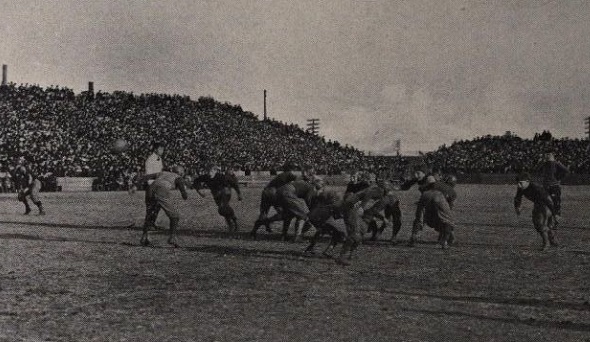
In an ironic twist, it was Roosevelt who saved the then-brutally violent game of football from itself more than 100 years ago. Yes, the same “Rough and Ready Teddy” who led the charge up San Juan Hill during the Spanish-American War and often sparred in the boxing ring while in office from 1901-09 opined that football was becoming so gruesome that he delivered an ultimatum: clean up the game or it would be outlawed.
The Chicago Tribune reported that in 1904 alone, there were 18 football deaths and 159 serious injuries, mostly among prep school players. Football deaths suffered by younger players were reported on a nearly weekly basis, as outraged citizens called on colleges and high schools to banish football outright.
In stepped Roosevelt, who called head coaches and representatives from Harvard, Yale and Princeton – college powers at the time – to the White House in 1905 urging them to eliminate excessive violence and set an example of fair play for the rest of the country. When the casualties actually rose by one during the ensuing season, Roosevelt reacted with greater resolve and convened leading football authorities for the purpose of authoring drastic rules changes. What emerged was an intercollegiate conference which was the predecessor of the NCAA.
Among the most effective changes for the 1906 season were the legalization of the forward pass, the elimination of mass formations, and the creation of a neutral zone. Football fatalities fell to 11 in each of the next two seasons, and severe injuries fell drastically.
Thanks to the introduction of protective equipment and ever-evolving rules changes, football during the 100-plus years to follow has become an exponentially safer game. Yet, the game’s leaders always will need to adjust and react to scrutiny that comes with the territory.
So, as the game once again undergoes rules modifications in the name of safety, give a tip of the cap to President Roosevelt while you enjoy college bowl season and the NFL playoffs and begin to think ahead to the first high school practice of 2014.
Zeeland West Rumbles to Another Title
November 27, 2015
By Bill Khan
Special for Second Half
DETROIT — The Zeeland West offensive machine was in good hands the last three seasons with Casey Brinks directing the attack.
 The Dux’ senior quarterback brought two teams to Ford Field during his varsity career, and ended it Friday night helping hoist a second MHSAA championship trophy.
West scored its first of five touchdowns with 35 seconds left in the first quarter and didn't let up from there, pounding its way to a 40-14 victory over Flint Powers Catholic for a fourth championship in 10 years.
"That one (in 2013) was really fun, but this one to me is a lot better, just being a senior and it's my last year," Brinks said. "To end my football career playing on a state championship team in Ford Field is amazing."
Brinks was the starting quarterback as a sophomore when West won its last title, throwing for one touchdown and running for another in a 34-27 victory over DeWitt in the Division 3 championship game. He also led West to the Semifinal round a year ago.
Brinks was one of three Dux who played in the 2013 championship game, the others being running back Dakota Geurink and lineman Zach VanValkenburg. Geurink ran 14 times for 71 yards and a touchdown Friday. VanValkenburg had two sacks among three tackles for losses.
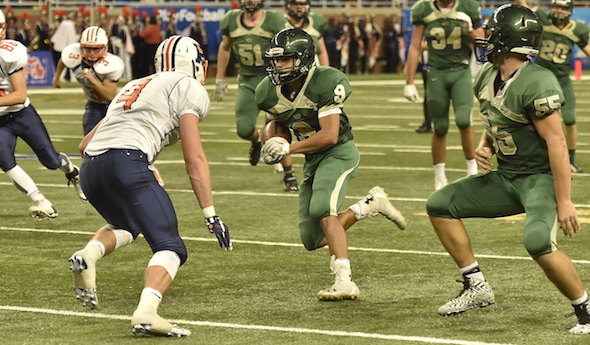
With his team facing fourth-and five near the end of the first quarter, fullback Darius Perisee scored on an 8-yard run for the opening touchdown and then added a 2-point conversion run. He was the top gainer for West's powerful T offense, finishing this season with 1,982 yards and 30 touchdowns rushing.
Brinks doesn't pass often but he was highly effective when he did. He finished 4 for 4 for 103 yards, with three straight completions on the team’s third possession. Tyler Thompson capped that drive with a 5-yard touchdown run, then added a 2-point run to make it 16-0 with 4:03 left in the second quarter.
Powers (11-3) drove to the West 18 late in the first half, only to be denied on the final play before halftime when Brinks picked off a pass in the end zone. He also had an interception in the third quarter, playing defense for only the second time this season.
"I played defense last week for the first time," said Brinks, who ran five times for 45 yards and a touchdown. "Otherwise, I didn't play defense. It was nice to play. Mostly in the playoffs, we've been playing running teams. We've played two passing teams the past two weeks."
 West came into the game running the ball 94 percent of the time and averaging 8.6 yards per carry. Even though Powers knew what was coming, the Chargers were unable to stop the Dux’ power-running attack.
Powers did get a huge stop when Reese Morgan caught Brinks for no gain on fourth-and-three from the Chargers' 5-yard line on the first series of the game, but West went on to score on its next five drives before running out the final 3:55 on its final possession.
"It's just a very deceiving offense they run," Morgan said. "It's hard to know who has the ball."
The Chargers nearly turned the momentum from that first defensive stop into a scoring drive of their own, marching down to West's 14-yard line on their first possession. On fourth-and-one, however, quarterback Noah Sargent came up inches short of a first down with 4:53 left in the first quarter.
"That was tough, but you can't say we lost the game on one play," said Sargent, who ran 17 times for 89 yards and a touchdown while going 12 for 19 for 158 yards, a touchdown and three interceptions through the air. "You've got to play the whole game."
Powers got on the board on the first possession of the second half, scoring on a 15-yard run by Sargent, but a 2-point run by Morgan was stopped by Riley Brinks. With West cashing in on all five of its 2-point conversion tries, the Chargers couldn't afford to miss theirs.
West (14-0) responded with a 13-play, 80-yard march that ended on a 4-yard run by Geurink with 3:14 to go in the third quarter. Following Casey Brinks' second interception, West built its lead to 32-6 on a 2-yard run by Thompson with 10:36 to go in the game.
Luke Brcic caught a 35-yard touchdown pass from Sargent and threw a 2-point conversion to Morgan with 7:28 remaining, getting Powers within 32-14, but Aaron Sleeman recovered the onside kick for the Dux.
Four plays later, West capped the scoring on a 39-yard run by Casey Brinks and Perisee's third 2-point run with 5:13 remaining.
Geurink picked off a pass with 3:55 remaining, and West was able to run out the rest of the clock and celebrate another championship.
"We've won four," West coach John Shillito said. "They're all different, but this one might have been the most complete on both sides of the ball. It's maybe not the deepest team, because we were playing a lot of guys two ways. I looked out there and we looked a little tired at times, because it's warm in here. It's maybe not the deepest (team), but the guys on the field were probably the best we've had."
West was able to score 40 points against a Powers team that had a school-record six shutouts, allowing only 21 points over its first four playoff games.
"I really just figured we had to score every time we had the ball, because no one has really stopped them all year," Powers coach Bob Buckel said. "Playing them, you start doing things you're uncomfortable doing, because you don't want to turn the ball over to them."
Thompson ran 16 times for 117 yards and two touchdowns to lead a West ground attack that had 318 yards and five touchdowns on 55 carries.
Matt Wiskur caught five passes for 70 yards, while Morgan ran 13 times for 61 yards for Powers. Both of them had brothers on the Chargers' 2011 Division 5 championship team.
The MHSAA Football Finals are sponsored by the Michigan National Guard.
PHOTOS: (Top) Darius Perisee breaks free for yardage in leading the Zeeland West rushing attack Friday. (Middle) The Dux hoist a championship trophy for the second time in three seasons.