

Thank Roosevelt for Football Weekends
December 20, 2013
By Rob Kaminski
MHSAA benchmarks editor
The next time you find yourself immersed in a tense crosstown football rivalry on a Friday night followed by a Saturday pilgrimage to the nearest college campus and a Sunday afternoon with a remote and your favorite snacks and beverages, take a moment to consider what the weekend would be like if it weren’t for Teddy Roosevelt.
The man who became our 26th President shortly after the turn of the 20th Century following the assassination of William McKinley in 1901 was a football fan like you. Maybe more so.
Today’s game of football has reached a critical crossroads. Player size and speed have increased across the board. Savage use of equipment as weapons rather than protective gear has been glorified on television networks and social media. Leaders of the game at all levels have recognized the need for change, employing new rules and widespread educational efforts to aid in preserving the sport.
History, as they say, is repeating itself.
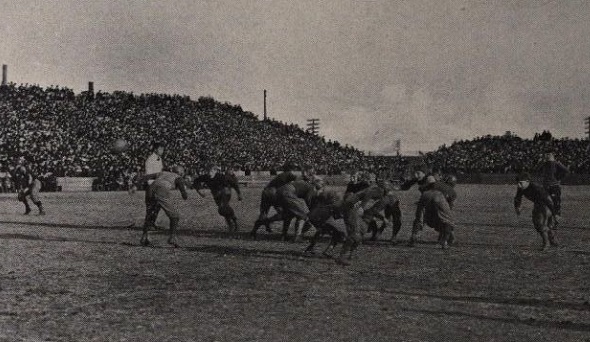
In an ironic twist, it was Roosevelt who saved the then-brutally violent game of football from itself more than 100 years ago. Yes, the same “Rough and Ready Teddy” who led the charge up San Juan Hill during the Spanish-American War and often sparred in the boxing ring while in office from 1901-09 opined that football was becoming so gruesome that he delivered an ultimatum: clean up the game or it would be outlawed.
The Chicago Tribune reported that in 1904 alone, there were 18 football deaths and 159 serious injuries, mostly among prep school players. Football deaths suffered by younger players were reported on a nearly weekly basis, as outraged citizens called on colleges and high schools to banish football outright.
In stepped Roosevelt, who called head coaches and representatives from Harvard, Yale and Princeton – college powers at the time – to the White House in 1905 urging them to eliminate excessive violence and set an example of fair play for the rest of the country. When the casualties actually rose by one during the ensuing season, Roosevelt reacted with greater resolve and convened leading football authorities for the purpose of authoring drastic rules changes. What emerged was an intercollegiate conference which was the predecessor of the NCAA.
Among the most effective changes for the 1906 season were the legalization of the forward pass, the elimination of mass formations, and the creation of a neutral zone. Football fatalities fell to 11 in each of the next two seasons, and severe injuries fell drastically.
Thanks to the introduction of protective equipment and ever-evolving rules changes, football during the 100-plus years to follow has become an exponentially safer game. Yet, the game’s leaders always will need to adjust and react to scrutiny that comes with the territory.
So, as the game once again undergoes rules modifications in the name of safety, give a tip of the cap to President Roosevelt while you enjoy college bowl season and the NFL playoffs and begin to think ahead to the first high school practice of 2014.
Drive for Detroit: Playoffs R1 in Review
November 2, 2015
By Geoff Kimmerly
Second Half editor
Three reigning champions were eliminated this weekend, six undefeated teams fell, and October came to and end with the MHSAA football playoff field halved to 136 teams still alive for nine titles.
Divisions 1, 2 and 6 will have new winners this month. And a few teams that looked like contenders also are done after the first round and a series of upsets that made headlines across the state.
See below for some of the most unexpected and heaviest-hitting results from the first week in all eight 11-player divisions and the 8-player bracket.
Division 1
Novi 31, West Bloomfield 28
After four straight losing seasons and an 0-3 start this fall, Novi (6-4) made the playoffs for the first time since 2008 with an at-large bid – and then dealt undefeated West Bloomfield (9-1) its only loss in arguably the biggest upset in the state this weekend. The teams combined for five touchdowns during the fourth quarter, but West Bloomfield never could completely catch up to the Wildcats. Click for more from the Oakland Press.
Also noted:
Rockford 24, Grandville 6 – The Rams (7-3) won the rematch of Ottawa-Kent Conference Red co-champions after also beating Grandville (6-4) in Week 4.
Romeo 28, Clarkston 14 – The Bulldogs (9-1) bounced back from a tough three-point loss to Utica Eisenhower in Week 9 to eliminate the reigning champion Wolves (7-3).
Ann Arbor Pioneer 22, Belleville 7 – Pioneer (7-3) ended a two-game losing streak by handing Belleville (8-2) its first loss since opening night.
Utica Eisenhower 23, Clinton Township Chippewa Valley 20 (2 OT) – Eisenhower (7-3) kept surging with its fourth straight win, first in the playoffs since 2012 and second in four weeks over Chippewa Valley (7-3).
Division 2
Detroit East English 25, Warren DeLaSalle 21
East English (8-2) has made the playoffs all four seasons as a program after emerging from the former Detroit Crockett, which made the playoffs its final 12 seasons and the MHSAA Semifinals twice. So the Bulldogs have had their share of success – but this might be the best win of the new program’s history, as they eliminated the reigning Division 2 champion and after falling to DeLaSalle (6-4) by only seven in last year’s District Final. Click for more from MLive-Detroit.
Also noted:
Muskegon 40, Traverse City Central 14 – The Big Reds (8-2) took the long trip up north and handed Traverse City Central (9-1) its first and only loss, earning a rematch with rival Mona Shores this week.
Byron Center 34, Portage Central 21 – The Bulldogs (8-2) have made three straight playoffs and won two playoff games only two years ago, but it’s still fair to say they were underdogs on the road at Portage Central (8-2).
Birmingham Groves 10, Farmington Hills Harrison 0 – Groves (10-0) reached 10 wins for the first time in program history with its sixth shutout this season, ending Harrison’s at 7-3.
Jackson 42, Livonia Churchill 35 – After making the playoffs for the first time since 2009, Jackson (8-2) won its first playoff game since 1999 in ending Churchill’s season at 5-5.
Division 3
East Grand Rapids 27, Grand Rapids Christian 14
After watching a 26-0 lead on Grand Rapids Christian fade in their first matchup this season, in Week 6, the Pioneers (7-3) finished this time against their O-K White rival. East Grand Rapids will play in a District Final for the first time since 2011. Grand Rapids Christian, which beat EGR 39-33 in that first game, ended at 5-5. Click for more from the Grand Rapids Press.
Also noted:
Vicksburg 16, Marshall 8 – The Bulldogs (8-2) quietly have built a five-game winning streak, adding to it with a road win at Marshall (7-3).
Trenton 34, New Boston Huron 21 – The Trojans (9-1) equaled their best record since 2003 by avenging last season’s District Final loss to Huron (5-5).
Coldwater 31, Parma Western 7 – Coldwater (10-0), which made the playoffs for the first time three seasons ago, earned its first playoff win by downing Western (6-4), which was playing in its first playoff game.
Redford Thurston 48, Warren Fitzgerald 14 – One of the rare at-large qualifiers with a home game, Thurston (6-4) justified it with a first-round win for the second straight season; Fitzgerald finished its second straight at 6-4.
Division 4
Benton Harbor 28, Dowagiac 7
We’ve nearly run out of neat ways to crunch the numbers for the Tigers (6-4), who are enjoying their best season and whose six wins this fall are more than they won over the previous eight combined. Benton Harbor’s first playoff game resulted in its first victory – and the chance to next take on annual championship contender Zeeland West. Dowagiac isn’t to be forgotten, however; the Chieftains (6-4) bounced back from finishing 3-6 in 2014. Click for more from the Kalamazoo Gazette.
Also noted:
Bloomfield Hills Cranbrook Kingswood 35, St. Clair Shores South Lake 14 – The Cranes (9-1) equaled their best record since 2004 and ended the best season for South Lake (8-2) since 2011; the Cavaliers improved from 2-7 a year ago.
Comstock Park 38, Saginaw Swan Valley 35 – Quarterback Pat Naughton threw four touchdown passes and Monterio Smith caught two and ran for a third score as Comstock Park (8-2) came back early and then held off the Vikings (6-4).
Detroit Denby 36, Detroit Collegiate Prep 6 – Denby (6-4) claimed its first playoff win since 2007 by handing the first loss this season to Collegiate Prep (9-1), the Detroit Public School League Division II champion.
Lake Fenton 29, Corunna 27 – Lake Fenton’s most recent loss was by seven to Corunna in Week 8, but the Blue Devils (6-4) went on the road to take the rematch from the Cavaliers (8-2).
Division 5
Ida 35, Ann Arbor Gabriel Richard 23
The Bluestreaks built on their first undefeated regular season since 1971 with a second straight playoff win over Ann Arbor Gabriel Richard (5-5). Ida (10-0) also set a program record for wins despite giving up the most points in a game this season; the Bluestreaks gave up only 64 total during the first nine weeks. They scored three times during the third quarter to pull away. Click for more from the Monroe Evening News.
Also noted:
Buchanan 34, Hillsdale 31 – The Bucks' first perfect regular season since 1988 has turned into its first 10-0 start ever after its third win in a month decided by three points or fewer, this time against a Hillsdale team (6-4) in its 15th straight playoffs.
Almont 10, Marine City 3 – The Raiders (8-2) have bounced back nicely from back-to-back losses in Weeks 7 and 8, this time downing Marine City (6-4) in the playoffs for the second straight season.
Dearborn Heights Robichaud 50, Brooklyn Columbia Central 37 – Robichaud (8-2) reached 50 points for the second time this season to get its first playoff win since 2012, while Columbia Central ended at 8-2 after three straight losing seasons.
Kingsford 25, Harrison 0 – The Flivvers bounced back from a sub-.500 record last season and then a loss in Week 9 to claim a playoff win for the first time since 2012 and with their first shutout of this fall – which also was the first time Harrison (7-3) was shut out since Week 1 of 2013.
Division 6
Clinton 14, Monroe St. Mary Catholic Central 10
Clinton (10-0) was one of two undefeated teams that had road games this weekend, and the Redskins responded by eliminating the reigning champion. Monroe St. Mary (8-2) had dominated most of its competition this fall, aside from a Week 9 loss to Division 5 contender Lansing Catholic. But Clinton drove 93 yards for the go-ahead score on the legs of Matt Sexton, who gained 100 yards total on the winning possession. Click for more from the Monroe Evening News.
Also noted:
Calumet 24, Negaunee 14 – The Copper Kings (8-2) earned their first win over Negaunee since 1955 and after five losses over the last four seasons to the Miners (7-3).
Sanford Meridian 44, Millington 38 – The Mustangs (10-0) also set a program record for wins and earned the opportunity to face another undefeated team, Ithaca, this week while ending Millington’s 12th straight playoff season at 8-2.
Laingsburg 23, Burton Bendle 15 – The Wolfpack (7-3) moved past six wins for the first time since 2009 by edging a Bendle team that went from 3-6 a year ago to 8-2 this fall.
Constantine 31, Schoolcraft 28 (OT) – In arguably the other biggest stunner of the first week of the playoffs, at-large qualifier Constantine (6-4) went on the road and downed rival Schoolcraft (9-1), handing the Eagles their first loss after falling to them 42-24 only two weeks ago.
Division 7
Saugatuck 42, Hesperia 7
These two played the only playoff game between undefeated teams during the first week, with the Indians (10-0) earning their first postseason victory since the 2010 run to the Division 8 Final. Hesperia made one of the most impressive turnarounds in MHSAA football history this fall, going from 1-8 last season to 9-1 before falling Friday. Click for more from the Holland Sentinel.
Also noted:
McBain 34, Whittemore-Prescott 22 – Highland Conference co-champ McBain (7-3) won this battle of league winners, edging the first-place Cardinals (5-5) from the North Star League Big Dipper.
Cass City 34, Ubly 6 – The Red Hawks (8-2) have their most wins in a decade after ending the best season for Ubly (7-3) since 2011.
Flint Beecher 30, Flint Hamady 28 – The Buccaneers (7-2) took the lead for good in the fourth quarter in their first matchup with Hamady (7-3) since a District Final in 2012.
Riverview Gabriel Richard 30, Grosse Pointe Woods University Liggett 27 – A 42-yard field goal by Zach Loewengruber on the game’s final play gave Gabriel Richard (7-3) its first playoff win and ended Liggett’s season at 6-4.
Division 8
Climax-Scotts 8, Mendon 6
Climax Scotts (10-0) held on for its first win over Mendon (5-5) since 1977, after 30 straight losses. Climax-Scotts scored on the first possession of the game and made a two-point conversion, and stopped Mendon’s conversion attempt after its lone score. The Panthers have made the playoffs 13 straight seasons, and now will try for a second Regional Final in eight tries; Mendon had eliminated them from the playoffs the past four seasons. Click for more from the Battle Creek Enquirer.
Also noted:
Crystal Falls Forest Park 24, Lake Linden-Hubbell 0 – The Trojans (6-3) must have figured out a few things between falling to Lake Linden-Hubbell 34-28 only a week earlier and then handing the Lakes (9-1) their first and only loss.
Bark River-Harris 22, Munising 6 – Three weeks after falling to Munising by seven, Bark River-Harris (8-2) advanced to a District Final for the second straight season by downing the reigning Division 8 runner-up Mustangs (7-3).
Johannesburg-Lewiston 35, Hillman 8 – The Cardinals (9-1) won their ninth game for the third time in four seasons by downing North Star League Little Dipper champion Tigers (6-4), and now get another shot at Ski Valley Conference winner St. Ignace after finishing a win behind the Saints in the league standings.
Ottawa Lake Whiteford 20, Petersburg-Summerfield 14 – Revenge surely was sweet for Whiteford (8-2), which fell to Petersburg-Summerfield (7-3) by 20 in their Week 4 Tri-County Conference matchup.
8-Player
Rapid River 36, Engadine 29
A Week 5 loss to Engadine started a string of three losses in four games for Rapid River (7-3), but the Rockets have avenged the first defeat and earned the opportunity to avenge a second against Powers North Central. Engadine (7-3) was held to fewer than 40 points for the first time since Week 3. Click for more from RRN Sports.
Also noted:
Cedarville 48, Owendale-Gagetown 28 – The reigning 8-player runner-up Trojans (8-2) have won four straight and delivered O-G (9-1) its first and only loss.
Lawrence 54, Waldron 52 – The Spartans (8-2) played the reigning champion impressively close, but Lawrence (8-2) emerged with another opportunity against rival Battle Creek St. Philip this week after falling to St. Philip two weeks ago.
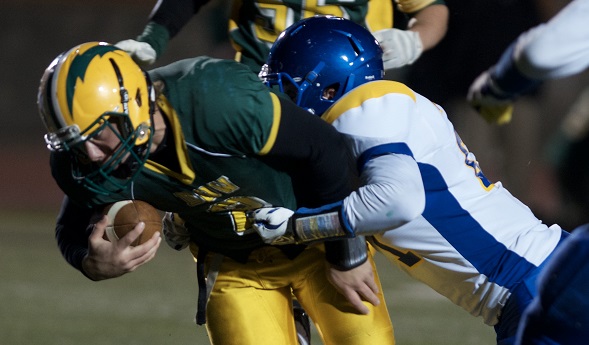
PHOTO: Midland Dow, in green, faced rival Midland for the second straight week and won for the second straight as well, 42-7. (Click for more from HighSchoolSportsScene.com.)