

Thank Roosevelt for Football Weekends
December 20, 2013
By Rob Kaminski
MHSAA benchmarks editor
The next time you find yourself immersed in a tense crosstown football rivalry on a Friday night followed by a Saturday pilgrimage to the nearest college campus and a Sunday afternoon with a remote and your favorite snacks and beverages, take a moment to consider what the weekend would be like if it weren’t for Teddy Roosevelt.
The man who became our 26th President shortly after the turn of the 20th Century following the assassination of William McKinley in 1901 was a football fan like you. Maybe more so.
Today’s game of football has reached a critical crossroads. Player size and speed have increased across the board. Savage use of equipment as weapons rather than protective gear has been glorified on television networks and social media. Leaders of the game at all levels have recognized the need for change, employing new rules and widespread educational efforts to aid in preserving the sport.
History, as they say, is repeating itself.
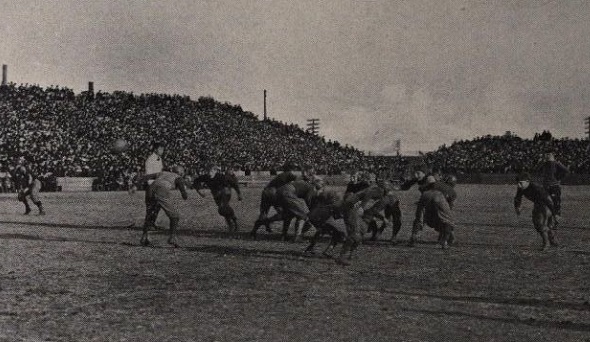
In an ironic twist, it was Roosevelt who saved the then-brutally violent game of football from itself more than 100 years ago. Yes, the same “Rough and Ready Teddy” who led the charge up San Juan Hill during the Spanish-American War and often sparred in the boxing ring while in office from 1901-09 opined that football was becoming so gruesome that he delivered an ultimatum: clean up the game or it would be outlawed.
The Chicago Tribune reported that in 1904 alone, there were 18 football deaths and 159 serious injuries, mostly among prep school players. Football deaths suffered by younger players were reported on a nearly weekly basis, as outraged citizens called on colleges and high schools to banish football outright.
In stepped Roosevelt, who called head coaches and representatives from Harvard, Yale and Princeton – college powers at the time – to the White House in 1905 urging them to eliminate excessive violence and set an example of fair play for the rest of the country. When the casualties actually rose by one during the ensuing season, Roosevelt reacted with greater resolve and convened leading football authorities for the purpose of authoring drastic rules changes. What emerged was an intercollegiate conference which was the predecessor of the NCAA.
Among the most effective changes for the 1906 season were the legalization of the forward pass, the elimination of mass formations, and the creation of a neutral zone. Football fatalities fell to 11 in each of the next two seasons, and severe injuries fell drastically.
Thanks to the introduction of protective equipment and ever-evolving rules changes, football during the 100-plus years to follow has become an exponentially safer game. Yet, the game’s leaders always will need to adjust and react to scrutiny that comes with the territory.
So, as the game once again undergoes rules modifications in the name of safety, give a tip of the cap to President Roosevelt while you enjoy college bowl season and the NFL playoffs and begin to think ahead to the first high school practice of 2014.
Answers from the Athletes
By
Rob Kaminski
MHSAA benchmarks editor
May 22, 2014
By Rob Kaminski
MHSAA benchmarks editor
MHSAA Student Advisory Council members were asked their opinions on several of the current issues facing the MHSAA Junior High/Middle School Committee and the MHSAA JH/MS Task Force. Students also shared experiences from their junior high/middle school days and from participation with non-school teams. Following is a sampling of responses:
Length of Contests and Seasons
Based on your junior high/middle school experiences, would you favor an increase in the number of contests/events that a junior high/middle school is allowed to play? Would you favor longer game times?
Kiersten Mead, Saginaw Swan Valley: “I personally don't believe that longer seasons are necessary. In middle school, student athletes are just starting to learn how to balance sports and school, so I think that the season time is already pretty reasonable.
“I do, however, believe that longer games would be really beneficial to all ages. It would allow more students to play and participate.”
Jonathan Perry, McBain Northern Michigan Christian: “When I was playing, I wish my season would have been longer, but it is at a reasonable length. It would be harder on parents having a middle school player and a high school player, but it would get you more ready for a high school-length schedule.
“The games are at a reasonable length also. The one benefit of having more games and longer games is that more kids get to play who otherwise might not if they had a shorter game or season.”
Connor Thomas, Marlette: “As a player, I would be totally in favor. If I were an adult, I would say no because of the traveling. As for the lengths of games, again, I’d favor it as a player. But with schools that have A and B teams for both grades, that could be a late night.”
Kristen Law, Bloomfield Hills Andover: “I really enjoyed playing in middle school, and I would have loved to be able to play more. Increasing the length of games might depend on the sport. For tennis, from what I remember, the matches were a shortened version of what we play in high school, and I thought they were appropriate given the level of the majority of the players that were competing.”
Zack Nine, Pinconning: “Based on my middle school sports experience, I would favor an increase in the number of contests and a longer game time. These changes would give athletes who do not get much playing time a chance to gain more experience. I also believe that more games and a longer game length would keep our youth in better shape and better prepare them for high school athletics through an easier transition.”
Mandy Paull, Cheboygan: “I think that middle school sports should be allowed to play more games, but I do not think that the length of games should be increased.”
Coby Ryan Manistique: “I would favor an increase in the number of contests. The seasons are quite short and go by too quickly, in my opinion.
“I would also favor longer game times. With this, more kids will get the opportunity to play, and it will also make the travel and the time invested more worthwhile.”
6th-Grade Participation
Is it time to also include 6th-graders at junior high/middle schools under MHSAA guidelines? Consider enrollments, sports and participation with 7th- and 8th-graders.
Eliza Beird, Holland Black River: “I would favor the addition of 6th-graders in all sports. This would allow for the possibility of two teams in some sports and it gets the kids playing with people they might be playing with for the rest of their high school careers.
“It is definitely easier to put 6th-graders with 7th- and 8th-graders at a smaller school because one grade usually won’t out-number another grade. In a big school, a bunch of 8th-graders will try out for the team because more go to a school. In larger schools, 6th-graders would have a chance to make only a 6th-grade team.
Hayden Smith, Hamilton: “I think it’s time for 6th-graders to be included, but not in all sports; just the non-contact ones. The various sizes of schools would make it easier for some to compete and harder for others, but it shouldn’t matter overall. All schools’ 6th-graders should be able to play. I think that would be a great experience for them.”
Mandy Paull, Cheboygan: “I think that 6th-grade students should be able to play middle school sports. Sports are a good way to initiate incoming elementary students to the middle school as well as provide a fun, constructive activity that they can participate in with their friends, and a way to make new ones as well.
“The 6th-grade athletes should only be mixed with the 7th and 8th grade in cross country and track, and have their own teams for sports like volleyball and basketball, just as the 7th- and 8th- graders do. Only non-contact sports should mix all grades.”
Connor Thomas, Marlette: “Coming from a smaller community, I think the MHSAA should include 6th-graders in only the schools that need them, such as small Class D schools. They should be allowed to play with 7th- and 8th-graders as long as the schools need them, and aren't bringing them up to have a ‘dream team.’ Enrollment has to be a factor; the schools should be struggling for numbers in order to have a 6th-grader on a team.”
Zack Nine, Pinconning: “I believe that 6th- graders should not be held accountable to MHSAA regulations. My opinion largely stems from the fact that not every school includes 6th grade as part of its middle school. I know mine does not. It would be difficult to regulate the participation of 6th-graders in some schools (because they're considered middle schoolers) while other schools cannot let their 6th-grade elementary students compete.”
Jonathan Perry, McBain Northern Michigan Christian: “I think all sports should be included if 6th-graders were allowed to play. I think it’s more helpful to small schools, but wouldn’t limit it based on enrollment. I go to a small school; last year my school did not have enough kids for a 7th-grade team.”
Kiersten Mead, Saginaw Swan Valley: “I understand the monetary considerations schools may have with 6th-grade teams through the MHSAA, but I do believe that the MHSAA should start setting guidelines for the schools which see it as feasible. Middle schools don't have to go through the MHSAA, but I believe that by including 6th-graders, it may generate a positive reaction from member schools.
“I feel like as long as the coaches don't see a major physical disadvantage to it, then it would be okay for 6th-graders to participate with the 7th and 8th grade in all sports. Non-contact sports would most definitely be alright, because in high school, you compete against all ages anyways.
Coby Ryan Manistique: “I believe that it is time for 6th-graders to get the chance to participate in athletics, regardless of school size. By choice, a child should always be given the opportunity to be active, stay out of trouble, learn about teamwork and leadership, and build a foundation for fundamentals that will be used for the rest of their athletic careers. Many schools do not have locally run programs, and the MHSAA running it would give thousands more kids a chance to play.”
Kristen Law, Bloomfield Hills Andover: “When I was in 6th grade, I was competing against 7th- and 8th-graders (on community teams), and I probably would have been upset if I couldn't compete against them. Sixth-grade participation should definitely be allowed in non-contact sports, but I don't know too much about contact sports and the risk of injury to 6th-graders if it were to be allowed.
“I don't think the size of the school should determine whether or not 6th-graders can compete against 7th- and 8th-graders.”
Community and Club Sports
If you played community sports during your JH/MS years, how did the experience compare with school sports? If you could have played MHSAA-based sports in 6th grade, would you have done so?
Emileigh Ferguson, Bear Lake: “I played little league softball prior to middle school, until 5th grade. I prefer MHSAA sports over other kinds because they are more serious and organized. My school has basketball for 5th and 6th grade so we don’t play with middle school.”
Eliza Beird, Holland Black River: “I played soccer and basketball from Kindergarten through 6th grade and still play club sports. My outside-of-school sports tended to be a bit better.
“If there were MHSAA sports in 6th grade, I would have definitely played basketball. I already played with a bunch of girls from school so playing for my school would not have been much different. Plus it’s fun to play for my school. I probably would not have played soccer because the club team I was on at the time was quite a bit better than the school team.”
Hayden Smith, Hamilton: “In my experience (community sports) was somewhat similar, but still different. School sports weren't coached by parents anymore; the best players got to start. Also, it was different in that a lot of kids stopped playing; only the ones who really liked it kept playing. However, it was similar because there were always people (parents and kids) complaining about playing time. It was similar in that there was always a strong community at your back.
“If I could have played school sports earlier, I would have done so because of the aspect of representing my community and school. I think I still would have done the travel baseball stuff, but that is always in the summer.”
Mandy Paull, Cheboygan: “I played girls little league softball from 3rd to 5th grade, and house hockey from 1st grade to 9th. In middle school the sports were more serious and I enjoyed them much more. As a team we would dress up for our games, and we got to travel on a bus to away games. There was a much stronger bond and all the players were more serious. The teams were also better in middle school due to tryouts.
“I definitely would have played middle school sports in 6th grade as opposed to community teams.”
Jonathan Perry, McBain Northern Michigan Christian: “I did not notice a huge difference between community sports and school sports. The big difference in community sports is that you get a wide range of kids, not just the kids in your school. I like playing the school sports better because I knew that the kids I was playing with were who I would play high school sports with.
“I would have played school sports in 6th-grade or earlier if the option was there. A lot of community sports I played on (were) all about winning. The school team sports provide learning sessions for both sports and life. It's an extension of the classroom. I saw that more with school sports than community sports.”
Kiersten Mead, Saginaw Swan Valley: “I did not play anything prior to middle school, but in 6th grade I was a part of an AAU volleyball team since my school did not offer a 6th-grade team. I also bowled in leagues at a few different bowling alleys.
“I definitely would have played with my school versus community. We really didn't have a solid AAU program in our area so the school team was much more organized. I found that the volleyball teams through my school were much more beneficial to me. We practiced on a regular basis, and it was nice to play with girls that I was already friends with. We were able to grow more as a team and gain a greater sense of unity. I believe that my school team made me a better athlete as well.”
Kristen Law, Bloomfield Hills Andover: “I enjoyed being able to play sports with my friends in middle school, but I also liked the competitiveness of the community- based sports I participated in. The middle school sports atmosphere didn't feel as competitive.
“When I was in 6th grade, I played tennis on the middle school team, but it was not affiliated with the MHSAA.”