

Thank Roosevelt for Football Weekends
December 20, 2013
By Rob Kaminski
MHSAA benchmarks editor
The next time you find yourself immersed in a tense crosstown football rivalry on a Friday night followed by a Saturday pilgrimage to the nearest college campus and a Sunday afternoon with a remote and your favorite snacks and beverages, take a moment to consider what the weekend would be like if it weren’t for Teddy Roosevelt.
The man who became our 26th President shortly after the turn of the 20th Century following the assassination of William McKinley in 1901 was a football fan like you. Maybe more so.
Today’s game of football has reached a critical crossroads. Player size and speed have increased across the board. Savage use of equipment as weapons rather than protective gear has been glorified on television networks and social media. Leaders of the game at all levels have recognized the need for change, employing new rules and widespread educational efforts to aid in preserving the sport.
History, as they say, is repeating itself.
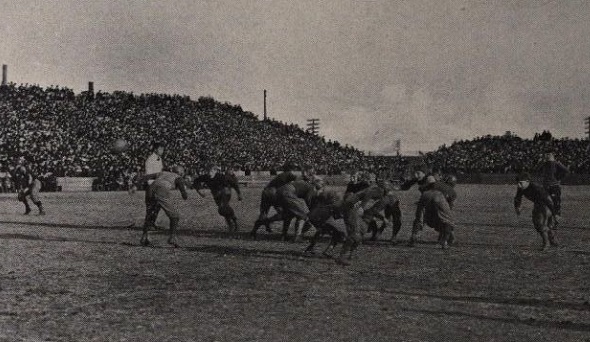
In an ironic twist, it was Roosevelt who saved the then-brutally violent game of football from itself more than 100 years ago. Yes, the same “Rough and Ready Teddy” who led the charge up San Juan Hill during the Spanish-American War and often sparred in the boxing ring while in office from 1901-09 opined that football was becoming so gruesome that he delivered an ultimatum: clean up the game or it would be outlawed.
The Chicago Tribune reported that in 1904 alone, there were 18 football deaths and 159 serious injuries, mostly among prep school players. Football deaths suffered by younger players were reported on a nearly weekly basis, as outraged citizens called on colleges and high schools to banish football outright.
In stepped Roosevelt, who called head coaches and representatives from Harvard, Yale and Princeton – college powers at the time – to the White House in 1905 urging them to eliminate excessive violence and set an example of fair play for the rest of the country. When the casualties actually rose by one during the ensuing season, Roosevelt reacted with greater resolve and convened leading football authorities for the purpose of authoring drastic rules changes. What emerged was an intercollegiate conference which was the predecessor of the NCAA.
Among the most effective changes for the 1906 season were the legalization of the forward pass, the elimination of mass formations, and the creation of a neutral zone. Football fatalities fell to 11 in each of the next two seasons, and severe injuries fell drastically.
Thanks to the introduction of protective equipment and ever-evolving rules changes, football during the 100-plus years to follow has become an exponentially safer game. Yet, the game’s leaders always will need to adjust and react to scrutiny that comes with the territory.
So, as the game once again undergoes rules modifications in the name of safety, give a tip of the cap to President Roosevelt while you enjoy college bowl season and the NFL playoffs and begin to think ahead to the first high school practice of 2014.
Flashback 100: Duckett's High School Domination Extended to Shot Put Circle
May 8, 2025
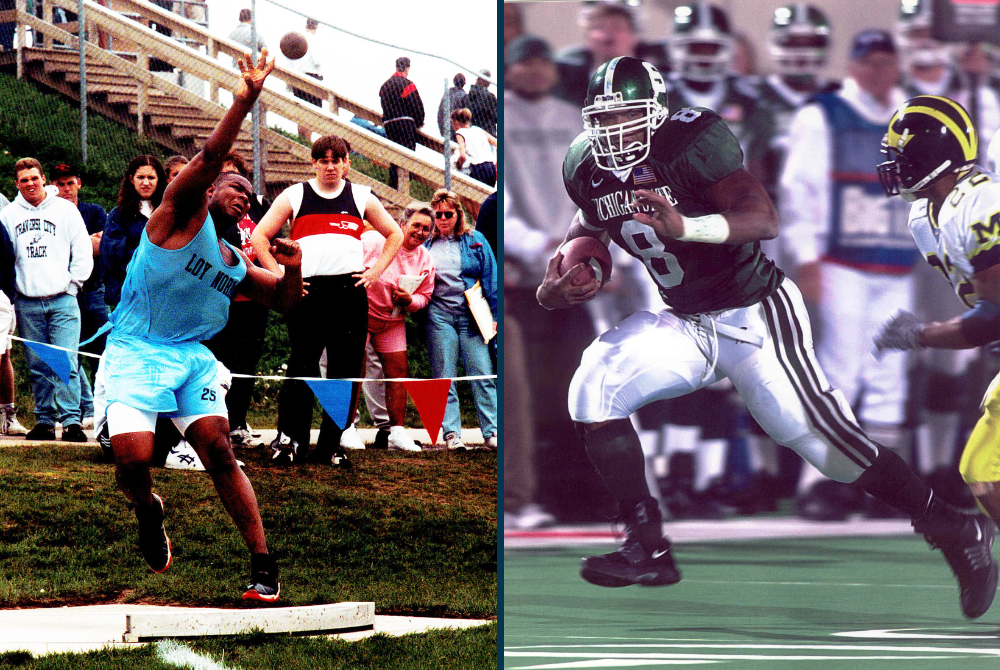
In 1997, Todd “T.J.” Duckett made history at the MHSAA Lower Peninsula Class A Finals by setting a meet shot put record with a throw of 63 feet, 6 inches. He surpassed his own milestone just two years later, launching the shot 64 feet, 0.5 inches at the 1999 Finals — an all-Finals (regardless of Class or Division) record that stood for 17 years until Oxford’s Connor Bandel delivered a remarkable toss of 67 feet, 5.75 inches in 2016.
Duckett's dominance in track & field was unmistakable. While competing for Kalamazoo Loy Norrix, he claimed four Class A Finals championships, including shot put titles in 1997, 1998, and 1999. He also was a member of the school’s victorious 400-meter relay team in 1997.
Though those accomplishments were impressive, Duckett was equally celebrated on the football field. Named Parade Magazine’s National Player of the Year as a senior, he drew national attention as a top recruit at both running back and linebacker. At Michigan State, Duckett left a lasting legacy, finishing his collegiate career with 3,379 rushing yards — sixth-most in program history, not far behind his older brother, Tico, who ranks third. T.J.'s 29 rushing touchdowns place him eighth on the Spartans' all-time list. One of his most iconic moments came in 2001, when he caught the game-winning touchdown pass as time expired in a thrilling 26–24 victory over rival Michigan.
Following his junior season, Duckett declared for the NFL Draft and was selected in the first round in 2002 by the Atlanta Falcons. He went on to enjoy a seven-year professional career, playing for four teams — Atlanta, Washington, Detroit, and Seattle — and finishing with 44 career touchdowns.
Previous "Flashback 100" Features
May 6: MHSAA Titles Just Start for NCAA Champion, Olympian Stark - Read
May 1: Legendary Actor Played Multiple Sports Roles at Country Day - Read
April 23: Legacy Program Provided Start for Pioneering NBA Official Schroeder - Read
April 11: Rice's Championship-Winning Ways Started at Flint Northwestern - Read
March 28: Youngquist's Times Still Among MHSAA's Fastest - Read
March 18: After 40 Years, Coles' Shot Remains Among Century's Most Famous - Read
March 7: Walled Lake Northern's Hellebuyck Reigns as NHL's Elite Netminder - Read
Feb. 27: Zeerip's Mat Stats Remain Rarely-Challenged Chart Toppers - Read
Feb. 21: Before TV Stardom, Kerwin Excelled as All-State Skier - Read
Feb. 14: Detroit Central Star Voted into Pro Football Hall of Fame - Read
Feb. 6: Multi-Sport Star Look Becomes Super Bowl Officiating Legend - Read
Jan. 31: Johnson Family Put Magical Stamp on Michigan High School Hoops - Read
Jan. 24: Future Hall of Famers Face Off First in MHSAA Class A Final - Read
Jan. 17: First-Ever WNBA Draft Pick Rocked at Salem, Won Titles at Tennessee - Read
Jan. 10: Despite Launching Before 3-Point Line, Smith Still Tops Scoring List - Read
Jan. 3: Edison's Jackson Earns Place Among State's All-Time Elite - Read
Dec. 20: Future Olympian Piper Leads Grosse Pointe North to Historic Heights - Read
Dec. 13: The Other Mr. Forsythe in Michigan School Sports - Read
Dec. 6: Coleman's Legendary Heroics Carry Harrison Through Repeat - Read
Nov. 29: Harbaugh Brothers' Football Roots Planted in Part at Pioneer - Read
Nov. 22: 8-Player Football Finals Right at Home at Superior Dome - Read
Nov. 15: Leland Career Helps Set Stage for Glass' International Stardom - Read
Nov. 8: Future Baseball Pro Led Escanaba's Legendary Football Title Run - Read
Nov. 1: Michigan High School Baseball Trio Provide World Series Voices - Read
Oct. 25: Before Leading Free World, Ford Starred for Champion GR South - Read
Oct. 18: Mercy Links Legend Becomes World Golf Hall of Famer - Read
Oct. 11: Fisher Races to Finals Stardom on Way to U.S. Olympic First - Read
Oct. 4: Lalas Leaves High School Legacies on Ice & Pitch - Read
Sept. 27: Tamer's History-Making Run Starts in Dexter, Continues to Paris - Read
Sept. 20: Todd Martin’s Road to Greatness Starts at East Lansing - Read
Sept. 13: James Earl Jones, Dickson High Hoops to Hollywood Legend - Read
Sept. 6: Pioneers' Unstoppable Streak Stretches 9 Seasons - Read
Aug. 30: Detroit dePorres Rushes to 1995 Class CC Football Championship - Read
(Football photo courtesy of Michigan State University.)