Thank Roosevelt for Football Weekends
December 20, 2013
By Rob Kaminski
MHSAA benchmarks editor
The next time you find yourself immersed in a tense crosstown football rivalry on a Friday night followed by a Saturday pilgrimage to the nearest college campus and a Sunday afternoon with a remote and your favorite snacks and beverages, take a moment to consider what the weekend would be like if it weren’t for Teddy Roosevelt.
The man who became our 26th President shortly after the turn of the 20th Century following the assassination of William McKinley in 1901 was a football fan like you. Maybe more so.
Today’s game of football has reached a critical crossroads. Player size and speed have increased across the board. Savage use of equipment as weapons rather than protective gear has been glorified on television networks and social media. Leaders of the game at all levels have recognized the need for change, employing new rules and widespread educational efforts to aid in preserving the sport.
History, as they say, is repeating itself.
In an ironic twist, it was Roosevelt who saved the then-brutally violent game of football from itself more than 100 years ago. Yes, the same “Rough and Ready Teddy” who led the charge up San Juan Hill during the Spanish-American War and often sparred in the boxing ring while in office from 1901-09 opined that football was becoming so gruesome that he delivered an ultimatum: clean up the game or it would be outlawed.
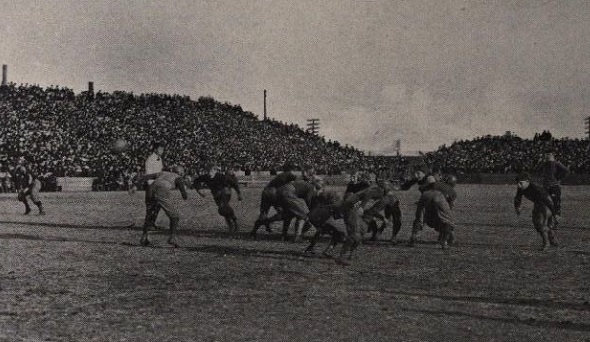
The Chicago Tribune reported that in 1904 alone, there were 18 football deaths and 159 serious injuries, mostly among prep school players. Football deaths suffered by younger players were reported on a nearly weekly basis, as outraged citizens called on colleges and high schools to banish football outright.
In stepped Roosevelt, who called head coaches and representatives from Harvard, Yale and Princeton – college powers at the time – to the White House in 1905 urging them to eliminate excessive violence and set an example of fair play for the rest of the country. When the casualties actually rose by one during the ensuing season, Roosevelt reacted with greater resolve and convened leading football authorities for the purpose of authoring drastic rules changes. What emerged was an intercollegiate conference which was the predecessor of the NCAA.
Among the most effective changes for the 1906 season were the legalization of the forward pass, the elimination of mass formations, and the creation of a neutral zone. Football fatalities fell to 11 in each of the next two seasons, and severe injuries fell drastically.
Thanks to the introduction of protective equipment and ever-evolving rules changes, football during the 100-plus years to follow has become an exponentially safer game. Yet, the game’s leaders always will need to adjust and react to scrutiny that comes with the territory.
So, as the game once again undergoes rules modifications in the name of safety, give a tip of the cap to President Roosevelt while you enjoy college bowl season and the NFL playoffs and begin to think ahead to the first high school practice of 2014.
Officials Sharpen Skills at MHSAA Clinic
June 28, 2012
By Geoff Kimmerly
Second Half Editor
ALMA --Frequently in pairs, they lined up beside linebackers, ran the sidelines and monitored the goallines earlier this week, next to many of Michigan's best recently-graduated high school football players.
The athletes were practicing for Saturday's Michigan High School Football Coaches Association All-Star Game at Alma College. But beside and all around them, officials also worked to hone their skills with the upcoming season only two months away.
A group of 34 attended the MHSAA's summer clinic Monday and Tuesday, run in coordination with the all-star game for the second year. Some were veterans brushing up on new rules, while others -- like Flushing's Tim Collick -- were newer officials hoping to pick up some knowledge from 12 clinicians providing instruction and feedback.
"The biggest thing is just the different tips from experienced guys you don't find in the books," said Collick, 32, who was one of 14 chosen from clinic participants to officiate Saturday's game. "Different, helpful clues like keys that made them successful, made things easier for them."
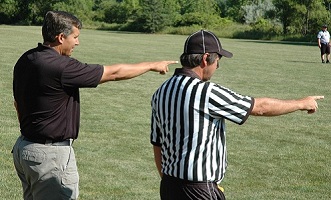 Instructors shadowed Collick and other participants during two practices and a Monday night scrimmage, providing guidance and feedback along the way.
Those practice sessions are combined with classroom instruction, similar to what the MHSAA has conducted during previous summers with basketball officials at Michigan State University camps.
Every participant this week came from the Lower Peninsula, but as far north as just below Mackinac Bridge, east from Detroit and west from the Grand Rapids area.
Two crews of seven officials were chosen from the camp participants to work Saturday’s game. The crews will alternate quarters, with five instructors also on hand to provide feedback.
The MHSFCA has been putting on the All-Star Game for 32 years, and has been a fantastic partner in providing an opportunity football officials don't often receive during the offseason, MHSAA assistant director Mark Uyl said.
"Football is unique in that there isn't a way to get live reps, while basketball, baseball and softball have summer team camps," Uyl said. "This is an opportunity for football officials to get training in the real thing."
Collick, a Flint Hamady grad who has been mentored by longtime Flint-area official Tom Rau, is heading into his third season of football as a back judge with a crew from the Genesee County Coaches and Officials Association. Although he'd heard a few of the speakers at the clinic before, he didn't know any of the officials before Monday. But he was sure to soak up as much as possible, with an eye on officiating for years to come and eventually, perhaps, at the college level as well.
"For me, one of the biggest things (at the clinic) is getting to make contacts with much more veteran officials. I'm learning from those guys," Collick said. "The instructors have worked at high levels as college officials, as high school officials for many years. It's nice to pick their brains."
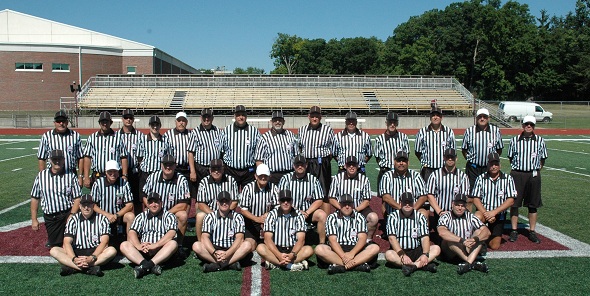
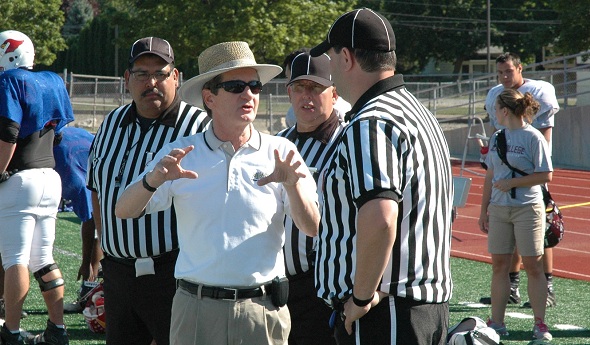
PHOTOS: (Top) Longtime official and recently-retired MHSAA assistant director Tom Minter (center) works with an official during Tuesday morning's East practice at Alma College. (Middle) MHSAA assistant director Mark Uyl (left) points something out to an official during the West practice. (Bottom) Officals at this year's clinic came from all parts of the Lower Peninsula, including the Detroit, Grand Rapids and Mackinaw areas.