

Thank Roosevelt for Football Weekends
December 20, 2013
By Rob Kaminski
MHSAA benchmarks editor
The next time you find yourself immersed in a tense crosstown football rivalry on a Friday night followed by a Saturday pilgrimage to the nearest college campus and a Sunday afternoon with a remote and your favorite snacks and beverages, take a moment to consider what the weekend would be like if it weren’t for Teddy Roosevelt.
The man who became our 26th President shortly after the turn of the 20th Century following the assassination of William McKinley in 1901 was a football fan like you. Maybe more so.
Today’s game of football has reached a critical crossroads. Player size and speed have increased across the board. Savage use of equipment as weapons rather than protective gear has been glorified on television networks and social media. Leaders of the game at all levels have recognized the need for change, employing new rules and widespread educational efforts to aid in preserving the sport.
History, as they say, is repeating itself.
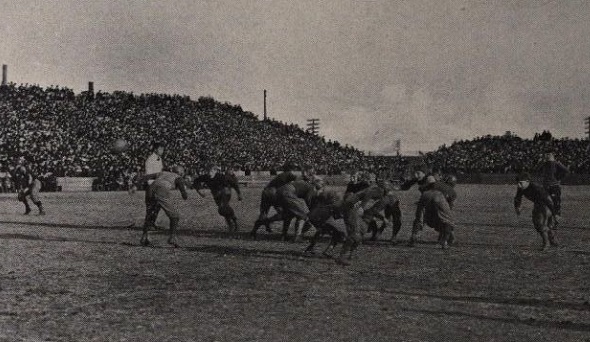
In an ironic twist, it was Roosevelt who saved the then-brutally violent game of football from itself more than 100 years ago. Yes, the same “Rough and Ready Teddy” who led the charge up San Juan Hill during the Spanish-American War and often sparred in the boxing ring while in office from 1901-09 opined that football was becoming so gruesome that he delivered an ultimatum: clean up the game or it would be outlawed.
The Chicago Tribune reported that in 1904 alone, there were 18 football deaths and 159 serious injuries, mostly among prep school players. Football deaths suffered by younger players were reported on a nearly weekly basis, as outraged citizens called on colleges and high schools to banish football outright.
In stepped Roosevelt, who called head coaches and representatives from Harvard, Yale and Princeton – college powers at the time – to the White House in 1905 urging them to eliminate excessive violence and set an example of fair play for the rest of the country. When the casualties actually rose by one during the ensuing season, Roosevelt reacted with greater resolve and convened leading football authorities for the purpose of authoring drastic rules changes. What emerged was an intercollegiate conference which was the predecessor of the NCAA.
Among the most effective changes for the 1906 season were the legalization of the forward pass, the elimination of mass formations, and the creation of a neutral zone. Football fatalities fell to 11 in each of the next two seasons, and severe injuries fell drastically.
Thanks to the introduction of protective equipment and ever-evolving rules changes, football during the 100-plus years to follow has become an exponentially safer game. Yet, the game’s leaders always will need to adjust and react to scrutiny that comes with the territory.
So, as the game once again undergoes rules modifications in the name of safety, give a tip of the cap to President Roosevelt while you enjoy college bowl season and the NFL playoffs and begin to think ahead to the first high school practice of 2014.
Century of School Sports: Finals Provide Future Pros Early Ford Field Glory
By
Geoff Kimmerly
MHSAA.com senior editor
November 26, 2024
For hundreds of Michigan high school athletes, this weekend’s 11-Player Football Finals will provide their first and only opportunity to play any sport where the pros play – in this case, Detroit’s Ford Field.
But for a handful, it could instead be the first of several games to come on the Lions’ home turf.
According to data at Pro-Football-Reference.com, Michigan high schools have produced 791 players from 303 schools who have gone on to play in the NFL. They’ve come from all over, predictably from larger population areas like Detroit but also from several now-closed schools like Stambaugh High School in the western Upper Peninsula, which produced a pair of pros during the 1930s before decades later consolidating with Iron River to become West Iron County.
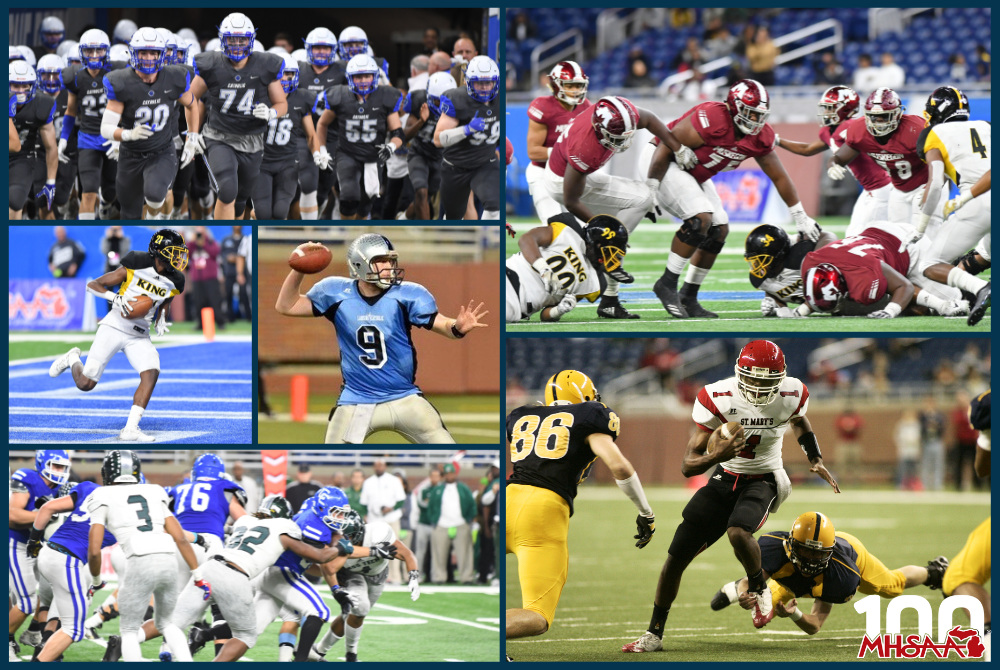
According to that data, 81 players from 61 schools are currently active in the NFL – topped by five from Detroit Cass Tech, including Jourdan Lewis (32) pictured above making a tackle against Detroit Cass Tech during the 2016 Division 1 championship game. Several more current players experienced Ford Field as a high schooler at the MHSAA Finals – perhaps most notably among them Ahmad “Sauce” Gardner, who caught a touchdown pass in Detroit Martin Luther King’s 41-25 win over Muskegon in the 2018 Division 3 championship game, went on to play at University of Cincinnati and has been an All-Pro after both of his first two seasons as a cornerback for the New York Jets.
(Coincidentally, in that win over the Big Reds, Gardner and King played against another future pro – Anthony Bradford, now a starting offensive lineman for the Seattle Seahawks.)
Gardner and Lewis are among those who have formed rich tradition as well of Detroit producing NFL talent. According to Bruce Feldman of The Athletic and FOX Sports, Detroit was tied for the fourth-most players on NFL opening-day rosters this season with 14 – trailing only Miami, Fla.; Las Vegas, Bradenton, Fla; and tied with Atlanta, Ga. During the most recent NFL draft, Michigan high schools saw seven players drafted over the seven rounds, with River Rouge one of 22 high schools nationwide with multiple players selected – Ruke Orhorhoro (Atlanta Falcons, from Clemson) and Kamal Hadden (Kansas City Chiefs, from Tennessee).
Gardner was selected fourth overall in the 2022 NFL Draft, joining a collection of impressive past Michigan high school stars picked at or near the top of the board. Among recent others: 2008 No. 1 Jake Long (Lapeer West/Michigan/Miami Dolphins), 2022 No. 2 Aidan Hutchinson (Dearborn Divine Child/Michigan/Detroit Lions), 2003 No. 2 Charles Rogers (Saginaw/Michigan State/Detroit Lions), 2005 No. 3 Braylon Edwards (Harper Woods Bishop Gallagher/Michigan/Cleveland Browns), 1984 No. 3 Carl Banks (Flint Beecher/Michigan State/New York Giants) and 1991 No. 5 Todd Lyght (Flint Powers Catholic/Notre Dame/Los Angeles Rams).
From this group, Rogers also played in an MHSAA Final catching a 60-yard touchdown pass as Saginaw defeated Bloomfield Hills Brother Rice 14-7 in the 1999 Division 2 championship game at the Pontiac Silverdome.
Previous "Century of School Sports" Spotlights
Nov. 19: Connection at Heart of Coaches Advancement Program - Read
Nov. 12: Good Sports are Winners Then, Now & Always - Read
Nov. 5: MHSAA's Home Sweet Home - Read
Oct. 29: MHSAA Summits Draw Thousands to Promote Sportsmanship - Read
Oct. 23: Cross Country Finals Among MHSAA's Longest Running - Read
Oct. 15: State's Storytellers Share Fall Memories - Read
Oct. 8: Guided by 4 S's of Educational Athletics - Read
Oct. 1: Michigan Sends 10 to National Hall of Fame - Read
Sept. 25: MHSAA Record Books Filled with 1000s of Achievements - Read
Sept. 18: Why Does the MHSAA Have These Rules? - Read
Sept. 10: Special Medals, Patches to Commemorate Special Year - Read
Sept. 4: Fall to Finish with 50th Football Championships - Read
Aug. 28: Let the Celebration Begin - Read
PHOTOS Clockwise from top left: (1) Jalen Mayfield (74) exits the Ford Field tunnel with Grand Rapids Catholic Central in 2017. (2) Muskegon's Anthony Bradford (75) makes a block during the 2018 Division 3 Final. (3) Orchard Lake St. Mary's Allen Robinson eludes an East Grand Rapids defender in 2009. (4) Detroit Cass Tech's Jourdan Lewis (32) makes a tackle in 2016. (5) Detroit Martin Luther King's Ahmad Gardner catches a touchdown pass against Muskegon in 2018. (6) Lansing Catholic's Cooper Rush throws a pass during the 2011 Division 5 Final. All were on NFL rosters at the starting of training camp this summer.