

Thank Roosevelt for Football Weekends
December 20, 2013
By Rob Kaminski
MHSAA benchmarks editor
The next time you find yourself immersed in a tense crosstown football rivalry on a Friday night followed by a Saturday pilgrimage to the nearest college campus and a Sunday afternoon with a remote and your favorite snacks and beverages, take a moment to consider what the weekend would be like if it weren’t for Teddy Roosevelt.
The man who became our 26th President shortly after the turn of the 20th Century following the assassination of William McKinley in 1901 was a football fan like you. Maybe more so.
Today’s game of football has reached a critical crossroads. Player size and speed have increased across the board. Savage use of equipment as weapons rather than protective gear has been glorified on television networks and social media. Leaders of the game at all levels have recognized the need for change, employing new rules and widespread educational efforts to aid in preserving the sport.
History, as they say, is repeating itself.
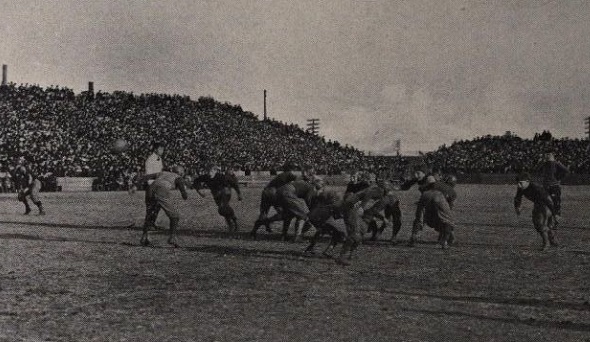
In an ironic twist, it was Roosevelt who saved the then-brutally violent game of football from itself more than 100 years ago. Yes, the same “Rough and Ready Teddy” who led the charge up San Juan Hill during the Spanish-American War and often sparred in the boxing ring while in office from 1901-09 opined that football was becoming so gruesome that he delivered an ultimatum: clean up the game or it would be outlawed.
The Chicago Tribune reported that in 1904 alone, there were 18 football deaths and 159 serious injuries, mostly among prep school players. Football deaths suffered by younger players were reported on a nearly weekly basis, as outraged citizens called on colleges and high schools to banish football outright.
In stepped Roosevelt, who called head coaches and representatives from Harvard, Yale and Princeton – college powers at the time – to the White House in 1905 urging them to eliminate excessive violence and set an example of fair play for the rest of the country. When the casualties actually rose by one during the ensuing season, Roosevelt reacted with greater resolve and convened leading football authorities for the purpose of authoring drastic rules changes. What emerged was an intercollegiate conference which was the predecessor of the NCAA.
Among the most effective changes for the 1906 season were the legalization of the forward pass, the elimination of mass formations, and the creation of a neutral zone. Football fatalities fell to 11 in each of the next two seasons, and severe injuries fell drastically.
Thanks to the introduction of protective equipment and ever-evolving rules changes, football during the 100-plus years to follow has become an exponentially safer game. Yet, the game’s leaders always will need to adjust and react to scrutiny that comes with the territory.
So, as the game once again undergoes rules modifications in the name of safety, give a tip of the cap to President Roosevelt while you enjoy college bowl season and the NFL playoffs and begin to think ahead to the first high school practice of 2014.
In Memoriam: Vic Michaels (1954-2025)
By
Geoff Kimmerly
MHSAA.com senior editor
December 30, 2025
The hearts of the MHSAA and countless others in the school sports community are heavy after the unexpected death Monday of Catholic High School League director Vic Michaels, also a longtime and devoted member of the MHSAA’s Representative Council. He was 71.
Michaels was inducted into the CHSL Hall of Fame in 2024 as a “Legend” – a title carrying prestige that certainly described his contributions to school sports on a statewide level as well.
After a decorated 17-year career as a coach, teacher and administrator at Center Line St. Clement, Michaels joined the CHSL office as associate director in 1995, and then assumed the role as leader of the league in 2003 when then-director Tom Rashid left to become associate director at the MHSAA.
 Michaels also joined the Representative Council in 2003, representing non-public schools and serving as the Council’s secretary-treasurer. But his impact was much more far-reaching than titles could explain. As MHSAA executive director Mark Uyl told the Detroit Free Press in coverage of Michaels’ 2024 CHSL recognition, “I’m not sure there’s been anyone who’s been more important to the MHSAA over the last 40 years than Vic Michaels,” and called him one of the key builders of the MHSAA over its first 100 years as that milestone was celebrated in 2024-25.
Especially over the last decade, as numerous Council and MHSAA staff members have retired or move on from school sports, Michaels has supplied vital context and institutional knowledge especially as a long-serving member of the Executive Committee, which considers eligibility decision appeals and other issues that must be addressed on a frequent basis. He provided a calm voice of reason and advocacy, not only for students he represented from nonpublic schools but for athletes, coaches and administrators from all 1,500+ high schools and junior high/middle schools that make up the MHSAA membership. And serving as treasurer, he filled another crucial role in making sure the MHSAA stood on solid ground financially even amid the challenge of COVID-19 and while expanding its numbers of sponsored tournament sports and students served.
Michaels attended Detroit St. Phillip High School, and after St. Phillip closed, was part of the final graduating class at Detroit St. Ambrose in 1972. He attended and played college basketball at Detroit Institute of Technology and earned his teaching certificate from University of Detroit Mercy.
He coached junior varsity at Dearborn St. Alphonsus and Redford St. Mary before beginning a tenure in 1978 at St. Clement where he taught, served as athletic director and assistant principal and won more than 300 games as the school’s boys and girls varsity basketball coach, earning statewide “Coach of the Year” awards leading both programs during the 1980s.
Michaels and his wife Linda were married 46 years, and he also is survived by his sons Marc and Brad, their wives and grandchildren.
As the CHSL noted in its memorial to Michaels, “Vic dedicated his life to Catholic education, interscholastic athletics, and the young people entrusted to his care. His leadership of the CHSL was marked by integrity, vision, humility, and an unwavering belief that athletics are an extension of the classroom — meant to form the whole person in faith, character, discipline, and service. … His decisions were thoughtful, his counsel wise, and his love for the educational athletics unmistakable.”
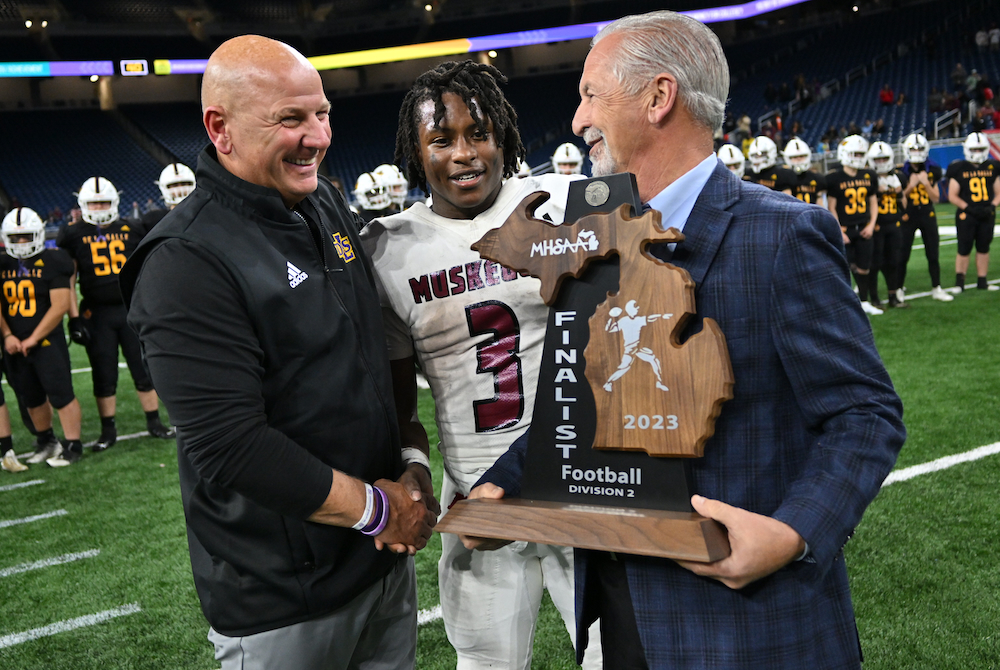
PHOTO MHSAA Representative Council member Vic Michaels, far right, with the assistance of MHSAA Student Advisory Council member M'Khi Guy from Muskegon, presents Warren De La Salle Collegiate coach Dan Rohn the finalist trophy after the 2023 11-Player Football Final at Ford Field. (Photo by Hockey Weekly Action Photos.)