

Thank Roosevelt for Football Weekends
December 20, 2013
By Rob Kaminski
MHSAA benchmarks editor
The next time you find yourself immersed in a tense crosstown football rivalry on a Friday night followed by a Saturday pilgrimage to the nearest college campus and a Sunday afternoon with a remote and your favorite snacks and beverages, take a moment to consider what the weekend would be like if it weren’t for Teddy Roosevelt.
The man who became our 26th President shortly after the turn of the 20th Century following the assassination of William McKinley in 1901 was a football fan like you. Maybe more so.
Today’s game of football has reached a critical crossroads. Player size and speed have increased across the board. Savage use of equipment as weapons rather than protective gear has been glorified on television networks and social media. Leaders of the game at all levels have recognized the need for change, employing new rules and widespread educational efforts to aid in preserving the sport.
History, as they say, is repeating itself.
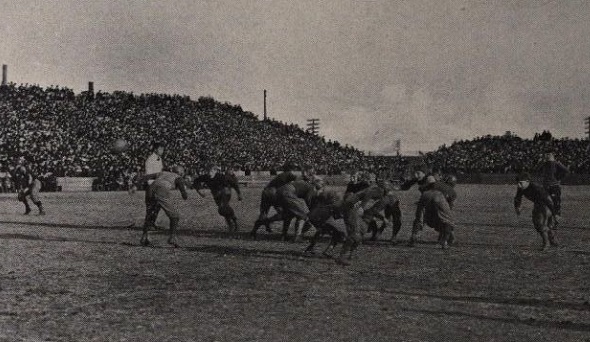
In an ironic twist, it was Roosevelt who saved the then-brutally violent game of football from itself more than 100 years ago. Yes, the same “Rough and Ready Teddy” who led the charge up San Juan Hill during the Spanish-American War and often sparred in the boxing ring while in office from 1901-09 opined that football was becoming so gruesome that he delivered an ultimatum: clean up the game or it would be outlawed.
The Chicago Tribune reported that in 1904 alone, there were 18 football deaths and 159 serious injuries, mostly among prep school players. Football deaths suffered by younger players were reported on a nearly weekly basis, as outraged citizens called on colleges and high schools to banish football outright.
In stepped Roosevelt, who called head coaches and representatives from Harvard, Yale and Princeton – college powers at the time – to the White House in 1905 urging them to eliminate excessive violence and set an example of fair play for the rest of the country. When the casualties actually rose by one during the ensuing season, Roosevelt reacted with greater resolve and convened leading football authorities for the purpose of authoring drastic rules changes. What emerged was an intercollegiate conference which was the predecessor of the NCAA.
Among the most effective changes for the 1906 season were the legalization of the forward pass, the elimination of mass formations, and the creation of a neutral zone. Football fatalities fell to 11 in each of the next two seasons, and severe injuries fell drastically.
Thanks to the introduction of protective equipment and ever-evolving rules changes, football during the 100-plus years to follow has become an exponentially safer game. Yet, the game’s leaders always will need to adjust and react to scrutiny that comes with the territory.
So, as the game once again undergoes rules modifications in the name of safety, give a tip of the cap to President Roosevelt while you enjoy college bowl season and the NFL playoffs and begin to think ahead to the first high school practice of 2014.
Father & Son Set to Meet for 1st Time Coaching from Opposing Benches
By
Doug Donnelly
Special for MHSAA.com
December 10, 2025
The bantering back and forth is almost complete.
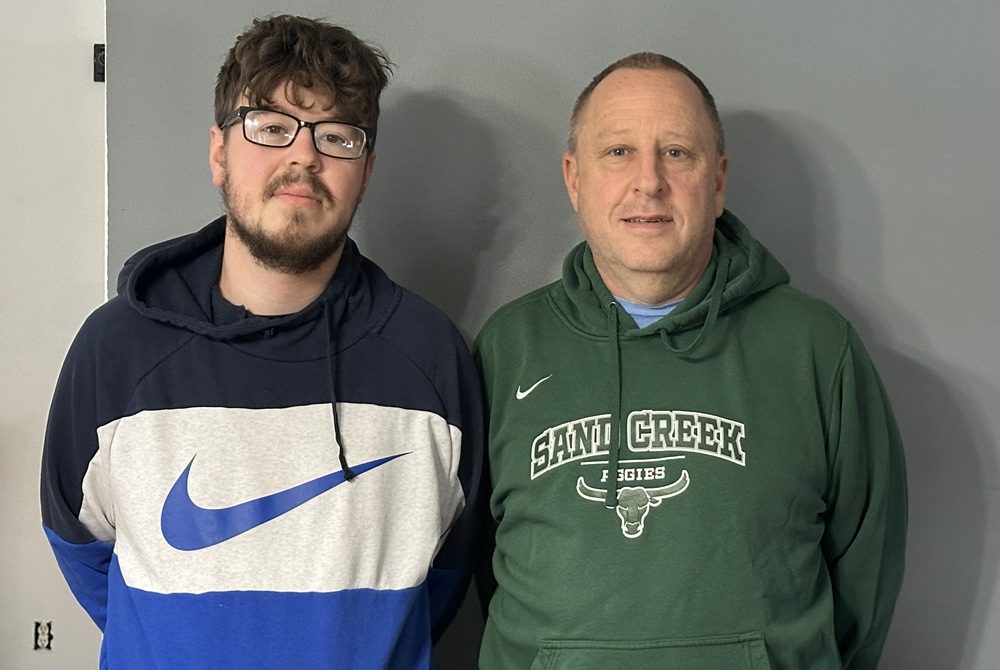
 On Thursday, Mike and Zachary Zyla will finally coach against each other in a varsity girls basketball game.
It’s a game that both coaches circled months ago when Zachary, 26, got his first head coaching job at Britton Deerfield.
“It’s going to be intense,” Zachary said. “I’m sure he will want to win just as badly as I will. Me and our girls have been talking about the game a lot because it’s a game we think we can win. We want to beat Sand Creek.”
Mike Zyla coaches Sand Creek and is Zachary’s dad. He is a longtime coach in cross country and track and added varsity basketball to his resume three years ago. Zachary, who played at Sand Creek, was hired this past offseason to coach the Patriots.
Both schools are in the Tri-County Conference.
“It’s going to be fun,” Mike said. “We’ve been going back and forth about it for a couple of weeks. We’ll see how it goes.”
Basketball is special in the Zyla household.
Zachary’s other brother, Ryan, coaches at a junior college in Minnesota. His sister, Chelsi, played two years of college basketball after graduating from Sand Creek. Their mom, Kirsten, keeps the scorebook for Mike’s games. She is a special education teacher at Britton Deerfield.
“When basketball season rolls around, that’s all we talk about,” Zachary said.
“I guess it’s a little bit in the bloodlines,” Mike said.
After graduating from Sand Creek in 2018, Zachary served in the Navy. He returned home two years ago and served two seasons as his dad’s assistant.
“I just love the game of basketball,” he said. “I’ve been playing since I was probably 2 years old. It’s the thing I’m passionate about. I watch almost every night. If it’s not a live basketball game, I watch clips of old games. I’m just a junkie for basketball.”
Mike said he misses having his son on his bench.
“I miss having him on staff,” Mike said. “He’s really sharp, picking stuff up on the fly. It was nice having him on the sidelines with me. It’s a good opportunity for him, though.”
Please welcome BD’s new varsity girls basketball coach Zach Zyla! Zach comes to BD from Sand Creek where his father Mike is the head girls coach. Zach assisted on the Aggie varsity girls team in the 2024/25 season and is a track assistant coach for the Aggies. Go Patriots! pic.twitter.com/6cpwUw6OW4
— BD Athletics (@athletics_bd) May 2, 2025
Zachary accepted the job in time to have a summer program with BD.
“I’ve always been a big fan of basketball,” he said. “It’s in my blood. I started coaching the Sand Creek hoopsters when I was 16 years old. I knew that’s what I wanted to do. I would say coaching at the varsity level was a goal of mine. It’s always been a dream of mine. I didn’t expect to get a head coaching job so soon. I’d like to get to the next level someday.”
He said he has a few new things for his team to run against his dad.
“He taught me a lot, but our coaching strategies are different,” Zachary said. “I think I’m going to have some things he hasn’t seen yet.”
Sand Creek and BD both lost their season openers Tuesday. Since BD’s game started at 4:30 p.m., Zachary was able to get to Sand Creek to see his dad’s game against Pittsford.
“He was able to scout us,” Mike said.
It’s all in good fun.
“We have a great relationship,” Zachary said. “We bounce ideas off each other all of the time. Even for our first game of the season, we were talking about what we should do, the offenses and defenses. We talk pretty much every day.”
As rare as it is for a father and son to coach against each other, it’s the second time it’s happened in Lenawee County in recent years. Hudson varsity boys basketball coach Jeff Webster coached against his son, Jamison Webster, when Hudson played Tecumseh two seasons ago.
Jamison said it was a great experience, one the Zylas will never forget.
“Coaching and competing against my dad’s teams at Hudson over the last few years has been a great experience,” he said. “We both want to win, being the competitors we are. That being said, the lifelong memories we have made being able to share a sport we both love is what makes it special.”
Zachary said he knows it will be a little different than normal.
“The game’s intensity will be higher than most nights,” he said.
Mike agreed. He doesn’t relish the idea of beating his son, but doesn’t plan on backing down. Since they are both in the TCC, they’ll face off again later this winter.
“We’re both pretty competitive,” he said. “Competitive genes are in the family. I don’t think either one of us will be very happy if we are on the losing side Thursday night.”
 Doug Donnelly has served as a news and sports reporter at the Adrian Daily Telegram and the Monroe News for 30 years, including 10 years as city editor in Monroe. He's written a book on high school basketball in Monroe County and compiles record books for various schools in southeast Michigan. He is now publisher and editor of The Blissfield Advance, a weekly newspaper. E-mail him at [email protected] with story ideas for Jackson, Washtenaw, Hillsdale, Lenawee and Monroe counties.
PHOTO Britton Deerfield varsity girls basketball coach Zachary Zyla poses for a photo with his father Mike Zyla, right, the varsity girls basketball coach at Sand Creek. (Photo provided by the Zyla family.)