

Thank Roosevelt for Football Weekends
December 20, 2013
By Rob Kaminski
MHSAA benchmarks editor
The next time you find yourself immersed in a tense crosstown football rivalry on a Friday night followed by a Saturday pilgrimage to the nearest college campus and a Sunday afternoon with a remote and your favorite snacks and beverages, take a moment to consider what the weekend would be like if it weren’t for Teddy Roosevelt.
The man who became our 26th President shortly after the turn of the 20th Century following the assassination of William McKinley in 1901 was a football fan like you. Maybe more so.
Today’s game of football has reached a critical crossroads. Player size and speed have increased across the board. Savage use of equipment as weapons rather than protective gear has been glorified on television networks and social media. Leaders of the game at all levels have recognized the need for change, employing new rules and widespread educational efforts to aid in preserving the sport.
History, as they say, is repeating itself.
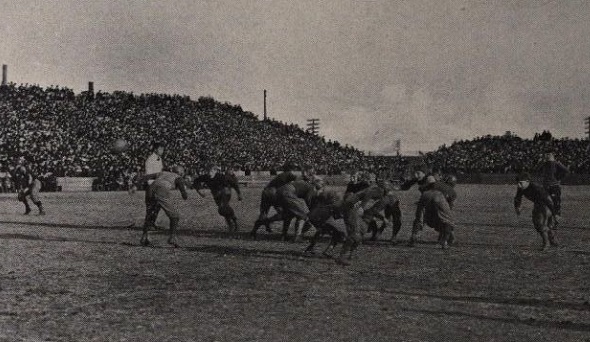
In an ironic twist, it was Roosevelt who saved the then-brutally violent game of football from itself more than 100 years ago. Yes, the same “Rough and Ready Teddy” who led the charge up San Juan Hill during the Spanish-American War and often sparred in the boxing ring while in office from 1901-09 opined that football was becoming so gruesome that he delivered an ultimatum: clean up the game or it would be outlawed.
The Chicago Tribune reported that in 1904 alone, there were 18 football deaths and 159 serious injuries, mostly among prep school players. Football deaths suffered by younger players were reported on a nearly weekly basis, as outraged citizens called on colleges and high schools to banish football outright.
In stepped Roosevelt, who called head coaches and representatives from Harvard, Yale and Princeton – college powers at the time – to the White House in 1905 urging them to eliminate excessive violence and set an example of fair play for the rest of the country. When the casualties actually rose by one during the ensuing season, Roosevelt reacted with greater resolve and convened leading football authorities for the purpose of authoring drastic rules changes. What emerged was an intercollegiate conference which was the predecessor of the NCAA.
Among the most effective changes for the 1906 season were the legalization of the forward pass, the elimination of mass formations, and the creation of a neutral zone. Football fatalities fell to 11 in each of the next two seasons, and severe injuries fell drastically.
Thanks to the introduction of protective equipment and ever-evolving rules changes, football during the 100-plus years to follow has become an exponentially safer game. Yet, the game’s leaders always will need to adjust and react to scrutiny that comes with the territory.
So, as the game once again undergoes rules modifications in the name of safety, give a tip of the cap to President Roosevelt while you enjoy college bowl season and the NFL playoffs and begin to think ahead to the first high school practice of 2014.
1st & Goal: 2021 11-Player Finals Preview
By
Geoff Kimmerly
MHSAA.com senior editor
November 24, 2021
We have a lot to be thankful for this fall, including the opportunities that have been provided for our high school athletes in every sport with 2020 still a not-so-distant memory.
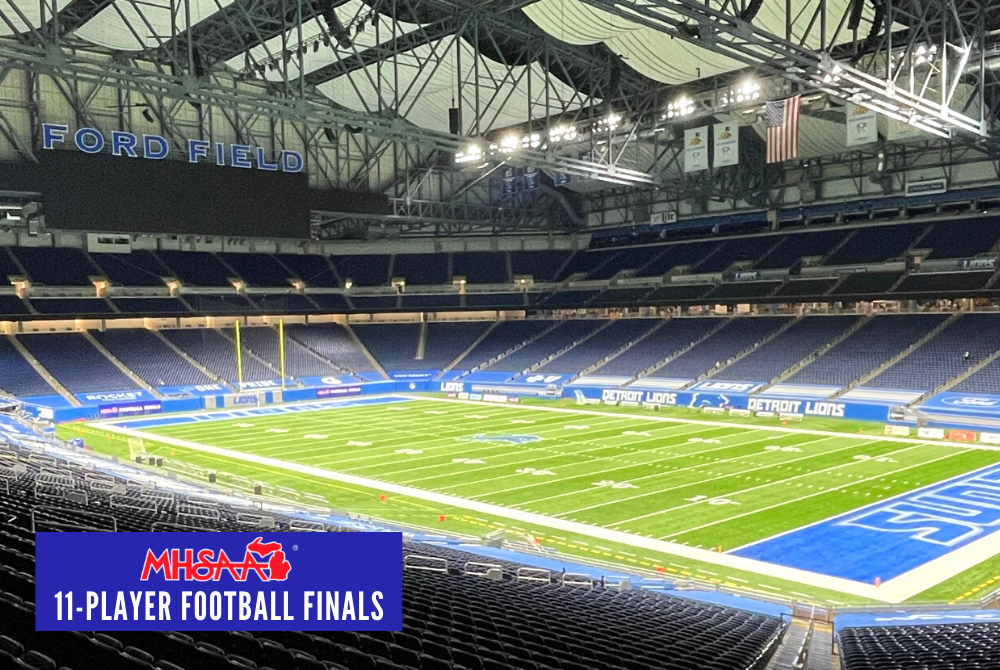
 On the football field, we surely are grateful for the opportunity to play a "normal" season. And we're most certainly thankful to again be celebrating another championship conclusion with our traditional 11-Player Finals weekend at Ford Field.
Here's the schedule for Friday and Saturday's games:
FRIDAY
Division 8 – 10 a.m. – Beal City (12-1) vs. Hudson (13-0)
Division 2 – 1 p.m. – Traverse City Central (12-1) vs. Warren De La Salle Collegiate (12-0)
Division 6 – 4:30 p.m. – Warren Michigan Collegiate (11-2) vs. Lansing Catholic (12-1)
Division 4 – 7:30 p.m. – Hudsonville Unity Christian (13-0) vs. Chelsea (13-0)
SATURDAY
Division 7 – 10 a.m. – Lawton (13-0) vs. Pewamo-Westphalia (13-0)
Division 1 – 1 p.m. – Belleville (12-1) vs. Rochester Adams (13-0)
Division 5 – 4:30 p.m. – Marine City (13-0) vs. Grand Rapids Catholic Central (13-0)
Division 3 – 7:30 p.m. – DeWitt (12-1) vs. Detroit Martin Luther King (12-1)
All games will be broadcast live on either the Bally Sports Detroit primary or PLUS channels – click for the schedule and check local listings to find the channels for your cable service. All eight also will be available on the Bally Sports app and streamed on the Bally Sports Detroit website. Additionally, all eight championship games will be available for listening from the MHSAA Network at MHSAANetwork.com.
Rankings below are derived from where teams finished the regular season in their divisions based on playoff point average. Statistics are through Regional Finals unless noted.
Division 1
 ROCHESTER ADAMS
Record/rank: 13-0, No. 5
Coach: Tony Patritto, 19th season (149-58)
League finish: First in Oakland Activities Association White
Championship history: Division 2 champion 2003.
Best wins: 40-20 over No. 4 Grand Blanc in Semifinal, 14-13 (Regional Final) and 35-17 over No. 7 West Bloomfield, 42-20 over Lapeer in District Semifinal.
Players to watch: QB/S Parker Picot, 6-2/185, jr. (1,316 yards/19 TDs rushing, 502 yards/7 TDs passing – includes Semifinal); RB/LB Griffin Henke, 5-10/185, sr. (863 yards, 15 TDs rushing); SL/LB Marco Discresce, 5-11/175, sr.; OL/DE Alex DeGrieck, 6-5/240, sr.
Outlook: Adams quickly made last season’s 3-5 finish a distant memory with a 35-17 win over reigning Division 1 champion West Bloomfield on opening night. The Highlanders have gone on to set a program record for wins while also defeating the Lakers a second time in the Regional Final and last week handing Grand Blanc its lone loss of the season. DeGrieck is a menace up front on defense, and that group allows only 12.1 points per game and hasn’t given up more than 21. Picot earned an all-state honorable mention last season and directs an attack that averaged 32 points per game during the regular season but has gone over 40 in three of four playoff wins.
BELLEVILLE
Record/rank: 12-1, No. 6
Coach: Jermain Crowell, seventh season (71-10)
League finish: First in Kensington Lakes Activities Association West
Championship history: Has never played in an MHSAA Final.
Best wins: 40-26 over No. T-10. Sterling Heights Stevenson in Semifinal, 12-7 (Regional Final) and 21-19 over No. 12 Dearborn Fordson, 14-10 over No. T-10. Ann Arbor Huron in District Semifinal, 46-9 over Hartland, 53-29 over Livonia Franklin.
Players to watch: DB/WR Jeremiah Caldwell, 6-3/175, sr.; QB Bryce Underwood, 6-2/180, fr.; RB/LB Aaron Alexander, 6-1/205, sr.; DB/WR Deshaun Lee, 5-11/175, sr. (Statistics not provided.)
Outlook: Belleville has broken through to reach championship weekend for the first time after playing in four straight Semifinals – and losing its previous two by a combined four points. The offense gets a lot of attention – and for good reason – but Belleville’s defense has given up only 11.5 points per game and is led in part by Alexander, who has committed to sign with Michigan. That offense does average nearly 42 points per game, with Underwood becoming an immediate star. Caldwell is a top target, and Underwood has found Lee for three touchdowns over the last two weeks. Junior Jeremiah Wilson (6-3/265) starts up front on both sides of the ball. Caldwell, Lee and senior offensive lineman Ja'Kobie Watkins (6-2/190) earned all-state honorable mentions last season.
Division 2
 WARREN DE LA SALLE COLLEGIATE
Record/rank: 12-0, No. 1
Coach: Dan Rohn, second season (20-5)
League finish: First in Detroit Catholic League Central
Championship history: Three MHSAA titles (most recent 2018), three runner-up finishes.
Best wins: 45-14 over Roseville in Regional Final, 47-26 over Division 3 No. 9 Harper Woods, 17-7 over Division 1 No. 9 Detroit Catholic Central, 21-16 over Division 3 No. 8 Bloomfield Hills Brother Rice, 38-29 over Division 3 No. 14 River Rouge.
Players to watch: QB Brady Drogosh, 6-4/205, jr. (1,285 yards/10 TDs passing, 1,440 yards/21 TDs rushing); WR Jack Yanachik, 6-2/180, jr. (426 yards/4 TDs receiving); RB Rhett Roeser, 5-11/210, soph. (774 yards/8 TDs rushing); LB Will Beesley, 6-1/215, sr.
Outlook: The Pilots are returning to the Finals for the second-straight season and fourth in five years, having most recently won back-to-back Division 2 titles in 2017 and 2018. Drogosh also directed the offense during last season’s run, and he has continued his rise as a playmaker – he threw for two more touchdowns and ran for two during the Semifinal win. Roeser also ran for a pair of scores in the Semifinal, and as a team the Pilots are averaging 43 points per game during the playoffs – up nearly a touchdown from the regular season. De La Salle’s defensive points-allowed average also has fallen five points during the playoffs to 12 points per game over the last month. Rohn led Grand Rapids West Catholic to Division 5 championships in 2010, 2013, 2014 and 2015.
TRAVERSE CITY CENTRAL
Record/rank: 12-1, No. 4
Coach: Eric Schugars, seventh season (62-15)
League finish: First in Big North Conference
Championship history: Three MHSAA titles (most recent 1988), one runner-up finish.
Best wins: 56-20 over No. 2 South Lyon in Semifinal, 42-14 over No. 3 Caledonia in Regional Final, 56-13 over Division 3 No. 8 Bloomfield Hills Brother Rice, 42-14 over Traverse City West, 24-0 over Division 4 No. 11 Cadillac.
Players to watch: QB/LB Josh Burnham, 6-4/230, sr. (1,487 yards/28 TDs rushing, 956 yards/14 TDs passing – includes Semifinal); HB/LB Reed Seabase, 5-11/190, jr. (1,175 yards/12 TDs rushing); SB/DB Carson Bourdo, 6-0/180, sr. (381 yards/5 TDs rushing, 468 yards/8 TDs receiving); OL/DE Kadyn Warner, 6-4/245, sr.
Outlook: The last time Central played in an MHSAA Final, it was known as Traverse City High with the creation of Traverse City West (and resulting split in enrollment) still nearly a decade away. But the Trojans have bulled their way back into the final weekend, led by a battering ram in Burnham – who is committed to sign with Notre Dame. While he does most of the damage on offense, Seabase and Bourdo are among a host of others who have complemented him well as the team has put up nearly 49 points per game. Central allows only 13.5, even more impressive considering the playoff run that’s included wins over the Nos. 2 and 3-ranked teams hasn’t seen the Trojans allow more than 20 points in a game. The only defeat came opening weekend to Division 3 finalist DeWitt.
Division 3
 DETROIT MARTIN LUTHER KING
Record/rank: 12-1, No. 1
Coach: Tyrone Spencer, sixth season (65-14)
League finish: First in Detroit Public School League Division 1
Championship history: Four MHSAA titles (most recent 2018), three runner-up finishes.
Best wins: 46-7 over No. 15 Mason in Semifinal, 28-7 over No. 6 Allen Park in Regional Final, 33-12 over No. 14 River Rouge in District Final, 39-29 over Cincinnati Moeller, 21-15 and 41-34 over Detroit Cass Tech, 40-19 over Division 2 No. 16 Muskegon Mona Shores.
Players to watch: QB Dante Moore, 6-2/195, jr. (2,820 yards/40 TDs passing – includes Semifinal); WR Lynn Wyche-El Jr, 5-9/160, sr. (823 yards/11 TDs receiving); DB Jameel Croft Jr., 6-1/170, jr.; LB Blake Bailiff, 5-11/210, sr.
Outlook: After falling by three to eventual Division 3 runner-up River Rouge in a Regional Final last season, King is back at Ford Field for its third championship game in four years. The team’s lone loss was by two points Week 1 to Indiana power Carmel, which finished 9-2. Moore is a returning all-stater and has continued to pick apart defenses with rarely-seen precision, with Wyche-El the leading receiver after earning an all-state honorable mention as a junior and seniors Chansey Willis Jr. (444 yards/6 TDs) and Joseph Williams (369/7) among other top targets. The Crusaders’ defense doesn’t get the same attention, but deserves its share of praise – King is giving up 16.7 points per game for the season, but only 9.5 per game during the playoffs. Bailiff and Croft both earned all-state honorable mentions last season.
DEWITT
Record/rank: 12-1, No. 2
Coach: Rob Zimmerman, 23rd season (234-46)
League finish: First in Capital Area Activities Conference Blue
Championship history: Division 3 champion 2020, five runner-up finishes.
Best wins: 42-12 over No. 10 Cedar Springs in Regional Final, 50-26 over No. 4 Mount Pleasant in District Final, 50-14 over No. 11 Stevensville Lakeshore, 49-14 over Division 2 No. 10 East Lansing, 47-27 over Division 2 No. 4 Traverse City Central.
Players to watch: QB/DB Tyler Holtz, 5-10/190, sr. (2,732 yards/39 TDs passing, 839 yards/11 TDs rushing); WR/DB Nicholas Flegler, 6-0/190, sr. (708 yards/14 TDs rushing, 433 yards/4 TDs receiving); RB/DE/LB Bryce Debri, 5-11/190, sr. (981 yards/12 TDs); WR/DB Thomas McIntosh, 6-5/205, sr. (1,238 yards/21 TDs receiving). (All statistics include Semifinal.)
Outlook: The Panthers won their first championship to close last season’s Finals, and have not slowed down with this fall’s only loss to Division 5 semifinalist Portland in Week 2. DeWitt has scored at least 42 points in every other game and averages 47 points per, with Holtz throwing for 5,128 yards and 74 touchdowns over the last two seasons. In addition to those listed above, junior Bryce Kurncz is another prominent target – he’s caught 10 touchdown passes. Holtz, Flegler, Debri, McIntosh and Kurncz – and senior lineman Jaden Hall – also start for a defense giving up 15.4 points per game. Holtz will play next at Brown, McIntosh at Wisconsin and Flegler at Air Force. McIntosh and Holtz both made the all-state first team last season, and Holtz was named Division 3-4 Player of the Year.
Division 4
 CHELSEA
Record/rank: 13-0, No. 1
Coach: Josh Lucas, fourth season (46-6)
League finish: First in Southeastern Conference White
Championship history: Division 4 runner-up 2018, Division 3 runner-up 2015.
Best wins: 30-27 over No. 9 Freeland in Semifinal, 27-20 over Detroit Country Day in Regional Final, 49-12 over Milan in District Final, 24-14 over St. Joseph.
Players to watch: RB/FS Trenton Hill, 5-10/185, sr. (1,490 yards/30 TDs rushing); QB Lucas Dunn, 6-0/170, sr. (1,641 yards/20 TDs passing); WR Lucas Hanifan, 6-0/164, sr. (718 yards/7 TDs receiving); SS Carson Gray, 6-0/160, sr. (All statistics include Semifinal.)
Outlook: After reaching Semifinals the last two seasons as well, Chelsea will return to Ford Field coming off two straight wins decided in dramatic fashion – the Bulldogs defeated Country Day on a blocked field goal returned for a touchdown during the final minute, then stopped Freeland less than two yards short of the end zone late in the Semifinal victory. Those last two games were the only single-digit wins of the season – the Bulldogs are winning by an average score of 41-14. Hill made the all-state second team and Gray earned honorable mention a year ago, and they part of a group of 35 seniors total. Lucas previously served as head coach at Allegan for three seasons before taking over at Chelsea in 2018 and guiding that team to Ford Field as well.
HUDSONVILLE UNITY CHRISTIAN
Record/rank: 13-0, No. 2
Coach: Craig Tibbe, 19th season (114-84)
League finish: First in Ottawa-Kent Conference Blue
Championship history: Division 5 champion 2018.
Best wins: 58-8 over No. 3 Edwardsburg in Semifinal, 53-22 over No. 11 Cadillac in Regional Final, 79-21 (District Final) and 58-21 over No. 7 Grand Rapids Christian, 40-14 over Division 5 No. 3 Grand Rapids West Catholic.
Players to watch: QB/DB Cameron Chandler, 6-3/185, sr. (879 yards/25 TDs rushing, 13 TDs passing – includes Semifinal); RB/DE Abraham Rappuhn, 6-3/195, sr. (1,116 yards/12 TDs rushing – includes Semifinal); RB/LB Micah Bush, 5-9/195, sr. (708 yards/10 TDs rushing); RB/DB Drew Chandler, 6-3/185, sr. (1,333 yards/20 TDs rushing, 9 TDs receiving – includes Semifinal).
Outlook: Unity Christian has scored 751 points, and needs only 24 more – or just more than 40 percent of its average scoring output – to break the record of 774 set by Muskegon Orchard View in 1999. The Crusaders have put up more than 40 every game and more than 50 in 11 wins, piling up more than 4,900 yards on the ground with Cameron Chandler then adding well-timed passes as more than half his completions heading into the Semifinal had gone for scores. An offense like that gives the defense a lot of room to breathe, but it’s not necessarily been needed – the Crusaders give up only 12.7 points per game.
Division 5
 GRAND RAPIDS CATHOLIC CENTRAL
Record/rank: 13-0, No. 1
Coach: Todd Kolster, 10th season (113-12)
League finish: First in O-K Gold
Championship history: Six MHSAA titles (most recent 2020), two runner-up finishes.
Best wins: 35-0 over No. 4 Frankenmuth in Semifinal, 25-6 over No. 12 Muskegon Oakridge in Regional Final, 44-6 over No. 3 Grand Rapids West Catholic in District Final, 41-40 over Division 3 No. 10 Cedar Springs, 43-21 over Lapeer.
Players to watch: QB/DB John Passinault, 6-0/180, sr. (2,086 yards/35 TDs passing, 9 TDs rushing); WR/DB Nolan Ziegler, 6-4/210, sr. (1,212 yards/23 TDs receiving, 86 tackles/7 sacks); WR/LB Ronin Russell-Dixon, 5-7/180, sr. (767 yards/7 TDs receiving); TE/DE Brady Redmer, 6-0/185, sr. (61 tackles).
Outlook: The Cougars are playing for a second-straight Division 5 championship, and fifth Finals win in six seasons after previously competing in Division 4. Last season’s quarterback star Joey Silveri was injured early this fall, but Passinault stepped in and has been outstanding as well, with Notre Dame-bound Ziegler again a major target. Ziegler made the all-state first team last season, and Redmer earned an honorable mention. After the Cedar Springs win in Week 8, GRCC hasn’t given up more than seven points in a game – and the Cougars have allowed only 12 over four playoff games, taking their season average down to 9.3 allowed per game.
MARINE CITY
Record/rank: 13-0, No. 2
Coach: Daryn Letson, second season (21-2)
League finish: First in Macomb Area Conference Silver
Championship history: Division 4 champions 2013 and 2007, runner-up 2011.
Best wins: 27-7 over No. 6 Portland in Semifinal, 43-12 over Division 4 No. 10 St. Clair, 21-10 over Pontiac Notre Dame Prep, 41-12 over Warren Fitzgerald.
Players to watch: QB Jeffery Heaslip, 5-11/190, jr. (1,435 yards/16 TDs passing, 519 yards/10 TDs rushing); RB/DB Zachary Tetler, 5-9/165, jr. (1,359 yards, 27 TDs rushing); FB/QB/SS Charles Tigert, 5-8/185, sr. (994 yards/9 TDs rushing, 58 tackles/12 sacks on defense); LB Wyatt Walker, 5-10/170, sr. (94 tackles)
Outlook: Marine City’s first trip to the Finals since winning Division 4 in 2013 has showcased a defense giving up only 9.1 points per game. In addition to Walker and Tigert, senior linebacker Jacob Hincherick (90 tackles) and senior safety Ty Nelson (58 tackles/7 interceptions) are among standouts. The Mariners have had to navigate only one single-digit win – over Corunna in the Regional Final – and Heaslip leads a steady offense averaging nearly 44 points per game with only three scoring less than 40.
Division 6
 LANSING CATHOLIC
Record/rank: 12-1, No. 1
Coach: Jim Baker, first season (12-1)
League finish: First in CAAC White
Championship history: Two MHSAA titles (most recent 2019), two runner-up finishes.
Best wins: 18-7 over No. 8 Standish-Sterling in Semifinal, 31-13 over No. 10 Montague in Regional final, 28-8 over No. 5 Millington in District Final, 31-29 over Division 5 No. 6 Portland
Players to watch: WR/S Alex Watters, 6-0/160, sr. (1,063 yards/14 TDs receiving, 8 TDs rushing); QB Joey Baker, 6-1/165, sr. (2,628 yards/27 TDs passing – includes Semifinal); WR/CB Brandon Lewis, 5-11/170, jr. (814 yards/11 TDs receiving, 411 yards/13 TDs rushing); DL/OL Bo Poljan, 6-3/235, sr.
Outlook: The Cougars are seeking to win a second championship in three years after claiming the Division 5 title in 2019 and reaching the Semifinals last season. Their only loss was to a team still playing – 12-7 to Division 7 finalist Pewamo-Westphalia in Week 9. Despite the defeat, that game started a run of five during which Lansing Catholic has given up only 9.2 points per game – cutting down their season points allowed average to 14 per. Watters starred on the 2019 team as well, and Poljan and offensive guard Jonah Richards also were key contributors during that run as sophomores. Watters and Poljan both made the all-state first team last season. Jim Baker took over the program this season after 27 years serving as a varsity assistant and later junior varsity head coach.
WARREN MICHIGAN COLLEGIATE
Record/rank: 11-2, No. 4
Coach: John Guth, eighth season (72-18)
League finish: First in Charter School Conference East
Championship history: Has never played in an MHSAA Final.
Best wins: 36-29 over Michigan Center in Semifinal, 38-16 over Ecorse in Regional Final, 46-13 over Port Huron, 22-0 over Romulus Summit Academy North.
Players to watch: QB/DB Deion Black, 6-4/186, sr. (944 yards/14 TDs passing, 1,222 yards/16 TDs rushing, 9 interceptions); RB/LB Deshaun Parkman, 5-11/210, sr. (727 yads/10 TDs rushing); RB/LB Teshawn Thomas, 5-10/205, jr. (685 yards/8 TDs rushing); WR/DB Tre’von Redding, 5-11/155, sr. (681 yards/10 TDs receiving, 4 TDs rushing, 11 interceptions.) (All statistics include Semifinal.)
Outlook: Michigan Collegiate has earned its first trip to the Finals, building on a 13th-straight playoff berth and third Semifinal appearance. Black earned an all-state honorable mention at quarterback last season and is a frequent playmaker on both sides of the ball. Redding is another player who can make something good happen any time he touches the ball; in addition to his receiving and rushing touchdowns, he’s returned two of his 11 interceptions for touchdowns and also scored on kickoff and punt returns. The defense total has 29 interceptions while giving up just 14.7 points per game. The Cougars’ only losses were to Division 4 Milan and Detroit Country Day.
Division 7
 PEWAMO-WESTPHALIA
Record/rank: 13-0, No. 5
Coach: Jeremy Miller, ninth season (104-9)
League finish: First in Central Michigan Athletic Conference
Championship history: Three MHSAA titles (most recent 2019), two runner-up finishes.
Best wins: 28-21 over No. 3 Traverse City St. Francis in Semifinal, 53-21 over No. T-10. New Lothrop in District Final, 42-7 over No. T-15. Ithaca in District Semifinal, 12-7 over Division 6 No. 1 Lansing Catholic, 26-14 over Division 5 No. 15 Olivet, 33-6 over Division 4 No. 6 Redford Union.
Players to watch: QB/LB Troy Wertman, 6-2/210, jr. (945 yards/15 TDs rushing, 580 yards/9 TDs passing); RB/DB Dak Ewalt, 5-9/180, sr. (833 yards/9 TDs rushing); FB/LB Gavin Nurenberg, 5-9/200, soph.; OL/DL Corey Schafer, 6-5/215, sr.
Outlook: The Pirates will be playing in their fifth Final in seven seasons, but arguably have never encountered and overcome so many obstacles to get here. In addition to a playoff road that included wins over both last season’s champion and runner-up, P-W has succeeded having lost its starting quarterback, leading receiver and all-state running back. But players like Wertman have kept things rolling – he threw for three touchdowns and ran for the fourth in the win over St. Francis last week – and Schafer made the all-state second team last season and continues to anchor both lines. All seven nonleague wins, including four in the playoffs, have come over teams that went on to or had won their conference championships.
LAWTON
Record/rank: 13-0, No. 8
Coach: Wade Waldrup, third season (30-3)
League finish: First in Southwestern Athletic Conference Valley
Championship history: Has never played in an MHSAA Final.
Best wins: 21-20 over No. 1 Jackson Lumen Christi in Semifinal, 41-22 over No. 6 Muskegon Catholic Central in Regional Final, 69-40 over No. T-10. Montrose.
Players to watch: RB/S Jake Rueff, 6-0/176, sr. (2,317 yards/46 TDs rushing); RB/S Carter Cosby, 5-9/165, jr. (847 yards/11 TDs rushing); QB/S Landon Motter, 6-0/154, sr. (622 yards/10 TDs passing, 8 TDs rushing); OL/DL Evan Stephayn, 6-2/250, sr. (All statistics through Semifinal.)
Outlook: Lawton will be playing in its first championship game, coming off arguably the biggest win in program history, and riding the legs of a senior standout putting up numbers hardly seen in 100+ years of Michigan high school football. Rueff’s 49 total touchdowns (including three receiving) currently rank fourth for one season; his 46 rushing touchdowns are third on that list. And when Lumen Christi kept him mostly contained last week, Motter ran for two scores and senior Cooper Geib (690 yards/8 TDs rushing) led the team in run yardage. Senior tight end/defensive end Chase Mitchell is another standout – he starts both ways and was an all-state honorable mention punter last season. Rueff also earned honorable mention, and Stephayn made the second team in 2020.
Division 8
 HUDSON
Record/rank: 13-0, No. 1
Coach: Dan Rogers, second season (18-4)
League finish: First in Lenawee County Athletic Association
Championship history: Division 7 champion 2010, three runner-up finishes.
Best wins: 28-22 over No. 2 Ottawa Lake Whiteford in Semifinal, 8-0 over No. 9 White Pigeon in Regional Final, 28-8 over No. 3 Addison in District Final, 22-0 over No. 14 Reading in District Semifinal, 22-14 over Division 6 No. 6 Ida, 59-14 over Division 7 No. T-15. Ithaca.
Players to watch: RB/LB Nick Kopin, 5-11/175, sr. (1,483 yards/16 TDs rushing – includes Semifinal); RB/S Bronson Marry, 5-10/155, sr. (640 yards/11 TDs rushing – includes Semifinal); RBLB Brendan Akers, 5-10/195, jr. (856 yards/12 TDs rushing); RB/LB Payton Rogers, 5-8/160 sr.
Outlook: A high-powered rushing game and a nearly-unbreakable defense have Hudson back at the Finals for the first time since that 2010. The Tigers are approaching 4,000 yards rushing for the season, and the defense has given up a mere 7.1 points and 136 yards per game this fall. Hudson has seven shutouts, and only Whiteford last week and Division 6 Clinton scored more than 14 points. Dan Rogers played at Hudson and served as an assistant since 1997 – including 19 seasons as defensive coordinator – before taking over the program a year ago. Senior Ethan Harris (6-foot-3/235 pounds) and junior Aden Barrett (5-9/170) start on both lines.
BEAL CITY
Record/rank: 12-1, No. 4
Coach: Brad Gross, seventh season (54-23)
League finish: First in Highland Conference
Championship history: Two MHSAA titles (most recent 2009), six runner-up finishes.
Best wins: 12-7 over No. 5 Ubly in Semifinal, 34-14 over No. 6 Carson City-Crystal in Regional Final, 41-6 over No. 7 Iron Mountain in District Final, 14-12 over Sand Creek.
Players to watch: RB/LB Cade Block, 5-9/165, sr. (1,351 yards/27 TDs – includes Semifinal); QB/DE Hunter Miles, 5-10/175, sr. (695 yards/6 TDs passing); RB/DB Jamisen Latham, 5-9/170, soph. (680 yards/6 TDs rushing – includes Semifinal); TE/DE Matt Oswald, 6-1/225, sr. (3 TDs receiving, 60 tackles).
Outlook: Beal City is headed back to Ford Field for the second time in three seasons, a one-point Week 1 loss to Division 7 Ravenna from a perfect record and riding one of the most impressive playoff runs into Detroit. In addition to the wins over three top-seven teams, the Aggies began the playoffs with a 36-0 win over another league champion, Bark River-Harris. The 6.8 points they are allowing per game during the playoffs falls right in line with their season average of 8.5. Oswald earned an all-state honorable mention last season, and he’s joined on both lines by senior Peyton Sellers (5-foot-10/230 pounds), with linebackers Wade Wilson and Josh Wilson two more key two-way starters and top tacklers.
Second Half’s weekly “1st & Goal” previews and reviews are powered by MI Student Aid, a part of the Office of Postsecondary Financial Planning located within the Michigan Department of Treasury. MI Student Aid encourages students to pursue postsecondary education by providing access to student financial resources and information. MI Student Aid administers the state’s 529 college savings programs (MET/MESP), as well as scholarship and grant programs that help make college Accessible, Affordable and Attainable for you. Connect with MI Student Aid at www.michigan.gov/mistudentaid and find more information on Facebook and Twitter @mistudentaid.