

Thank Roosevelt for Football Weekends
December 20, 2013
By Rob Kaminski
MHSAA benchmarks editor
The next time you find yourself immersed in a tense crosstown football rivalry on a Friday night followed by a Saturday pilgrimage to the nearest college campus and a Sunday afternoon with a remote and your favorite snacks and beverages, take a moment to consider what the weekend would be like if it weren’t for Teddy Roosevelt.
The man who became our 26th President shortly after the turn of the 20th Century following the assassination of William McKinley in 1901 was a football fan like you. Maybe more so.
Today’s game of football has reached a critical crossroads. Player size and speed have increased across the board. Savage use of equipment as weapons rather than protective gear has been glorified on television networks and social media. Leaders of the game at all levels have recognized the need for change, employing new rules and widespread educational efforts to aid in preserving the sport.
History, as they say, is repeating itself.
In an ironic twist, it was Roosevelt who saved the then-brutally violent game of football from itself more than 100 years ago. Yes, the same “Rough and Ready Teddy” who led the charge up San Juan Hill during the Spanish-American War and often sparred in the boxing ring while in office from 1901-09 opined that football was becoming so gruesome that he delivered an ultimatum: clean up the game or it would be outlawed.
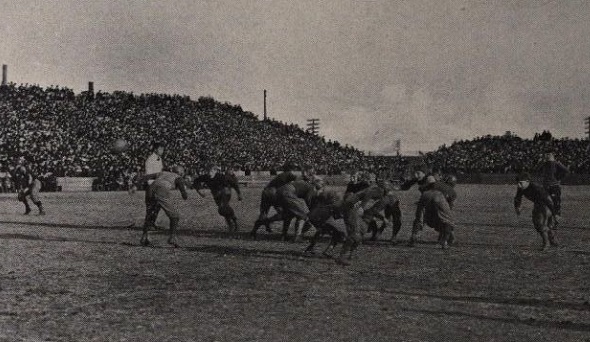
The Chicago Tribune reported that in 1904 alone, there were 18 football deaths and 159 serious injuries, mostly among prep school players. Football deaths suffered by younger players were reported on a nearly weekly basis, as outraged citizens called on colleges and high schools to banish football outright.
In stepped Roosevelt, who called head coaches and representatives from Harvard, Yale and Princeton – college powers at the time – to the White House in 1905 urging them to eliminate excessive violence and set an example of fair play for the rest of the country. When the casualties actually rose by one during the ensuing season, Roosevelt reacted with greater resolve and convened leading football authorities for the purpose of authoring drastic rules changes. What emerged was an intercollegiate conference which was the predecessor of the NCAA.
Among the most effective changes for the 1906 season were the legalization of the forward pass, the elimination of mass formations, and the creation of a neutral zone. Football fatalities fell to 11 in each of the next two seasons, and severe injuries fell drastically.
Thanks to the introduction of protective equipment and ever-evolving rules changes, football during the 100-plus years to follow has become an exponentially safer game. Yet, the game’s leaders always will need to adjust and react to scrutiny that comes with the territory.
So, as the game once again undergoes rules modifications in the name of safety, give a tip of the cap to President Roosevelt while you enjoy college bowl season and the NFL playoffs and begin to think ahead to the first high school practice of 2014.
North Central Builds On High-Flying Fame with Repeat Title
By
Adam Niemi
Special for Second Half
November 20, 2021
MARQUETTE — In the end, the encore wasn't that much different than the first title run for the latest Powers North Central powerhouse team.
The Jets got off to a fast start en route to a 63-0 win against Colon to repeat as MHSAA 8-player Division 2 champions Saturday. Last season, many of the same standouts led North Central to a 70-48 championship game win over Portland St. Patrick.
"Oh gosh, it just feels great," Powers North Central head coach Leo Gorzinski said. "Like I've been telling these guys all week, we come this far, we work this hard and let's finish it. And that's been the rallying point all week. We talked about all the time people didn't work. They were in a weight room since February, two-a-days in August. So they weren't going to let this one slip away. But it's a great feeling."
Saturday's title adds to the Jets' 8-player football championship pedigree with go-to athletes. This championship also was the their fourth in seven years.
The Jets (13-0) won these two with Luke Gorzinski at quarterback. The Jets also won back-to-back championships in 2015 and 2016, led by quarterback Jason Whitens, now a redshirt senior basketball player at Michigan State, with then-head coach Kevin Bellefeuil.
"I want to thank all the guys that come before us," Gorzinski said. "Once they showed it can be done, everybody started believing that it was possible. And then once they believed it, now they want to be the ones to let it go. We've got a pretty good thing going right now."
The 2021 season will go down as one of the most dominant in Michigan 8-player history. Through 13 games, the Jets outscored opponents 745-43, an average game score of 57 to 3.
The details of Saturday's win hinted at the athleticism and depth that spurred the Jets on. They had 520 yards of offense. Colon had 126.
Colon received the kickoff to start the game, and the Jets' defense set the tone with three straight tackles for loss and forced a three-and-out from Colon's 4-yard line.
The Jets' potent defense went on to hold the Magi rushing game to minus-14 yards on 20 carries.
Saturday also spelled the end to Colon's Cinderella run. The Magi had beaten undefeated teams in every round of the playoffs except Saturday.
Junior quarterback Simon Vinson went down with an injury with 1:01 remaining in the first quarter. Magi head coach Robbie Hattan said Vinson's injury changed the mood on the sidelines.
"Losing Simon, when Simon went down, some kids put their heads down and they couldn't bounce back from that," Hattan said. "I'll give my kids credit. The second half they battled, we played much better in the second half defensively. A lot of the kids struggled getting used to the heat here. Right away they're cramping, and somehow our Gatorade was left on the bus and the kids couldn't refuel. It just was a weird day for us."
Powers North Central senior running back Wyatt Raab scored both touchdowns to open the game, from 15 and 30 yards out, respectively. He finished the day with 101 yards on five carries (20.2 yards per carry).
Luke Gorzinski led with a game-high 125 yards on 15 carries (8.3 yards per carry) and a touchdown.
 Colon (11-2) started drives deep in its own territory early on, and were forced to punt. Their average field position to start a drive was their own 27-yard line.
Holding the Magi deep in their territory meant the Jets had a short field for most of the day, leading to a quick succession of scores. North Central had 369 yards of total offense in the first half alone.
Powers North Central rushed for 236 yards on 20 carries with four TDs in the first half and led 49-0.
North Central executed as efficiently as it had all season. The Jets moved the chains all game while their defense prevented Colon's offense from doing the same.
Gorzinski had two sacks and 10 tackles. Drew Webber had six tackles. Caden Tietz, Drew Allgeyer and Lane Nehring each had a sack. Owen Eichmeier had an interception.
Tucker Lafler had 11 tackles to lead Colon's defense. Owen Wilson had eight and Kaleb Johnson had six.
"They're so competitive with one another — it's our depth" Leo Gorzinski said of the defense. "We've got so many kids that are the same caliber, same type of athlete. So day in and day out they're fighting for every single position. They want to show Coach 'l caught it over so-and-so, tackle over so-and-so.’"
Saturday was the Magi's second Finals appearance in three seasons after winning the 2019 Division 1 championship against Suttons Bay. The Magi lost in the Regional Finals in 2020 to Portland St. Patrick, which then lost to the Jets in the Final.
Hattan said there were naysayers even within Colon as the team made its playoff run. That, and falling a game short of a championship, is a motivator for next year, he said.
"Nobody expected us to be here. Even some people in our community were 'It's a rebuilding year,'” he said. "We lost, we only had two returning starters on offense, two returning starters on defense. Nobody expected us to be here. We return a lot of players (next season). We graduate like six seniors, three of them that were starters. We have some holes to replace, but we return a lot of kids. Now, this is motivation for some of our guys to get bigger, faster, stronger.
"They understand where they’ve got to work now to bring us back here and get to the next step, which is winning the state championship."
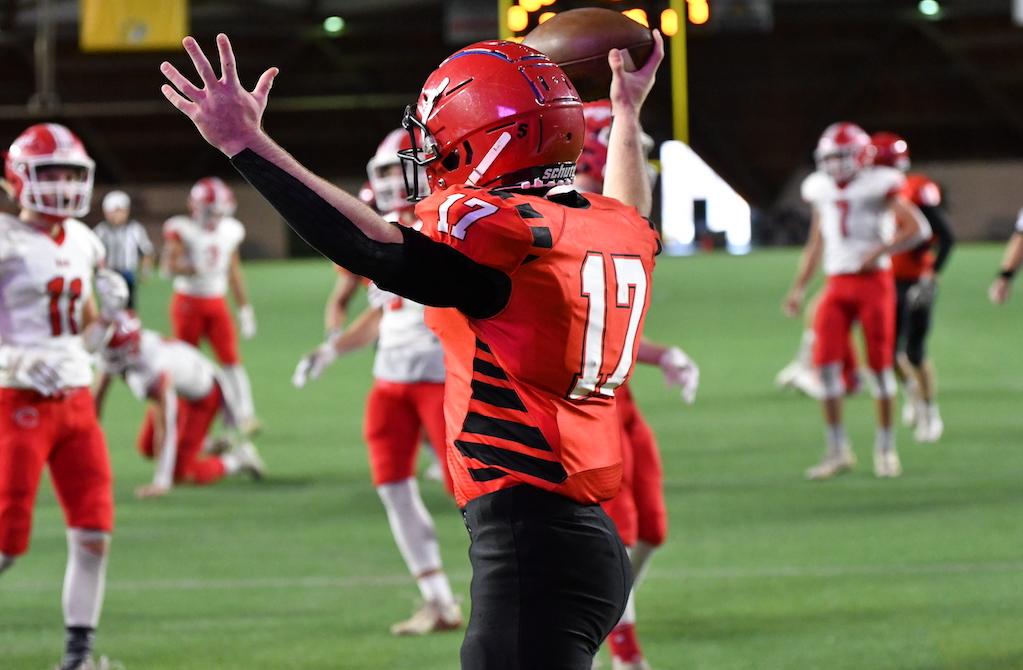
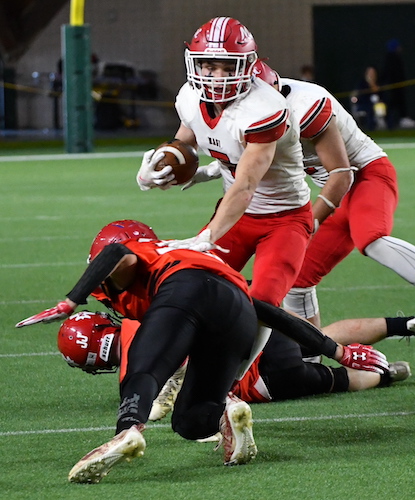
PHOTOS (Top) Powers North Central’s Wyatt Raab (17) celebrates a touchdown during Saturday’s Division 2 Final at Superior Dome. (Middle) Colon’s Kodey Dovey (5) works to elude the Jets’ Carter Tietz (32). (Photos by Cara Kamps. Click for more.)